
A character lightsaber guide is really a guide to versions, not to characters. Almost every named character carried more than one hilt, props changed between films and between animation seasons, and the differences are what collectors mean by accuracy. The way through is to fix the era first, then the character, then the specific version — in that order, because the era decides which hilts even exist.
“Which character’s saber” is the wrong first question, though it is the one most people start with.
Pick a character and you immediately hit a second question: which version. Almost none of them carried one saber, and the ones who did still had it rebuilt, recut or redesigned between appearances.
This page sorts the character hilts by era, explains why the version count runs so high, and points to the detailed history for each one.
What’s on This Page
- The Three Axes That Sort Every Character Saber
- The Prequel Era
- The Original Trilogy Era
- The New Republic and Rise Era
- The Animation and Game Eras
- Why Some Characters Have Five Versions
- Blade Color as a Shortcut
- The Hilts That Are Not Sabers
- What a Complete Character Saber Includes
- Where to Start
- Frequently Asked Questions
The Three Axes That Sort Every Character Saber
Three things decide what a character saber is: the era it appeared in, the family the hilt belongs to, and how many versions exist. Era sets the visual language, family decides the shape, and version count decides how much there is to choose between.
Sort by these and the field stops being a list of names.
Era is the strongest filter. A prequel-era hilt and a sequel-era hilt were designed decades apart, on different film techniques, and they do not look alike.
Hilt family is the second. Some hilts are built on a shared body with different details; others are one-off shapes that were never repeated.
Version count is the third, and it is the one that matters most on a product page. A character with one version is a simple decision; a character with five is a research project.
| Era | Design language | Typical hilt | Version count |
|---|---|---|---|
| Prequel | Smooth, curved, ornamental | Long bodies, curved grips, mixed materials | Often 2–4 |
| Original trilogy | Found-part, industrial | Flash handles, tape, clamp boxes | Often 2–3 |
| New Republic / Rise | Asymmetric, revisited | Rebuilt classics, crossguards, split sabers | Often 1–3 |
| Animation and games | Readable in motion | Bold shapes, colour-coded blades | Often 2–4 |
The version counts are approximate and deliberately so. They vary by whether you count a rebuild as a new version or as a repair to the same one — which is itself one of the recurring arguments in this hobby.
The Prequel Era
Prequel-era hilts are the most ornamental group, and the most likely to be curved or to mix materials across one body. The era produced the most distinctive single hilt in the franchise in the curved duelling form, and several of its characters carried two sabers rather than one.
The design language here is deliberate craft. Hilts are treated as objects a person made, not parts a person found.
The curved hilt is the era’s signature. It exists in exactly one on-screen design, and it belongs to one character, whose history is covered in the prop history of the only curved hilt in the films.
The famous exceptions are the two-blade and the two-hilt characters. One carried a single long hilt that ignites at both ends, covered in the saberstaff timeline. Another carried two curved hilts at once, and the pairing matters as much as the shape.
The era also holds the two most-informed-shape hilts in the franchise: the one carried by Obi-Wan Kenobi across his three sabers, and the deliberately plain one belonging to Qui-Gon Jinn.
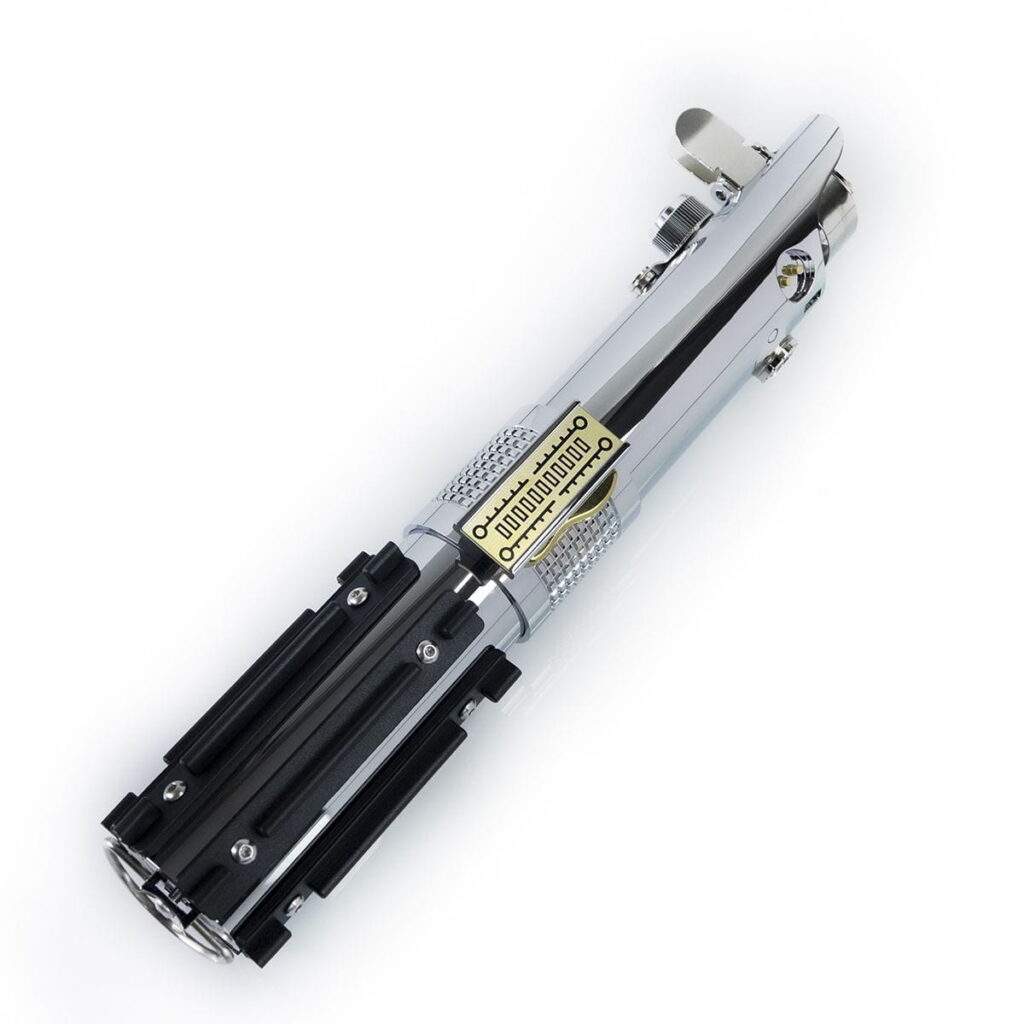
For the most-recognised hilt of the whole period, the history runs through Anakin Skywalker’s saber — which is also the hilt that later reappears twice more under other owners.
The Original Trilogy Era
The original-trilogy hilts are mostly built from found parts, which is why so many of them are recognisably repurposed hardware. The era also contains the franchise’s most-replicated hilt family, because the same body was reused and re-detailed across three films and then borrowed again decades later.
Where the prequel era made objects, this era assembled them.
The consequence is that detail matters more than shape. Two hilts of this era can share an identical body and differ in grip count, clamp layout and finish — differences small enough that most listings do not mention them.
The two most-followed threads are every film version of Vader’s saber and the complete timeline of Luke Skywalker’s props. Between them they account for most of the era’s hilt variants.
The era’s most unusual carry is not a classic at all: the Emperor’s blade, which is built into a curved hilt and is almost never seen drawn. Its history is in the story of the saber he barely used.
It also contains the one hilt that is not a saber at all in the usual sense — the black-cored blade of Mandalore, covered in a thousand years of its history.
The New Republic and Rise Era
The most recent films build character hilts by revisiting older designs rather than inventing from nothing. Rebuilt classics, split sabers and one famous crossguard make up most of the group, and version counts are lower simply because there has been less time for variants.
This is the era of the callback hilt.
One character’s saber is a repair of a much older one, which makes its version history unusually tangled — it is simultaneously a new hilt and a continuation of an old one.
Another is a split pair: two hilts designed to join into one, carried by Ahsoka Tano across four sabers, a history that spans both animation and live action.
The era’s sharpest design break is the crossguard, a hilt whose side vents exist for a stated in-universe reason. That history is in the story of the broken blade and its earlier form in the weapon before the break.
Two rebuilt classics define the era’s other end: Rey’s yellow blade and the sabers of Din Djarin.
The Animation and Game Eras
Animated and game appearances produce some of the most readable hilts in the franchise, because a design has to stay identifiable while it is moving. This group also holds the broadest variety of unusual shapes, from double-blades to a whip.
Design for motion is a real constraint, and it shows.
Colour does more work here, because an animated frame can commit to a blade colour in a way a live-action lighting setup cannot.
The game-era hilts are where the unusual shapes cluster: the two-piece saber of Kanan Jarrus, the blaster-saber hybrid of Ezra Bridger, and the four-blade collection of Asajj Ventress.
The era’s most-copied hilt is also its most repaired: Cal Kestis’s saber, which changes configuration as a story mechanic rather than as a prop change.
For the animated-era characters with the largest followings, the histories run through Ahsoka, Mara Jade, Shin Hati and Baylan Skoll.
Why Some Characters Have Five Versions
Version counts run high for three reasons: the prop was altered between films, the character appeared in more than one medium, or the design was rebuilt for a sequel decades later. A character who appeared once in one film usually has one hilt; everyone else accumulates variants.
The count is a record of production decisions, not of story importance.
Film-to-film alteration is the most common cause. A prop is repaired, re-detailed or replaced for a new shoot, and the differences are small but real.
Cross-medium appearances multiply it. A character who appears in live action and in animation will usually have a live-action prop and a drawn design, and the two are not identical.
Late sequels reset the count. A hilt designed in the 1970s and revisited in the 2010s inherits both the original’s variants and the new production’s own.
This is why the honest answer to “is this screen accurate” is almost always “accurate to which version”. A listing that claims accuracy without naming a version has not answered the question.
Blade Color as a Shortcut
Blade colour narrows the field faster than any other filter, because canon assigns colours to roles rather than to individuals. Narrowing by colour first, then by era, then by character, is the fastest route through a large list.
The colour carries meaning, and the meaning is about the wielder’s role rather than their name.
For the colours themselves, the reference articles on this site cover how a blade colour is actually produced and the crystal families behind them. The colour-to-role mapping is the reason a character’s saber colour is usually knowable before their hilt is.
The Hilts That Are Not Sabers
A group of character weapons sits outside the standard one-blade-one-hilt pattern, and they are usually what collectors look for after they have the classics. A long shaft, a perpendicular grip, a flexible blade and a curved hilt each ask a different question of the buyer.
These are the designs where the hilt stops being a handle and becomes the point of the weapon.
The polearm group puts a short blade on a long shaft, covered in the two forms of the lightsaber pike.
The perpendicular group adds a second grip at a right angle, covered in why a guard shoto’s handle sits at 90 degrees.
The flexible group replaces the rigid blade with a pliant one, covered in how a light whip works and where it fails.
Two more sit between the groups. The katana saber lengthens the hilt and adds a guard without changing the blade; the seven combat styles take the opposite route and change nothing physical at all.
What a Complete Character Saber Includes
A modern character saber is three decisions bundled: the hilt replica, the electronics that drive it, and the blade. Hilt families differ in how accurate the body is; the electronics decide how it behaves; the blade decides whether it is for display or for contact.
Shopping a character saber means shopping all three at once, which is why two listings for the same character can differ so much.
The hilt carries the accuracy. This is where the version question lives, and it is the part you cannot change later.
The electronics carry the behaviour. Motion response, blade effects and sound depth all come from the board, and the range across tiers is wide.
The blade carries the use. A blade built for even, scrolling light and a blade built to absorb impact are different objects, and a character saber is often supplied with the first.
For the build side of those three decisions, this site covers the systems every saber is built from and what each section of a hilt does.
The Narrowing Order — Era, Then Character, Then Version
A character saber choice narrows in three stages: era first, because it settles the design language; character second, and only a hilt you can visualise; version third, which is where the actual work is. Blade colour is a legitimate shortcut applied before the character stage, not an alternative to it.
Where to Start
Pick the era you already know best, then the character from it whose saber you can picture, then the version by counting grips and checking the control section. Starting with a character you cannot visualise makes the version decision impossible to verify.
The order matters more than the specific answer.
Era first, because it halves the field and settles the visual language before any other choice is made.
Character second, and preferably one whose hilt you could sketch from memory. If you can picture it, you can tell whether a listing matches.
Version third, and this is where most of the work is. For the two characters with the longest histories, the version breakdowns are in the Luke and Vader timelines; the underlying judging criteria are in how screen accuracy is judged.
If the saber is for wearing rather than shelving, the costuming side is covered separately in character-accurate cosplay pairings and convention readiness.
Frequently Asked Questions
Q1: Which character has the most lightsaber versions?
A: The Skywalker line and Vader’s saber between them account for the largest clusters, because the same hilt body was reused, re-detailed and rebuilt across multiple films and then revisited decades later. Luke’s and Vader’s histories each run through several distinct film versions.
Q2: How do I know which version of a character’s saber I am looking at?
A: Count the grip bands, check the control section layout, and look at the emitter shape. Those three details date a hilt to a specific film more reliably than its overall silhouette, which stays similar across versions of the same character.
Q3: Is a character saber better than a custom saber?
A: They answer different questions. A character saber is a replica of a specific prop and is judged on accuracy; a custom saber is built for behaviour and comfort and is judged on handling. A character hilt with a control box or a thin neck looks right and can be awkward to swing, while a custom hilt is usually simpler by design.
Q4: What is the most iconic lightsaber to start with?
A: The Skywalker hilt, because it is the most widely reproduced design in the franchise and has the most documented version history. That documentation is the real advantage: there is more information available to check a listing against.
Q5: Do all character sabers come with electronics?
A: No. Character hilts are sold across a wide range, from a static prop shell with no electronics at all through to a full build with a board, sound and a blade. That is the single biggest reason two listings for the same character can differ so much in price.
Q6: Can you duel with a character saber?
A: Sometimes, but accuracy and durability pull in opposite directions. Replica hilts often have protrusions that interfere with a grip, and a display blade is not built to absorb impact. A saber intended for contact will state its blade grade and wall thickness, and a simpler hilt is usually the better choice for it.
Q7: What makes a character saber screen accurate?
A: Matching one specific film version, not the character in general. Props were altered between films, so a hilt accurate to one appearance can be wrong for another. A listing that says screen accurate without naming a version has not made a checkable claim.
Q8: Which lightsaber colors belong to which characters?
A: Canon assigns colours by role rather than by person. Blue is the Order’s default, green the consular path, red the Sith, purple the balanced, yellow the sentinel, white the purified. Any character’s colour follows from the role they occupy, which is why the colour is usually easier to pin down than the hilt.
Q9: Are there character sabers that are not standard hilts?
A: Yes, and they are often the ones collectors hunt after the classics. A long-shafted pike, a perpendicular-gripped guard shoto, a flexible light whip and the single curved hilt are the main departures from the one-blade-one-hilt pattern.
Q10: How much should a character saber cost?
A: It depends entirely on which of the three parts you are buying. A static hilt shell, a baselit build and a full pixel build with a blade sit in different bands, and the same character name appears in all of them. Decide the electronics tier before comparing prices, or the numbers will not be comparable.
Related reading on this site: how to judge screen accuracy, collector-grade saber construction, and what a display saber needs.