Luke Skywalker carried four distinct lightsabers across the original trilogy — and they’re not four versions of one prop. They’re four different weapons with four different production stories.
The ANH and ESB sabers were the same Graflex camera flash prop. The ROTJ saber was a completely different object — a repurposed Obi-Wan stunt saber, because Luke’s original fell down a reactor shaft on Bespin.
The short version: Luke’s first saber (which was Anakin’s) is the Graflex — the most famous lightsaber in the world.
His ROTJ saber is the green thin-neck, built in a rush from an Obi-Wan stunt prop. Each has its own collector scene, replicas, and price range.
This page is a time-line reference: the real prop history, the on-screen versions, and how modern replicas reproduce each one.
What’s on This Page
- The Timeline at a Glance — every version in one table
- V1: The Graflex (ANH & ESB) — Anakin’s saber, Luke’s inheritance
- Lost on Bespin — why the story splits here
- V2: The ROTJ Workhorse — the saber in 90% of the film
- V3 & the Hero — the duel saber and the publicity blade
- After ROTJ — the repaired Graflex and Rey
- Modern Replicas — how each version is reproduced
- Replica Price Guide — what each version costs
- Which Luke Saber Should You Get?
- Frequently Asked Questions
The Timeline at a Glance
Luke’s lightsabers split into two families: the Graflex (ANH/ESB) and the green thin-neck (ROTJ). The Graflex is Anakin’s blue saber. The ROTJ saber is a completely new weapon Luke built after losing the first.
| Version | Film | Prop Identity | Blade Color | On-Screen Role |
|---|---|---|---|---|
| V1 — Graflex | ANH + ESB | Same camera-flash prop, lightly modified | Blue | Luke’s first saber — originally Anakin’s |
| Lost on Bespin | ESB finale | Falls down the reactor shaft with Luke’s hand | — | Ends the Graflex’s on-screen run |
| V2 — ROTJ workhorse | ROTJ | Repurposed Obi-Wan ANH stunt saber, repainted | Green | On Luke’s belt, passed around — ~90% of the film |
| V3 — duel saber | ROTJ | Another Obi-Wan conversion, brass neck | Green | Used in the Vader duel |
| Hero | ROTJ (publicity) | Built after the film for close-ups | Green | The iconic version most replicas copy — never in the action |
| Repaired Graflex | Sequel era | Refound, rebuilt, handed to Rey | Blue | Returns in TFA/TROS as the legacy saber |
That last row is why “Luke’s lightsaber” is confusing: the blue Graflex comes back in the sequels, and the green ROTJ saber is a different weapon entirely.
V1: The Graflex (ANH & ESB)
The Graflex saber is Anakin’s lightsaber — built by a young Anakin, carried by Luke, and the single most iconic lightsaber prop ever made. The hilt was machined from a Graflex 3-cell camera side-attach flash, a real photography accessory from the 1940s–50s that the prop department gutted and rebuilt.
It’s the saber Anakin used through the Clone Wars and the one he carried to the Mustafar duel, where Obi-Wan cut him down and took it. Obi-Wan kept it for 19 years of exile on Tatooine, then handed it to Luke in A New Hope.
ANH: Luke’s first screen appearance of the saber is the unmodified Graflex — silver clamp box, glass eye, circuit card, and all.
ESB: Luke tweaks it. The grip gains screws, the clamp box swaps circuit cards, and a second red button replaces the glass eye. Same physical prop, new details — fans read this in-universe as Luke making the saber his own.
Lost on Bespin
The Graflex’s screen life ends in the ESB duel: Vader severs Luke’s hand, and both fall into the reactor shaft at Cloud City. The saber, the hand, and the whole prop storyline vanish — and this is the pivot point for everything after.
The prop department began filming ROTJ with the same Graflex again — an error, since Luke no longer had it. When they realized the mistake, they had to improvise a replacement, fast.
V2: The ROTJ Workhorse
The ROTJ saber is a repurposed Obi-Wan ANH stunt saber, hastily converted into a green thin-neck — and it’s the version you actually see for most of the film. The prop team grabbed an old Obi-Wan stunt saber (the one Vader “chops” in ANH).
They repainted it black with peeling, chipping paint, added a Graflex-style clamp and circuit card, wrapped the neck in gaffer tape, and capped it with a conical knob from an X-wing flight suit chest panel.
It’s rough, it’s improvised, and it’s on screen constantly — on Luke’s belt, handed to the Emperor, set on the Emperor’s chair, held by Vader. Fans call it the V2, and it’s the true workhorse of ROTJ, used in roughly 90% of the film’s scenes.
V3 & the Hero
ROTJ used multiple metal versions, and the iconic “Hero” you see in collectibles is the least on-screen one of all. The story splits into two more props.
V3 — the duel saber: Another Obi-Wan stunt conversion, this one with a brass/copper-colored neck, a Graflex clamp wrapped in foil tape, and a brushed control box. It was used as the dueling/combat prop in the Vader fight — the shots where blades actually connect.
The Hero: Built after the V2, specifically for the close-up of Vader holding Luke’s saber on the Endor gantry, and for publicity photos.
Ironically, the famous “Hero” design — the one Master Replicas and most replica makers copy — never appears in the film’s action. It was made for the camera to look perfect in close-ups.
After ROTJ
The Graflex’s story doesn’t end in the reactor shaft — it comes back in the sequel trilogy as the “legacy saber.” How it surfaced is a canon gap.
It reaches Maz Kanata, calls to Rey in The Force Awakens, gets torn in half in The Last Jedi, is repaired in The Rise of Skywalker, and is finally buried by Rey at the Lars homestead on Tatooine.
For collectors, the sequel-era Graflex is its own category — the Reyflex, the repaired version Rey carries, with its own replica line and a slightly different emitter and clamp detail.
Modern Replicas
Modern replicas reproduce three distinct Luke sabers: the blue Graflex, the green ROTJ thin-neck, and the sequel-era Reyflex. Each is a separate product with separate accuracy standards.
| Replica | Blade | Typical Electronics | Accuracy Focus |
|---|---|---|---|
| Luke Graflex (ANH/ESB) | Blue Neopixel or baselit | Xenopixel, SNV4, or Proffie | Clamp box, glass eye, circuit card, T-track grips |
| Luke ROTJ (V2/Hero) | Green Neopixel or baselit | Xenopixel, SNV4, or Proffie | Thin neck, black-ribbed grip, V-clip, control box |
| Reyflex / Luke TROS | Blue Neopixel | Xenopixel, SNV4, or Proffie | Repaired clamp, newer emitter |
Two electronics notes matter for replicas. The green ROTJ blade is the famous “Luke green” — a warm, slightly yellow-green that’s distinct from Obi-Wan’s lighter green. A good Neopixel replica gets this color right.
And the Graflex emitter is where accuracy lives — the flash-tube rings, the clamp, and the glass eye are the details replica makers obsess over.
Replica Price Guide
Luke replicas span a wide range — from budget baselit around $150–$200 to film-accurate collector pieces over $500. Here’s what each tier looks like.
~$150–200
$230–420
$500–1,800
The tiers reflect accuracy and electronics, not just brand. A $230–$420 Neopixel Luke (typically TXQ or LGT-based) reproduces the iconic look with scrolling ignition and a green or blue pixel blade.
A $500–$1,800 collector piece (e.g., 89Sabers with Proffie) is the film-accurate tier — precise emitter details, weathering, and a made-to-order build.
Which Luke Saber Should You Get?
The honest answer depends on which Luke you want to be. Here’s the decision rule.
Get the blue Graflex if:
- You want the most iconic saber ever. The Graflex is the saber everyone pictures when they hear “lightsaber.” It’s the ANH/ESB hero, Anakin’s legacy, and the one Rey inherits.
- You like the “passed down” story. Anakin → Obi-Wan → Luke → Rey. No other saber has that throughline.
Get the green ROTJ if:
- You want the “completed Jedi” Luke. The green thin-neck is Luke as a full Jedi Knight, in black, on Endor. It’s the final-form Luke.
- You want a more distinct collector piece. The green saber is less common than the Graflex and instantly reads as ROTJ.
Both, if you can:
Many collectors own the Graflex and the ROTJ saber — they’re the bookends of Luke’s journey. The Graflex is where he starts, the green saber is where he ends.
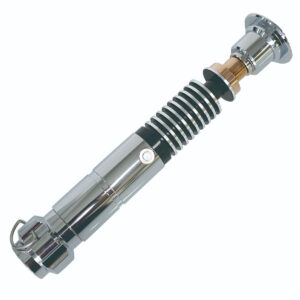
Luke Lightsaber
Character Lightsabers / Luke Skywalker Lightsaber
Frequently Asked Questions
Q1: Are Luke’s ANH and ESB sabers the same lightsaber?
A: Yes. ANH and ESB use the same physical Graflex prop, with minor ESB modifications — screws added to the grip, a different circuit card, and a second red button replacing the glass eye. It’s one saber, lightly modified between films.
Q2: Why is Luke’s ROTJ lightsaber different from his other one?
A: Because he lost the original. The Graflex fell down the reactor shaft on Bespin (along with his hand) in ESB. For ROTJ the prop department built a replacement — a repurposed Obi-Wan ANH stunt saber, repainted as a green thin-neck. It’s a completely different weapon.
Q3: Which Luke saber is the “Hero” version?
A: The Hero is the ROTJ saber built after filming, for the close-up of Vader holding it and for publicity photos. Ironically, it never appears in the film’s action — the rough V2 is the one on screen 90% of the time. Most replica makers copy the Hero because it looks perfect.
Q4: What’s the best Luke lightsaber for a first-time buyer?
A: A mid-range Neopixel Luke in the $230–$420 range. The blue Graflex is the safest first pick — it’s the most iconic, the most widely made, and the easiest to match a good screen-accurate example. Save the film-accurate $500+ tier for when you know what details matter to you.
Q5: Is the Luke ROTJ blade a different green than other green sabers?
A: Yes. Luke’s ROTJ green is a warm, slightly yellow-green, distinct from Obi-Wan’s lighter green. On a Neopixel blade the color difference is subtle but real — and replica makers set Luke’s green specifically to match the on-screen ROTJ look.
Q6: What’s the Reyflex?
A: The Reyflex is the repaired Graflex that Rey carries in the sequel trilogy. It’s the same legacy saber, rebuilt after The Last Jedi broke it in half. It has its own replica line with a slightly different emitter and clamp detail than the ANH/ESB version.
Q7: Can I duel with a Luke lightsaber replica?
A: Yes, if it’s the right build. A baselit Luke with a heavy-grade blade duels well — the LED is in the hilt, and the blade is a tough polycarbonate tube. A Neopixel Luke is for light sparring, cosplay, and display only — the LED strip inside the blade cracks on hard impact.
Q8: Why is the Graflex so expensive compared to other sabers?
A: Because it’s the most famous lightsaber in the world — and accurate Graflex replicas need the right emitter rings, clamp box, glass eye, and T-track grips, which are fiddly to reproduce. That accuracy work, plus demand, keeps even mid-range Graflex replicas at a premium.