Kanan Jarrus’s lightsaber is one of the few Jedi weapons built to be hidden — a blue-bladed saber that splits into two pieces so its owner could carry it for fifteen years without being recognized as a Jedi.
It was built by a padawan named Caleb Dume under his master Depa Billaba, hidden away after Order 66, and reassembled only when Caleb had become Kanan and taken an apprentice of his own.
This page traces the saber from its construction to its final fate — the two-piece design that let a fugitive Jedi survive, the fights it fought, the blindness its owner carried into battle, and the officer who delivered it to Grand Admiral Thrawn as proof of a Jedi’s death.
What’s on This Page
- Born as Caleb Dume’s Saber — a padawan’s weapon under Depa Billaba
- The Two-Piece Design — how Kanan hid a lightsaber in plain sight
- Fifteen Years in Hiding — from Order 66 to the Ghost
- The Reveal and the Fights That Followed
- After Malachor: Fighting Blind
- The Saber’s Fate After Lothal
- What Makes the Design Distinct
- Frequently Asked Questions
Born as Caleb Dume’s Saber
Kanan’s lightsaber was built when he was still the padawan Caleb Dume, trained by Jedi Master Depa Billaba, with guidance from the droid Huyang — the same instructor who helped many Jedi construct their first sabers.
Caleb was a Jedi youngling who came of age as the Clone Wars were ending. His saber was a standard blue-bladed Jedi weapon, built the way padawan sabers were built across the Order.
The design carried the hallmarks of its era — a straight body, a blade emitter, and a grip meant for a young hand still growing into the weapon.
That ordinary beginning matters, because what happened next was anything but ordinary.
Caleb was on a mission with Depa Billaba when Order 66 came down, and the clone troopers they fought alongside turned on them. Depa was killed. Caleb survived, and the saber that was supposed to mark him as a Jedi became the most dangerous thing he could carry.
The Two-Piece Design
To survive under the Empire, Caleb — now calling himself Kanan Jarrus — modified his lightsaber so it split into two pieces, letting him carry a Jedi weapon without anyone recognizing it as one.
The saber’s most distinctive feature was born of necessity, not style.
Carrying a full lightsaber on his belt would have identified Kanan as a Jedi the moment an Imperial officer saw it. So he broke the weapon down into components that read as ordinary gear.
The main body and grip sat at the small of his back, under his jacket.
The emitter shroud, which carries a tsuba-style handguard, rode separately on his left side. To assemble the saber, Kanan slid the emitter section into the main body and twisted to lock the two halves together.
| Part | Where Kanan carried it | Why |
|---|---|---|
| Main body + grip | Small of his back | Hidden under his jacket, read as a tool or belt gear |
| Emitter shroud | Left side | Carried separately so the two pieces never read as a saber |
The split was also practical for a working smuggler and mercenary. A two-piece saber was easier to conceal during the years Kanan spent drifting through the galaxy’s criminal underworld, doing odd jobs and keeping his head down.
How the Two Pieces Come Together
The concealment design in two states. Split, the main body and grip read as ordinary belt gear while the emitter shroud (with its tsuba handguard) rides apart on the left. Assembled, Kanan slides the emitter into the body and twists to lock — one working blade.
Fifteen Years in Hiding
For roughly fifteen years after Order 66, Kanan kept the saber hidden — storing it in a compartment aboard the freighter Kasmiri, then aboard the Ghost, where it sat undiscovered until a teenage pickpocket named Ezra Bridger found it some fourteen years after Kanan had joined the crew.
The timeline of Kanan’s concealment runs through two ships.
He first stashed the saber on Janus Kasmir’s vessel, the Kasmiri. Later, after joining the crew of the Ghost, he hid it there — and for years, no one on the ship knew the grizzled mercenary was carrying a Jedi’s weapon in a compartment nearby.
During those years Kanan did not use the lightsaber at all.
He worked as a smuggler and hired gun, and when he needed a weapon that would not give him away, he used a blaster. The lightsaber stayed packed away, a relic of a life he had abandoned.
The hiding worked. Kanan lived and moved through the Imperial era for a decade and a half without the Empire ever learning a Jedi was walking around as a common mercenary.
The Reveal and the Fights That Followed
Kanan’s identity came out during a rescue on Kessel, when he drew the lightsaber to save his crew — and the moment the blue blade ignited, he marked himself as a Jedi for the Empire’s hunters to find.
Ezra Bridger, who had found the hidden saber and was being trained by Kanan, was part of the crew the rescue pulled out. The Wookiee rescue on Kessel forced Kanan’s hand.
Once the blade was seen, there was no going back. The Grand Inquisitor, the Empire’s Jedi hunter, learned that a Jedi was alive and active, and Kanan became a target.
The fights that followed defined the saber’s active years.
Kanan wielded it against the Grand Inquisitor and the other Inquisitors, against Darth Vader himself, and against the former Sith Lord Maul. The same weapon that had spent fifteen years in a box now saw some of the hardest lightsaber combat of the Rebel era.
In one famous moment, Kanan even borrowed Ezra’s blaster-saber and fought with two blades at once against the Grand Inquisitor — a trained Jedi Knight using a padawan’s experimental hybrid alongside his own weapon.
After Malachor: Fighting Blind
Kanan kept fighting with the same lightsaber after Maul blinded him at Malachor — learning to “see” through the Force instead of his eyes, and defending himself and his crew with the blade for months before his death.
At Malachor, Maul struck Kanan down and took his sight. The Jedi who emerged was blind, but he was not helpless.
With the help of the Bendu, a powerful and mysterious Force being on Atollon, Kanan relearned to perceive the world around him — through the Force rather than through his eyes.
The blind Jedi kept using the two-piece saber. In the episodes after Malachor, Kanan fought Inquisitors and troopers, sensing their presence and blocking their shots without being able to see them.
The saber’s split design took on a new meaning in that period.
A weapon Kanan had built to hide his identity was now wielded by a man who could not be identified by sight at all — only by the Force that moved through him.
The Saber’s Fate After Lothal
Kanan died on Lothal saving his crew, and the saber was recovered by Governor Arihnda Pryce, who presented it to Grand Admiral Thrawn as proof that the Jedi was finally dead.
In the Rebels finale, Kanan gave his life to hold back an explosion and push Ezra, Sabine and the others to safety.
In the chaos, the lightsaber was knocked from his grasp. The weapon that had been hidden for fifteen years, then fought across the galaxy, ended its journey on a Lothal platform.
Rukh, the assassin working for Thrawn, was the one who found it.
Governor Pryce then carried the saber to Thrawn as evidence — the physical proof the Empire’s greatest admiral needed that the Jedi known as Kanan Jarrus was gone.
The story does not end with Kanan, though. His saber’s design lived on.
Years later, Ezra Bridger — by then a grown Jedi in the Ahsoka era — built his own new saber around an emitter copied from a spare part originally made for Kanan. The master’s weapon, in a quiet way, became the apprentice’s.
What Makes the Design Distinct
Kanan’s saber stands apart from other Jedi sabers for one reason — it was engineered for concealment, with a detachable emitter and a tsuba-style handguard that no standard Jedi hilt carries.
Most Jedi sabers are built to be seen — worn on the belt, displayed as a mark of office.
Kanan’s was built to disappear. The two-piece construction, the separate emitter shroud, and the carrying positions all serve a single goal: keep the weapon from being recognized.
| Feature | Standard Jedi saber | Kanan’s saber |
|---|---|---|
| Carried as | One assembled hilt on the belt | Two separate pieces, concealed |
| Emitter shroud | Fixed part of the hilt | Detachable, carried separately |
| Handguard | Rare | Tsuba-style guard present |
| Assembly | None needed | Insert emitter, twist to lock |
For replica builders, that detachable emitter and the twist-lock mechanism are the defining engineering challenge of the hilt.
A Kanan replica that cannot actually split, or whose emitter does not lock cleanly, has missed the point of the design.
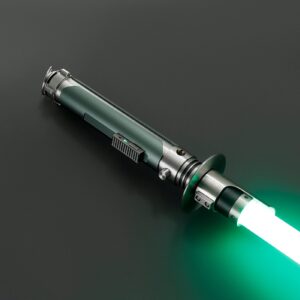
Kanan Jarrus Lightsaber — Xenopixel V3 / Proffie 2.2 Jedi Replica
Character Lightsabers / Proffie Lightsabers
Frequently Asked Questions
Q1: Why does Kanan’s lightsaber split into two pieces?
A: So Kanan could carry it without being recognized as a Jedi. After Order 66, he hid the main body and grip at the small of his back and carried the emitter shroud separately on his left side. To use it, he inserted the emitter into the body and twisted to lock them together.
Q2: Who built Kanan’s lightsaber?
A: Kanan built it when he was still the padawan Caleb Dume, trained by Jedi Master Depa Billaba, with guidance from the droid Huyang. It was a standard blue-bladed padawan saber before he modified it for concealment.
Q3: Where did Kanan hide his lightsaber for fifteen years?
A: First in a compartment aboard Janus Kasmir’s freighter, the Kasmiri, and later aboard the Ghost. Ezra Bridger found it there fourteen years after Kanan had become part of the ship’s crew, which is how Kanan’s secret came out.
Q4: How was Kanan’s identity as a Jedi revealed?
A: During a Wookiee rescue on Kessel, Kanan drew the lightsaber to save his crew. Once the blue blade was seen, the Grand Inquisitor learned a Jedi was alive, and Kanan became a target for the Empire’s hunters.
Q5: Did Kanan keep using his lightsaber after Maul blinded him?
A: Yes. After being blinded at Malachor, Kanan learned to sense the world through the Force with help from the Bendu. He continued to fight Inquisitors and troopers with the same saber, blocking shots he could not see.
Q6: What happened to Kanan’s lightsaber after he died?
A: It was knocked from his grasp when he died saving his crew on Lothal. The assassin Rukh found it, and Governor Arihnda Pryce presented it to Grand Admiral Thrawn as proof that the Jedi was dead.
Q7: Does Kanan’s saber design live on anywhere?
A: Yes. Years later, Ezra Bridger built a new lightsaber in the Ahsoka era using an emitter copied from a spare part originally made for Kanan — so the master’s design quietly carried into the apprentice’s weapon.
Q8: Is Kanan’s lightsaber the same as a standard Jedi saber?
A: No. Its defining features — the detachable emitter, the twist-lock assembly, and the tsuba-style handguard — were built for concealment. Standard Jedi sabers are worn assembled on the belt; Kanan’s was designed to be broken down and hidden.