
Darth Vader’s lightsaber changed between every film he appeared in — five distinct hilts across ROTS, ANH, ESB, and ROTJ, each built on a different prop base. The ANH, ESB, and ROTJ versions all started life as MPP (Micro Precision Products) 3-cell camera flashguns, modified by the prop department.
Most fans picture one black-hilted red saber. The reality is a chain of prop evolution: a custom-built hilt for Revenge of the Sith, two MPP flashgun versions for the original trilogy, and a ROTJ hilt that was actually a modified Luke stunt saber.
This page is the timeline: what each version was built from, how it differs on screen, and how the replica market reflects those differences today.
Facts below come from prop-construction records and community documentation on the prop forums. Where a detail is debated, it’s marked as such.
What’s on This Page
- The Five Hilts at a Glance
- The MPP Flashgun Base — Where It All Started
- ROTS — The Transition Hilt
- ANH — The 7-Grip Original
- ESB — The Cloud City Saber
- ROTJ — The Graflex-Inspired Redemption Hilt
- How Replicas Track the Timeline
- The Red Blade — Bleeding a Crystal
- Frequently Asked Questions
The Five Hilts at a Glance
Vader never carried one saber through his on-screen career — the prop changed shape, grip count, and emitter with every film. Here’s the full picture before we dig into each one.
| Version | Film | Prop base | Grips | Distinctive feature |
|---|---|---|---|---|
| ROTS | Revenge of the Sith | Custom build (Australia) | — | Transition piece; barely on screen |
| ANH | A New Hope | MPP flashgun | 7, short with rounded ends | Straight aluminum clamp bars |
| ESB | Empire Strikes Back | MPP flashgun | 6, longer, reaching the clamp | Black tapered clamp bars, nut lock |
| ROTJ | Return of the Jedi | Modified Luke ESB stunt | — | Graflex-inspired emitter |
The through-line: every original-trilogy hilt traces back to a 1950s camera flash unit. That odd origin is what makes Vader’s saber a prop-construction favorite.
The MPP Flashgun Base — Where It All Started
The MPP (Micro Precision Products) was a British 3-cell camera flashgun, and its body became the black hilt of cinema’s most famous villain. The prop department gutted it, slid an Exactra 19/20 calculator bubble-strip lens into the clamp, and added T-track grips.
Prop forums have documented the build in obsessive detail: the clamp variations (straight vs. tapered bars, long vs. short lever bolts), the shroud machining, the grip placement.
That documentation is why replicas can be graded by how close they get to a specific film’s prop.
The MPP base matters for buyers too — a real MPP on the collectors’ market runs into serious money, which is why most people go for a replica built on the same geometry.
ROTS — The Transition Hilt
The Revenge of the Sith Vader saber was custom-built by the Australian prop department as a bridge between Anakin’s ROTS saber and the ANH Vader design. It was heavily influenced by the ESB/ROTJ-era props and never appears on screen in the film itself.
Vader wears it in the final scene overlooking the Death Star’s construction, and it shows up in publicity and promotional photography. Collectors treat it as a unique transition piece rather than a screen-used weapon.
Replica makers have measured the original ROTS prop for their reproductions, making it a distinct line in the Vader family — not quite Anakin, not quite the flashgun sabers.
ANH — The 7-Grip Original
The A New Hope Vader saber is the first on-screen version — an MPP flashgun with 7 short grips with rounded ends, leaving a gap before the clamp. It’s the least-refined of the three original-trilogy hilts.
Forum-documented details set it apart: the clamp sits at the 5:00 position viewed from the emitter, the clamp sidebars are silver, and the lock uses a lever — reportedly held together with a nail after the lever broke during filming.
Screen-accurate ANH replicas are the rarest of the three, and accuracy disputes run deep in the community. Grip count, grip length, and clamp geometry all became hotly debated topics on the prop forums.
ESB — The Cloud City Saber
The Empire Strikes Back hilt — the one from the “I am your father” duel — is the most recognizable Vader design and the version most fans picture. It dropped to 6 grips, each longer and reaching the clamp, with a nut lock instead of the ANH lever.
The clamp sidebars turned black, and a red wire appears near the emitter. Community consensus holds that the ESB prop is noticeably lighter than the ANH version — a fact duelers still cite when choosing a Vader saber.
Prop records also describe the ESB hilt as one of the longest of the main-trilogy props, with a wider control box and silver-plated finish. It’s the Cloud City prop, and it’s the design most replica lines lead with.
ROTJ — The Graflex-Inspired Redemption Hilt
Vader’s Return of the Jedi saber wasn’t a new build — it was a modified Luke ESB stunt hilt with a Graflex-inspired emitter, making it visually distinct from every other Vader hilt. It’s the throne-room saber, and it shows up in the film’s redemption scene.
The Graflex base (the same flashgun family used for Luke’s and Anakin’s sabers) gives it a boxier emitter profile. Collectors often pick it as their favorite precisely because it breaks the MPP mold.
For buyers, the ROTJ version is the “different one” — if you want a Vader saber that doesn’t look like every other Vader saber, this is the hilt to seek out.
How Replicas Track the Timeline
Replica lines mirror the film timeline: each film gets its own numbered version, so a buyer shopping for “Vader” is really choosing which film’s hilt they want. The convention maps directly to the prop history above.
- The ANH replica — precision-scaled to the original 7-grip prop, with the straight aluminum clamp bars.
- The ESB replica — the Cloud City hilt, the longest of the three, with the wider control box and silver finish.
- The ROTJ replica — the Graflex-inspired emitter, the collectors’ favorite for its distinct look.
The takeaway: “which Vader saber should I buy” usually means “which film’s version,” and the answer depends on whether you want the iconic ESB look, the rarest ANH accuracy, or the distinctive ROTJ profile.
Which Vader Hilt Is for You?
Match the version to what you want out of the saber. The ESB is the fan-favorite look; the ANH is the accuracy deep-dive; the ROTJ is the distinctive odd one out.
Iconic
Rarest
Distinct
A rough guide, not a spec. Screen-accuracy depth runs ANH > ESB > ROTJ; sheer familiarity runs the opposite way.
The Red Blade — Bleeding a Crystal
Vader’s red blade comes from a Sith ritual called bleeding — pouring anger, pain, and hatred into a kyber crystal until it turns red. In canon, Vader took a Jedi’s lightsaber, brought the crystal to Mustafar, and bled it to forge his own.
The Vader Lineage at a Glance
Every Vader hilt traces back to one of two prop families — and every replica maps onto this tree. Pick a film, follow the branch.
In-universe, the red is a subjugated crystal: the color of a weapon bent to its owner’s will. Every Sith from Dooku to Kylo Ren uses red for the same reason.
The in-universe red is a subjugated crystal: the color of a weapon bent to its owner’s will. Every Sith from Dooku to Kylo Ren uses red for the same reason.
That lore matters to replica buyers because the red blade is the whole point — and modern pixel blades render that red with the same intensity as the films’ rotoscoped glow.
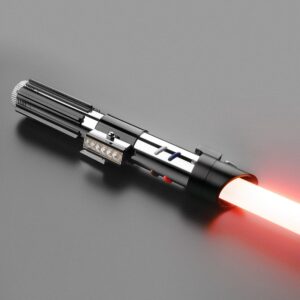
Darth Vader Lightsaber — Xenopixel V3 / Proffie 2.2 ESB Replica
Character Lightsabers / Darth Vader Lightsaber
Frequently Asked Questions
Q1: Was there a story behind Vader saber’s resemblance to his old Padawan saber?
A: In-universe, yes — both the ROTS saber (a gift from Palpatine) and the ANH saber share the MPP-style shroud, echoing his Anakin-era design. The community reads this as Vader recycling his own design language; the practical reading is that the prop department reused the flashgun geometry they already had.
Q2: ANH saber vs. ESB saber?
A: Same MPP base, different details. The ANH has 7 short grips with rounded ends, silver clamp sidebars, and a lever lock; the ESB has 6 longer grips reaching the clamp, black tapered sidebars, a nut lock, and a red wire near the emitter. The ESB is also the lighter prop and has a wider control box.
Q3: Vader ESB Question?
A: The ESB saber is a community favorite — owners praise its hilt detail, its balanced feel, and what one forum member called “the coolest switchoff on any of the FX sabers,” where the blade’s shutoff animation syncs with the sound. If you’re choosing one Vader saber, ESB is the one most fans pick.
Q4: Which version of Darth Vader is prime Vader?
A: The community splits — ROTJ Vader and Knightfall Vader tie as “prime” for power debates, while ANH and ESB trail. But that’s about the character, not the hilt. For the saber itself, the poll favorite among Sith hilts is the ANH first, then the ESB.
Q5: Why is Darth Vader’s lightsaber red?
A: Because the kyber crystal was “bled.” A Sith forces negative emotions — anger, pain, hatred — into the crystal, corrupting it and turning it red. The red blade is the color of a subjugated crystal, which is why every Sith weapon ends up red.
Q6: How long is Darth Vader’s lightsaber?
A: The hilt is about 28 centimeters long. In canon, Vader’s saber was a dual-phase design with two kyber crystals, letting him adjust the blade length mid-duel — a combat trick the films never fully showed.
Q7: Was Vader’s ROTJ saber a new hilt?
A: No — the original ROTJ prop had been lost, so the prop department built a replacement that looks more like a dark version of Anakin’s second saber. It’s the distinctive Graflex-inspired hilt from the throne room and redemption scenes.
Q8: Where did Vader’s lightsaber hilt come from?
A: The ANH, ESB, and ROTJ hilts were all built from MPP (Micro Precision Products) 3-cell camera flashguns — 1950s British camera equipment. The prop team added an Exactra calculator lens and T-track grips to turn a flash unit into a lightsaber. Note: some “vintage” finds turn out to be Heiland flashes, a close-but-not-used substitute.