The short answer: Kylo Ren’s lightsaber is a single weapon with three identities — Ben Solo’s blue Jedi blade, the cracked red blade Kylo bled and broke, and the broken hunk he hurled into the sea on Kef Bir.
Every fan knows the crossguard silhouette. Few know the saber started blue, that its crack came from a failed bleeding ritual, and that the crossguard exists for heat venting, not style. The weapon mirrors Kylo’s own arc: a Jedi weapon that a Sith wannabe broke, then threw away to become Ben again.
This is the complete in-universe history of that blade, from the Jedi Temple-era blue saber to the ocean floor — with the technical details that make it the most complex lightsaber ever built for the screen.
What’s on This Page
- The Blue Blade Ben Solo Built
- The Bleeding: How the Crystal Cracked
- Why the Crossguard Is Functional, Not Decorative
- The Unstable Blade in Action
- Cast Away on Kef Bir
- The Legacy of a Cracked Crystal
- How Replicas Rebuild the Broken Blade
- More Common Questions
The Blue Blade Ben Solo Built
Kylo Ren’s lightsaber began as a standard blue-bladed Jedi weapon that Ben Solo constructed while training under Luke Skywalker at the Jedi Temple — the same weapon he carried into the darkness.
Ben Solo built this lightsaber as a Padawan, choosing a blue crystal aligned with the Jedi Guardian path. It was unremarkable by design: a normal hilt, a stable blue blade, no crossguard, no cracks.
The Rise of Kylo Ren comic miniseries (2019, 4 issues) confirms the timeline. Ben carried this same weapon through the destruction of Luke’s new Jedi Order and into his dark-side apprenticeship, until the day he decided the blue blade no longer represented who he was becoming.
That single weapon is the whole story. Kylo never built a second saber. He took the Jedi weapon he already owned, broke its crystal, and rebuilt the hilt around the damage.
The Bleeding: How the Crystal Cracked
The crack in Kylo’s blade came from a failed bleeding ritual: in The Rise of Kylo Ren #4, he forced his natural blue crystal to bleed red, and his inexperience or raw rage caused it to crack under the strain.
Bleeding is the dark-side process of forcing a light-attuned kyber crystal to turn red. The user floods the crystal with rage, hate, and pain until it submits. Sith normally succeed. Kylo, mid-bleed, saw visions of his parents, Luke, Chewbacca, Lando, and his friend Tai — and kept going anyway.
When he opened his hand, the crystal was red. It was also cracked — the crystal barely containing the weapon’s power. Kylo’s bleeding worked, but at the cost of the crystal’s structural integrity.
The result is the unstable blade every viewer remembers: ragged, serrated, and crackling, like a lightning bolt held in a handle. The crack is not a design flourish. It’s the physical record of a botched ritual.
Why the Crossguard Is Functional, Not Decorative
The crossguard exists to vent heat. A cracked crystal that barely contains the weapon’s power expelled excess energy, and Kylo split the blade’s stream into perpendicular vents so the saber didn’t burn his hand.
When Kylo first ignited the weapon as a single beam, the cracked crystal’s excess heat burned his hand. The lateral exhaust vents were his engineering answer: an array of focusing crystal activators splits the primary blade’s energy stream into perpendicular channels.
Those channels are the crossguard blades — the quillons that make the silhouette iconic. They emerge from the side vents and divert the overflow heat away from the hilt and the wielder.
The design dates to an ancient crossguard type from the Great Scourge of Malachor, a Jedi-Sith conflict shown in Star Wars Rebels (2017, “Twin Suns” era flashbacks) that predates the clone wars. Kylo deliberately revived an ancient form because it solved a modern problem.
He could have repaired the crystal. He chose not to. The unstable, volatile nature — and the ominous crackle on ignition — became part of the weapon’s identity.
The Unstable Blade in Action
The broken blade saw its most famous use at Starkiller Base, where Kylo killed Han Solo with it and later lost it — Rey tore the weapon from his grip and split it down the middle.
The saber’s on-screen history is short and brutal. Kylo used it to kill Lor San Tekka on Jakku (The Force Awakens, 2015) and Han Solo on the Starkiller Base bridge. The weapon then dueled Finn and Rey in the snow, in a fight that ends with the blade in Rey’s hands.
Rey ended that duel with the weapon itself. She pulled the saber from Kylo’s grip with the Force and sliced it clean through the crossguard and up the blade, leaving him holding a sparking, severed hunk of metal.
The broken saber, in both halves, was a visual of the crack’s cost. The weapon that had survived a botched bleeding and an engineering rebuild could not survive a clean duel loss.
Cast Away on Kef Bir
Kylo’s lightsaber was destroyed for good when he cast it into the ocean on Kef Bir, after seeing a vision of his father during his turn back toward the light.
Kylo continued using a rebuilt version of the weapon through The Last Jedi (2017) and into The Rise of Skywalker (2019). Its final scene mirrors its origin: on the ocean world Kef Bir, after facing a vision of his father, Kylo Ren drops the red blade into the sea. The hilt sinks, and Kylo Ren is gone.
The weapon sinks. Kylo Ren is gone. Ben Solo remains, weaponless, having returned to the light with nothing left of the dark side’s signature tool.
Lucasfilm has never shown the saber recovered. In current canon, the broken blade rests on the ocean floor — the last act of the weapon that started as a blue Jedi blade.
The Legacy of a Cracked Crystal
The cracked-crystal unstable blade redefined how lightsabers could look and sound, and it remains the clearest on-screen demonstration of what happens when a bleeding ritual goes wrong.
- First crackled blade on screen — before Kylo, unstable blades were described in canon but never shown in live action.
- Bleeding made visible — the crack gave viewers a physical consequence for a dark-side process that comics describe but films never show.
- Functional design storytelling — the crossguard is one of the few saber features in the films with an explicit engineering reason.
- A mirror of the character — the weapon’s three identities track Kylo’s arc: Jedi, Sith, and the man who gave it up.
- Replica-making challenge — the jagged blade and crossguard vents are among the hardest features for replica makers to reproduce convincingly.
How Replicas Rebuild the Broken Blade
Replica makers approach the Kylo hilt as a three-part engineering problem: the cracked blade effect, the crossguard vents, and the weathered black hilt — each requiring a different technique.
| Feature | What accuracy requires | Common approach |
|---|---|---|
| Unstable blade | Ragged, serrated edge that looks like crackling energy | Neopixel strip with custom “unstable” blade styles |
| Crossguard vents | Side blades that ignite and glow like the main blade | Two smaller side LED strips or Neopixel tubes in the vents |
| Weathered hilt | Black, battle-scarred body with exposed wiring | Dark anodized metal with burnt accents and scuff marks |
| Side blade durability | Realistic look without being duel-rated | Resin or 3D-printed side blades, display-only |
The honest constraint: the crossguard side blades are almost always display pieces. The main blade can take hits on many replicas, but the thin side vents are built for looks, not sparring. A buyer wanting a durable Kylo saber usually treats the side blades as cosplay detail and the main blade as the working edge.
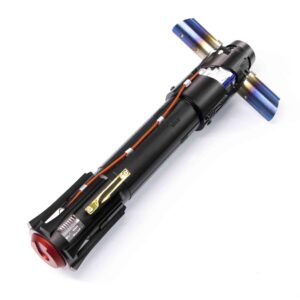
Kylo Ren Crossguard Lightsaber — Kylo Ren Replica from ISABER
Character Lightsabers / Replica Lightsabers
More Common Questions
Q1: Why is Kylo Ren’s lightsaber unstable?
A: Its kyber crystal cracked during the bleeding ritual that turned it red. In The Rise of Kylo Ren #4, Kylo forced his natural blue crystal to bleed red, and the crystal cracked under the strain. The damaged crystal barely contains the weapon’s power, producing the ragged, crackling blade.
Q2: Why does Kylo Ren’s lightsaber have a crossguard?
A: For heat venting, not decoration. The cracked crystal expelled excess heat that burned Kylo’s hand when he first ignited a single beam. He split the blade’s energy into perpendicular exhaust vents — the side blades — to divert the heat away from the hilt.
Q3: How did Kylo Ren get his lightsaber?
A: He built it as Ben Solo, a blue-bladed Jedi weapon, while training under Luke Skywalker. After falling to the dark side, he bled the crystal red, cracked it, and rebuilt the hilt with the crossguard vents to manage the damaged crystal’s heat.
Q4: Did Kylo Ren build a new lightsaber?
A: No. He kept modifying the same weapon throughout the sequel trilogy. Rey split it at Starkiller Base, he rebuilt it, and he finally cast it into the ocean on Kef Bir before turning back to Ben Solo.
Q5: What is the crack in Kylo’s lightsaber?
A: A structural crack in the kyber crystal caused by the bleeding ritual. It’s a real fracture, not a stylistic choice — the reason the blade is unstable and the crossguard vents exist at all.
Q6: Is Kylo Ren’s lightsaber the only cracked one?
A: In current canon it’s the most prominent example of a cracked bleeding crystal. Other Sith bleeding rituals produced stable red crystals; Kylo’s failure to fully focus made his crack. The white blades Ahsoka wields are the opposite case — purified bled crystals.
Q7: Why did Kylo Ren throw his lightsaber away?
A: On Kef Bir, after confronting a vision of his father, Han Solo, Kylo Ren chose to turn back to the light. Dropping the red blade into the ocean was the symbolic end of the dark-side weapon and the Kylo Ren identity.
Q8: What lightsaber did Ben Solo use after?
A: None. Ben Solo appears weaponless after the Kef Bir scene. In the final fight against the resurrected Palpatine, he fights as a Force user, and dies on the ruined Death Star shortly after helping Rey — without ever carrying another lightsaber.