Obi-Wan Kenobi carried three distinct lightsabers across his life — the minimalist Padawan saber built under Qui-Gon Jinn, the near-identical replacement of his knighthood, and the iconic thin-neck saber he wielded from the Clone Wars to his final duel on the Death Star.
No Jedi’s weapon history tracks the arc of a life the way Obi-Wan’s does. Each saber marks a stage — the Padawan who built his blade to match his master’s, the knight who rebuilt it the same way, and the master whose final design was entirely his own.
His third saber became the most famous lightsaber in cinema history: the first blade audiences ever saw on screen, in 1977.
This page is a time-line reference: the full history of his three sabers, the technology behind the thin neck, and how replicas reproduce each era.
What’s on This Page
- The Three Sabers at a Glance — every blade in one table
- The Padawan Saber — built to match Qui-Gon
- The Replacement Saber — nearly identical, by design
- The Iconic Thin-Neck Saber — from EP3 to ANH
- The Real-World ANH Prop — jet engine parts and a rifle grenade
- The Thin-Neck Design — why it’s hard to engineer
- How Replicas Reproduce Each Era
- Frequently Asked Questions
The Three Sabers at a Glance
Obi-Wan’s saber history runs through three distinct blades, each tied to a stage of his life — from Padawan to knight to the master who trained two generations of Jedi. Here’s the whole lineage in one table.
| Saber | Era | Blade Color | Hilt Design | How It Was Lost |
|---|---|---|---|---|
| First saber | Episode I | Blue | Simple black-and-gray, near-identical to Qui-Gon’s | Kicked down a reactor shaft by Maul on Naboo |
| Second saber | Episode II | Blue | Nearly identical to the first | Confiscated by Count Dooku on Geonosis |
| Third saber | EP3 → ANH | Blue | Thin neck, black-and-silver with gold accents | Carried to his death on the Death Star |
Each loss marked a turning point. The first loss at Maul’s hands led to his knighthood. The second, to Dooku, led to his masterhood. The third stayed with him until the end.
The Padawan Saber
Obi-Wan’s first lightsaber was built by himself as a Padawan, with a simple minimalist black-and-gray hilt that was nearly identical to his master Qui-Gon Jinn’s — a deliberate mark of respect.
In the Jedi Order, a Padawan builds their own saber after finding a kyber crystal. Obi-Wan’s first build was strikingly plain: a simple cylinder, no ornament, black and gray.
That it matched Qui-Gon’s design was intentional — a young student who followed his master’s example in everything, down to the hilt in his hand.
The blade was blue, the color of a Jedi Guardian — the Order’s warrior class, focused on combat and protecting the innocent. It was a fitting color for a student whose master was killed fighting a Sith.
It’s the saber he used at the Battle of Naboo, and the one Darth Maul kicked down a reactor shaft during their duel.
After watching Qui-Gon fall, Obi-Wan took up Qui-Gon’s green saber to deliver the killing blow against Maul — a borrowed blade for a final strike, marking his transition from Padawan to Jedi Knight.
The Replacement Saber
After his knighthood, Obi-Wan built a second lightsaber that was nearly identical to his first — so close that fans originally thought it was the same weapon, with only a slightly altered emitter separating them.
This was pure Obi-Wan. Where most Jedi would mark their promotion with a new design, he rebuilt the same blade — “if it ain’t broke, don’t fix it” as a Jedi philosophy. The near-identical rebuild honored his fallen master Qui-Gon, and it reflected Obi-Wan’s by-the-book approach to the Order.
He carried this saber through his early training of Anakin Skywalker, the rain-soaked duel with Jango Fett on Kamino, and the arena on Geonosis — where Count Dooku confiscated it when Obi-Wan was captured. He never recovered it.
During the First Battle of Geonosis, he fought with a borrowed lightsaber instead. It was the second time a Sith took his blade, and the second time it marked a turning point: from knight to Jedi Master.
The Iconic Thin-Neck Saber
Obi-Wan’s third lightsaber — built after Geonosis and his promotion to Jedi Master — was a major departure from his first two: a sleeker, individual design with a thin neck, black-and-silver coloring, and touches of gold.
It’s the saber that defined the rest of his life. He carried it through the Clone Wars, dueling Count Dooku, General Grievous, Asajj Ventress, and Maul. He used it to defeat Anakin on Mustafar, severing his limbs and leaving the man who would become Darth Vader to burn.
During his exile on Tatooine, he buried it in the desert alongside Anakin’s saber — a deliberate act of giving up the weapon that had defined him.
He retrieved it years later during the Obi-Wan Kenobi series to rescue Leia Organa, and used it to finally defeat Maul in their last duel.
His final use was on the Death Star, in the duel against Darth Vader where he allowed himself to be struck down. This was the first lightsaber audiences ever saw on screen, in 1977.
After Kenobi’s death, Vader retrieved the weapon. Its fate was likely sealed with the Death Star itself.
The Real-World ANH Prop
The original A New Hope prop was famously assembled from real-world found parts — a Rolls-Royce Derwent jet engine balance pipe, a World War I-era rifle grenade, a battery pack, and a faucet handle.
Before the prequels retroactively designed the elegant thin-neck saber, the 1977 prop was a practical build. The prop department grabbed whatever machined parts looked futuristic and assembled them into what became the most iconic weapon in cinema.
Here’s what went into it:
- Rolls-Royce Derwent jet engine balance pipe — the main body, a real aerospace component
- World War I rifle grenade — the clamp section
- Battery pack — functional-looking detail
- Faucet handle — part of the control box
When the prequels came decades later, the on-screen design was an intentional evolution of that original prop — the thin neck, the clamp, the gold accents all echo the 1977 silhouette while looking sleeker.
The Thin-Neck Design
The thin-necked emitter is the saber’s most distinctive engineering feature — a narrow “choke” section separating the emitter from the body, which held the reserve power cell and is tricky to engineer for durability in replicas.
On screen, the thin neck is pure elegance. In the real world of replica making, it’s a headache. Here’s why:
- Narrow channel — the blade housing runs through a slim neck, which limits internal space for electronics.
- Durability risk — a thin metal section is structurally weaker than a full-width hilt; replica makers add internal reinforcement to keep it from bending.
- Screen-accurate blades — some replicas use a 7/8-inch blade to match the thin neck’s proportions, instead of the standard 1-inch blade.
In-universe, the saber required advanced emitter technology because of that narrow channel — magnetic stabilizers to prevent blade flicker during rapid movement. Replica makers solve the same problem in real metal, which is why thin-neck sabers are among the harder replicas to build well.
How Replicas Reproduce Each Era
Replica makers reproduce all three of Obi-Wan’s sabers, with the thin-neck EP3/ANH design being the flagship — machined from aluminum with brass accents, gold detailing, and the distinctive slim profile.
The thin-neck saber gets the most attention from replica makers because it’s the famous one. Screen-accurate builds use precision CNC-machined 6061 aluminum with brass components, anodized surfaces, black ribbed grip, and gold-accented details.
| Replica Era | Hilt | Typical Electronics | Accuracy Focus |
|---|---|---|---|
| EP1 Padawan | Simple black-and-gray cylinder | RGB / Neopixel | Minimalist hilt, no ornament |
| EP2 replacement | Near-identical, altered emitter | RGB / Neopixel | Subtle emitter detail |
| EP3/ANH thin-neck | Thin neck, black-silver-gold | SNV4 Pro, Xenopixel, Proffie | Thin-neck proportions, gold accents, clamp detail |
Two details matter most. The thin-neck proportions are what separate a good Obi-Wan replica from a generic hilt — get the neck wrong and it doesn’t read as his saber. And the brass-and-gold accents are what give the third saber its warmth; a flat all-silver build misses the design intent.
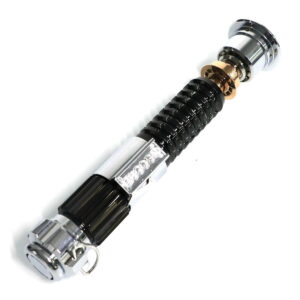
Kenobi Lightsaber v2.0
Character Lightsabers / Obi-Wan Kenobi Lightsaber
Frequently Asked Questions
Q1: How many lightsabers has Obi-Wan Kenobi had?
A: Three distinct sabers across his life: the minimalist Padawan saber built under Qui-Gon Jinn, the near-identical replacement of his knighthood, and the iconic thin-neck saber he carried from the Clone Wars to his death on the Death Star.
Q2: Why is Obi-Wan’s lightsaber blue?
A: All three of Obi-Wan’s sabers had blue blades. Blue is the color of a Jedi Guardian — the Order’s warrior class focused on combat and protecting the innocent. It’s a fitting color for a Jedi whose life was defined by duels: Maul, Dooku, Grievous, Ventress, and finally Vader.
Q3: What’s the difference between Obi-Wan’s three lightsabers?
A: His first two were nearly identical minimalist designs — the Padawan saber matched Qui-Gon’s, and the replacement was almost the same blade. The third, built after Geonosis, was a major departure: a sleeker thin-neck design with black-and-silver coloring and gold accents, the only one he carried as a Jedi Master.
Q4: Why did Obi-Wan’s lightsaber have a thin neck?
A: In-universe, the thin neck held the reserve power cell and required advanced emitter technology with magnetic stabilizers to prevent blade flicker. In the real world, it’s an elegant design that replica makers find hard to engineer for durability — the narrow metal section is structurally weaker, so builds add internal reinforcement.
Q5: What was Obi-Wan’s lightsaber made of in A New Hope?
A: The original 1977 prop was assembled from real-world found parts: a Rolls-Royce Derwent jet engine balance pipe for the body, a World War I-era rifle grenade for the clamp, a battery pack, and a faucet handle. Modern replicas machine the same silhouette from aluminum and brass.
Q6: What happened to Obi-Wan’s lightsaber after he died?
A: After Obi-Wan fell to Darth Vader on the Death Star, Vader retrieved the weapon. Its ultimate fate is unknown, but it was almost certainly destroyed with the Death Star when the Rebels destroyed the station.
Q7: Did Obi-Wan use Qui-Gon’s lightsaber?
A: Yes, once — and only at the most significant moment. After Darth Maul killed Qui-Gon and kicked Obi-Wan’s own saber down a reactor shaft, Obi-Wan took up Qui-Gon’s green saber to deliver the killing blow against Maul, marking his transition from Padawan to Jedi Knight.
Q8: Why did Obi-Wan bury his lightsaber on Tatooine?
A: It was a deliberate act during his exile. After Order 66 and the fall of the Republic, he buried his saber in the desert alongside Anakin’s — symbolically giving up the weapon that had defined him, hiding from the Empire’s reach. He retrieved it years later during the Obi-Wan Kenobi series to rescue Leia.