
A red lightsaber means that a kyber crystal was taken from someone else and broken until it turned. That is a statement about an act rather than about a personality, which is why the same colour covers groups that share nothing except the colour.
The roster runs from Sith Lords through Imperial enforcers who never held the title, and it ends with a few people who simply picked a weapon up off the floor.
This page lists all of them, explains why the meaning of red has changed twice, and then does the part the fiction cannot do: it says what red looks like when it comes out of a blade you can hold.
Most answers to this question describe the ritual and stop there. The ritual is real and it is well documented, so we will give it one section and a link, and spend the rest of the page on the parts those answers leave out.
The roster is the first of those parts. Red is treated as the Sith colour, yet a large share of the red blades on screen belong to people who hold no Sith title at all, and the reason each of them has red is not the same reason.
The second part is real-world: why the story reached for red before it had any rules about it, and what happens to that meaning when the colour leaves the page and becomes light in a tube.
What’s on This Page
- The Short Answer: an Act, Not a Personality
- Three Rulebooks, Three Meanings
- Everyone Who Carries Red, Sorted by What They Are
- The Three Cases People Get Wrong
- Why the Story Chose Red at All
- Can a Jedi Carry One?
- The Red on a Blade Is Not the Red in the Films
- Why Red Blades Look Orange, and What Helps
- What Red Means When You Are Buying
- FAQ
The Short Answer: an Act, Not a Personality
Red means the crystal that makes the blade was bled, and bleeding is something done to a crystal rather than a colour that someone selects.
The 2017 Darth Vader comic run set the process out in explicit terms. A dark side user takes a crystal that is bonded to the light side and forces his hatred, fear and pain into it until the crystal yields and goes red.
Palpatine’s framing of the moment is that a Sith’s blade is not given but taken, and that the colour is the colour of the taker’s rage.
The crystal resists the whole way through, which is the part that gets dropped from short summaries. A crystal that simply changed colour on request would make red a preference. A crystal that has to be broken makes red a record of damage, and that difference is what every later argument about the colour depends on.
So red does a grammatical job that blue and green do not: blue and green describe what a crystal is, while red describes what was done to it, and the act comes before the colour in the order of events.
One consequence follows directly, because a red blade cannot be manufactured as a red blade. The redness is the injury rather than the material, and anything made red from scratch belongs to a different explanation entirely.
That older explanation is where most of the confusion on this subject comes from.
For the ritual in full, including what happens when the crystal cracks during the process, our page on the bleeding ritual covers the mechanism and this one will not repeat it.
Three Rulebooks, Three Meanings
Red has carried three incompatible explanations, and almost every disagreement about the colour comes from one source quoting a rulebook that its reader is not thinking in.
The first rulebook is everything written before the colour had rules. In the earliest material, red was simply a colour a lightsaber could be, and several Jedi were drawn carrying red blades with no comment at all.
Names that turn up in that material include Adi Gallia, Even Piell, A’Sharad Hett and Depa Billaba, which reads as strange now and was unremarkable then.
Most of those were quietly repainted blue or green later, including in Legends material, which is why the red versions are hard to find and easy to mistake for a mistake.
The second rulebook is the old Expanded Universe. There, the Sith made their own crystals instead of taking anyone else’s, and the synthetic crystals came out red by construction. Red in that system marked a manufacturing choice, so a red blade proved that someone had the means to grow a crystal, not that anyone had been hurt.
The third rulebook is the current canon, and it replaced the second one in 2014 when the Expanded Universe was set aside. The bleeding explanation arrived in print in 2017 through the Vader comic, and it has since been confirmed on screen in games and series.
The colour never changed. The rule that produced it did, twice.
| Rulebook | Where it applies | What red means there | What red proves about the user |
|---|---|---|---|
| Early print, pre-2002 | Any old source you find | A colour a saber can be | Nothing at all |
| Old Expanded Universe | Legends material, still widely repeated | A synthetic crystal, grown red | Access to manufacturing |
| Current canon | Films from 2015 on, comics from 2017, series and games | A crystal taken and forced | That a specific act was done |
That table matters practically, because a lot of the writing still circulating about red was produced under the second rulebook and never revised. If a page tells you the Sith grew their own crystals, it is quoting material that stopped being authoritative in 2014.
Everyone Who Carries Red, Sorted by What They Are
Red is carried by five kinds of people, and only the first kind is Sith, which is where the useful detail sits.
The Sith Lords are the obvious group and the smallest useful one for this question. Sidious, Vader, Maul, Dooku, Bane and Plagueis all carry red, and for each of them the crystal was taken and broken in the way the ritual describes. Their red is the reference case that everyone else is measured against.
The Inquisitorius is the largest single block of red blades in canon, and its members are not Sith. They are dark side adepts who report to Vader, and their blades were issued to them rather than earned through the ritual, which is why several of them carry the same rotating double-bladed design with only cosmetic differences.
The third group is dark side users who never held a Sith title. Kylo Ren is the famous one, and the Knights of Ren are the same pattern at lower resolution. Asajj Ventress belongs here too: she was trained by a Sith Lord but never became one, and canon never shows her performing a bleeding.
The fourth group is Jedi who used a red blade without owning one, usually for the length of a single fight. Obi-Wan has fought with a captured red blade and given it back, and Luke has carried a Sith Lord’s weapon in the comic material and described feeling its influence while he held it.
The fifth group is fallen Jedi who bled their own crystal after turning. Barriss Offee and Dagan Gera both sit here, and their cases are the cleanest illustration that the colour records a decision rather than a rank.
| Group | Named in canon | Why the blade is red | Sith rank? |
|---|---|---|---|
| Sith Lords | Sidious, Vader, Maul, Dooku, Bane, Plagueis | Own ritual, done as part of claiming the title | Yes |
| Inquisitorius | Grand Inquisitor, Fifth Brother, Seventh Sister, Eighth Brother, Tenth Brother | Crystals issued by the Empire, not bled by the holder | No |
| Dark side, untitled | Kylo Ren, Knights of Ren, Asajj Ventress | Same method without the institution | No |
| Jedi, briefly | Obi-Wan, Luke | Used a captured weapon, then let it go | No |
| Fallen Jedi | Barriss Offee, Dagan Gera | Bled their own crystal after turning | No |
Read down the last column and the point of the page arrives. Four of those five groups carry red, and four of the five are not Sith, which means red is better understood as a marker of dark side practice than as a marker of Sith membership.
The distinction is not pedantry. It explains why Kylo Ren has red while explicitly not being a Sith, why the Inquisitors all match each other, and why a Jedi can hold a red blade for ten minutes without becoming anything.
The Three Cases People Get Wrong
Kylo Ren, the Inquisitors and Asajj Ventress all carry red without being Sith, and each one is red for a different reason.
Kylo Ren bled a crystal badly. He put too much into it, the crystal cracked, and a cracked crystal produces an unstable blade that spits and flickers.
That instability is the reason for the crossguard vents on his hilt. His red is not a statement of rank at all. It is the visible cost of doing the job wrong.
The Inquisitors got their crystals from someone else. Their uniform red is an equipment decision made by the Empire, and it reads as an insignia rather than a biography, in the same way a uniform jacket tells you where someone works without telling you what they have done.
Ventress is the interesting case, because she is the one most often filed under Sith and is not one. She was trained in dark side practice by a Sith Lord and then discarded.
Her red blades were obtained rather than bled on screen. If you were writing a rule from her alone, red would mean dark side affiliation and nothing more.
Three different mechanisms, one colour. That is the strongest argument against reading red as a single signal, and it comes out of the fiction rather than out of a fan argument.
Why the Story Chose Red at All
Red was the obvious pick before the lore existed, because human beings already read red as stop, danger and blood, and the films borrowed that meaning instead of inventing one.
In safety signage the colour is not decorative. International standards reserve red for prohibition and for fire equipment, which is why a red circle with a bar through it reads as forbidden in countries whose languages you cannot read.
Red is also the hardest of the light colours to ignore. It sits at the long-wavelength end of the visible range, around 620 to 700 nanometres, and the eye is built to notice it against almost any background, which is why brake lights and tail lights are red rather than blue.
The films used that for contrast. A blue or green blade against a dark set reads as cool and steady, and a red blade on the same set reads as heat, which means the two characters do not need dialogue to signal that they are in opposition.
So the ritual came later than the colour, and it arrived to give an existing visual convention a reason. That order matters when you are reading about this subject, because it explains why the older material treats red so casually.
Can a Jedi Carry One?
Not as a blade of their own, because making red is the act that ends a Jedi’s standing, but the films and comics do show Jedi holding one for a few minutes.
The reason is structural rather than a rule of etiquette. A light side user cannot bleed a crystal, because the process requires the emotions the Jedi code specifically trains out, and a crystal that is not bled does not turn red.
The temporary case is different and does happen. A red blade that has been knocked out of a hand is still a working weapon, and picking it up for one exchange has been shown more than once, including by Obi-Wan and by Luke.
Luke’s case is the one with consequences. He carried a dead Sith Lord’s blade in the comic material and the writing gives him a sense of the weapon pressing back on him, which is the fiction’s way of saying that ownership and use are not the same as making.
In the old Expanded Universe several Jedi had red blades for no reason beyond the fact that the colour had no rule yet. Luke built a red shoto there as a second, off-hand weapon, cut from a synthetic crystal made in a hurry rather than taken from anyone.
Those examples are still quoted as evidence that Jedi can have red, and they come from the first rulebook in the table above rather than the current one.
What a crystal can do once it has been bled, and what other crystal types exist, is set out in our reference on crystal types.
The Red on a Blade Is Not the Red in the Films
A screen blade is drawn at the long end of the red range, while a red LED sold for sabers is usually binned around 630 nanometres, and that gap is most of the reason so many red sabers look orange.
Orange sits near 590 nanometres and true red sits near 650. A red emitter at 630 is the compromise LED makers settle on, because it is visibly red while still producing useful brightness.
The gap between 620 and 640 is wide enough that two saber LEDs of the same nominal colour can look like different colours side by side.
The brightness part is not an opinion. Human sensitivity falls off steeply past 630, so a deep red emitter at 660 gives roughly a quarter of the perceived brightness of a standard red at 630 for the same electrical power.
| Wavelength | Reads as | CIE photopic response | Relative brightness |
|---|---|---|---|
| 590 nm | Amber orange | 0.757 | 75.7% |
| 630 nm | Standard saber red | 0.265 | 26.5% |
| 660 nm | Deep red, blood red | 0.061 | 6.1% |
The scale is the standard photopic curve, where 555 nanometres is defined as 1.000, so the bars are showing what our eye actually registers rather than how much power goes in. A 660 nanometre blade is running at four times the power of a 630 nanometre blade to look like the darker one.
That trade is the entire design problem behind a red saber. Push the wavelength up and the colour gets closer to the films, then the blade gets dimmer, then people stop buying it. Stay at 630 and it looks correct in daylight and slightly orange in a dark room.
The blade tubes themselves add nothing to the colour, which is worth saying because the tube is what you actually look at. Polycarbonate is clear or lightly frosted, and every colour you see is coming through it rather than off it. Our blade reference covers the tube side of this in detail.
Why Red Blades Look Orange, and What Helps
Three separate causes produce the same complaint, and only one of them is the wavelength of the LED.
The first cause is genuine: the emitter really is nearer orange than the film colour. Two LEDs sold as red can sit forty nanometres apart, and binning is not usually listed on a product page, so the safest predictor is the reputation of the specific emitter rather than the word on the listing.
The second cause is the camera. Most phones overexpose a bright red blade until the highlight clips toward white, and the surrounding spill then reads as orange. The same blade photographed at a lower exposure will come out considerably redder.
The third cause is control, and this one you can fix in the app. Most red presets are not pure red. A mix with a little green in it, which looks richer on a screen, drifts toward orange as soon as output is lowered.
| What you see | Likely cause | What actually helps |
|---|---|---|
| Orange in person, not on camera | Emitter near the 620 end of the bin | Choose a deeper bin and accept a dimmer blade |
| Orange in photos only | Highlight clipping and auto white balance | Lower exposure, lock white balance, no flash |
| Reddish at the hilt, orange at the tip | Tube diffusion plus distance from the emitter | Run the blade at a lower output for photos |
| Drifts toward orange as the battery drops | Mixed preset losing the green or blue channel first | Use a single-channel red preset for the whole session |
Builders have a fourth option that is worth knowing about even if you never use it. A very small amount of blue, somewhere around five to seven percent, pulls the hue away from orange and toward crimson, and the effect is stronger in photographs than in the room.
The general behaviour of colour on a lit blade, from the RGB values up to what reaches the tube, is covered in our guide to how blade colour works.
What Red Means When You Are Buying
On a replica, colour is a setting rather than a part, so the red that arrives is whatever your board is set to rather than anything you chose at checkout.
That is not a technicality. A hilt has no colour in it. The blade colour comes from the emitter or from the strip inside the tube, and both of those are driven by a controller with a menu, which means the same hilt can be red for one evening and blue for the next.
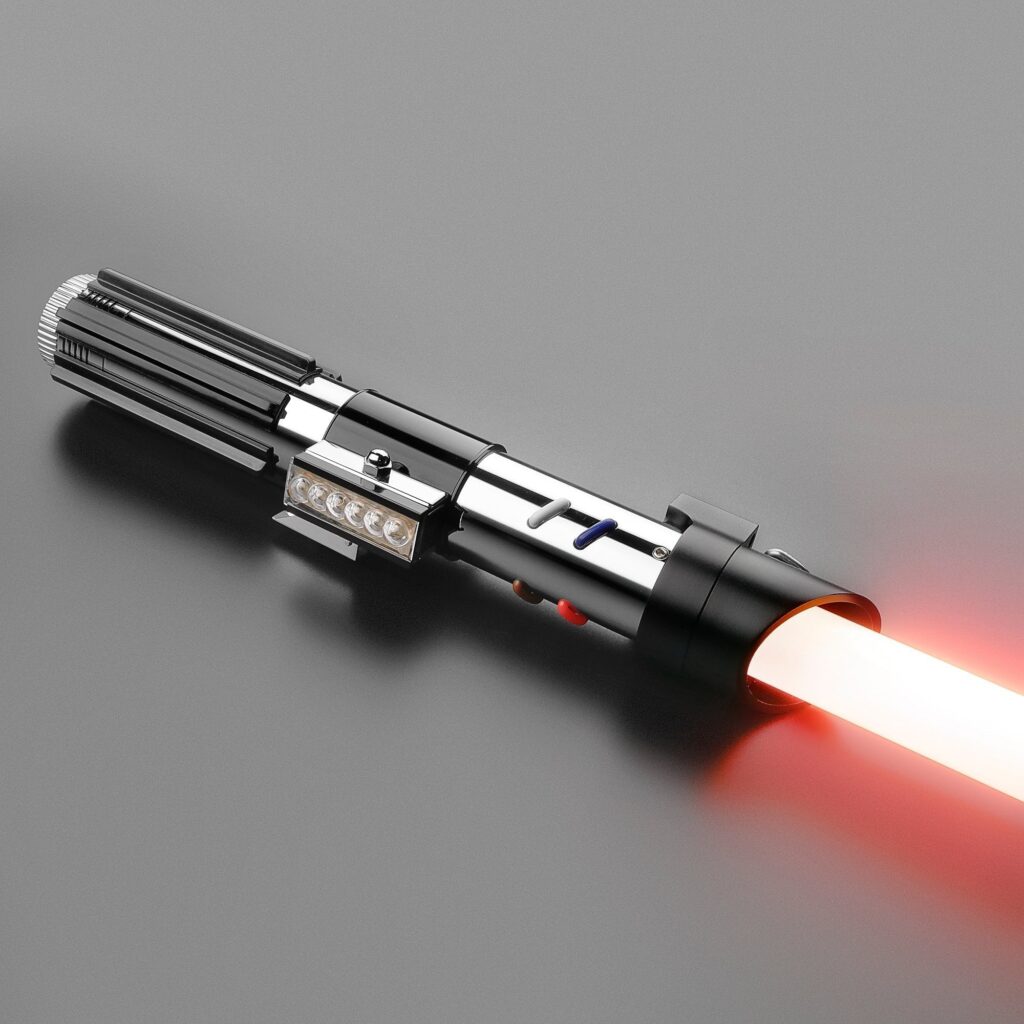
What does vary between buyers is how well each colour survives the tube. Red is the easiest colour to get bright and the hardest to get deep, so the version most of us end up keeping is the compromise we are happiest to live with rather than the one that matches the films.
Two settings are worth knowing before you order. A baselit saber runs one high-power emitter in the hilt and a hollow tube, which gives the strongest red and the cheapest blade to replace.
A strip blade has no single red source, because every pixel is set individually. That makes the colour more even along the length, and it makes the blade more fragile in a duel.
Our own Vader hilt is the obvious place to start, since the red blade and the black-and-silver body are the same combination the fiction established first.

Darth Vader Lightsaber — Xenopixel V3 / Proffie 2.2 ESB Replica
Character Lightsabers / Darth Vader Lightsaber
FAQ
Q1: What does a red lightsaber mean?
A: In current canon it means the crystal was bled, which is a matter of something being done to a crystal rather than a colour being selected. It signals dark side practice. It does not signal Sith membership, because several groups carry red without holding that title.
Q2: Why are Sith lightsabers red?
A: Because a Sith takes a crystal bonded to the light side and forces rage and pain into it until it turns. The process is described in the 2017 Vader comic run, and it replaced the older explanation in which the Sith simply grew their own crystals.
Q3: Who has a red lightsaber in Star Wars?
A: Sidious, Vader, Maul, Dooku, Bane and Plagueis for the Sith. The Inquisitorius as a body of Imperial enforcers. Kylo Ren, the Knights of Ren and Asajj Ventress outside any order. Obi-Wan and Luke briefly, using captured blades.
Q4: Can a Jedi have a red lightsaber?
A: Not as a blade of their own, because making red requires the emotions the Jedi code trains out. A Jedi can hold one for a short time, and both Obi-Wan and Luke have done so in the middle of a fight.
Q5: Is Kylo Ren a Sith because his blade is red?
A: No. He is not a Sith, and his red comes from bleeding a crystal badly enough that it cracked. The crossguard vents exist because the cracked crystal produces excess energy that has to escape somewhere.
Q6: Are the Inquisitors Sith?
A: No. They are dark side adepts who answer to Vader, and their red crystals were issued to them rather than bled by each holder. That is why their blades match each other so closely.
Q7: Was red always the Sith colour?
A: No. In the earliest material red was just a colour, and several Jedi were shown with red blades because no rule existed. The colour became exclusive to dark side users only once the rulebook caught up with it.
Q8: Can a red crystal turn back?
A: It can be healed, but it does not return to its original colour. A purified crystal turns white, which is why white blades are read as a statement about the person carrying them. Ahsoka Tano’s blades are the standard example.
Q9: Why does my red lightsaber look orange?
A: Usually because the emitter sits near 620 nanometres rather than 640. Camera overexposure makes it worse, and a preset that mixes in a little green drifts toward orange as output drops. Lowering exposure for photos is the cheapest fix.
Q10: Is a red blade more powerful than a blue one?
A: No. In canon the colour records what was done to the crystal and nothing in the films shows a red blade cutting differently. Reach comes from blade construction and the person holding it, not from the hue.
Q11: Do I have to choose red when I order?
A: No. Colour is a setting on the controller rather than a part you buy, so any lit hilt can be red. What you are choosing at checkout is the hilt and the blade type, not the colour.
Q12: Standard red or deep red?
A: Standard red at 630 nanometres is brighter and reads orange in some rooms. Deep red at 660 is closer to the films and roughly a quarter as bright for the same power. If the orange tint is what bothers you, deep red is the one to pick.
Conclusion
Red stopped being a colour and became evidence in 2017, when the bleeding ritual gave it a mechanism. Everything before that is either the older manufacturing explanation or the even older period when red meant nothing at all.
If you remember one line from this page, take the one about the roster. Four of the five groups carrying red are not Sith, and the colour is far more accurate as a marker of dark side practice than as a membership badge.
For the blade in your hands, the same distinction is worth keeping. Red is a setting, the setting has a wavelength, and the wavelength decides whether the thing looks like the films or like a traffic light.
ISABER Double Bladed Lightsaber — RGB Baselit / Xenopixel Staff Saber
Accessories / RGB & Baselit Lightsabers