White is the rarest blade color in canon and the only one produced by undoing something. Every other color records a bond or an act of force — white records a repair, and canon names exactly one person who has carried one.
The usual reading is that white means neutrality, balance, or a path outside the Order. That reading is real, but it describes the person who carried the blade rather than a rule attached to the color.
White is also the one color that does not come from a crystal’s own history. It comes from reversing a history that was imposed on it.
This page covers what canon actually says, how a crystal is bled and then purified, the only canon wielder and her blade history, what white does and does not mean, where else white blades appear, and why a white blade is the heaviest and hardest color to build.
What’s on This Page
- Canon: What White Actually Records
- The Bled Crystal: How Red Is Made
- Purification: What It Takes
- The Only Canon Wielder
- Her Blade History: Green, Then Blue, Then White
- What White Means, and What It Doesn’t
- White Outside Canon and in Games
- White in Hardware: The Hardest Color to Mix
- Frequently Asked Questions
Canon: What White Actually Records
Canon gives a stated meaning to exactly two blade colors — red and white — and they are a matched pair. Red records a crystal being forced to serve. White records that force being undone.
Neither of the two is a rank, a role, or a temperament. Both are records of something that was done to a crystal.
That is why white cannot be read the way the blue and green traditions are read. It does not describe what a wielder is; it describes what a wielder did.
Nothing in canon assigns white to a doctrine. There is no order, rank, or school attached to it, and no rule restricting it to one side of the Force.
What white has instead is a mechanism. It is the only color in the spectrum that cannot be reached from a fresh crystal at all.
| Red | White | |
|---|---|---|
| What it records | A crystal forced to serve a new owner | That force being reversed |
| Act that produces it | Bleeding | Purification |
| Who performs it | A dark side user | A light side user |
| Can a fresh crystal produce it? | No | No |
| Is it a rank or a role? | No | No |
The pair is what makes the color conversation make sense. Every other color is an outcome with no act behind it. Only these two are consequences of a decision.
The Bled Crystal: How Red Is Made
A red blade comes from a crystal that was taken from a defeated Jedi and broken into serving its new owner — a process described as making the crystal bleed. The original color is destroyed, not covered.
A dark side user does not recolour their own crystal. A crystal that has already bonded to its wielder does not change when that wielder changes.
What produces red is capture. The crystal has to be taken from someone else, by force, and then overcome.
The overcoming is the bleeding. The wielder pours pain, anger, and hatred into the captured crystal until it breaks and serves.
Under the old continuity this was described as the crystal choosing to accept the new owner. Under the current one it is closer to a wound.
The detail that matters for white is what is gone. Nothing of the original blue or green survives underneath the red, waiting to come back.
The crystal is not hiding its old colour. That colour no longer exists — which is why the repair that follows does not restore it.
Purification: What It Takes
Purification reverses the bleeding: a light side user meditates with the bled crystal and realigns it. It is described as requiring genuine empathy for the person who broke it, and the result is white — not the colour it started as.
The two operations are not mirror images in difficulty. Forcing a crystal is described as comparatively easy; undoing the force is not.
The wielder has to reach whatever is left of the crystal’s own pain and answer it. Overpowering it is the wrong move, because overpowering is what caused the damage.
That is why white is rare in canon rather than merely uncommon. The technique requires a specific disposition, not a specific skill level.
And it does not simply restore the crystal. Blue and green do not come back. A bled crystal that is purified comes out white.
How a crystal reaches white — and why it can’t get back
The chain runs one way. Nothing in canon describes a purified crystal returning to its original hue, which is why white has no before-and-after in the way the other colours do.
The Only Canon Wielder
Canon names exactly one white blade wielder: Ahsoka Tano, who took the two crystals out of a fallen Inquisitor’s weapon and purified them.
She did not inherit the crystals and she did not find them. She pulled them out of an active double-bladed saber during a fight, which destroyed the weapon and killed its owner.
The scene is set on the moon Raada, in the 2016 novel Ahsoka by E.K. Johnston — the book that introduced the purification rule to canon.
The crystals had belonged to Jedi before that. They had been taken and bled, which is why the repair was possible in the first place.
The framing given by the person who ran her story is that she is not a Jedi and not evil. That is the statement the colour is doing the work of.
That line is often stretched further than it goes. White does not announce a philosophy — it records what she chose to do with two broken crystals when nothing required her to fix them.
| Stage | What Happened |
|---|---|
| The crystals’ first life | Jedi crystals, taken and bled after their owners were defeated |
| How she obtained them | Pulled from an Inquisitor’s active saber mid-fight |
| What she did with them | Meditated with them and realigned them to the light side |
| The result | White blades, in casings built from scrap and salvaged parts |
The casings matter to the reading. They were assembled from what she had on hand, with parts taken from the weapon she had just destroyed.
A blade built out of scrap is a statement about resources, not about rank. There was no temple left to issue her anything.
Her Blade History: Green, Then Blue, Then White
White is the third colour she has carried, which is what makes it read as a milestone rather than a starting point — and each of the three colours maps to a different phase of her life.
She carried green in the earliest period, while still inside the Order and still training.
She carried blue during the final stretch of the Clone Wars, a period when the Order was collapsing around her.
She carried white afterwards, from the purified crystals, with no Order left at all.
The sequence is the point. Green belongs to a version of her that had a structure. Blue belongs to the version that watched it come apart.
White belongs to the version that made her own decision about what to do next. The colour change is a record of that transition, not a power upgrade.
That also means white is not a colour anyone grows into. Her first two blades came from a normal bond. The third one could only exist because something had been broken first.
What White Means, and What It Doesn’t
White is widely read as neutrality, balance, and a path outside the Order — but that reading describes the wielder rather than a rule attached to the colour, and no canon body defines a category it authorises.
The most common overreach is treating white as the property of a recognised faction. It is not.
There is no canon order, rank, or council that issues white sabers or recognises a class of wielder defined by them.
What white does mark is a choice about a broken object. The wielder could have destroyed the crystal, discarded it, or used it as it was. Instead they repaired it.
That is the difference between white and every other colour. Blue records a bond, red records a capture, and white records a repair.
The balance reading is a fair description of the character it is associated with. It is just not a rule, and it is worth keeping the two apart when comparing sources.
White Outside Canon and in Games
Other white blades exist in Legends and in games, and none of them use the purification mechanism — they are white for their own reasons, which is why the readings do not carry over.
The old Expanded Universe had an order of knights who used white as a unity symbol, appearing in the Legacy comics, and their crystals were synthetic rather than purified.
A Republic-era game offered a rare white saber with a black core as an expensive vendor item, which framed white as scarcity rather than as a technique.
The current canon also includes white crystals as trade goods. An antiquities dealer in the licensed attractions sells them as artifacts, which is a retail framing rather than a purification one.
| Source | Why the Blade Is White | Canon Status |
|---|---|---|
| Canon | A bled crystal was purified | Canon |
| Old Expanded Universe | A unity symbol; synthetic crystals | Legends |
| Republic-era game | Rarity and vendor economy | Legends |
| Licensed attractions | Sold as an artifact | Canon-adjacent retail |
The practical consequence is that a claim about white is only as good as its source tier. The purification explanation applies to the current canon and to nothing else.
White in Hardware: The Hardest Color to Mix
A white blade is the only one that runs all three diodes at once. That makes it the heaviest electrical load of any colour and the hardest to get neutral, because white out of three coloured dies is not the same as white out of a white die.
In a colour-changing emitter, white is red, green, and blue at or near equal levels. No single channel can carry it.
Published channel profiles put a full white at maximum on all three, on a board scale that runs from 0 to 1023.
A manufacturer profile describes white as an even three-way mix — roughly a third of the drive on each die, with the total landing around three times a single channel’s current.
That is the structural difference. A red or blue blade can be built around one diode. A white blade cannot.
One builder note is worth knowing before tuning a white blade. Running all three channels flat at full can read slightly red-tinted rather than neutral, because the channels do not produce equal perceived brightness at equal drive.
A white that reads as neutral usually needs red pulled below the other two, which is the middle profile above.
The other consequence is current. Published measurements put a single full-colour pixel at roughly 50–60 mA, and a blade is a long strip of them lit at once.
The peak case is the flash effect. It drives all three channels near maximum simultaneously, and measured peaks on a three-channel white flash run above 10 A.
Builders plan the battery and the driver around that peak rather than around the steady blade.
Voltage sag is the other visible effect. As the cell drops, the three channels fall unevenly and a white blade drifts warm or yellow before it dims.
How many diodes a colour actually runs
Channel counts and levels from published emitter profiles on a 0–1023 board scale. A blade that reads as one colour to the eye is usually two or three diodes at carefully unequal drive.
There is one shortcut, and it has a cost. Emitters that include a dedicated white die alongside the three coloured ones produce a cleaner white without mixing.
The trade-off is that a dedicated white die cannot be tinted, so a blade built on one gives up the ability to fine-tune the exact shade.
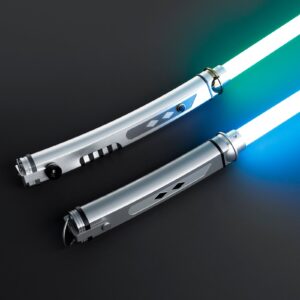
Ahsoka Tano Lightsaber — Xenopixel V3 / Proffie 2.2 Dual White Blade Replica Set | ISABER
ISABER's Ahsoka Tano replica: dual electroplated hilts with white Neopixel blades. Full-size main hand + shoto off-hand. 7/8-inch blade diameter. Available i...
Frequently Asked Questions
Q1: What does a white lightsaber mean?
A: It records a specific act rather than a rank. Canon gives a stated meaning to only two colours — red, which records a crystal being forced to serve a new owner, and white, which records that force being undone. White is the only colour that cannot be reached from a fresh crystal at all, because it requires a crystal that was broken first and then repaired. The neutrality reading attached to it describes the one character who carried one rather than a rule.
Q2: Why is a white lightsaber so rare?
A: Because the technique that produces it is described as rare and difficult, and because it needs a specific starting material. A crystal has to be taken from a Jedi, bled into red, and then purified — three separate conditions, and the middle one requires a dark side user to have done something first. Canon names exactly one wielder, which makes white the least represented colour in the spectrum.
Q3: How do you get a white lightsaber?
A: In canon terms, you obtain a bled crystal — usually by taking one from a dark side user’s weapon — and then meditate with it until it realigns to the light side. The procedure is described as requiring genuine empathy for whoever broke the crystal, not superior strength; overpowering it is the wrong approach, since overpowering is what damaged it. The purified crystal comes out white.
Q4: Who else has a white lightsaber besides Ahsoka Tano?
A: In current canon, no one. She is the only recorded wielder of a purified white blade. White blades do appear elsewhere, but from different sources: an order of knights in the old Expanded Universe used white as a unity symbol with synthetic crystals, and a Republic-era game offered a rare white saber with a dark core as an expensive vendor item. Those readings do not carry the purification meaning.
Q5: Did Ahsoka Tano’s blades used to be a different colour?
A: Yes, twice. She carried green while still training inside the Order, then blue during the final stretch of the Clone Wars, and white afterwards. The white blades were built from two crystals she took out of a fallen Inquisitor’s weapon and purified. The sequence is why white reads as a milestone rather than a starting point — each colour maps to a different phase, and only the last one required something to have been broken first.
Q6: Is a white lightsaber stronger than other colours?
A: Nothing in canon ties a blade’s performance to its colour, and white is no exception. What is different about it is the history the crystal carries, not its output. The colour is described as reflecting the crystal used to build the saber and the state that crystal is in — not a power level. The reading of white as more advanced is fan interpretation rather than a documented rule.
Q7: Can a Sith have a white lightsaber?
A: Nothing in canon restricts white to one side of the Force, but the mechanism makes it unlikely in practice. Producing white requires a light side user to realign a bled crystal through meditation and empathy for the person who broke it. That is a description of the light side’s method rather than the dark side’s, so the operation itself is what rules the case out rather than a prohibition.
Q8: Does a purified crystal go back to its original colour?
A: No, and that is the detail most retellings get wrong. A crystal that has been bled does not retain its old blue or green underneath the red. That colour is destroyed by the bleeding rather than hidden by it, so when the crystal is purified it does not revert — it comes out white. White has no before-and-after in the way the other colours do.
Q9: Why does a white blade draw more power than other colours?
A: Because it is the only named colour that runs all three diodes simultaneously. Red or blue can be built around a single channel, and most mixed colours run two at unequal levels. White runs red, green, and blue together, and a manufacturer profile describes it as roughly a third of the drive on each die. That makes it the heaviest continuous load of any colour, and the flash effect is the instantaneous peak the build has to survive.
Q10: Why does a white blade drift yellow when the battery drops?
A: Because the three channels fall unevenly as voltage sags. A white blade is a balance between red, green, and blue at set levels, and when the cell drops the channels do not lose output at the same rate. The balance shifts, so the blade reads warm before it reads dim. It is the same reason a white blade often needs red tuned below the other two to look neutral when the battery is full.