
Most lightsaber colour lists quietly merge three different sources — the colours that appeared on screen, the system invented for the novels and roleplaying books, and the extra palette added by video games — and then present the blend as canon.
Only two colours have a creation rule written into canon at all. Everything else is convention, and some of it belongs to sources that no longer count.
Ask what a blade colour means and the answer changes depending on which list the person is reading from. The screen gave eight colours.
The older novels gave a working system that catalogued Jedi by role, and retired it. The games added a short palette of their own — and all three get quoted as if they were one thing.
This page separates them. It sets out the screen set, the rule that governs only two of those colours, the role-based system that is not canon, and the palette that only exists in games.
The point is not to pick a winner. It is to say which list each answer comes from, because that is the disagreement behind most of the arguments.
What’s on This Page
- Why the Colour Lists Disagree
- The Screen Set: Eight Colours
- The Rule Only Two Colours Have
- The Role System That Is Not Canon
- The Palette That Only Exists in Games
- Why the Meaning Charts Contradict Each Other
- Meaning and the Hardware Setting Are Different Questions
- Frequently Asked Questions
Why the Colour Lists Disagree
There are three separate sources of lightsaber colour: the films and series, the older novels and sourcebooks, and the video games. They were written at different times for different purposes, they do not agree, and most published lists splice at least two of them without saying so.
Start with the timeline, because it explains the split. The screen material came first and used a small set of colours for reasons that were often practical rather than symbolic.
The novels and roleplaying sourcebooks then built a whole system on top, cataloguing Jedi by the colour of their blade. The games arrived later and added colours that served a menu, not a story.
The novel-era system was later set aside, which is the fault line that gets missed. When the older stories were reclassified, the role-based colour system went with them, even though the habit of quoting it survived.
The result is a topic where a correct-sounding answer can be sourced entirely to material that is no longer treated as official, and nobody flags it.
The three lists side by side. A list that blends a row from each column is where most confusion starts.
The Screen Set: Eight Colours
The screen material has shown eight blade colours: blue, green, red, purple, yellow, orange, white, and the black of the Darksaber. Of those, only red and white are given a stated reason for existing. The rest appeared for reasons that were practical, personal, or simply visual.
That is a smaller set than the colour charts suggest, and the reasons behind it are more mundane than the symbolism attached to them.
The single clearest in-universe rule is the one for red, and it is the only colour with an explicit creation process written into the current material.
| Colour | Where it appears | Why it exists (as stated) | Famous bearer |
|---|---|---|---|
| Blue | Films and series, common | No stated rule; the order’s default by convention | Obi-Wan, Anakin |
| Green | Films and series, common | No stated rule; on film, chosen so a blade read against a bright sky | Yoda, Qui-Gon |
| Red | Films and series, common | Stated: a crystal is forced to change colour | Vader, Maul |
| Purple | Films, one bearer | A personal request from the actor who carried it | Mace Windu |
| Yellow | Films and series | Tied to one role, not a personality | Temple guards, Rey |
| Orange | Series, one era | Left deliberately open; not the pure red of the Sith | Baylan Skoll, Shin Hati |
| White | Series, one bearer | Stated: a corrupted crystal is restored | Ahsoka Tano |
| Black | Series, one weapon | Unique object; not a colour mix at all | The Darksaber |
Two of these eight have a mechanism and six do not. That imbalance is the whole reason the “meaning” of a colour is such a slippery question: for most of the set, there is nothing in the material to mean.
The Rule Only Two Colours Have
Red and white are the only colours with a creation rule stated in the material. A crystal is forced to change colour to make red; a crystal that was forced is restored to make white. Both are treatments applied to a crystal, not properties a crystal is born with.
Everything else is either a default, a personal choice, or a visual decision, which is why the honest answer to “what does blue mean” is thinner than the charts imply.
What this buys is a clean line. If a claim about a colour’s meaning involves a process — forcing, restoring, changing — it is talking about red or white. If it involves a personality trait, it is talking about a convention somebody else invented.
The practical test for any colour claim: does the material show the colour being made, or does it only show the colour being carried? For six of the eight screen colours, it only shows it being carried.
Read down that column and the pattern is plain. The colours with the most elaborate “meanings” online are usually the ones with the least said about them on screen.
The Role System That Is Not Canon
The familiar idea that blue is the combat Jedi, green is the scholar, and yellow is the sentinel comes from the novels and roleplaying sourcebooks, not from the screen.
It was a working catalogue of Jedi roles, and the material that set it aside took the system with it — which is why it is still quoted despite no longer applying.
This is the single most-quoted “meaning” and the one that has been carried over the longest, so it deserves a plain statement: it is a role catalogue, and it belonged to the older line.
A role catalogue is a different thing from a meaning. It does not say a person is calm because their blade is green; it says a green blade marks a job. The two get conflated constantly.
The same sourcebooks added colours that never reached the screen at all, silver and bronze among them, carried by minor characters in the older stories.
| Claim | Where it really comes from | Status |
|---|---|---|
| Blue = fighter, green = scholar, yellow = sentinel | The novels and roleplaying sourcebooks | A role catalogue, set aside |
| Silver and bronze blades | The older stories only | Never reached the screen |
| Red = forced crystal | Screen material | Stated rule, still current |
| White = restored crystal | Screen material | Stated rule, still current |
The role system is not wrong to describe, and a lot of people grew up with it. It is wrong only when it is presented as the current rule, which is what most colour charts do.
The Palette That Only Exists in Games
Cyan, indigo, and magenta reached the blade through a video game menu, not through a story. They were added as selectable options, they have almost no screen history, and the “meanings” attached to them are associative fill rather than anything the material states.
This is a separate list from the first two, and it is the newest, which is why it keeps getting folded into the canon set by mistake.
A game adds a colour to serve a menu, not a plot. The options exist so a player has choices, and a choice needs a distinct look more than it needs a reason.
One colour has since made the jump. Orange sat in the game palette until the series put it on screen in the hands of a character who is neither Jedi nor Sith.
That is the one case of a game colour becoming a screen colour rather than the other way round.
| Colour | How it arrived | Screen history | Stated meaning |
|---|---|---|---|
| Cyan | A game menu option | Nearly none | None stated |
| Indigo | A game menu option | One comic appearance | None stated |
| Magenta | A game menu option | None | None stated |
| Orange | Game palette, then screen | Yes, in a series | Left deliberately open |
The tell is the phrasing. When a chart says a magenta blade “represents charm” but cannot name a single character who ever carried one, it is describing an invented reading, not a canon fact.
Why the Meaning Charts Contradict Each Other
Two colour charts disagree because each one draws from a different list, and neither names the list. A chart built on the novel-era roles will contradict a chart built on the game palette, and both will contradict the screen material, which says very little about meaning at all.
Once the three sources are separated, the contradictions stop being contradictions and become a labelling problem.
The most common splice is role plus game. A chart takes the blue-is-the-fighter idea from the sourcebooks, adds the game palette as if it were canon, and presents the whole thing as one system.
The second common splice adds the screen colours without noticing that the screen never gave them the meanings the chart is asserting.
A useful question for any chart is simply: which list is this row from? Most rows will answer themselves, and the ones that will not are the ones worth mistrusting.
Meaning and the Hardware Setting Are Different Questions
On a modern blade, colour is a setting, not a destiny. A colour-changing saber can run any colour in its range regardless of what any list says that colour means.
So “what colour suits me” is a hardware question and a meaning question at the same time — and they do not have to agree.
This matters because the two questions get answered as if they were one. They are not.
A colour-changeable saber separates the two completely. The meaning attached to a colour is a story; the colour on the blade is a value you select. You can carry a colour for the character, or for the look, or for neither.
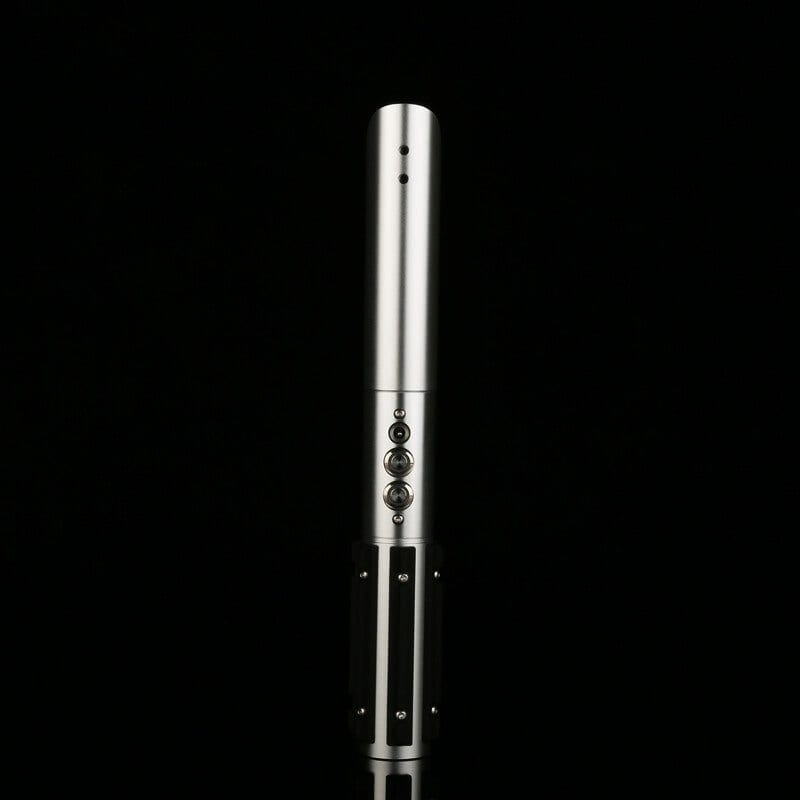
A fixed single-colour build is the only case where the two are locked together, because the colour is a property of the hardware you bought rather than a setting you change.
| Build | Can the colour change? | What that means for the question |
|---|---|---|
| Fixed single-colour | No | The colour is a purchase decision, made once |
| Colour-changeable | Yes, from a preset set | Meaning and setting are separate; you can change either alone |
| Fully programmable | Yes, per blade style | Different stored colours can each carry their own story at once |
So the honest answer when someone asks what colour a blade “should” be is that the meaning is a reading and the colour is a setting, and only the second one is fixed by anything real.
Frequently Asked Questions
Q1: How many lightsaber colours are there?
A: It depends on which list you count. The screen material has shown eight: blue, green, red, purple, yellow, orange, white, and the black of the Darksaber. The games added cyan, indigo, and magenta as menu options. Counting them all as one set is where most inflated numbers come from.
Q2: Which lightsaber colours are actually canon?
A: The eight that have appeared on screen. Of those, only red and white are given a stated creation rule; the others appear without an explanation. Cyan, indigo, and magenta arrived through a game menu, so calling them canon is a claim with no screen history behind it.
Q3: What do the lightsaber colours mean?
A: Less than the charts suggest. Red and white have a stated mechanism. Yellow is tied to a role. Blue, green and purple appear without a stated rule. The elaborate personality meanings that circulate come from the older sourcebooks, which were set aside, and from game lore.
Q4: Why is there no official meaning for blue and green?
A: Because the screen never gave them one. Blue is the order’s default by convention and green was chosen on film so the blade would read against a bright sky. The role meanings people remember were added by the sourcebooks, not the films.
Q5: What do cyan, indigo, and magenta mean?
A: Nothing the material states. All three arrived as selectable options in a video game, with almost no screen history, and the meanings attached to them are associative readings rather than canon. If a chart assigns them a meaning but cannot name a character who carried one, that tells you what to mistrust.
Q6: Is orange a canon colour?
A: It is now, and it is the one colour that moved the other direction. Orange began as a game option before a series put it on screen in the hands of a character who is neither Jedi nor Sith.
Its meaning is left deliberately open, which is itself the point.
Q7: Why do different colour charts disagree with each other?
A: Because each one draws from a different source. A chart built on the novel-era roles contradicts one built on the game palette, and both contradict the screen material, which says very little. Once you ask which list each row comes from, most of the disagreement resolves.
Q8: Is the Guardian, Consular, Sentinel system real?
A: It was, in the novels and roleplaying sourcebooks, where it catalogued Jedi by the role their blade colour marked. That material was set aside, and the system went with it. Describing it as history is fine; presenting it as the current rule is not.
Q9: What is the rarest lightsaber colour?
A: In canon, the colours with a single bearer are the rarest — purple and white each belong to essentially one character on screen, and the black blade is a single unique weapon rather than a colour.
Among the game palette, magenta has no named bearer at all, which is a different kind of rarity.
Q10: Can I choose any colour I want on a modern saber?
A: On a colour-changeable saber, yes — within its range, through presets or an app, and on programmable boards you can store different colours for different blade styles.
A fixed single-colour build is the only case where the colour is locked, because it is a property of the hardware rather than a setting.
Related reading on this site: the hardware side of blade colour, how a kyber crystal sets the hue, and the single-colour references for blue, green, yellow and white.