The Inquisitor lightsaber is a double-bladed weapon with a ring-shaped emitter that spins the blades in a circle while the hilt stays still — built for the Inquisitorius, the Empire’s order of dark side Jedi hunters, and issued to every member from the Grand Inquisitor down.
It is one weapon with one design and a whole hierarchy of owners. The Grand Inquisitor carried a version whose ring could separate from the handgrip, so the blades turned with almost no effort. The Eighth Brother’s could unfold into a wheel of razor blades.
All of them shared the same weakness, and that weakness killed more Inquisitors than any Jedi did.
This page follows the design across the entire Imperial era — where it came from, how it works, why the Inquisitorius kept using a weapon with a fatal flaw, and how it ended.
What’s on This Page
- What the Weapon Actually Is — the short answer
- The Inquisitorius: What It Was For
- The Grand Inquisitor and the Temple Guard Origin
- The Design: A Ring That Spins, a Hilt That Doesn’t
- The Fatal Flaw
- The Ranks and the Members
- Every Generation of the Weapon
- Why the Inquisitorius Ended
- Frequently Asked Questions
What the Weapon Actually Is
The Inquisitor lightsaber is a double-bladed red lightsaber whose ring-shaped emitter spins the blades around a stationary hilt, and it can be used as a single blade or folded out into a full disc.
It appeared first in Star Wars Rebels in 2014, and later in live action in Obi-Wan Kenobi, where the prop team adapted the animated design into a physical weapon.
Every member of the Inquisitorius carried one. It was standard issue the way a lightsaber was standard issue for a Jedi Knight.
The blades are red, and the crystals came from the Jedi Temple — taken after the Purge and bled to crimson by the people who used to guard them.
The Inquisitorius: What It Was For
The Inquisitorius was the Empire’s order of dark side Jedi hunters, established in 19 BBY — the same year the Clone Wars ended — and placed under Darth Vader’s direct command.
Order 66 killed most of the Jedi Order in a night. It did not kill all of them, and the survivors scattered across the galaxy with no way to find one another.
The Inquisitorius existed to finish the job. Its members hunted Jedi who had escaped the Purge, and they were good at it.
Palpatine had been building toward this before the Empire existed. In The Clone Wars he ran an operation to condition Force-sensitive children into dark side operatives on Mustafar, and he kept records on Jedi who showed aggressive or selfish tendencies.
The timing mattered. Because the Inquisitors were former Jedi, they had to be recruited before the survivors of the Purge went to ground and became impossible to find.
They were supported by Purge Troopers, soldiers dedicated to the Inquisition and specialized in fighting Force users.
The Grand Inquisitor and the Temple Guard Origin
The Grand Inquisitor was a Pau’an and a former Jedi Temple Guard — the first recruit to the Inquisitorius program, approached directly by Palpatine after Order 66 and lured with the promise of full access to the Jedi Archive.
That origin explains the weapon. The Jedi Temple Guard used double-bladed lightsabers and lightsaber pikes, and the Inquisitor lightsaber is the same idea turned to the opposite purpose.
He does not have a name the audience is given. He is the Grand Inquisitor, the highest-ranking member of the order, and he still answered to Vader.
The series creator confirmed that he had appeared earlier, in The Clone Wars, as one of the Temple Guards escorting Anakin Skywalker when Barriss Offee was arrested — so the character was on screen as a Jedi before he was ever shown as an Inquisitor.
One account of his fall says he turned after watching the Jedi Order falsely accuse and nearly exile Ahsoka Tano. It is one explanation among several, and the series never states the cause outright.
He was the main antagonist of Rebels season one, hunting Kanan Jarrus and Ezra Bridger. When Kanan finally defeated him, he killed himself rather than accept whatever punishment Vader had waiting.
The symmetry is the point. A man who spent his life guarding the Temple spent his death hunting the people who used to be his colleagues, using a weapon shaped like the one he used to carry.
The Design: A Ring That Spins, a Hilt That Doesn’t
In the Inquisitor design, the emitters spin along tracks inside a ring while the hilt stays stationary — which means the blades rotate fast without the wielder spending any effort on turning them.
That is the difference between this weapon and an ordinary double-bladed saber. A regular staff is only as fast as the person swinging it.
The ring design gives the appearance of speed the user does not have to generate. It is a machine that turns for them.
It is also only marginally larger than a standard single-emitter lightsaber, unlike Darth Maul’s considerably bulkier staff.
The Grand Inquisitor’s version took this furthest. Its ringed emitter could partially detach from the central cylindrical handgrip, letting the blades turn with almost nothing from the user.
Force-sensitives could also fly with it, combining micro repulsorlifts with the propeller motion of the spinning blades. In practice this was used to escape a fight rather than to win one.
The Eighth Brother’s version had a rotating wheel of sharp razor blades that could unfold from the weapon. Ezra Bridger nearly lost a hand to it.
The handgrip could also be removed from the ring entirely, leaving the ring as a disc that could be thrown. It is a weapon built around the assumption that the holder will not have to fight anyone who understands it.
The Fatal Flaw
The ring is also the weapon’s weakness: cutting through it destroys the saber instantly, and the hilt was made of an alloy that a lightsaber blade cuts straight through.
Everything the spinning design buys in intimidation it pays back in exposed surface area. The ring presents a large, obvious target for anyone who understands what it does.
Cut the ring, or sever the emitter, and the weapon separates into pieces. The Inquisitor is left holding half a hilt in the middle of a duel.
The list of people who exploited it is long. Vader severed the Grand Inquisitor’s weapon in their first confrontation. Kanan Jarrus cleaved it in two aboard the Sovereign, and the fragments were destroyed in a reactor explosion shortly before the Inquisitor’s death.
The Fifth Brother died in the Rebels season two finale when damaged emitters caused his hilt to come apart mid-flight. Both he and the Eighth Brother were killed on Malachor after their opponents targeted and damaged the emitters.
That is the strange part of the whole design. The Inquisitorius was an organization built to hunt people trained to destroy weapons exactly like this one.
The creator of Rebels had a name for what the weapon actually was: a cheat mode lightsaber. It imitated what Darth Maul could do without requiring Maul’s training, which let an Inquisitor credibly threaten a master-and-apprentice pair.
The flaw and the purpose are the same fact. A weapon that substitutes for skill is only ever as reliable as the people it is pointed at.
The Ranks and the Members
Inquisitors below the Grand Inquisitor used titles of Brother or Sister followed by a number, competed hard for higher ranks, and moved up whenever a vacancy opened.
The numbering was a ranking system as much as a name. When an Inquisitor died, the ones below them competed to claim the rank left behind.
| Title | Known identity | Where they appear |
|---|---|---|
| Grand Inquisitor | Pau’an, former Jedi Temple Guard; name unknown | Rebels, Obi-Wan Kenobi, Darth Vader comics |
| Second Sister | Trilla Suduri, former Padawan of Cere Junda | Jedi: Fallen Order |
| Third Sister | Reva Sevander | Obi-Wan Kenobi |
| Fifth Brother | Unnamed | Rebels |
| Sixth Brother | Bil Valen | Darth Vader comics |
| Seventh Sister | Unnamed | Rebels |
| Eighth Brother | Unnamed; razor-wheel variant of the saber | Rebels |
| Ninth Sister | Masana Tide | Jedi: Fallen Order, Jedi: Survivor |
| Tenth Brother | Prosset Dibs | Darth Vader comics |
| Thirteenth Sister | Iskat Akaris | Darth Vader comics |
| Fourth Sister | Unnamed | Obi-Wan Kenobi |
| Marrok | A former Inquisitor, later a mercenary | Ahsoka |
The total number is not settled. One accounting puts it at twelve. Another counts fifteen canon Inquisitors — twelve dead and three with fates unresolved. The Legends continuity, a separate timeline, has thirty-three known Inquisitors.
Every one of them was a former Jedi. That is what the order was built from — the people who had been trained by the institution they were now erasing.
Every Generation of the Weapon
The saber stayed fundamentally the same across the whole Imperial era, with the variations coming in how the ring was integrated and what extra features each wielder added.
The Spinning Blade Across the Imperial Era
The Inquisitor saber was designed once and then adjusted per wielder. The ring always spun, the hilt was never lightsaber-resistant, and that combination ended more of its owners than it saved.
Why the Inquisitorius Ended
By the time of the Battle of Yavin, the Inquisitorius had become redundant — there were too few Jedi left to hunt — and the order ceased to exist.
That is the shape of the whole project. It was built as a temporary instrument for a specific job, and it ran out of work.
The weapon ended with the organization. No successor order picked up the spinning design, and no later dark side faction adopted it.
What survives is the design itself, which is why custom saber makers still produce it — the ring-and-spinner mechanism is one of the few lightsaber types that cannot be replicated with an ordinary hilt.
Vader’s role in training them is worth noting for what it says about the weapon. He pushed his Inquisitors through aggressive dark side combat and, on some occasions, severed their limbs to teach them about pain and loss.
They were hunters trained by a hunter, issued a weapon with a hole in it, and sent after people who knew exactly where to cut.
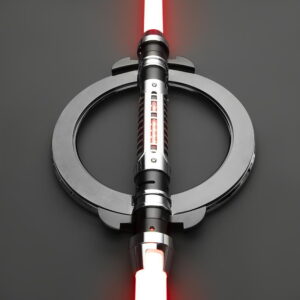
Inquisitor Lightsaber
Character Lightsabers / Replica Lightsabers
Frequently Asked Questions
Q1: What is an Inquisitor lightsaber called?
A: It is formally known as a double-bladed spinning lightsaber, and also referred to as an Inquisitor lightsaber or Inquisitorius lightsaber. The name refers to the ring-shaped emitter that spins the blades around a stationary hilt.
Q2: Why do Inquisitor lightsabers spin?
A: Primarily for intimidation. The spinning ring lets the blades rotate fast without the wielder spending effort on turning them, which is meant to frighten opponents and catch them off balance. It was most effective against the younglings and partially trained Jedi who survived Order 66.
Q3: What is the Inquisitor lightsaber’s weakness?
A: The ring. Cutting through it, or severing the emitter, destroys the weapon instantly and splits it in two. The hilt was made of an alloy that a lightsaber blade cuts straight through, so the ring was both the weapon’s signature feature and its largest exposed target.
Q4: Was the Grand Inquisitor a Jedi?
A: Yes. The Grand Inquisitor was a Pau’an and a former Jedi Temple Guard. He appeared in The Clone Wars as one of the guards escorting Anakin Skywalker when Barriss Offee was arrested, and he was the first recruit to the Inquisitorius program after Order 66.
Q5: How many Inquisitors are there?
A: Sources disagree. One accounting puts the total at twelve. Another counts fifteen canon Inquisitors, twelve dead and three with unresolved fates. The Legends continuity, a separate timeline, has thirty-three known Inquisitors.
Q6: Why did Inquisitors use a weapon with a fatal flaw?
A: Because it worked on the people they were hunting. Most Jedi who survived Order 66 were younglings or partially trained, and a black-clad figure with a spinning double-bladed saber was enough to terrify them. For that target, intimidation was worth more than durability.
Q7: When was the Inquisitorius created?
A: In 19 BBY, the same year the Clone Wars ended and the Republic became the Empire. It was placed under Darth Vader’s direct command. Palpatine’s preparations went back further, including an operation in The Clone Wars to condition Force-sensitive children on Mustafar.
Q8: What happened to the Inquisitorius?
A: By the time of the Battle of Yavin, it had become redundant because so few Jedi remained. The order ceased to exist, and no later dark side faction adopted the spinning lightsaber design.
Q9: Can the Inquisitor lightsaber fly?
A: Yes, but only for Force-sensitives. The weapon combined micro repulsorlifts with the propeller motion of the spinning blades to lift the user. In practice it was used to escape combat rather than to fight from the air.