
The Star Wars gift that lands on an adult fan who already owns a lightsaber is almost never another object — it’s the equipment around the object: a mount that holds the hilt, a spare blade, a charger for the cell inside it, a plug for the socket left open when the blade comes out. Those parts run under $30, they can’t duplicate what the fan already has, and the fan almost never buys them for himself.
Open any gift guide for this fandom and you get the same shape. Sixty-odd items, sorted by what they are: figures here, brick sets there, a page of books, a page of plush.
That shape is fine for browsing. It’s the wrong shape for buying, because the person typing the search is usually not the person receiving the gift, and has no idea what’s already on the shelf.
So this page sorts by the one thing you can actually answer: what does this person already own?
What’s on This Page
- Why a Category List Doesn’t Help You Choose
- The One Question That Splits the Whole Category
- If They Already Own One: Buy the Support System
- The Budget Ladder
- The $200 Gift That Doesn’t Become Clutter
- If They Don’t Own One Yet
- What Not to Buy
- FAQ
Why a Category List Doesn’t Help You Choose
A category list fails a buyer for one reason: the buyer can’t see the collection, so the failure modes that matter are ones no product list mentions — a duplicate, the wrong side of the fandom, or an object with nowhere to go.
Three things go wrong with a fandom gift. None of them are about quality, and none of them show up in a buying guide.
Duplicate. The fan already bought the obvious thing, usually years ago. Big-media lists lead with the same handful of items every season, which means the most-promoted gift in the category is also the one most likely to be the second copy.
Wrong side. This fandom has eras, and fans are not evenly distributed across them. A gift that hard-codes one character is a hit or a miss depending on a preference you may not know.
Nowhere to go. Adult fans run out of shelf, not out of affection. Any gift that needs wall or desk space is competing with what’s already there.
There’s a fourth problem, and it’s the one that actually decides most purchases: the fan is better at this than you are. They know what they want, and they’ve already decided not to buy it — usually because it’s a lot of money for a want.
Which is why the most reliable gift in the category is the thing the fan keeps deferring. Not the object. The equipment around it.
The One Question That Splits the Whole Category
Ask whether the person already owns a lightsaber. That single answer sorts the whole category into two gifts with almost no overlap: equipment for a hilt they own, or the hilt itself.
If the answer is yes, everything else on this page applies. A saber owner has a socket, a cell, a hilt and a blade — four parts, each of which wears out, runs down, or has nowhere to sit.
If the answer is no, the accessory tier is the wrong gift entirely. A blade plug with no saber to plug is a small metal disc in a box.
And if the person isn’t really a weapon person at all, that’s worth knowing too. A lot of people like this franchise and have never wanted a sword.
Three outcomes, three different shopping trips. Only the first one is cheap.
If They Already Own One: Buy the Support System
A saber owner spends his money on hilts and blades and almost nothing on the parts around them, which makes the support tier the highest value per dollar in the hobby — and the only class of gift that cannot be a duplicate.
Here’s the thing that makes this tier work. Fans buy the fun parts themselves. The unglamorous parts get deferred indefinitely, because a fan with $200 will buy another hilt, not a stand.
So a stand, a case, a charger, a plug — these are all things the recipient wants, has priced, and hasn’t bought. That is the ideal shape for a gift.
It also solves the duplicate problem structurally. You can’t buy a second wall mount for a hilt that has one, because you don’t know it has one — but if he does, nobody minds a second mounting point. Duplication is harmless in this tier in a way it never is with objects.
| The problem he actually has | The part that solves it | Typical cost | Why it lands |
|---|---|---|---|
| Blade out, socket left open and dusty | Blade plug | Under $25 | He’s seen the bare socket. It bugs him. |
| Cell dies mid-session, no spare | 18650 cell plus USB-C charger | Under $25 | Every hilt runs on one. They all die. |
| Hilt leaning against something on a desk | Acrylic hilt stand | About $20 | Cheapest way to make a hilt look intentional. |
| Collection outgrowing the available surface | Wall mount | Under $30 | Uses wall instead of desk. Zero new footprint. |
| Two hilts, one staff wanted | Threaded coupler | Under $25 | Turns two purchases into a third product. |
| Hilt on a belt at a con | Belt clip wheel | Under $20 | Cosplay tier, weapon tier price. |
| Blade worn, bent, or the wrong length | Replacement blade | $30–$35 | Consumable. Every duellist needs spares. |
| Transport to a meetup or a con | Padded bag or hard case | $20–$140 | Nobody buys the bag until something breaks. |
Two of those rows deserve a note, because they’re the ones buyers get wrong.
The blade plug is the single most under-bought part in the hobby. When the blade comes out, the emitter is an open socket with a lens and exposed pins inside. Dust gets in, and the light spills out the wrong end. The plug is a metal or plastic disc that closes it. Solid ones block the light path, vented ones let some through. It costs less than lunch.
The charger is not optional equipment. Most hilts run on a removable 18650 cell, and cells are consumable. A spare cell plus a proper charger means a session never ends early. The failure mode is specific: capped cells with integrated protection are longer than bare cells, and some hilts won’t close on them.
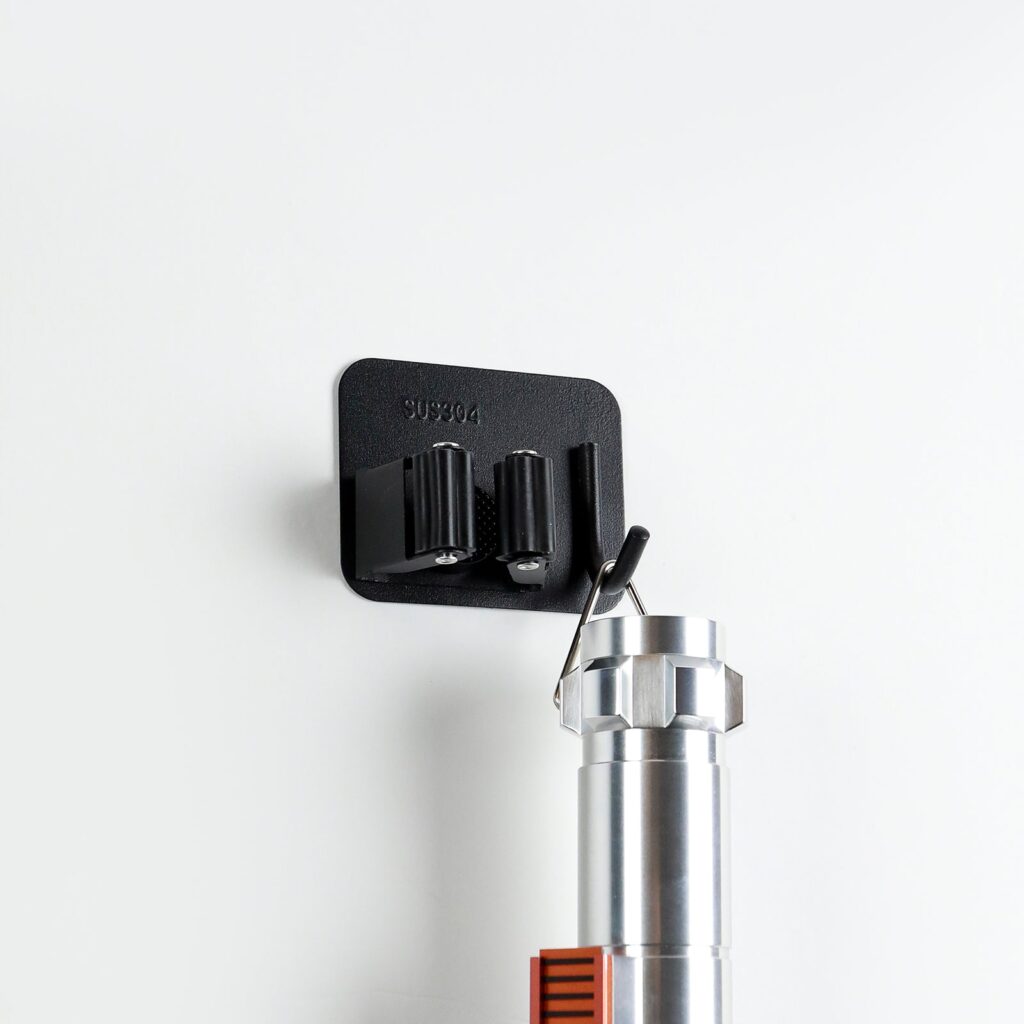
ISABER Wall Hung Saber Mount
No-drill wall mount that holds your saber hilt vertically - clamp arms with adjustment knobs, metal support hook, and 3M adhesive backing.
The Budget Ladder
Four price bands cover the useful range, and the only jump that changes the gift is at $70: below it you’re buying parts, above it you’re buying the object. Nothing between $30 and $70 is a better present than something at $25.
This is worth stating plainly because gift budgets and gift categories tend to get matched wrongly. A $50 budget does not buy a worse version of a $200 gift. It buys an entirely different and often better one.
| Band | What it buys | Risk |
|---|---|---|
| Under $30 | Plug, charger, belt wheel, acrylic stand, canvas bag | Reads small in the box. Wrap it well. |
| $30–$70 | Replacement blade, heavier storage bag, a cosplay layer | Needs to match a socket or a blade length. |
| $70–$210 | Hard case, tripod stand, levitating display | Needs floor or wall clearance. |
| $210 and up | A complete hilt, or a prop-grade replica | Duplicate risk, and preference risk. |
Notice that the under-$30 band has the most entries. That’s not an accident of pricing. It’s because the useful parts are genuinely cheap and the expensive items are the ones he already owns.
If you have $50 to spend, two $25 parts beat one $50 part. They solve two problems instead of one, and the recipient opens two things.
The $200 Gift That Doesn’t Become Clutter
Around $200 there is a class of gift that solves the fandom-clutter problem structurally: a display that holds the collection instead of adding to it. It replaces shelf space rather than consuming it.
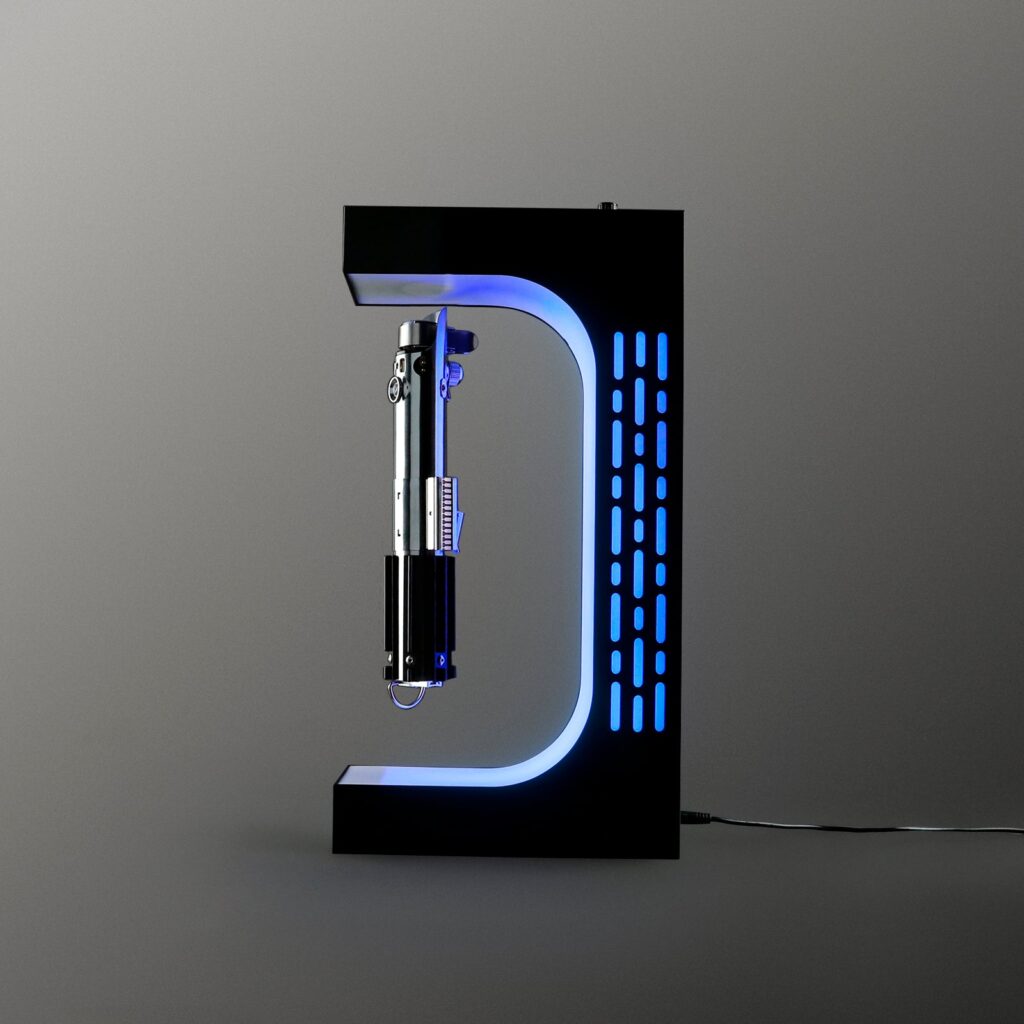
The obvious example is magnetic levitation. A hilt floats above a base, held by a field, with the base carrying the weight and turning it slowly.
It works as a gift for a specific reason. The recipient has no polite way to not display it, and displaying it is exactly what he wanted to do anyway. There’s no “where do I put this” conversation.
There’s one mechanical detail worth knowing before you buy one, because it’s the thing that makes the whole idea possible. A hilt is aluminium, and no magnet grips aluminium. So the stand doesn’t grip the hilt. It ships with a magnetic insert that seats into the emitter end the way a blade plug does, and the insert is what floats. That also means the hilt has to accept a plug-style insert — an empty or removable-core hilt is the safe case.
The same logic applies lower down the ladder: a tripod stand and a wall mount are the same idea at a third of the cost. All three are gifts that take the collection seriously.
One caution, because it’s the failure mode for this whole tier. Choose the mount by where the hilt is going, not by how impressive the base looks.
A levitating display needs a flat, level surface and a live outlet, because the field runs on mains power — it isn’t a passive stand. It also has a floating clearance of about 14 inches, which caps how long a hilt it will hold.
A wall mount is the opposite trade. It takes the hilt off the desk entirely, and it doesn’t need a drill: the backing is adhesive, so it goes onto a painted wall without making a hole. That makes it the one in this tier you can give to someone in a rented flat.
ISABER Magnetic Levitation Lightsaber Display Stand
Electromagnetic display stand that suspends your saber hilt in mid-air with a smooth 360-degree rotation - no cradle, no visible support.
If They Don’t Own One Yet
For someone with no lightsaber, every accessory on this page is the wrong gift, because each one assumes a hilt it attaches to. The gift becomes the saber, and the decision becomes blade type and blade length.
The first fork is how the blade makes light. A baselit blade is a tube lit from the base by a single high-power LED. A pixel blade has a strip of individually addressed LEDs running its whole length, so it can do ignition travel, blade lock-up, and per-inch effects.
That difference decides price more than anything else, and the baselit versus pixel comparison covers it properly. The short version: a baselit hilt is the better first saber, and a pixel hilt is the one people end up buying second.
The second fork is length. Blades come in standard lengths around 28, 32 and 36 inches, and length is a body-proportion question rather than a taste question. The blade length reference has the numbers against height.
One thing to avoid: the collapsing toy tier is a different product for a different person. If the recipient is an adult fan, a toy saber reads as a joke gift. That tier is covered separately in the toy saber breakdown.
What Not to Buy
Four categories absorb most of the money spent on this fandom and return the least, and three of them are the first things a seasonal gift guide will suggest.
- A second entry-level saber. If he already owns a working hilt, a cheap one is a downgrade he’ll store and never mention.
- Anything pinned to one character. Unless you know which era he actually cares about, a fixed-character gift is a coin flip on a preference you can’t observe.
- Anything that needs wall space if you don’t know the room. Freestanding is the safer default when you can’t see the wall. An adhesive mount is more forgiving than a drilled one, but it still needs a smooth, clean surface.
- Novelty kitchenware. The mug, the ice tray, the chopsticks. They get used once, photographed once, and then live in a cupboard next to last year’s.
There’s a pattern in that list. Every item on it is an object that has to be displayed to be enjoyed, in a home that already has a display problem.
The gift that works is the one that solves the display problem, or the one that gets used without being displayed at all. A charger is not decorative. That’s its advantage.
Charger and Cell Basics
Blade Plug Fit Guide
How to Display a Saber
Couplers and Staff Builds
Baselit vs Pixel Blade
FAQ
Q1: What do you buy a Star Wars fan who already has everything?
A: Buy the equipment around what he owns rather than another object. A blade plug, a spare cell and charger, a wall mount or a display stand all cost under $30 and all solve a problem he has. None of them can duplicate something he already bought.
Q2: What’s a good gift for a fan who already owns a lightsaber?
A: Anything that attaches to the hilt: a blade plug for the open socket, a replacement blade, a padded bag, a belt clip, or a mount to display it on. These are the parts fans defer buying for themselves because they’d rather spend the money on another hilt.
Q3: How much should I spend on a Star Wars gift?
A: Under $30 is the most efficient band, because the useful accessories all sit there. $70 to $210 buys a display piece or a hard case. Above $210 you’re buying a saber itself, where duplicate and preference risk both appear.
Q4: What are good small Star Wars gifts?
A: Blade plugs, spare 18650 cells, a USB-C cell charger, a belt clip wheel and an acrylic hilt stand. All run roughly $19 to $25, all are parts rather than objects, and all get used on the first day instead of going into a drawer.
Q5: What’s a unique Star Wars gift?
A: A magnetic levitation display, where the hilt floats above a lit base held by a field. It runs around $200, and unlike most collector items it takes no shelf space — the display becomes the place the collection lives.
Q6: Is a lightsaber a good gift?
A: Yes, if the recipient doesn’t own one and actually wants a sword. It’s the wrong gift if he already has a working hilt, and it’s the wrong gift for someone who likes the films but has no interest in holding a replica prop.
Q7: What Star Wars gift should I avoid?
A: A second cheap saber for someone who owns a good one, anything hard-coded to a character you haven’t confirmed he likes, and novelty kitchenware. All three get stored rather than used, and two of them are the most-promoted gifts every season.
Q8: Do I need to know their favorite character?
A: No, if you buy in the equipment tier. Mounts, chargers, plugs, blades and bags fit every hilt regardless of which character it replicates, so you can buy well without knowing a single preference.
Q9: What’s a good Star Wars gift for a man?
A: The same equipment tier applies, with a lean toward the display side: a wall mount or a levitating display, since desks fill up faster than walls. Under $30 gets the mount; around $200 gets the display piece.
Q10: What’s a good Star Wars gift for a teenager?
A: A first saber rather than an accessory, because a teenager usually doesn’t own one yet. Length matters more than features at that age, and a baselit hilt at the entry price is the safer buy than a pixel blade.
Q11: Are expensive lightsabers worth it?
A: Above about $160 what you’re paying for is the blade type and the hilt’s internals, not the metal. A pixel blade at the top of that range behaves visibly differently from a baselit one. Below that price, the difference is mostly finish.
Q12: Can I buy a gift card instead?
A: You can, but it removes the one advantage this category has. The parts are cheap and specific, which means a $25 plug reads as a considered choice while a $25 gift card reads as an amount.
The short version: buy around the object, not another object. The fan has already decided which sword he wants. What he hasn’t decided is where it lives.