
A toy lightsaber is defined by one design constraint that shapes everything else about it: the blade has to collapse into the hilt.
That single requirement dictates the telescoping blade, the oversized handle, the compromised sound, and the material choices — which is why toys behave so differently from every other saber tier. It is not that they are built badly. They are built around a mechanism the others do not have.
Most comparisons of lightsaber tiers start with the hilt material and work outward. That misses the real dividing line. A toy saber is not a cheap replica of an adult saber; it is a different kind of object that happens to light up the same way.
This page is about the toy tier on its own terms: the collapsing blade that defines it, the handle size that follows from it, the sound that suffers because of it, the age ratings that govern it, and the one marketing claim that is worth checking before you buy.
What’s on This Page
- What Actually Makes a Saber a Toy
- The Collapsing Blade — and Why It Decides Everything
- Why the Handle Is Always Too Big
- Why the Sound Is Never Right
- The “Laser” Claim Worth Checking
- Age Ratings and What They Mean
- What the Toy Tier Is Good At
- Frequently Asked Questions
What Actually Makes a Saber a Toy
A saber is a toy when its blade collapses into the handle, because that single feature sets the material, the size, and the internals of everything else. Material alone does not decide it — a cheaper replica can also use plastic. The collapsing blade is the real dividing line.
That is why a toy and a replica can look similar at a glance and behave nothing alike. One is built to fold away and survive a child; the other is built to hold a fixed blade in line.
The design goal is different, not just the budget. A toy has to be put in a bag, swung against a sibling, dropped on pavement, and still work.
A fixed-blade saber has none of those requirements, which is exactly why it can spend its money on materials and electronics instead of on a mechanism.
Everything on this page follows from that one difference.
| Design goal | Toy saber | Fixed-blade saber |
|---|---|---|
| Blade | Collapses into the hilt | Fixed, usually replaceable |
| Hilt internals | Must hold the whole blade when folded | Holds electronics and a battery only |
| Handle size | Set by the folded blade | Set by the hand |
| Priority | Survive rough play | Looks and feels right |
Read the two columns as two different problems being solved. A toy solves “make it collapse and not break.” A fixed blade solves “make it look and feel correct.” Neither is doing the other’s job badly; they are not attempting it.
The Collapsing Blade — and Why It Decides Everything
A collapsing blade works as a set of nested tubes that telescope out of the hilt.
In the common spring-loaded version, a spring inside the handle launches the smallest tube outward, and it catches the next tube on the way, and that one catches the next, until the sections are extended. Retraction is usually done by pushing the blade back in by hand.
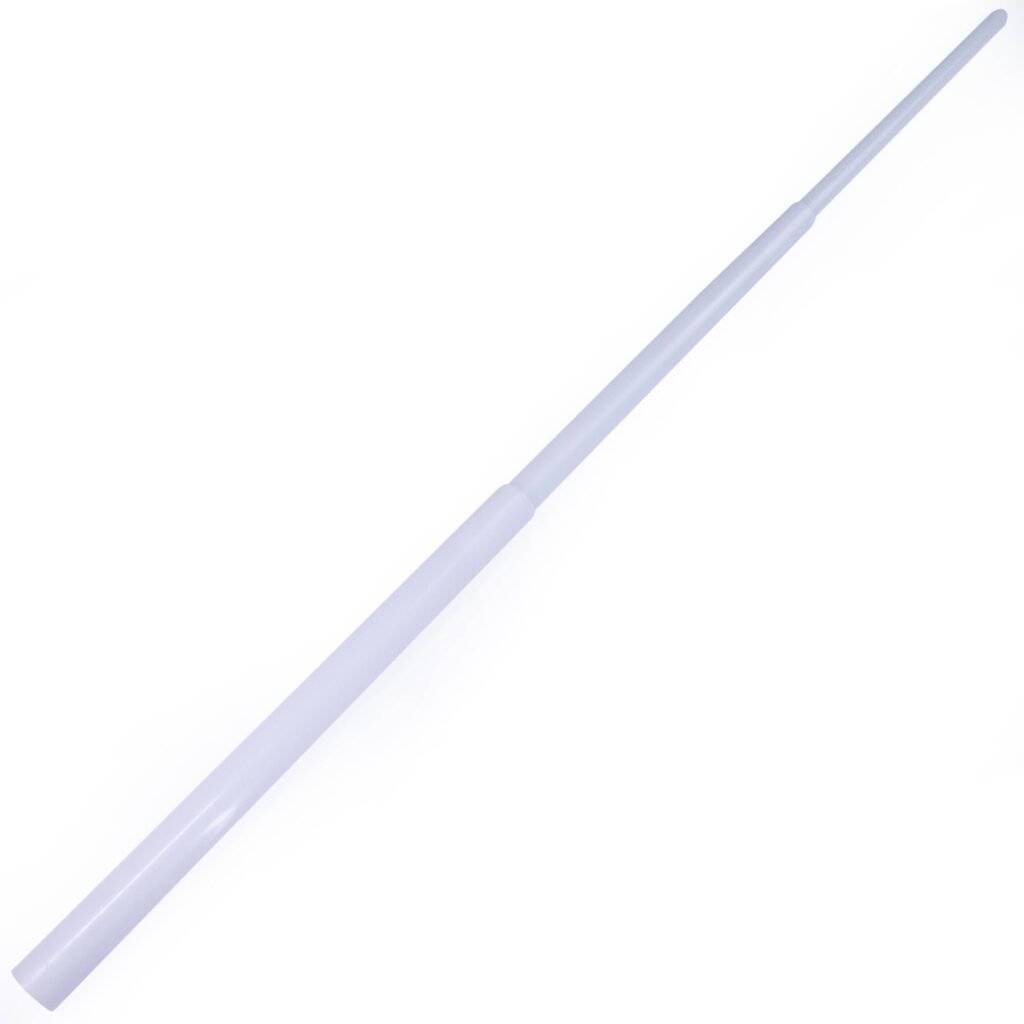
That cascade is worth picturing, because it explains the handle, the sound, and the wear pattern all at once.
The tubes stack inside each other like cups. Three or four sections nest down to the length of the shortest one, which is how a full-length blade becomes short enough to hide inside a handle.
The spring-loaded version is the cheapest and the most common. It also has a known weakness: the spring and the release button are the parts that fail first, and the extension is fast and forceful enough that it needs to be pointed away from faces.
A smaller number of toys use a motor instead of a spring, driving the sections out on a threaded shaft or a set of spools. That removes the launch, but it adds parts, and the parts have to fit in the same handle.
The mechanism, reduced to what matters. The blade has to fold short enough to fit the handle, so it is built from stacked sections — and each section is thinner than the one below it.
Two consequences follow straight from the drawing. The blade tapers because the sections nest, so the tip is the thinnest part and the first to bend.
The blade’s resting length is set by the folded stack, which is why a telescoping toy blade is usually shorter than a fixed blade of the same handle.
Why the Handle Is Always Too Big
A telescoping toy handle has to contain the entire folded blade, plus the spring or motor that extends it, plus the batteries, the light, the speaker, and the board.
Every one of those parts competes for the same space, and the handle grows to fit them — which is why a toy hilt is typically wider than a hand-hold needs.
The oversized handle is not a style choice. It is the folded blade’s storage box with electronics packed around it.
Start with the blade itself. A folded three or four-section blade is a solid stack of tube that has to sit somewhere when the saber is closed, and the only place for it is inside the handle.
Then add the mechanism. A spring, a latch, and a release button in the simplest version; a motor, a threaded shaft or spools, and a switch in the motorized version. Then the electronics: a battery, a small board, a speaker, and a motion sensor.
The result is a handle sized by the sum of those parts rather than by the hand that holds it, and it is the reason a small child’s toy often has a grip as thick as an adult’s palm.
Note which item is not on that list: the hand. The handle is not shaped to a grip because the grip is not what set its dimensions.
Why the Sound Is Never Right
A toy’s sound is wrong for three reasons that stack: the board triggers effects from a cheap motion sensor rather than from the blade’s position, the speaker is small and crammed beside the mechanism, and the mechanical release of the blade itself can be louder than the effect.
Those three are structural, not a matter of tuning — there is no version of a cheap toy that solves them all at once.
Each cause on its own would be noticeable. Together they are why toy audio reads as approximate rather than synced.
The trigger is the first problem. A quality saber tracks the blade; a toy tracks movement with a basic sensor, so the swing sound fires on a delay or on the wrong motion. Users commonly report sensors that react to the slightest movement and then lag behind it.
The speaker is the second. It has to share the handle with the mechanism and the battery, so it is small, and a small speaker in a cramped space produces thin audio no matter how good the recording is.
Then the mechanism adds noise of its own. A spring-loaded blade releases with a physical snap that can be as loud as the effect playing underneath it.
| Sound element | Toy tier | Why |
|---|---|---|
| Trigger | Basic motion sensor | Tracks movement, not blade position |
| Timing | Often delayed or over-sensitive | Cheap sensor, no smoothing |
| Output | Small, thin speaker | Crammed beside the mechanism |
| Interference | Mechanical release noise | The extension itself is audible |
The honest summary is that toy audio is designed to be recognizable, not accurate. It has to sound like a lightsaber across a room, which is a much lower bar than tracking a real blade through a swing.
The “Laser” Claim Worth Checking
Almost nothing sold as a “laser sword” is a laser. The blade is an LED behind diffusing material, which is why it is safe to look at from a distance but still bright enough that its instructions warn against pointing it at a face.
Genuine laser-based sabers do exist and are not toys at all.
The word is used as a synonym for “glowing” in most listings, which is harmless until it is read the other way.
An LED blade is an ordinary light source. It is bright, and a direct look into the tip at close range is uncomfortable, but it does not carry the concentrated energy of a laser beam.
A real laser-based “saber” is a different object: it uses actual laser diodes, and the safety guidance around it involves protective eyewear and warnings about eye injury and burns. That class of product is not a child’s toy and should not be bought as one.
| Product | Light source | Safety framing |
|---|---|---|
| Toy “laser” saber | LED behind diffuser | Do not point at eyes; otherwise a light-up toy |
| Fixed-blade saber | LED, in hilt or in blade | Same as above; brightness scales with tier |
| Actual laser saber | Real laser diodes | Protective eyewear; eye and burn hazard; not a toy |
Before buying anything marketed as a laser, check the light source. If it is an LED, the only guidance you need is the eye-safety line in the box. If it is a laser diode, it belongs in a different category entirely.
Age Ratings and What They Mean
Toy lightsaber age ratings cluster around three or four years and up, with a firm floor at three because the battery compartment and small parts are a choking risk.
Several models also carry an explicit “under adult supervision” line, and the ratings are about the toy, not the child’s interest in it.
The number on the box is a safety rating, which is a different thing from a suitability rating, and the two get read as one.
Three is the wall, not a suggestion. Below it, small removable parts — and the battery door in particular — are the stated hazard, which is why the warning appears on products a child of that age would otherwise enjoy.
Above the floor, the ratings spread with the mechanism. A simple nonelectronic blade lands lower than a motorized one with a battery and moving sections, because more moving parts mean more to supervise.
| Age | What the rating reflects |
|---|---|
| Under 3 | Not suitable — small parts and battery access are a choking hazard |
| 3+ | Simplest toys; still advised under supervision |
| 4+ | The most common rating on role-play sabers |
| 6–7+ | Mechanized or motorized versions; more parts to manage |
The supervision line matters more than the number for a spring-loaded blade, because the hazard is the fast release rather than the parts. Pointed away from faces and used with an adult nearby, it is a toy; treated as a sword in a crowded room, it is not.
What the Toy Tier Is Good At
The toy tier is genuinely good at exactly the things the higher tiers give up: it survives being dropped, it collapses to fit a bag, and it costs little enough that damage does not matter.
Where it stops is durability of the blade under a real swing and accuracy of the look and feel — both of which a heavier tier buys instead.
Framed that way, the choice is not “cheap versus good.” It is which set of trade-offs matches what the saber is for.
A collapsing blade is the single feature no other tier has. Nothing with a fixed blade can be carried folded, and for a young child that portability is most of the appeal.
The cost of that feature is everything on this page. To fold, the blade must taper and thin; to fold, the handle must be oversized; to fold cheaply, the mechanism must be simple and the sound must follow.
Those are not defects to fix. They are the price of the one thing a toy does that the others do not.
| What it is good at | What it gives up for it |
|---|---|
| Collapses to carry and store | Blade is thinner and shorter than fixed |
| Survives drops and rough play | Look and heft feel toy-like |
| Low cost if it breaks | Sound and trigger are approximate |
| Safe light source for a child | Not built for a full-force swing |
Match the tier to the use and the trade-offs stop being complaints. A saber meant to be folded into a backpack and swung by a seven-year-old is a toy by design, and the design is doing its job.
RGB Lightsaber Blade (Telescopic)
Accessories / RGB & Baselit Lightsabers
Frequently Asked Questions
Q1: What is the difference between a toy lightsaber and a real one?
A: The toy has a blade that collapses into the handle, which forces the material, size and internals of everything else. A “real” replica has a fixed blade and spends its budget on materials and electronics instead of a folding mechanism.
The blades also differ: a telescoping toy blade tapers and is shorter than a fixed blade of the same handle.
Q2: Why is the handle on a toy lightsaber so big?
A: Because it has to hold the entire folded blade, plus the spring or motor, the batteries, the speaker and the board.
The handle is sized by its contents rather than by the hand, which is why a child’s toy can have a grip as thick as an adult’s palm.
Q3: Why does the sound on a toy saber not match the movement?
A: Three reasons stacked. A cheap motion sensor triggers effects from movement rather than blade position, the speaker is small and crammed beside the mechanism, and a spring-loaded blade releases with a physical snap that competes with the effect. Toy audio is built to be recognizable, not synced.
Q4: Is a “laser sword” actually a laser?
A: Almost never. The blade is an LED behind diffusing material, which is why it is safe at a distance but still warns against pointing it at a face. Genuine laser-based sabers exist, use real laser diodes, and carry eye-injury and burn warnings. They are not toys.
Q5: What age is a toy lightsaber safe for?
A: Most are rated three or four and up. Three is a firm floor because small parts and battery access are a choking hazard below it. Several models also advise adult supervision, which matters most for spring-loaded versions because the hazard is the fast release rather than the parts.
Q6: Can a toy lightsaber be used for dueling?
A: It can be swung, but it is not built for force. A telescoping blade tapers toward the tip, so it bends under a hard hit, and the extended joints are the weakest points. Rough play between children is what the tier is designed for; full-force combat is not.
Q7: Why is the toy blade shorter than other lightsabers?
A: Because it has to fold into the handle. The blade is built from nesting sections, and its extended length is limited by how many sections can stack in the hilt. A fixed blade has no such limit, which is why it can be longer on the same handle.
Q8: Do toy lightsabers use a replaceable blade?
A: Usually not. The blade is part of the extending mechanism rather than a separate part you swap, so a damaged section means a damaged saber rather than a blade replacement. A fixed-blade saber is the tier where the blade comes off and can be changed.
Q9: Is a spring-loaded blade dangerous?
A: The extension is fast and forceful, which is why the standard advice is to point it away from faces and use it with an adult nearby. The spring and release button are also the parts that wear out first over time.
It is a play hazard to manage, not a defect.
Q10: Is a toy a good first lightsaber for a child?
A: For a young child, yes — it is the tier built to collapse, take a drop, and cost little if it breaks. The limits are a slightly shorter, thinner blade and approximate sound.
Those limits are the price of the folding mechanism, and for a child the folding is usually the point.
Related reading on this site: the collector-grade reference, the child-safe reference, and a guide to which blade colour suits which user.