A lightsaber coupler is a threaded adapter that joins two complete hilts at their pommel ends, turning a pair of single sabers into one double-bladed staff. It is a structural part first and a cosmetic one second, because everything the two hilts do — weight, balance, switch position, sound — changes the moment they are locked together.
Most couplers are sold by thread size rather than by hilt, and that is the source of most of the trouble. A coupler that screws onto your hilt may still be the wrong one for the build.
This page covers what a coupler does mechanically, the thread standards involved, why switch alignment matters more than people expect, how sound behaves once the pommels face each other, the choice between a fixed and a quick-release coupler, and what a staff does to balance and handling.
What’s on This Page
- What a Coupler Actually Does
- Thread Standards and Why They Differ
- Switch Alignment and the Fit
- Sound Once the Pommels Face Each Other
- Fixed vs Quick-Release Couplers
- Balance, Reach and Handling a Staff
- Mid-Blade Couplers and Conventional Cores
- Thread Care, Storage and Wear
- Frequently Asked Questions
What a Coupler Actually Does
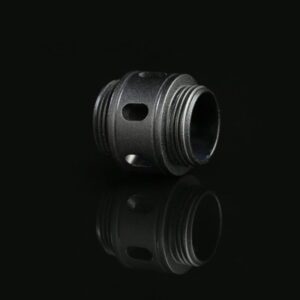
A coupler is a short threaded barrel that screws into the pommel end of one hilt and the pommel end of another, holding them end to end. It carries the full mechanical load of the joined assembly, because everything above and below it is hanging off those two threads.
That load is the part people underestimate. A staff is not two sabers resting against each other; it is one long object whose leverage doubles the moment you swing it from one end.
A coupler is typically 40 mm to 60 mm long and machined from the same aluminium as the hilt, anodised to match. It may be smooth, knurled for grip, or shaped to read as a continuation of the hilt body.
The critical dimension is not the outer diameter but the interior bore and the thread. The exterior can be any shape the design wants, as long as the threads match the hilts at both ends and the bore stays open for the wire run and the battery.
A coupler that is solid through the middle will block the battery compartment of any hilt whose cells load from the pommel end. The cell that has to pass is a 18650, which measures 18 mm across and 65 mm long, or on larger builds a 21700 at 21 mm by 70 mm. The coupler’s bore has to clear that with room for the holder.
| What the coupler has to carry | Why it matters |
|---|---|
| Thread engagement at both ends | The whole assembly hangs on two joints |
| Open central bore | Pommel-loaded batteries must still pass |
| Alignment keying or flat faces | Determines where each hilt’s switch ends up |
| Venting, if the pommels are the speakers | Facing pommels into each other encloses the audio path |
| Surface grip | The coupler is often the hand position on a staff |
Thread Standards and Why They Differ
Couplers are specified by thread, and thread is not standardised across manufacturers. Two hilts can both be 1 inch in bore and still not screw onto the same coupler, because the thread diameter and pitch are separate numbers from the bore.
The bore is the smooth internal diameter a blade slides into. The thread is the cut spiral at the pommel, and the two are independent.
Take a 1-inch hilt. Its 25.4 mm bore says nothing about the thread cut into the pommel behind it, because a thread is described by two numbers — a diameter and a pitch, the distance between adjacent crests — and neither is fixed by the bore.
Two hilts can share a bore diameter and still carry threads that will not join. A thread of the same diameter but a finer pitch will start to engage and then bind partway in, which is a harder failure to diagnose than one that never starts at all.
Partial engagement is worse than no engagement. A coupler that threads two turns and then stops will hold under its own weight and fail under a swing, which is exactly the failure mode to avoid.
Bore families split the same way. A 1-inch socket measures 25.4 mm and a 7/8-inch socket measures 22.2 mm, and the two take different couplers because the pommel geometry scales with the bore.
There is a second variable on top of that. Hilts differ in whether the pommel carries the thread on the outside or the inside, so couplers are sold in versions that match. A hilt with an externally threaded pommel needs a coupler threaded internally at that end, and buying the opposite version produces a part that is correct in every dimension and still will not join.
The practical rule is to match coupler to hilt within the same family. Threads that came from the same shop are the ones that will seat fully.
Where the thread is finer than expected, the coupler will feel tight early and need more turns than usual. Where it is coarser, it will rattle at the end of travel.
Switch Alignment and the Fit
A threaded joint stops wherever the thread happens to stop, which means the two hilts will not line up by default. Real couplers solve this with a locking feature — a set of flat faces, a grub screw, or a shim — that decides where rotation ends.
Switch position is the reason. On a staff, the hand sits somewhere in the middle, and a switch rotated to face the wrong way is a switch you cannot reach without letting go.
There are three ways this usually gets handled. A locking nut backs against the hilt’s pommel and can be positioned at any angle, which lets the two hilts be clocked anywhere relative to each other.
A flat-faced joint gives a small number of discrete positions rather than infinite adjustment, and it is simpler and more solid.
A grub screw lets the coupler be locked at any angle but requires a tool, and a screw that is overtightened can mark the hilt’s anodising where it bites.
Where a coupler offers no adjustment at all, the two hilts will meet at whatever angle the thread ends on. On two identical hilts that is often close to aligned, but it is not something to count on.
The coupler reads as a smooth continuation of the hilt, but the joint inside is where the whole assembly’s strength lives.
Sound Once the Pommels Face Each Other
Most single sabers vent sound through the pommel. Coupling two of them points both speaker outlets into the coupler, so the audio path has to be provided by the coupler itself or the staff will sound enclosed.
This is the second-most-common complaint after alignment, and it is a direct consequence of the geometry rather than a fault.
Vented couplers exist for exactly this reason. They carry slots or holes through the barrel so the sound has somewhere to go, and the same openings let light through if the hilts have illuminated pommels.
A solid coupler in that position muffles both hilts at once. The effect is not subtle, because the enclosed volume is small and the openings are facing each other.
Where both hilts have forward-firing sound rather than pommel-firing, this problem does not arise, and a solid coupler is the better choice because it is structurally simpler and stiffer.
Fixed vs Quick-Release Couplers
A fixed coupler screws both hilts together and stays that way. A quick-release coupler unscrews by hand so the staff can be split back into two sabers in seconds. The trade is rigidity against convenience.
The fixed version is a plain threaded barrel, sometimes with a locking nut. It has the fewest parts, the least to come loose, and the stiffest joint.
A quick-release version usually adds a knurled collar or a spring-loaded sleeve so the joint can be broken without tools. That extra mechanism is the part that develops play over time.
The choice comes down to how the saber actually gets used. A display staff is set up once and benefits from the fixed joint. A saber that gets carried, split for transport, and reassembled wants the quick-release version.
There is also a middle path that is easy to overlook: two fixed couplers and two hilt halves let the same parts build a staff or two singles without any special hardware, at the cost of time each conversion.
| Fixed coupler | Quick-release coupler | |
|---|---|---|
| How it separates | Unscrews, usually with effort | By hand, at a collar or sleeve |
| Joint rigidity | Highest — fewest moving parts | Slightly less; mechanism can develop play |
| Parts that wear | The threads only | Threads plus the release mechanism |
| Best for | Set-up-once display staffs | Sabers carried and split often |
| Typical length | 40 mm to 60 mm | Longer, to house the collar |
Balance, Reach and Handling a Staff
Joining two sabers does not just double the length. It moves the balance point to the middle of the assembly, which is roughly where the coupler sits, and it doubles the leverage acting on the joint.
On a single saber the weight sits near the hand. On a staff the mass is split either side of the grip, and the rotation happens around the coupler.
That makes the staff far more stable to hold still and far heavier to swing. The inertia at the far end of a two-hilt assembly is much greater than the sum of the two sabers used separately, because the far hilt is now at the end of a lever rather than in a hand.
The numbers get large quickly. A 32-inch blade is 813 mm, so two of them contribute 1.63 m of blade alone. Add two hilt bodies and the coupler and the assembly commonly passes 2 m tip to tip.
Where the two hilts differ in weight, the balance point shifts off the coupler and the staff will feel one-sided. Two identical hilts are the configuration that behaves predictably.
Grip is the other change. A staff is normally held with one hand on or beside the coupler and the other further down, so the coupler’s surface texture becomes a handling feature rather than decoration.
Mid-Blade Couplers and Conventional Cores
In the lore, the couplers on a double-bladed saber are described as aligning the two crystals so the blades fire together. The real-world equivalent is a coupler that carries a blade socket of its own, so the assembly can mount a blade at the joint rather than only at the far ends.
The conventional description is that the two crystals have to be matched in frequency, and the coupler is the part that holds them in the correct relationship.
A coupler with its own socket turns the assembly into something different again — not a staff but a saber with an emitter at the middle as well as the ends.
That configuration is harder on the joint than a plain coupler, because the central socket adds both a lever arm and a heat path at the point where the threads are already carrying the whole assembly.
Where a hilt is designed with field-replaceable coupler plates, the plates are the parts that take the wear. Threads that are worked repeatedly will loosen before the machined body does, and plates are the cheaper part to replace.
Thread Care, Storage and Wear
Aluminium threads on aluminium threads wear, and the wear is silent until the joint stops seating. The maintenance that prevents it is simple: keep the threads clean, do not cross-thread, and do not store the saber assembled with the joint under load.
Cross-threading is the failure that does the most damage fastest. The coupler should start by hand and turn freely for the first turn or two before any force is applied.
A thread that binds immediately is the wrong thread, not a stiff one. Forcing it cuts material off both sets of threads and the damage is permanent.
Aluminium needs no lubricant in this application and lubricant attracts grit. A dry, clean thread that has been wiped is the better state.
For storage, a staff left assembled sits with the full weight of one hilt hanging on the other’s threads. Breaking it down for storage removes that standing load, and it also makes the assembly fit in a case built for a single hilt.
Discoloured grey residue on the threads is oxidised aluminium. It is normal on a frequently worked joint, and it should be wiped off rather than left to build up.
Frequently Asked Questions
Q1: What is a lightsaber coupler?
A: A lightsaber coupler is a short threaded adapter that joins two complete hilts at their pommel ends to make one double-bladed staff. It carries the full mechanical load of the joined assembly, so the threads at both ends have to seat properly and the central bore has to stay open for the batteries.
Q2: Will any coupler fit my lightsaber?
A: No. Couplers match on thread, not on bore. Two hilts can both take a 1-inch blade and still not share a coupler, because the thread diameter and pitch are separate from the bore size. You also have to match male to female: check whether your pommel’s thread is on the outside or the inside, because a coupler threaded the other way will not join no matter what size it is.
Q3: How do I stop the two hilts ending up at the wrong angle?
A: You need a coupler with an alignment feature. A locking nut can be positioned anywhere and then backed against the hilt, giving full adjustment. A flat-faced joint gives a few fixed positions. A grub screw locks at any angle but needs a tool and can mark the anodising.
Q4: Why does my staff sound quieter than the two sabers did?
A: Because most sabers vent sound through the pommel, and coupling points both pommels into the coupler. The audio path gets enclosed. A vented coupler with slots or holes through the barrel is the fix. If your hilts fire sound forward instead, this does not apply.
Q5: Should I get a fixed or a quick-release coupler?
A: Fixed if the staff is set up once and left assembled, because it has the fewest parts and the stiffest joint. Quick-release if you carry the saber around and split it often, at the cost of a mechanism that will eventually develop some play.
Q6: Does coupling two sabers change how it handles?
A: Considerably. The balance point moves to roughly the middle, near the coupler, and the far hilt now sits at the end of a lever rather than in your hand. The staff is more stable to hold still and much heavier to swing, with far more inertia at the far end.
Q7: Why won’t my coupler screw all the way in?
A: Two possibilities, and they need different responses. A thread that binds after a turn or two is the wrong pitch and should not be forced. A thread that turns freely and then stops may simply be at the end of its travel, or may have a solid centre that is meeting the hilt’s battery compartment.
Q8: Do I need to take the staff apart for storage?
A: It is worth doing. Assembled, one hilt’s full weight hangs on the other’s threads as a standing load. Separating them removes that load, reduces wear on the joint, and lets the parts fit a case sized for a single hilt.
Q9: Can a coupler hold a blade in the middle?
A: Some can, if the coupler carries its own blade socket. That makes an assembly with an emitter at the joint as well as at the ends, which puts extra leverage and heat into the threads that are already carrying the whole structure. It is a harder duty than a plain coupler.
Q10: Is thread wear on a coupler repairable?
A: Usually not on the coupler itself, which is why cross-threading has to be avoided. On hilts that use replaceable coupler plates, the plate is the part that wears and the part that gets replaced, which keeps the damage off the machined hilt body.