
It aired once, on CBS, Friday 17 November 1978, from 8 to 10 pm, and has never been broadcast in the United States again. Ninety-seven minutes of variety-show segments, musical numbers and a Wookiee family speaking without subtitles, made for about $6.4 million. It is also, awkwardly for everyone involved, the reason Boba Fett and Life Day exist.
What’s on This Page
- What it actually was
- Who was in it
- Why it got made at all
- The 97 minutes, segment by segment
- What the ratings were, and why the numbers disagree
- Why it has never been shown again
- Five things it added that are still canon
- The animated segment, and the debut inside it
- Life Day, the holiday that outlived the special
- What 1978 left in people’s hands
- Where you can and cannot see it
What It Actually Was
A two-hour television variety special, not a film and not an episode. Ninety-seven minutes of runtime, one broadcast on CBS, and a production budget that was unusually large for the format.
The framing device is Life Day, a Wookiee holiday, and the plot follows the family of Chewbacca on the Wookiee homeworld waiting for him to get home for the celebration.
Around that frame the production hung the format that was normal for television in 1978: musical performances, comedy sketches, guest stars from other shows, and a long animated insert.
That mixture is what makes it hard to describe now. It is not a bad film, because it is not a film. It is a variety show with Star Wars sets and Star Wars costumes, made by people who produced variety shows.
| Item | Detail |
|---|---|
| First and only broadcast | Friday 17 November 1978, 8 to 10 pm, CBS |
| Runtime | 97 minutes |
| Reported budget | About $6.4 million |
| Format | Television variety special |
| Setting | Wookiee homeworld, between the first two films |
| Animated segment | Produced by Nelvana, roughly ten minutes |
| Home release | None, in any format |
| US rebroadcast | Never |
Being set between the two films is the detail that explains its existence. In 1978 the franchise was one enormous hit with no sequel in cinemas yet, and any broadcast that kept it in front of an audience was welcome.
Who Was in It
The film cast all appear, and around them sit four television performers doing the material the special was actually built for.
That split is the clearest way to see what went wrong. The film actors are given almost nothing to do; the television performers are given the whole show.
Mark Hamill, Carrie Fisher, Harrison Ford, Peter Mayhew, Anthony Daniels and Kenny Baker all appear, mostly in the closing sequence and in brief inserts, and all of them play it straight.
The guest performers carry the variety content: Bea Arthur as the cantina owner, Art Carney as a trader who keeps the household supplied, Harvey Korman in several roles including a cooking-show host, Diahann Carroll in a virtual-reality sequence, and Jefferson Starship as a holographic band.
Korman is the one worth watching, because he is the only person on screen who has understood what kind of production he is in and is performing accordingly. The film cast are the ones who have not been told.
Behind the camera the split runs the same way. The production came out of television variety, the animated segment came from a separate animation studio, and the whole was coordinated by people whose previous work had nothing to do with science fiction.
Why It Got Made at All
Because a hit film in 1978 was also a television property, and a holiday special was the standard way to keep a property visible between instalments.
The economics were straightforward. CBS wanted a two-hour event for the November sweeps period, the studio wanted the franchise on television without committing a sequel budget, and a variety special was the cheapest thing that satisfied both.
What nobody priced in was that a variety special is a specific craft, and the people who made this one were good at that craft rather than at science fiction. The result is competent television that is wrong for the material.
The tonal problem is structural rather than accidental. Sketch comedy needs the characters to be relaxed and talkative; the films work because the characters are terse and the universe is dangerous.
Put those together and you get a production where every element is executed at the level it was written at, and the result still does not work, because the writing was for a different show.
The 97 Minutes, Segment by Segment
A home on the Wookiee homeworld, four musical numbers, several comedy sketches, one animated short, and a closing song. Nothing in that list is the problem on its own.
The show opens at the family home, where Chewbacca’s wife Mallatobuck, his father Itchy and his son Lumpy wait for him to arrive. They speak Wookiee throughout, with no subtitles, for long stretches.
That choice is the single most-criticised decision in the production and it is worth understanding rather than mocking. Dialogue-free scenes were a real technique in 1978 television, and the production committed to it hard.
From there the show cuts between the home and a series of guest sequences: a comedy sketch in a cantina, a musical number in the same cantina, a cooking demonstration, a virtual-reality sequence, and a stormtrooper raid on the house that is played entirely straight.
Then the animated short, roughly ten minutes long, which is the part almost everyone who defends the special is actually defending.
The closing sequence has the whole cast gathered for a Life Day song, sung to the melody of the main theme, which is where most viewers decide the production has gone too far.
The structural failure is that none of these segments know about each other. A variety show is a sequence of unrelated acts; a story is a chain of consequences. The special is built as the first and plotted as the second.
What the Ratings Were, and Why the Numbers Disagree
About 13 million viewers by the most widely cited figure, and something near 18 million households in others. The two numbers are not measuring the same thing and the gap has never been settled.
Both figures get quoted, and both trace back to Nielsen, which is why the argument has never been resolved. One counts viewers, the other counts households, and the two have never been the same quantity.
The more informative fact is the ranking. The special did not place in the top ten for the evening, and it was out-drawn on ABC by the miniseries Pearl and by The Love Boat.
Losing to a regular series in its own slot is what mattered commercially. A two-hour event that finishes behind ordinary programming has failed as a television event regardless of the raw audience.
It also explains the speed of the reaction. A show that had won the night would have had a reason to be repeated; a show that lost its slot did not.
Why It Has Never Been Shown Again
Because the people who own it decided against it, and because the copies that exist were made by viewers rather than by the studio.
The production was never re-broadcast in the United States, never released on any home format, and has never been made available in full through any official channel.
George Lucas has been blunt about it for decades. He has said publicly that he would like every copy destroyed, and the studio has acted on the sentiment rather than the wording.
There is a commercial logic underneath the sentiment. A franchise being rebuilt for a sequel trilogy has more to lose from a widely distributed embarrassment than it has to gain from licensing an old television special.
Every complete copy in circulation descends from a home recording of that single evening. Tape generations compound, so the versions people trade are progressively softer, noisier and occasionally missing whole seconds where a recording was paused.
That is why the special is genuinely hard to watch rather than merely embarrassing. There is no master to go back to, and the best surviving copies are not good.
Five Things It Added That Are Still Canon
The Wookiee homeworld, Chewbacca’s family, the holiday, a ship from the animated segment, and one bounty hunter.
- Life Day. A Wookiee celebration, invented for the special, now marked by fans every 17 November.
- Chewbacca’s family. Mallatobuck, Itchy and Lumpy — a household with three generations and names, invented here and referenced in later material.
- The Wookiee homeworld. Shown as a forest world with a family house long before the prequels returned to it.
- A blockade runner in the animated segment. The ship design was reused later, which is why it looks familiar to people who never saw the special.
- Boba Fett. The bounty hunter’s first appearance anywhere, in animation, months before any other appearance.
| Element | What it was in 1978 | Where it went afterwards |
|---|---|---|
| Life Day | A Wookiee family holiday, invented for the broadcast | Marked by fans each 17 November; appears in later licensed material |
| Chewbacca’s family | Mallatobuck, Itchy and Lumpy, at home | Named characters that later material still uses |
| The homeworld | A forested world with a family house | Revisited in later films |
| Blockade runner | A ship in the animated segment | Design reused in later productions |
| Boba Fett | An unnamed armoured bounty hunter | Backstory, merchandise, and eventually a series of his own |
That fifth item is the reason the special cannot be written off completely. A production that everyone involved would prefer to forget is also the only origin of one of the franchise’s most durable characters.
The other four are quieter. They were absorbed into later productions without ceremony, which means most viewers have met this material without knowing where it came from.
The Animated Segment, and the Debut Inside It
Roughly ten minutes of hand-drawn animation made by Nelvana, and the only part of the special that is still defensible as film-making.
The animation was produced separately, in Canada, by a studio working from its own designs and its own schedule. That separation shows. The character designs are looser, the colours are bolder, and the timing is closer to feature animation of the period than to television.
Inside it, a bounty hunter in green armour is introduced with no explanation and no name beyond a title card, and then leaves. That is the entire debut.
The design was strong enough to survive being introduced in a variety special. It reappeared in live action, was given a backstory, became merchandise, then a television character, then the lead of its own series.
The segment is called The Story of the Faithful Wookiee, and it is the one piece of the special that has since been released on its own through an official channel, as a short. Everything else remains where it was in 1978.
For anyone interested in why that one design worked, the same logic applies to the crossguard: a silhouette that reads as dangerous from a distance without needing an explanation, which is covered in our crossguard buying guide.
Life Day, the Holiday That Outlived the Special
Invented for the broadcast, ignored for decades, then adopted by fans as an unofficial holiday on the anniversary of the airing.
The special treats Life Day as an established Wookiee tradition with a tree, an orb, red robes and a family gathering, which is exactly the shape of a real holiday compressed into a fictional one.
Fans kept the date. November 17 is now marked online with rewatch threads, and the holiday has appeared in later licensed material, which makes it one of the few elements of the special that the franchise stopped pretending did not happen.
That is a strange outcome for a production nobody wanted to release. The invented holiday outlasted the show that invented it and outlasted the embarrassment attached to it.
What 1978 Left in People’s Hands
Not the special, which nobody can legally own, but the props and designs from that window, which are the objects collectors still build and buy.
The special sits between the two films, which means everything it shows belongs to the visual language of the first film rather than the second.
That language is still the most-replicated one in the hobby. The 1977-era designs are the ones reproduced most often, because they are the ones people saw first and because their shapes are simpler than the later ones.
The most-copied object from that window is still Darth Vader’s saber: a heavy, deliberately clumsy-looking hilt with a control box and a wide flared emitter, built to look like industrial equipment rather than a weapon.

Vader Lightsaber
Character Lightsabers / Darth Vader Lightsaber

Vader has three scenes in the special and all three are played straight, which is more than can be said for the rest of the production. The saber is the only prop from the broadcast that people still want to own in physical form.
Where You Can and Cannot See It
There is no official complete copy. The animated segment has been released on its own, and everything else exists only as recordings of the 1978 broadcast.
That situation has held for over four decades and there is no sign of it changing, because the incentive runs the other way: the property’s owners gain nothing from a release and lose the option of it never having happened.
- No home video release, in any format, ever
- No complete version on any streaming service
- The animated segment released separately as a short
- Complete copies exist only as recordings of the single CBS broadcast
So the practical answer to can I watch it is that the honest, high-quality copy does not exist. What exists is a record of what a television audience saw in 1978, soft and incomplete.
Which is, in the end, the right way to see it. It is a document of a specific evening rather than a film, and it is more interesting as that than it would have been as a good television movie.
Clone Wars Episode Order
Clone Troopers vs Stormtroopers
Best Dueling Lightsabers
A History of the Clones
Frequently Asked Questions
Q1: When did the Star Wars Holiday Special air?
A: Friday 17 November 1978, from 8 to 10 pm on CBS. It ran 97 minutes and was broadcast once. It has never been shown again on American television.
Q2: How much did it cost to make?
A: About $6.4 million, which was a large budget for a television variety special at the time and roughly the cost of a modest feature.
Q3: How many people watched it?
A: About 13 million viewers by the most widely cited Nielsen figure, with some sources quoting roughly 18 million households. The two are measuring different things. What is not disputed is that it failed to reach the top ten for the evening, finishing behind Pearl and The Love Boat on ABC.
Q4: Why has it never been re-released?
A: Because the people who control it have consistently declined to release it. George Lucas has said publicly that he wanted every copy destroyed, and no home video or streaming release has ever been authorised.
Q5: Can I watch it legally anywhere?
A: Not in complete form. The animated segment, The Story of the Faithful Wookiee, was released separately as a short, and everything else exists only as recordings of the 1978 broadcast. There is no official complete copy in any format.
Q6: Did Boba Fett appear in it first?
A: Yes. His first appearance anywhere was in the Nelvana animated segment, months before any other appearance, introduced with a title card and no backstory.
Q7: Is Life Day canon?
A: It originated in the special and has since appeared in later licensed material. Fans mark it on 17 November, the anniversary of the broadcast.
Q8: Why do the Wookiees not have subtitles?
A: The production chose to play long dialogue-free scenes in Wookiee, which was a deliberate technique rather than an oversight. It is the most-criticised decision in the show and also the one most tied to the format it was made for.
Q9: Who was in it?
A: Mark Hamill, Carrie Fisher, Harrison Ford, Peter Mayhew, Anthony Daniels and Kenny Baker from the films, plus Bea Arthur, Art Carney, Harvey Korman, Diahann Carroll and Jefferson Starship in the variety segments. Chewbacca’s family was played by actors in Wookiee costumes.
Q10: Is it as bad as people say?
A: It is not a bad film, because it is not a film. It is a variety special made by people skilled in variety television, applied to material that needed a different craft. The mismatch is structural rather than a failure of execution.
Q11: What is the animated segment called?
A: The Story of the Faithful Wookiee, roughly ten minutes long, produced by Nelvana separately from the rest of the special and the only portion released on its own.
Q12: Was it a ratings failure?
A: It drew about 13 million viewers and lost its time slot. Losing the slot to ordinary programming is what made it a failure as a television event, and that is what removed any reason to broadcast it again.

ISABER Wall Hung Saber Mount
No-drill wall mount that holds your saber hilt vertically - clamp arms with adjustment knobs, metal support hook, and 3M adhesive backing.
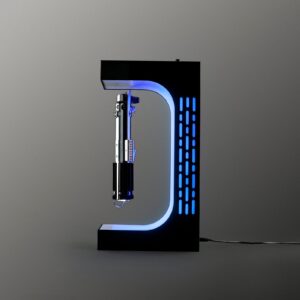
ISABER Magnetic Levitation Lightsaber Display Stand
Electromagnetic display stand that suspends your saber hilt in mid-air with a smooth 360-degree rotation - no cradle, no visible support.