
Star Wars movies in order is thirteen films totalling 1,724 minutes. Which order to watch in comes down to one question: do you already know who Luke’s father is? If not, start with the 1977 film. If you do, start in story order.
What’s on This Page
- The order, films only
- All thirteen, with runtime
- How long it actually takes
- Which order to pick
- The order that skips one film
- Where the shows fit
- What changed in 2026
- Where the other lists are wrong
- FAQ
The Order, Films Only
Chronological order means the order the events happen in, not the order the films came out. Those two are almost completely different, and the gap is the whole reason this question gets asked.
Here is the thirteen in story order, with the year each one is set in explained just below the list.
- The Phantom Menace
- Attack of the Clones
- The Clone Wars (the animated film, not the series)
- Revenge of the Sith
- Solo
- Rogue One
- A New Hope
- The Empire Strikes Back
- Return of the Jedi
- The Mandalorian and Grogu
- The Force Awakens
- The Last Jedi
- The Rise of Skywalker
The dates you see on every other guide, the BBY and ABY ones, count from a battle that happens near the end of the first film. BBY means before the Battle of Yavin, ABY means after it.
So the timeline is measured from a point in the middle of the story. That is why the numbers run backwards before it and forwards after.
Three entries share a year with a neighbour, and in each case the list above is the order that makes the ending work. Rogue One sits at year zero and finishes minutes before A New Hope begins.
The animated Clone Wars film sits at the same year as Attack of the Clones and runs straight into it. The Force Awakens and The Last Jedi are both at 34 years after Yavin and are only days apart.
If this is your first time through, we would not start you here, and there is a good reason for that in a moment.
All Thirteen, With Runtime
Every other list on this subject gives you a release date and an in-universe year. None of them tell you how long the thing runs, which is the number that decides whether you start tonight or on Saturday.
| Story order | Film | Released | Set in | Minutes |
|---|---|---|---|---|
| 1 | The Phantom Menace | 1999 | 32 BBY | 136 |
| 2 | Attack of the Clones | 2002 | 22 BBY | 142 |
| 3 | The Clone Wars (animated film) | 2008 | 22 BBY | 98 |
| 4 | Revenge of the Sith | 2005 | 19 BBY | 140 |
| 5 | Solo | 2018 | 13 to 10 BBY | 135 |
| 6 | Rogue One | 2016 | 0 BBY | 133 |
| 7 | A New Hope | 1977 | 0 BBY | 121 |
| 8 | The Empire Strikes Back | 1980 | 3 ABY | 124 |
| 9 | Return of the Jedi | 1983 | 4 ABY | 131 |
| 10 | The Mandalorian and Grogu | 2026 | about 11 ABY | 132 |
| 11 | The Force Awakens | 2015 | 34 ABY | 138 |
| 12 | The Last Jedi | 2017 | 34 ABY | 152 |
| 13 | The Rise of Skywalker | 2019 | 35 ABY | 142 |
Read down the released column and then down the set-in column and the problem becomes visible immediately. Three films made between 1977 and 1983 sit at the midpoint of the story.
Three films made between 1999 and 2005 sit at the start of it. The earliest-made films are not the earliest-set ones, and that inversion is the single fact behind every argument about watch order.
Two entries here are not part of any trilogy, and both sit outside the numbered episodes. Rogue One in particular has to be watched after Revenge of the Sith and before A New Hope or its ending loses most of its force.
The animated film is the one most lists drop from story order, usually without noticing.
How Long It Actually Takes
1,724 minutes. That is 28 hours and 44 minutes of film, before you add a single episode of television. At two hours a night it is fourteen evenings and a bit of a fifteenth.
Published totals for this disagree with each other by several hours, so we have shown the arithmetic instead of quoting one figure. Add the runtimes from the table above in three groups.
| What you’re counting | Films | Minutes | Hours |
|---|---|---|---|
| The nine numbered episodes | 9 | 1,226 | 20 h 26 |
| Plus Solo, Rogue One and the animated film | 12 | 1,592 | 26 h 32 |
| Plus The Mandalorian and Grogu | 13 | 1,724 | 28 h 44 |
The middle row is what reconciles the usual figures, because the sources we checked give 26.5 hours for twelve films, which is 1,592 minutes, and that matches our sum exactly. The numbers you see quoted above 28 hours are counting a thirteenth film those same pages still describe as unreleased.
The prequel block is the largest single stretch at 516 minutes, and it is also the block most people tell you to skip first. Both things are true; it is 30 percent of the total.
One more number worth having, because it changes how you plan this. The three films that carry most of the story, the original trilogy, come to 376 minutes. A newcomer can have the whole thing that made the franchise famous in three sittings, and decide about the other 1,348 minutes afterwards.
Which Order to Pick
One question decides it for you, and it is not taste, not era, not which trilogy is better. Do you already know that Darth Vader is Luke’s father?
If you don’t know, watch in release order: A New Hope, The Empire Strikes Back, Return of the Jedi, then the three prequels, then the three sequels.
That is the order the films were built to be entered in. The reveal in the second film only works once, and every later film assumes you have had it.
If you already know, watch in story order. The thirteen above, top to bottom, with Solo and Rogue One in place. Nothing is spoiled that isn’t already yours, and the connective tissue between the eras is the reason to do it this way.
The mistake we would steer you away from is the one most lists quietly invite: starting a first-timer on The Phantom Menace because it comes first in the timeline.
It runs 136 minutes, it is set 32 years before anything the saga is actually about, and it answers questions the original trilogy spends three films asking. Starting there hands someone the answers before the questions.
There is also a third situation worth naming, because it is common and none of the big guides address it. You have seen everything. You are about to watch with someone who hasn’t. That is the case the order in the next section was invented for.
The Order That Skips One Film
Four, five, two, three, six. Leave out the first one entirely.
The logic is structural rather than a matter of taste, and it turns on where The Empire Strikes Back leaves you.
If you drop the two prequels in at that point, they stop being a prologue and become a flashback that explains how the man in the mask got there. Return of the Jedi then resolves it in the right order for the person watching.
The first film is dropped because almost nothing it introduces survives into the rest of the story: the characters it spends its runtime establishing are killed, sidelined, or better established elsewhere. Keeping it costs you 136 minutes and a fair amount of patience.
This was proposed on a personal blog in 2011 and has been argued about ever since. A mainstream film magazine called it the definitive order six years later. It has variants: one keeps the first film and runs four, five, one, two, three, six instead, which is the compromise most people actually use.
What it costs is real. You lose the podrace, you lose one of the two prequel duels people remember, and you meet a character in the second film who then vanishes from the order and never comes back.
What it buys is a first-timer who gets the reveal intact and gets the prequels at the one moment they are genuinely interesting.
Our read: it is the best order for a rewatch with a newcomer. For someone watching alone for the first time, plain release order is simpler, loses less, and does not require you to explain why you skipped a film.
Where the Shows Fit
Films are the easy part. The shows are where the commitment changes shape, because one of them is 133 episodes and another is six.
Here is the television side in story order, with the bar under each count scaled against the longest one so you can see at a glance which of these is a weekend and which is a month.
| Series | Ran | Set in | Episodes |
|---|---|---|---|
| The Acolyte | 2024 | about 132 BBY | 8 |
| Tales of the Jedi | 2022 | 50 to 18 BBY | 6 |
| The Clone Wars | 2008 to 2020 | 22 to 19 BBY | 133 |
| Tales of the Empire | 2024 | from 19 BBY | 6 |
| The Bad Batch | 2021 to 2024 | 19 to 18 BBY | 47 |
| Maul: Shadow Lord | 2026 | about 18 BBY | 10 |
| Tales of the Underworld | 2025 | varies | 6 |
| Obi-Wan Kenobi | 2022 | 9 BBY | 6 |
| Andor | 2022 and 2025 | 5 to 1 BBY | 24 |
| Rebels | 2014 to 2018 | 5 to 1 BBY | 75 |
| The Mandalorian | 2019 to 2023 | 9 ABY | 24 |
| The Book of Boba Fett | 2021 | 9 ABY | 7 |
| Ahsoka | 2023 | 9 ABY | 8 |
| Skeleton Crew | 2024 | 9 ABY | 8 |
| Resistance | 2018 to 2020 | 34 ABY | 40 |
Three of them carry real weight, and we would name them rather than say the shows are optional as a category.
The Clone Wars is the one that explains the war the films skip over between Attack of the Clones and Revenge of the Sith.
Rebels is the one that sets up the characters Ahsoka assumes you already know, and the live-action Ahsoka series is effectively a continuation of it rather than a spin-off.
Andor is the best-regarded thing on this entire page and stands completely alone, so you can start there with no preparation at all.
Everything else can be skipped, and saying so plainly is more useful than a ranking. The Acolyte, Resistance, and the three Tales anthologies come to 66 episodes between them and none of them is load-bearing for the films.
The Bad Batch is worth it if you finished The Clone Wars and want to know what happened to the clones, and it is 47 episodes of homework otherwise.
There is one honest gap before you go counting, because episode totals for this franchise are not consistent between sources. The same show gets counted as 75 episodes in one place and 77 in another, depending on how short-form episodes and specials are treated. The 133 for The Clone Wars is the one figure everybody agrees on.
What Changed in 2026
Two things landed this year, and between them they dated every watch-order guide written before April.
The Mandalorian and Grogu opened on 22 May 2026 and runs 132 minutes. It is the first Star Wars film in cinemas since 2019, it sits about 11 years after the Battle of Yavin, and it is entry ten in the list at the top of this page.
Its opening weekend was the lowest for any film in the series since Solo, which is a box office fact and not a verdict on the film.
Whether you like it is a separate question from where it goes. Where it goes is between Return of the Jedi and The Force Awakens.
Maul: Shadow Lord premiered on 6 April 2026 as ten animated episodes, released in pairs each week and finishing on the fourth of May.
It is set roughly a year after Revenge of the Sith, which puts it after The Bad Batch and before Obi-Wan Kenobi, and a second season has been ordered.
Two more dates are already fixed for 2027, which matters if you are planning a full run rather than a weekend. The original 1977 film returns to cinemas on 19 February for its fiftieth anniversary, and a new film is dated 28 May. A second season of Ahsoka is set for 20 January.
None of that changes the thirteen at the top. It changes what a page written last year will tell you, and there are a lot of those.
Where the Other Lists Are Wrong
Five errors turn up over and over, and they are specific enough to name. If a guide gets one of these wrong, its other numbers are worth checking before you trust them.
- Listing the 2026 film as upcoming when it has been in cinemas since May. Any page that calls it a 2026 release with no runtime was written before it opened and not touched since.
- Dropping the 2008 animated Clone Wars film from story order. It belongs between Attack of the Clones and Revenge of the Sith, it is 98 minutes, and it is the entry most often missing entirely.
- Using audience scores as a guide to what to watch next. A rating tells you what a crowd thought years ago. It does not tell you whether the film is a two-hour commitment or a two-and-a-half-hour one.
- Dating the studio’s purchase of the franchise to 2015. It was 2012. 2015 is when the first film of the new trilogy opened, which is where the confusion comes from.
- Saying the shows are optional without naming the exception. Two of them are not optional if you intend to watch the live-action series that continues them.
Our own version of this page, written in 2023, carried two mistakes of its own: it dated the studio’s purchase of the franchise to 2015, and two of its entries repeated the cast list from the film above them. Both are gone. We mention it because a page that has been corrected is easier to check than one that has not.
One Object Runs Through All Thirteen
If you want a single visual cue for where you are in the timeline, watch the lightsabers. They change hands, change colour, and change owner across all thirteen films, and each change is a timestamp.
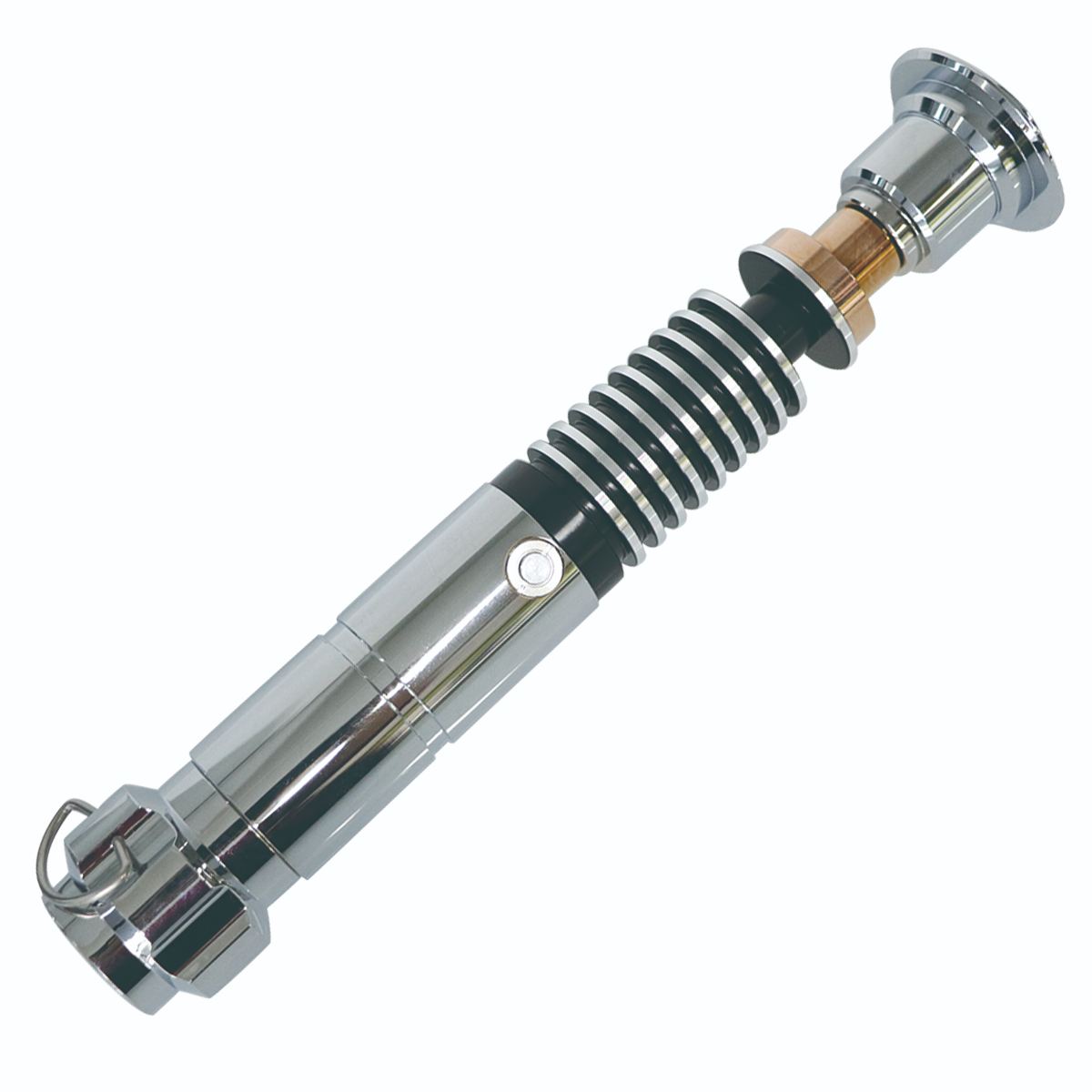
It starts as a blue blade belonging to a Jedi knight, is lost, is picked up by his son, changes to green between the second and third films, and is still being argued over in the sequel trilogy forty years of story time later.
Watching that single object is a better way to keep your place than remembering which episode number comes next. The episode numbers are production numbers. The blade is the story.
That is also why the hilt matters more than the colour. A replica that gets the hilt right but ships a blade in the wrong shade is describing the wrong moment in the timeline.

Luke Lightsaber
Character Lightsabers / Luke Skywalker Lightsaber

Ahsoka Tano Lightsaber — Xenopixel V3 / Proffie 2.2 Dual White Blade Replica Set | ISABER
ISABER's Ahsoka Tano replica: dual electroplated hilts with white Neopixel blades. Full-size main hand + shoto off-hand. 7/8-inch blade diameter. Available i...
If you are working backwards from a specific film rather than forwards through the timeline, the Vader timeline tracks one hilt across every version it appears in, and the ranking by scoreboard covers the other question people ask right after this one.
Best Star Wars Movie
Star Wars Gift Guide
Best Sci-Fi by Score
Vader’s Every Film Version
FAQ
Q1: What order should I watch Star Wars in for the first time?
A: Release order. A New Hope, The Empire Strikes Back, Return of the Jedi, then the three prequels, then the three sequels. That keeps the reveal in the second film unspoiled, which is the one thing a later viewing cannot recover.
Q2: Is chronological order the same as release order?
A: No, and they are almost reversed. The three films made between 1977 and 1983 sit in the middle of the timeline. The three made between 1999 and 2005 sit at the beginning. Watching chronologically means starting with the newest-made of the earliest-set films.
Q3: How long does it take to watch all the Star Wars movies?
A: 1,724 minutes, which is 28 hours 44 minutes across thirteen films. The nine numbered episodes alone are 1,226 minutes, or 20 hours 26. At two hours a night the full set is fourteen evenings plus a short fifteenth.
Q4: Do I have to watch the TV shows?
A: No, for the films. Yes, for two of the live-action series. Ahsoka continues a story that starts in Rebels, and Rebels rests on The Clone Wars. Everything else in the television list is optional and the films work without any of it.
Q5: Do I need to watch The Clone Wars before Ahsoka?
A: Strictly, no. Practically, yes. The live-action Ahsoka series continues character arcs that begin in The Clone Wars and run through Rebels, and it is closer to a fourth season of Rebels than to a standalone show. At minimum, watch Rebels.
Q6: Where does The Mandalorian and Grogu go?
A: Between Return of the Jedi and The Force Awakens, about 11 years after the Battle of Yavin. It is entry ten of thirteen in story order, and it runs 132 minutes.
Q7: What is the Machete order?
A: Four, five, two, three, six, with the first film left out. It was proposed on a personal blog in 2011. The point is that the two prequels play as a flashback after the cliffhanger in the second film rather than as a prologue before the first one.
Q8: Should I skip The Phantom Menace?
A: On a first watch with someone who does not know the story, it is a reasonable skip at 136 minutes. On a rewatch, watch it and decide for yourself. The order that skips it exists for a specific situation, not as a general rule.
Q9: Where does Rogue One go?
A: Immediately before A New Hope, at year zero. It ends minutes before the other film begins, and watching it out of that position costs it most of its ending. Solo goes earlier, between Revenge of the Sith and Rogue One.
Q10: Is The Acolyte part of the timeline?
A: It is set about a century before The Phantom Menace, in the era the franchise calls the High Republic, and it is canon. It ran one season and was not renewed. Nothing in the thirteen films depends on it.
Q11: How many Star Wars films are there?
A: Thirteen, counting the 2008 animated Clone Wars film and the 2026 release. Nine of them are numbered episodes, two are standalones, one is animated, and one opened this May.
Conclusion
Thirteen films, 1,724 minutes, and one question that settles the order. Everything else here is bookkeeping around those two facts.
If you are starting tonight, start with A New Hope, give it ninety minutes, and see whether you want the rest.
If you have already seen them and you are planning a run with someone new, the Machete order gives them the best first trip through it.
Either way, we would rather you watched four films in the right order than thirteen in the wrong one. The list at the top will still be here when you come back for the other nine.