
The best dueling lightsaber is usually not the most expensive one in the lineup. What survives repeated contact is a thick-walled polycarbonate tube, a plain machined hilt with no thin neck and no protruding greeblies, and electronics you can replace. The flagships built to look best on a shelf fail most of those tests.
What’s on This Page
- The answer, and why it inverts the price list
- Five things that decide whether a saber can be dueled
- Blade wall: 2 mm against 3 mm
- Baselit against neopixel, without the marketing
- What hilt shapes actually survive contact
- The shortlist by role
- Gear comes before the saber
- Why duel ready on a listing means almost nothing
- The two failures that end a blade
The Answer, and Why It Inverts the Price List
The saber that takes a hit best is a brushed-metal hilt with a straight barrel, a 3 mm polycarbonate blade and a baselit LED in the hilt. Every step up in visual fidelity makes that job worse.
The question gets answered badly because people answer it as a buying question. Asked as an engineering question, the answer falls out almost on its own.
Dueling puts load into three places. The blade takes impact along its length, the emitter takes torque where the blade leaves the hilt, and the board takes shock through the body of the saber.
A saber optimised for display puts mass where dueling does not want it. A thin neck looks elegant and concentrates stress into the narrowest part of the hilt. A high-density blade strip puts the heaviest part of the blade at the tip.
So the two goals are not in tension because one is harder. They are in tension because they pull in opposite directions, and a product built for a shelf cannot be fixed into a dueling tool by adding a stronger blade.
Five Things That Decide Whether a Saber Can Be Dueled
Blade wall thickness, blade material, hilt wall thickness at the emitter, hilt profile, and whether the electronics can be replaced. Everything else is preference.
- Blade wall. Under 2 mm the tube dents and the diffuser inside scatters light unevenly from then on.
- Blade material. Polycarbonate, not acrylic. Acrylic is clearer and cracks instead of flexing.
- Emitter wall. The blade meets the hilt at its highest-stress point, and thin metal there ovalises.
- Hilt profile. Cylindrical and smooth, with no thin neck and nothing projecting sideways.
- Replaceability. A blade you can swap and a chassis you can reach are what separate a repairable saber from a disposable one.
Those five are checkable before purchase from a specification sheet, which is the point of listing them. None of them require trusting a claim about durability.
Blade Wall: 2 mm Against 3 mm
Both walls are polycarbonate and neither breaks easily. The difference is what happens to the bore after a few hundred hits, and that difference decides how the blade looks a year later.
A one-inch blade has an outside diameter of about 25.4 mm. The wall thickness eats into that from the inside, so a 2 mm wall leaves roughly a 21.4 mm bore and a 3 mm wall leaves about 19.4 mm.
The trade is honest but often misdescribed. The thicker wall is stiffer, takes a dent without creasing, and loses some brightness because there is less room for the diffuser and the light has more material to travel through.
The thinner wall is brighter, flexes more on impact, and returns to shape rather than staying bent. It is also the one that eventually shows a flat spot, and a flat spot is permanent.
For choreography, medium contact and convention floors, 2 mm is fine and most sabers at the entry and mid price points ship with it. For full-contact sparring, 3 mm is the correct upgrade and the money is better spent there than on extra blade effects.
One number matters more than the wall spec, and almost nobody publishes it: impact rating. There is no standard for it in this industry, which is why the next section exists.
Baselit Against Neopixel, Without the Marketing
Baselit puts the light in the hilt and shines it up an empty tube. Neopixel puts hundreds of LEDs inside the blade. The second looks dramatically better and is the worse choice for contact.
| Baselit | Neopixel | |
|---|---|---|
| Where the LEDs sit | In the hilt, behind the emitter | On a strip inside the blade |
| Ignition effect | Extend and retract, or instant | Rolls up per LED, one at a time |
| Blade weight | Light; tube and diffuser only | Heavier; a strip runs the full length |
| Balance | Near the emitter | Tip-weighted as the blade gets longer |
| Damaged blade means | Replace a tube | Replace the strip as well |
| Best use | Contact, spinning, long sessions | Display, film, choreography |
The weight difference is the part people underestimate. A strip down the full length of the blade moves the centre of mass away from your hands, and the effect compounds as blade length increases.
That is not a small ergonomic detail. It changes how fast you can stop a swing, which changes how quickly you can recover, which is the whole skill being practised.
There is also a repair argument. A dented baselit blade is a tube and a diffuser. A dented neopixel blade is a tube, a diffuser and a strip, and the strip is the expensive one.
What Hilt Shapes Actually Survive Contact
A plain cylinder with a thick emitter wall. Nothing projecting, no narrow waist, no clamp box where your hand goes.
Thin necks are the single most common compromise. They appear on replica hilts because the film props had them, and they concentrate every impact into the narrowest cross-section of the whole saber.
Protruding parts fail differently. A clamp box or a control card on the side of a hilt does not break, it catches, and it eventually tears away from its fixings or digs into the hand that is holding it.
Grip texture matters less than people expect. Ribbed sections give a little grip but also create a place for the hilt to rotate against your palm during a fast spin.
Length is a preference, but there is a rule worth knowing. Two-handed grips want roughly 26 to 30 cm of usable hilt between the emitter and the pommel; anything shorter forces one hand onto the pommel.
One practical check before buying: the emitter should feel like a solid tube when you tap it, not a thin ring. That is a proxy for wall thickness you can test in a shop and cannot read off a web page.
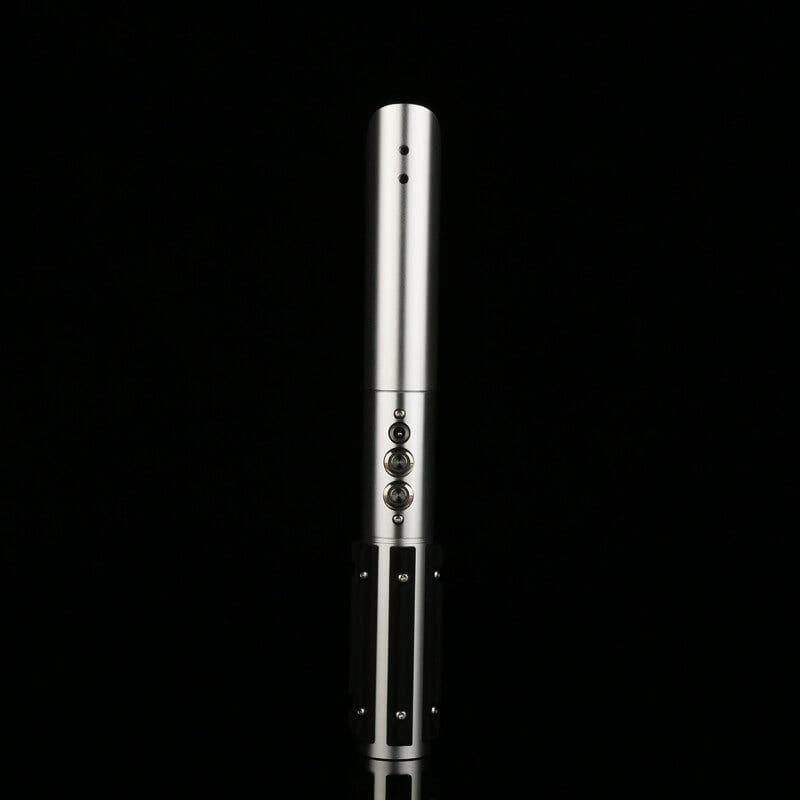
Our own dueling pick is that hilt: 30 cm of frosted aluminium, a 1.21 lb body, a 1-inch polycarbonate blade at 28.5 inches, and a USB-C port so the battery is not a sealed problem. The 2 mm wall is the standard for the band and takes medium contact without complaint.
If your group spars hard and often, budget for a thicker blade as a separate purchase rather than paying more for a fancier board. The blade is the consumable, and the wall is what you are actually buying.
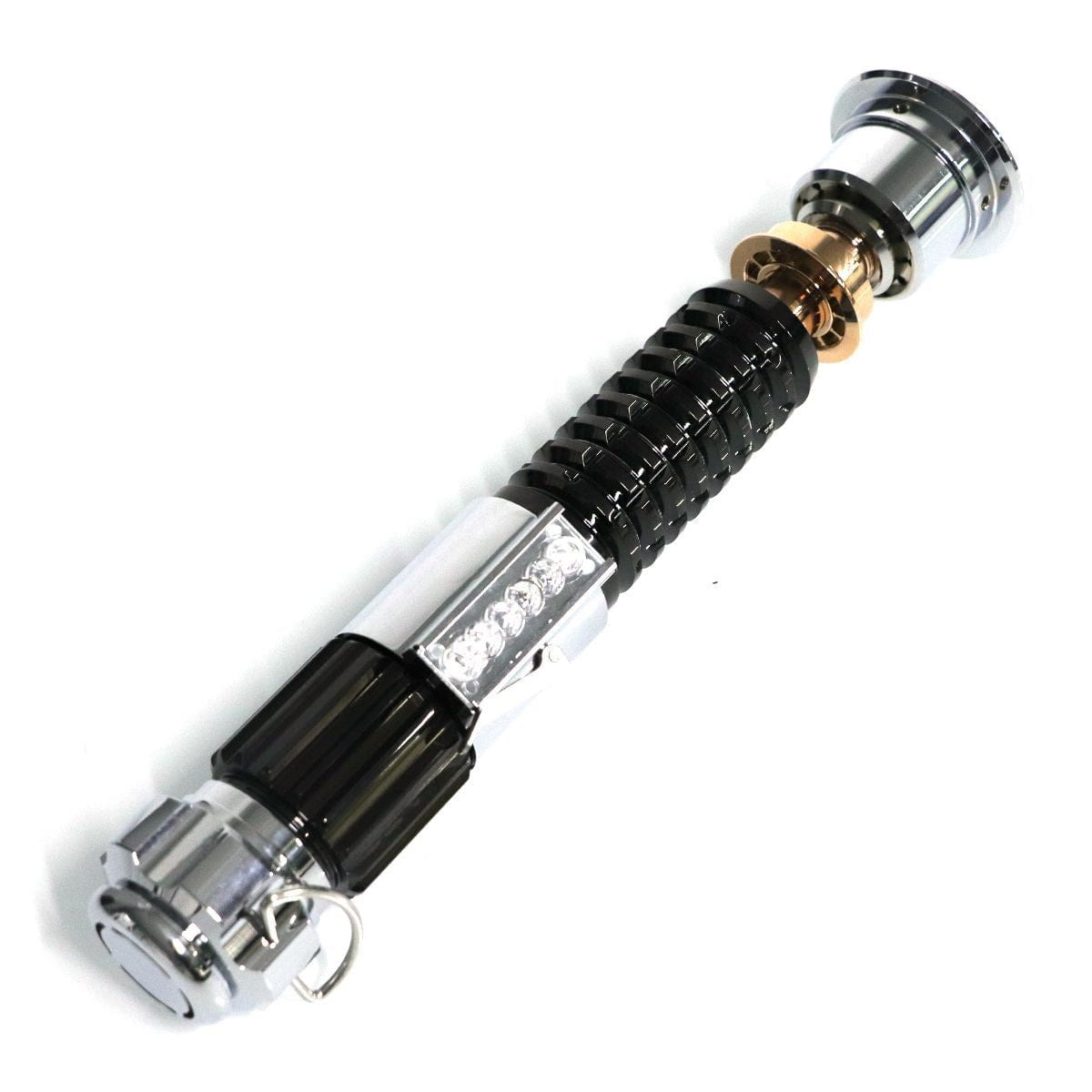
The other end of the same catalogue is the collector pattern: a three-tone hilt with a thin brass neck acting as the choke point, and a 50 W neopixel blade. It is the better object and the worse dueling tool, and its own specification says so.
That is not a flaw in the product. It is the honest description of what a thin-neck neopixel is for, and buying one to spar with is a category error rather than a quality problem.
The Shortlist by Role
Different people mean different things by dueling, so the right answer changes with the role rather than with the budget.
Match the row to how you will actually use the saber, and accept that one saber will not do all six jobs well.
| If you are | Configuration to buy | Blade | Skip |
|---|---|---|---|
| Starting out, medium contact | Baselit, straight 30 cm hilt | 1 inch, 2 mm wall, 28 to 32 inches | Neopixel, thin neck |
| Sparring hard, often | Baselit, thick emitter wall | 1 inch, 3 mm wall, shorter blade | Anything with a narrow waist |
| Spinning and flow art | Baselit, smooth cylinder | 2 mm wall, balanced near the emitter | Protruding control boxes |
| Two-handed long sessions | Baselit, 26 to 30 cm grip length | 3 mm wall for weight forward | Sub 24 cm hilts |
| Choreography and film | Neopixel | Long, accepting tip weight | Nothing; this is the right use |
| Display and collecting | Neopixel replica | Whatever the design calls for | Baseball swings |
The last two rows are on the list because most buyers are in one of them and get talked into the first four. If the saber is going on a stand, buy for how it looks and stop reading dueling advice.
Conversely, if you are in the second row, the visual difference between baselit and neopixel stops mattering the moment someone swings at you.
Gear Comes Before the Saber
Eye protection and hand protection cost a fraction of the saber and are the difference between a hobby and an injury.
Organised dueling groups set their own rules on equipment and on who may spar, and those rules are stricter than most home buyers expect. Minimum ages are common and full-contact formats usually specify protective headgear.
- Eye protection, rated for impact rather than for dust
- Gloves, because a polycarbonate blade on knuckles splits skin easily
- Head protection if your format allows contact above the shoulders
- A spacer or a limit on blade length for younger or newer duelers in the group
Blade length is the control people ignore. A shorter blade is a smaller lever, so it hits with less force at the same speed, and groups that run beginners usually set a shorter maximum for exactly that reason.
Why Duel Ready on a Listing Means Almost Nothing
Duel ready is a marketing phrase, not a specification. No standard governs it, no test backs it, and no vendor publishes an impact rating.
The three numbers that would settle the question are blade wall thickness, hilt wall thickness at the emitter, and a tested impact figure. The first is sometimes published, the second almost never, and the third essentially never.
What is published is a set of claims that sound like specifications. Combat grade, shatterproof, heavy dueling, and tournament approved all describe an intention rather than a measured result.
The practical response is to buy from the numbers that do exist and to treat the rest as decoration. Blade wall in millimetres is real. Blade material is real. Hilt length and weight are real. Everything else is a sentence somebody wrote.
This is also why a warranty conversation matters more than a claim. A vendor willing to replace a blade that cracked in normal use has told you more about their confidence than any adjective on the page.
The Two Failures That End a Blade
A crease from a hard hit and a burnt strip from a stalled connection. Both are local, both are permanent, and both are visible the moment the blade lights.
The crease is mechanical. Polycarbonate dents, a dent becomes a flat spot, and a flat spot scatters light into a bright patch that never goes away.
The burnt strip is electrical. A neopixel blade carries power through a connector at the base, and a partial connection heats the first few LEDs until one fails and takes its neighbours with it.
Both are noticeable immediately, which is useful. A blade that lights cleanly after a session has survived it; a blade with a bright patch or a dark segment has not, and the damage will not improve.
Clone Trooper Costume and Armor
Cosplay Costume Pairings
The Star Wars Holiday Special
Star Wars Movies in Order
Frequently Asked Questions
Q1: What is the best lightsaber for dueling?
A: A baselit saber with a straight 26 to 30 cm aluminium hilt, a thick emitter wall and a 1 inch polycarbonate blade in a 3 mm wall. Lighter blades suit choreography and medium contact; thicker walls suit repeated hard contact.
Q2: Is neopixel good for dueling?
A: It is the better-looking blade and the worse contact blade. The LED strip adds weight along the full length, moves the balance toward the tip, and turns a damaged blade into a strip replacement rather than a tube replacement.
Q3: Should I choose a 2 mm or a 3 mm blade wall?
A: 2 mm is the standard at entry and mid price points and is fine for medium contact. 3 mm is stiffer, resists denting better and is slightly dimmer. For regular hard contact, buy the 3 mm.
Q4: How long should a dueling blade be?
A: Commonly 28 to 32 inches for adult one-handed use, shorter for two-handed control, and shorter again for beginners. A shorter blade is a smaller lever and hits with less force at the same swing speed.
Q5: Why are thin-neck hilts a problem?
A: The neck concentrates impact into the narrowest cross-section of the saber. It is a faithful copy of several film props and a poor shape for repeated contact, which is why so many replicas recommend light use only.
Q6: Does duel ready mean anything?
A: Not as a specification. No standard governs the phrase and almost no vendor publishes an impact rating. The numbers that matter are blade wall thickness in millimetres, blade material, and hilt wall thickness at the emitter.
Q7: Can I duel with an acrylic blade?
A: No. Polycarbonate flexes and survives; acrylic is clearer and cracks. Any blade sold on clarity rather than material is a display part.
Q8: What protective gear do I need?
A: Impact-rated eye protection and gloves as a minimum, plus head protection if your group allows contact above the shoulders. Organised groups also set minimum ages, which is worth checking before buying.
Q9: How do I know when a blade is damaged?
A: It lights unevenly. A flat spot from a crease shows as a bright patch, and a failed strip shows as a dark segment near the base. Both appear the moment the blade ignites and neither improves.
Q10: Can I replace just the blade?
A: On most sabers with a retained blade, yes, which is the main argument for buying a design that allows it. Check that the blade is held by a screw or a collet rather than fixed into the emitter.
Q11: Is a heavier saber better for practice?
A: Only for strength work, and at the cost of speed. For technique, a lighter saber with the balance near the emitter teaches control faster because you can feel where the blade is going.
Q12: How often should a blade be replaced?
A: There is no interval to quote because it depends entirely on contact. Replace it when it lights unevenly, not on a schedule, and treat the blade as the consumable part of the saber.