
Nothing about the blades changed. The line used to draw them did. Rebels (2014) returned to the thin, unstable beam painted for A New Hope, after fifteen years of every other production drawing the same weapon fat, saturated and hard-tipped.
That reversal is a drawing decision, not a change to the weapon. The argument has been running ever since because almost nobody separates the two.
The question sounds like it is asking about lore. It is actually asking about rendering, and the two have been confused for over a decade of forum threads.
Three separate things get called “thin” in these conversations. Only two of them can be measured with a ruler.
- Three different things called thin
- Six dates that fixed the width
- Where the thin blade actually came from
- Why the 1977 blade was thin in the first place
- The reading that is not canon
- The test the finale ran
- The other thinness, the one you can buy
- What a thin neck costs a buyer
Three Different Things Called Thin
A drawn blade is a line. A hilt neck is a machined tube. An in-story blade width is neither, and no production has ever claimed the beam itself got narrower.
When someone says Rebels drew thin sabers, they are describing line weight. It is the same class of decision as hair shape or cape length.
When someone says the same show had thin hilts, they are describing a real object with a narrow section between the emitter and the body. That one has threads, wall thickness and a failure mode.
And when someone says the blades in that era were canonically weaker or smaller, they are describing something no episode states. That claim exists in fan discussion only.
| What is called thin | What it physically is | Can you measure it? | Does it change how the weapon works? |
|---|---|---|---|
| The blade as drawn | A stroke width in a frame | Yes, per frame | No |
| The hilt neck | A narrow machined section | Yes, per millimetre | Yes — it is the weak point |
| The blade “in canon” | Nothing on screen states it | No | No |
Keeping those three apart answers most of the question. The rest is a date problem.
Six Dates That Fixed the Width
The width was never set once. It was set by six productions, and two of them reached back to the same source — which is why the two thin entries look related even though twenty years separate them.
The production paintings for A New Hope drew the blade as a slender beam with a faint halo, brighter near the hilt and fading toward the tip. That drawing was never the final look, but it was the first written-down idea of one.
The 1977 film then had to make that drawing exist optically. The result was thin, but the thinness came from the method rather than from taste — a subject for its own section below.
From The Phantom Menace in 1999 the prequels redrew the blade. Wider, more saturated, with a strong even glow along the whole length and a hard diamond point at the tip. That version became the default for the next fifteen years.
The Clone Wars, running 2008 to 2020, carried that prequel look forward without much argument, because it was depicting the same era.
Then Rebels arrived in 2014, set five years before A New Hope, and drew the blade back down to a narrow line with a soft, uneven tip. It held that line for four seasons and 75 episodes.
And in 2023, Ahsoka put the same characters into live action across eight episodes, where the blade is drawn at ordinary width again.
| Date | How the blade was drawn | What set the width |
|---|---|---|
| A New Hope, production paintings | Slender beam, faint halo, no hard tip | Concept art, before any effect existed |
| 1977, one film | Thin, wavering, tip never quite resolves | The optical method used on set |
| 1999–2005, three films | Wide, saturated, even glow, hard diamond point | A deliberate break from the 1977 look |
| The Clone Wars, 2008–2020, 7 seasons, 133 episodes | Carried the prequel version forward | It was depicting the prequel era |
| Rebels, 2014–2018, 4 seasons, 75 episodes | Narrow line, soft tip, visible flicker | A return to the original paintings |
| Ahsoka, 2023, 8 episodes | Ordinary width again | Live-action convention |
The 2014 entry is not a new idea. It is the pre-1977 drawing arriving a second time, after fifteen years of the opposite.
Read down the middle column and the pattern is a single reversal. The width tracks the era each production wanted to belong to, not a change in what a blade is.
Where the Thin Blade Actually Came From
The 2014 choice was sourced, and the source is stated plainly in the art book published for that series: the blades appear thinner and sharper than their film counterparts, reflecting a concept from early in the first film’s development.
That sentence matters because it rules out the two explanations people usually reach for first.
It was not a budget shortcut. A thinner line is not meaningfully cheaper to draw than a thicker one, and the series spent real effort on the flicker and the soft tip — both harder than a clean wide stroke.
It was not a mistake or a technical limit. The wider prequel look had already been produced by the same studio across the whole run of The Clone Wars.
A third reason circulates as well: that thinner blades made the fight choreography easier to animate. This one is the least supported, and it does not survive being stated plainly. Line weight is a property of the stroke, not of the movement that stroke traces. A thinner line does not make a swing easier to draw — it makes the swing harder to keep clean, because there is less room to hide a wobble.
The series creator described the original-trilogy blades as reading like long, glowing fencing foils, as opposed to the prequel blades with their strong steady glow and specific diamond point. That comparison is the design brief in one sentence.
So the sequence is unusual. The paintings came first, the 1977 optical blade accidentally matched them because of how it was built, the prequels deliberately left both behind, and Rebels went back to the paintings on purpose.
Why the 1977 Blade Was Thin in the First Place
The original blade could not have been drawn fat. It was a physical object photographed through a camera, and its thinness was a side effect of the trick used to make it glow.
The method: a dowel rod, wrapped in a retroreflective tape of the kind used on road signs, spun by a small motor inside the hilt, lit hard from near the camera lens. The spinning tape threw light back into the lens and read as a glowing shaft.
The glow was then strengthened in post by hand-tracing the blade frame by frame, at 24 frames per second. That is why the old blades have a slightly soft, breathing edge instead of a hard vector outline.
Every visible quirk of the 1977 blade traces to that method. The brightness shifts as the rod turns. The edge wavers. The tip never resolves into a clean point, because there was no point to photograph — just the end of a rod.
Rebels reproduced all three of those artefacts on purpose. Flicker, uneven brightness and a tip that refuses to sharpen. Those are not stylistic noise. They are a reconstruction of a 1977 camera problem, drawn by hand in 2014.
That is also why the prequels look so different. By then the blade was a digital element that could be drawn clean, so it was — wide, even, and pointed.
The Reading That Is Not Canon
The most quoted explanation — that thin flickering blades signal a dying Jedi order — is a statement about mood from the people making the show. It is not something any character says, and no episode establishes it.
That distinction is worth keeping sharp, because the reading gets repeated as if it were lore.
The reasoning runs: the wider, steadier blades of the prequel era belonged to a Jedi order at full strength, so drawing the blade thinner and less stable in an era when the order is nearly gone makes the weapon feel like it is dying with them.
As a design rationale, that is a good answer to “why this choice for this show.” As a fact about the weapon, it does not exist. Nobody in any episode measures a blade. Nobody remarks that a blade seems dimmer than it used to be.
Labelling the difference honestly: (a) the drawn width, which is a documented production fact; (b) the intent behind it, which the makers have stated; (c) the in-universe explanation, which is inference layered on top of (b). The third one is a reasonable reading. It is still the third one.
The Test the Finale Ran
In the Ahsoka finale, the droid saber-smith Huyang hands Ezra Bridger a blade emitter, and Ezra objects that it is too narrow. Fans read the line as an answer to nine years of complaint. The line is about the emitter, not the blade.
That detail is easy to miss and worth sitting with.
The complaint was always about how wide the blade was drawn. The reply moved the subject to a machined part — an emitter shroud with a bore through it. The two are not the same measurement, and the show knew it.
Read that way, the scene does something cleverer than a wink. It relocates the thinness from the drawing to the hardware, which is where a thinness can actually exist.
The scene then lands the point. Huyang produces a duplicate of the exact emitter shroud Kanan Jarrus carried, explaining that he had two and gave one to Kanan — whom he still calls by his birth name, Caleb Dume. Ezra’s new saber quietly becomes a copy of his master’s.
There is a harder test underneath, and it needs no interview to run. The blade Ezra builds around that same emitter is drawn at ordinary width, while the hilt it copies was a slim flickering line for four seasons of animation.
Rebels-era characters standing in live action throughout Ahsoka carry blades at that ordinary width too. The thinness did not travel with them. It stayed in the animation.
That is the cleanest evidence available that the change was never in the object.
The Other Thinness, the One You Can Buy
Separate from the drawn blade, there is a hilt design with a genuinely narrow section between the emitter and the body. It is real metal, it predates Rebels by nine years, and it is the only part of this question that costs anything.
The narrow section is a choke point. The emitter sits at the top, the body below, and between them the tube narrows down — sometimes to little more than a sleeve around the blade socket.
That shape reached the screen as the signature of Obi-Wan Kenobi’s third saber, built for Revenge of the Sith in 2005.
The design was worked backwards from the 1977 prop, which had been assembled out of found parts — a jet-engine balance pipe as the main body, a World War I rifle grenade as the clamp, a faucet handle in the control section.
Structurally, the choke is the weakest point on the whole hilt. It is a reduced cross-section at the highest bending load, in the place where the blade meets the hand. Every maker who builds one has to decide how to reinforce it.
Two solutions exist, and they produce different products:
| Approach | What it does | What you get | What you give up |
|---|---|---|---|
| Step the blade down to 7/8 inch | Keeps the neck proportion at true scale | Closest silhouette to the screen hilt | Fewer blade options, less mass in the blade |
| Keep the 1 inch blade, reinforce internally | Holds standard blade size behind a narrow neck | Full accessory and blade compatibility | The neck is slightly beefier than the prop |
| Ignore both and bore it out | Thinnest neck, maximum blade | Looks right on a stand | Cannot take a hit; this is the failure case |
None of those is wrong on its own terms. They are different answers to the same constraint, and which one is right depends on whether the saber is going to be swung.
What a Thin Neck Costs a Buyer
A thin-neck hilt is the one version of this design where the specification sheet matters more than the photo. The question is not how narrow the neck is, but what the maker put inside it.
Our own Kenobi build keeps a full 1 inch removable blade behind the narrow neck, secured by retention screws, with the reinforcement running through the choke rather than around it.
That is the second approach in the table above, chosen so the hilt does not lock you out of standard 1 inch blades — the size that a 36 inch (92 cm) blade and every common tip are cut for.
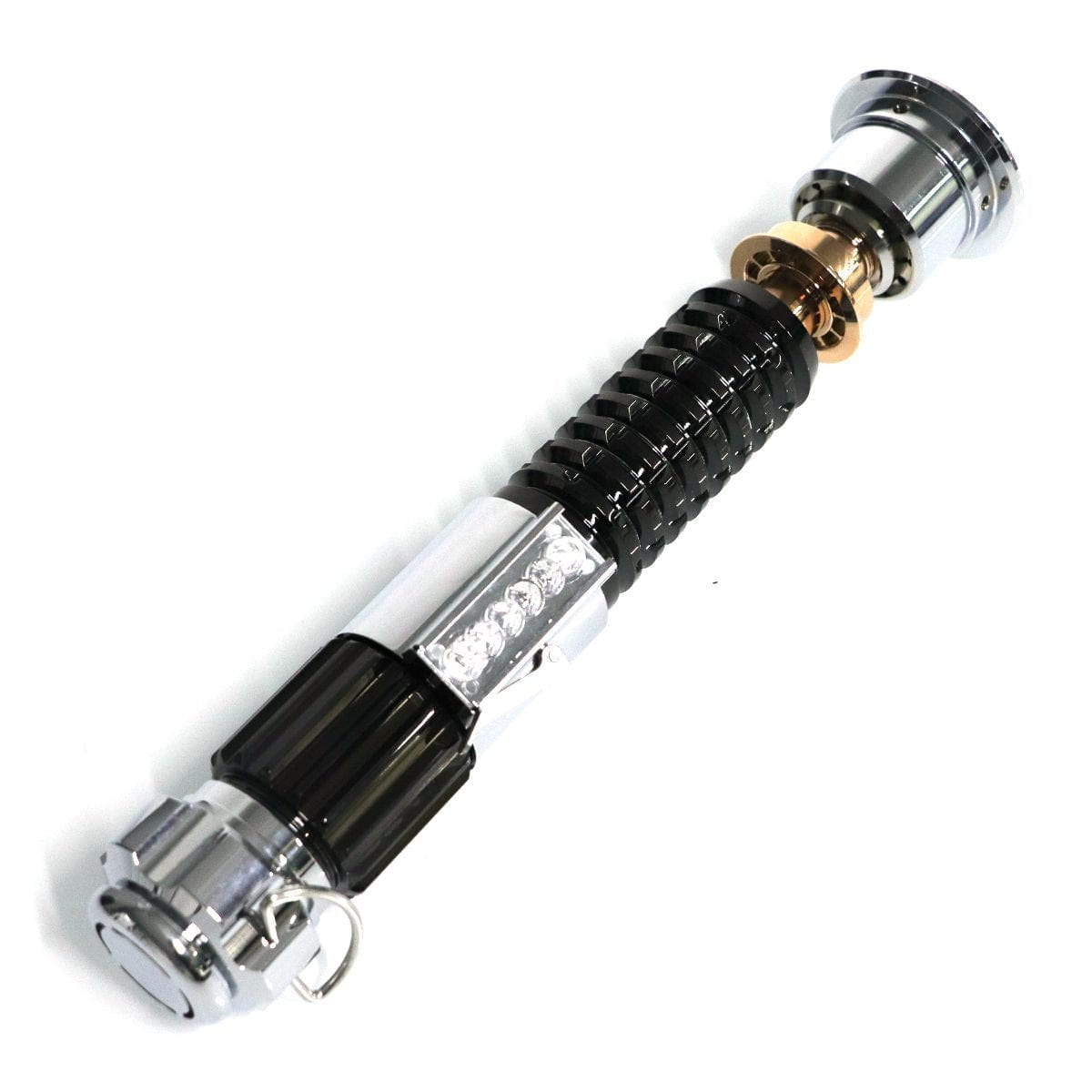
Four things to check before ordering one, in the order that matters:
- Blade diameter. 1 inch or 7/8 inch. This decides what blades and what tips you can buy later, and 7/8 inch is the smaller market.
- Where the wall thickness goes. Ask whether the neck is reinforced internally. A neck that is thin because material was removed is a different product from a neck that is thin because material was added elsewhere.
- The dueling rating. Model-specific, not brand-wide. A given hilt can ship as a heavy-dueling build in one electronics tier and a display build in another.
- The coupler or shroud interface. Thin-neck hilts often carry a detachable shroud at the top. That joint is a second stress point on top of the neck.
None of this makes a thin-neck saber a bad purchase. It makes it a purchase where a photo cannot tell you what you need to know.
Kenobi Lightsaber v2.0 — Obi-Wan Kenobi Neopixel Replica | ISABERS
Character Lightsabers / Neopixel Lightsabers
The thin-neck saber’s own history
What 28, 32 and 36 inches mean
The two-piece saber from this era
The five build decisions that decide durability
Frequently Asked Questions
Q1: Why are lightsabers so thin in Rebels?
A: Because the production went back to the slender blades drawn in the original film’s early concept paintings, and to the look of the practical 1977 blade with its flicker and soft tip. It was a deliberate reversal of the wide, hard-tipped prequel style.
Q2: Are the blades canonically thinner, or just drawn thinner?
A: Just drawn thinner. No episode establishes that a blade in this era is narrower than one in an earlier era. When the same characters appear in live action, the blade is drawn at ordinary width.
Q3: Did the original films ever show blades this thin?
A: The 1977 film did, in effect. Its blade was a spinning rod photographed through a camera, so it was narrow and its edge wavered. The thinness was a by-product of the method rather than a design choice.
Q4: Why did the prequels and the animated series look so different?
A: By 1999 the blade was a digital element that could be drawn perfectly clean, so it was drawn wide, saturated and pointed. That version then carried into the animated series depicting the same era.
Q5: Is the thin blade based on concept art?
A: Yes, and the art book published for the series says so directly — the blades appear thinner and sharper than their film counterparts, reflecting an idea from early in the first film’s development.
Q6: Why do the blades flicker and wobble in that series?
A: Because the 1977 blade did. Brightness shifted as the rod turned and the tip never resolved cleanly, so those artefacts were redrawn by hand as a reconstruction of the original camera problem.
Q7: Does a thin blade mean the Jedi are weaker in this era?
A: No. The makers have described the thinner, less stable blade as a way of making the order feel like it is dying out, but that is a statement about mood. Nothing on screen measures a blade or remarks on its brightness.
Q8: Is a thin blade harder to animate?
A: It is harder to animate convincingly, which is why the choice is evidence the production cared. A clean wide stroke is easier than a wavering narrow one with an unstable tip.
Q9: What did the line about the emitter being too narrow mean?
A: In the 2023 live-action finale, a droid saber-smith hands over an emitter and is told it is too narrow. Most viewers read it as an answer to the long-running complaint. Note that it is about the emitter — a machined part — rather than the drawn blade.
Q10: Does a thin blade exist anywhere in live action?
A: Not at the width the series used. Live action has drawn blades at ordinary width throughout, including when the same era and characters are depicted.
Q11: Is a thin-neck hilt the same thing as a thin blade?
A: No, and the confusion is the root of most of these arguments. A thin neck is a narrow machined section on a real object. A thin blade is a stroke width on a frame. Only the first one can be bought.
Q12: Should I buy a thin-neck saber for dueling?
A: It can be a dueling saber, but the neck is the weakest point on the hilt, so the answer depends on how that specific model is reinforced. Check the blade diameter, the internal structure and the dueling rating for that exact build rather than for the brand.
ISABER Double Bladed Lightsaber — RGB Baselit / Xenopixel Staff Saber
Accessories / RGB & Baselit Lightsabers