
White is the rarest lightsaber colour that a person can actually choose to make: at least four named characters in canon have carried one, and every one of them got there by purifying a crystal that had been corrupted into red. Black is rarer as an object — one blade exists, and it was destroyed. Pink is rarer still by the strictest count, but no named character has ever carried one.
Every article answering this question picks one of those three and states it as fact. That is why the answers disagree. They are not disagreeing about the films. They are answering three different questions with one word.
This page separates the questions, counts what each one counts, and then does the part the fiction cannot do: says what “rare” means when the colour is a setting on a circuit board.
What’s on This Page
- The Short Answer, With Its Condition Attached
- Why Every Source Gives a Different Colour
- The Count, Colour by Colour
- The White Answer: How You Get One
- The Black Case, and Why It Stopped Being True
- The Pink Case Is Zero
- What “Rare” Means When the Colour Is a Setting
- The One Place the Fiction and the Hardware Agree
- What to Order If You Want the Rare-Looking One
- FAQ
The Short Answer, With Its Condition Attached
Rarest colour a person can make: white, at least four named users. Rarest blade in existence: black, one of them. Rarest by strict user count: pink, zero named users.
The condition is doing real work. “Rarest” in everyday use asks how unlikely it is to meet someone carrying that colour. That is the white answer, because the process is one almost nobody completes.
“Rarest” as an object count asks how few of something exist. That is the black answer, and it wins by an enormous margin: not few, but one.
“Rarest” as a literal count of named people asks which roster is shortest. That is pink, at zero, which is also why most lists quietly exclude it.
Three defensible answers, one word. Choosing the metric is the whole argument.
Why Every Source Gives a Different Colour
The disagreement is not sloppy research. It comes from canon supporting three separate counts, and from a fourth count that covers both continuities at once.
One reference wiki dataset ran the widest version of this count, pulling the blade colour of every lightsaber in its own archive and returning 132 unique blades with a known colour.
That set deliberately merged canon and the old Expanded Universe, counting overlap once. Blue led by a wide margin, then red, then green. Every genuinely rare colour sat in a long tail.
That merge is exactly what most lists get wrong. Legend material is full of shade names canon has never used: bronze, silver, viridian, jade, carmine.
So a list can be internally consistent and still wrong, because it is counting a bigger universe than the one it claims to describe.
| Question being asked | Winner | What the count actually is |
|---|---|---|
| Fewest named characters | Pink / magenta | Zero in canon |
| Fewest blades in existence | Black | One, now destroyed |
| Fewest people who could make one | White | At least four named |
| Rarest across canon plus Legends | Shade-level names | A long tail of one-off hues |
Pick the first row and pink wins. Pick the second and black wins. Pick the third and white wins. All three are true statements about the same eight colours.
The Count, Colour by Colour
Canon runs on eight blade colours: blue, green, red, purple, yellow, orange, white and black. Four are common, four are not, and only two of the rare ones are colours anyone can set out to produce.
Blue and green are the Order’s working colours and appear throughout every era. Red is not chosen at all: it is what a crystal becomes when it is forced.
That leaves the four that get argued about. Their counts are not close to each other, which is what makes the ranking stable once you name the metric.
| Colour | Named canon users | How it happens | Rank by user count |
|---|---|---|---|
| Blue | Widespread | Standard attunement | Common |
| Green | Widespread | Standard attunement | Common |
| Red | Widespread | Crystal forced by dark side use | Common |
| Yellow | Temple Guard plus a few | Attunement; institution colour | Uncommon |
| Purple | Seven | Unexplained in canon | Rare |
| Orange | Two | Attunement; none before 2023 | Rare |
| White | At least four | Purifying a bled crystal | Rarest achievable |
| Black | One blade, several wielders | One forging, never repeated | Rarest object |
| Pink / magenta | Zero | Not established in canon | Rarest, or not a colour |
Two entries in that table break the pattern. Black is not a colour category, it is one object. Pink is not a category either, because canon has never assigned it to a named person.
Purple is the one rare colour with no explanation at all, which is why it has its own seven-name roster rather than a paragraph here.
Orange is the clearest recent change. For decades it was a game and Legends colour with no canon user. Two characters in one 2023 series gave it a canon roster overnight.
The White Answer: How You Get One
White is not a colour a crystal has. It is the colour a crystal returns to after being taken back from red, and that requires one specific act.
A crystal can be forced to red by a dark side user. The process is called bleeding, and the crystal is described as resisting it the whole way.
Reversing it needs the opposite. Someone has to reach the crystal, understand what was done to it, and undo it — which the fiction frames as an act of compassion rather than force.
Ahsoka Tano is the famous case. She took red crystals out of an Inquisitor’s weapon about a year after the Clone Wars and turned them white, and the colour is read as her having left both orders behind.
The High Republic era added more. Jora Malli purified an ancient Sith weapon’s crystal, and Orla Jareni is named with a white blade in the same material.
At least one further name appears in the crystal reference, and a later comic run gives Luke Skywalker a white blade. The count is small but it is not one.
That last point corrects a claim still repeated by sellers: that one character is the only person who has ever done this. The roster has grown since that was written down.
For the mechanism itself, the bleeding process and the crystal reference cover it in depth. The white blade’s meaning gets its own treatment here.
The Black Case, and Why It Stopped Being True
Black wins every “how many exist” argument, because the answer is one — and that one was destroyed on screen.
The weapon was forged about a thousand years before the Skywalker era by the first Mandalorian inducted into the Jedi Order. That origin is why it is a relic before it is a lightsaber.
Its blade is not a round column. It is broad and flat, produced by focusing lenses and emitters built to a different geometry, and the Order is recorded as finding it inelegant.
Its behaviour is also unique. In animation it is described as growing heavier when the wielder doubts himself — the crystal reading the person holding it.
Then the “one of one” claim weakened twice. A second black blade appears in High Republic material, and the original is destroyed in a later series.
So the honest phrasing is: black is the rarest object, not the rarest colour. Nobody can make another, and the one that existed is gone. The black blade reference holds the full history.
The Pink Case Is Zero
No named character in canon has carried a pink or magenta blade. That is a lower count than white and a stronger claim than black, and most lists still leave it out.
It appears in player colour options in two games, and on background students in an animated children’s series. Neither is a named wielder.
The old Expanded Universe did assign magenta to named characters, which is where the fan answer originates. That is a different continuity with different rules.
So pink is the technically correct answer to a question almost nobody is asking. If “rarest” means “fewest named people”, pink wins outright at zero.
If “rarest” means “rarest colour that belongs to the tradition”, pink is not in the tradition yet, and white takes the title.
What “Rare” Means When the Colour Is a Setting
None of those three counts applies to a replica, because a replica has no crystal. Every colour comes out of the same emitter, so scarcity in the fiction has no counterpart in the product.
A modern lit blade is a polycarbonate tube with a strip of individually addressed LEDs inside it. Colour is three numbers sent to every pixel.
Nothing is in short supply: pink, white and black all come off the same strip, and the controller treats every one of them as an entry on a menu with no price.
What that means practically is that the rarity you experience as a buyer is not supply. It is the gap between a colour setting and the colour actually coming out of the tube.
Atmosphere illustration — how a lit blade tube reads from the outside, edge glow only (not a product photo).
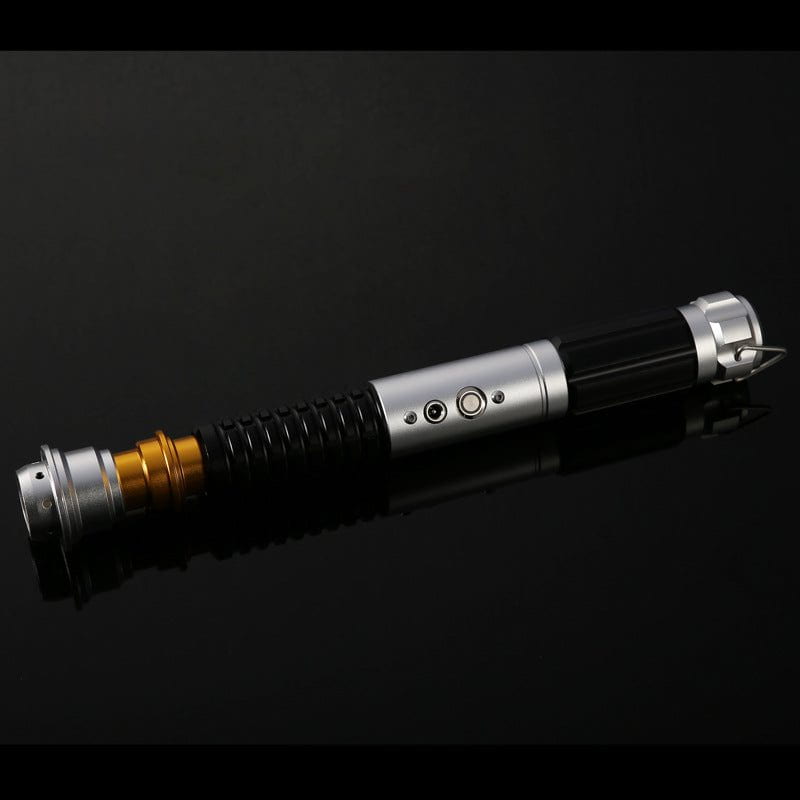
The hilt below carries no colour at all until you set one. That is the real version of the question: not “can I get white”, but “does white survive the tube”.
The One Place the Fiction and the Hardware Agree
White is the hardest colour in the fiction and also the hardest on a real blade, for two completely unrelated reasons — and that coincidence is the only thing the two lists share.
In the fiction, white is hard because it requires undoing a corruption. In a tube, white is hard because it requires every channel at once.
RGB mixing is what it sounds like. White is red, green and blue all at full output, so any channel running slightly weak shifts the result off-white.
Yellow and orange sit right behind it. Both are two-channel mixes at high output, so both inherit the same weakness, and both are the colours most often described as looking washed out.
A second failure mode appears only on strips that carry a dedicated white die. On some of those, the blue channel also excites the white phosphor, adding light where none was asked for.
A third limit is resolution. Strip-based blades control each channel in 8-bit steps, against finer control on high-power direct-drive builds, so the last bit of tuning is coarser.
And the pure white core that appears in films and in most product photography is largely a camera effect. In person the blade reads as a bright, slightly coloured column.
Atmosphere illustration — three separate sources merging into one pale glow (not a product photo).
| Colour | How a blade makes it | How hard it is to get right |
|---|---|---|
| Blue, green, red | Single channel dominant | Easy — the tube has headroom |
| Purple | Red and blue mixed | Moderate — balance is visible |
| Yellow | Red and green near full | Hard — drifts orange or lime |
| Orange | Red at full, green well under | Hard — drifts red or amber |
| White | All three channels full | Hardest — any weak channel tints it |
The blade mechanics behind that table are covered in how blade colour actually works.
What to Order If You Want the Rare-Looking One
If you want the blade that reads as rare in a room, order white or yellow and expect to spend a little time tuning. If you want it to look right in photographs, order blue, green or red and stop there.
White is the one that gets a reaction, because almost nobody sees one in person. That is the same reason it is the one most likely to disappoint on arrival.
Purple is the safer unusual choice. It is uncommon enough to stand out, and the two-channel mix is far more forgiving than a full white.
Orange is worth it only if you specifically want that character’s look. It is the most temperamental of the rare colours and the one most likely to read as red.
The general guide to which colours are canon and what each one means is here, and the orange and yellow blades have their own technical pages.
FAQ
Q1: What is the rarest lightsaber colour?
A: White, if you mean the rarest colour a person can choose to make — at least four named characters in canon have carried one. Black is rarer as an object, with a single blade. Pink is rarer by a strict user count, at zero named users.
Q2: Is black or white rarer?
A: Black is rarer as an object and white is rarer as an achievement. Only one black blade was ever forged, and it has since been destroyed. White has a short roster of named users, but that roster grows.
Q3: Has anyone had a pink lightsaber?
A: No named character in canon has carried one. Pink appears as a player colour option in two games and on unnamed background characters in an animated series. The old Expanded Universe did assign magenta to named people.
Q4: How many people have had a white lightsaber?
A: At least four named characters in canon, including Ahsoka Tano, Jora Malli and Orla Jareni. A later comic run adds Luke Skywalker. Every case involves purifying a crystal that had been turned red.
Q5: Why is white so rare?
A: Because getting it requires undoing a corruption rather than picking a colour. Someone has to take a crystal that was forced to red and bring it back, which the fiction frames as an act of compassion rather than strength.
Q6: Is the Darksaber a lightsaber?
A: Yes. It is a lightsaber with a flattened blade made by different focusing geometry, forged about a thousand years before the Skywalker era. It is treated as a relic because of who made it, not because it is a different kind of weapon.
Q7: Does the Darksaber still exist?
A: No. It is destroyed in a later series, which leaves the black blade with no surviving example and removes the possibility of counting it going forward.
Q8: Was orange a canon colour before Ahsoka?
A: No. Orange existed in games and in the old Expanded Universe with no canon user for decades. Two characters in a 2023 series gave it a canon roster in a single appearance.
Q9: Is yellow rarer than purple?
A: Purple is rarer by named users — seven in canon. Yellow is institutional rather than rare, because an entire order of Temple Guards carries it, which makes it unusual without being scarce.
Q10: Can you buy a lightsaber in any colour?
A: Yes, on any lit blade with RGB control. Colour is a setting rather than a part, so there is no shortage of white, pink or any other hue. What varies is how accurately each colour renders.
Q11: Which colour is hardest to make on a real blade?
A: White, because it needs all three channels at full output and any weak channel tints it. Yellow and orange are next, since both are two-channel mixes at high output that drift easily.
Q12: Do I need to pick a colour when I order?
A: No. Choose the hilt for how it feels and handles, and set the blade colour afterwards. The colour you settle on is usually not the one you ordered for.
The short version: white wins if you count difficulty, black wins if you count objects, pink wins if you count names — and none of the three applies to a blade whose colour is a setting.
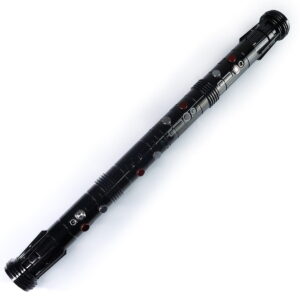
ISABER Double Bladed Lightsaber — RGB Baselit / Xenopixel Staff Saber
Accessories / RGB & Baselit Lightsabers