
Qimir’s lightsaber is a red-bladed hilt that comes apart in the middle, and the lower half is a second, shorter saber. That second blade sits inside the main hilt and points the same direction, so nothing gives it away until the two halves separate.
The Star Wars Databank describes it in one line: “a hidden dagger that can be deployed when the hilt is separated into two parts.”
Qimir is the character The Acolyte calls The Stranger. He is not the season’s only mystery, but his weapon is the part people keep asking about, because it breaks a rule most of us assumed was fixed.
This page takes the hilt apart, starting with what the split does and what the second blade is, then separating what the show confirms from what we can only infer, and finishing on what a replica has to get right.
What’s on This Page
- The Short Answer: One Hilt, Two Blades
- The Hilt: What the Split Actually Does
- The Hidden Blade: Shoto, Lightdagger, or Dagger
- Two Crystals in One Tube
- The Geometry of Deception
- Cortosis: Why Jedi Blades Failed
- What He Did With It on Khofar
- What a Replica Has to Get Right
- FAQ
The Short Answer: One Hilt, Two Blades
Qimir’s saber is a split hilt with two emitters and two blades, and the smaller blade is hidden inside the larger one rather than mounted beside it. The design exists to deceive, and it works because every other two-blade saber shows its second blade before the fight starts.
Maul’s saberstaff joins two full sabers end to end. The Inquisitor’s ring saber spins two blades on a circle. Cal Kestis splits one hilt into two full-length halves.
All three announce themselves, and Qimir’s does not.
His hilt is long for a single blade, which is the first clue, and that length is not decoration: it is the housing for the second set of parts.
| Weapon | Second blade | Visible before use | What it is for |
|---|---|---|---|
| Darth Maul’s saberstaff | Full length, opposite end | Yes | Reach and continuous attack |
| Inquisitor’s ring saber | Full length, spinning ring | Yes | Intimidation and aerial attacks |
| Cal Kestis split saber | Full length, splits into two hilts | Yes | Switching between staff and dual wield |
| Qimir’s split hilt | Short, hidden inside | No | One surprise strike at close range |
The table is the whole argument in four rows, because three of these weapons are built for reach and one is built for a moment.
The Hilt: What the Split Actually Does
The hilt separates into two working halves, and each half has its own emitter, so the lower section is not a battery compartment or a spare grip. It is the front end of a second saber.
The order in the fight is the tell: he does not swing the long blade and reveal a second one behind it, but breaks the hilt apart first and brings the short emitter into line while the opponent is still tracking the long one.
On screen the body is dark, angular, and squared off at the emitter rather than round, with a pronged ring around the main opening and a grooved grip section lower down. That shape is unusual for a Jedi hilt and closer to a Sith design than the films usually allow.
The split point sits above the grip, which matters for the hand. If the joint were inside the grip area, the two halves would shift under load during a bind. Moving it forward keeps both halves solid where the fingers are.
The lower emitter is the whole trick, a real emitter mounted in line with the main one that only clears the body when the joint opens.
The Hidden Blade: Shoto, Lightdagger, or Dagger
The short blade is best described as a shoto, which is the standard term for a lightsaber built shorter than a standard one, and the Databank’s own word for it is dagger.
Shoto has a long history in Star Wars: Yoda carried one as his main weapon because a full-length hilt did not suit his reach, and Ahsoka Tano carried a second in her off hand, a pairing of long and short blades that has its own name in Jar’Kai.
What is new here is not the shoto but the storage.
Ahsoka’s second blade is a separate hilt on her belt, Yoda’s is the weapon in his hand, and Qimir’s sits inside his main weapon, dark until the moment it is not.
| Term | What it means | Usual role |
|---|---|---|
| Shoto | A lightsaber built shorter than standard | Primary weapon for a shorter wielder, or off-hand blade |
| Jar’Kai | The practice of using two blades at once | Combined attack patterns with two hands |
| Lightdagger | A dagger-sized blade, not a standard form | Concealment and a single close strike |
| Tràkata | Switching a blade off and on during a duel | Breaking an opponent’s timing |
Those four words get mixed up constantly in comment sections. They are not the same thing, and only two of them describe a physical object.
Two Crystals in One Tube
The most likely reading is two kyber crystals, one for each blade, because a single crystal drives a single blade in every other saber we have seen on screen.
That is inference rather than a published schematic, since Lucasfilm has not explained the internals, so we should mark the line between what is shown and what is worked out.
| Claim | How firm is it | Basis |
|---|---|---|
| The hilt separates into two working parts | Confirmed | Shown on screen, and named in the Databank entry |
| The lower part fires its own blade | Confirmed | He uses it as a blade, not as a club |
| Both emitters point the same way | Confirmed by the action | The short blade emerges on the long blade’s line |
| Two kyber crystals | Inference | One crystal per blade is the pattern everywhere else |
| Two full power cells | Inference | The short blade’s size would allow a smaller cell |
The distinction matters if you are building or buying a replica. A hilt that splits into two handles is easy. A hilt that splits into two lit sabers needs two complete blade assemblies in one tube, and that is the part that costs.
Maul’s saberstaff is the closest precedent, since it also carries two crystals. His layout puts them end to end and fires them in opposite directions. Qimir’s fires both forward, which is a harder packaging problem.
The Geometry of Deception
The hidden blade works because of what an opponent has already learned in the first few seconds, and that lesson is the long blade’s reach.
A duelist tracks the weapon that threatens them, so once the long blade is registered the short one stays invisible until it is closer than the guard.
The fight plays this out exactly: Jecki Lon shatters his mask and believes she has taken his advantage, and he separates the hilt and puts the short blade into her three times while her guard is still set against the long one.
His wider style supports the trick, since he leans on Form VII, the aggressive and unpredictable form, and mixes in Jar’Kai once both blades are out.
The third element is Tràkata, the forbidden technique of snapping a blade off mid-swing to break an opponent’s parry, then bringing it back. It is a timing trick, and hiding a whole blade is the same idea taken one step further.
None of it is about strength, and all of it is about what the other person thinks they know.
Cortosis: Why Jedi Blades Failed
Qimir’s helmet and off-hand gauntlet are made of cortosis, a material that shorts out a lightsaber on contact and turns a blade into a brief dead weight.
Cortosis is old Expanded Universe material, and The Acolyte is its first live-action appearance. It works by disrupting the blade’s plasma loop long enough to matter, then failing.
The show keeps it limited on purpose, and the writers describe it as brittle, scarce, and short lived, effective for something close to a minute, which is why the helmet comes off.
The armour is deliberately partial: his gauntlet covers one arm, his helmet covers his head, and the rest of him is cloth, a character choice rather than a budget one, because he expects nobody to land a hit.
The helmet does a second job, hiding his face and blocking a Force user from reading him, which is why nobody identified him before the mask broke.
What He Did With It on Khofar
Episode five, “Night,” is where the weapon is used in full, and the sequence is one long ambush in a forest rather than a duel with an intermission.
The squad comes to Khofar looking for a Wookiee Jedi and finds Kelnacca already dead. Qimir engages them in the trees, and the fight becomes a running massacre.
By the end, the named casualties are Jecki Lon and Yord Fandar: Jecki dies on the hidden blade, and Yord dies to a broken neck rather than a saber, a detail worth noticing because he does not need the weapon for everyone.
Master Sol survives, and so do Osha and Mae, while the wider squad does not.
The episode also settles the character question, because the Stranger removes his helmet and turns out to be Qimir, the man who had been selling Mae her supplies.
What a Replica Has to Get Right
Four things separate a real split hilt from a decorative one: the joint stays rigid when assembled, the second emitter is real, the short blade is short on purpose, and the body stays dark and angular.
Start with the joint, because a hilt that wobbles at the seam will not survive a swing, let alone a bind, and most two-part hilts fail here rather than at the electronics.
The second test is the emitter, since a lower half that only produces a grip makes the prop a look-alike rather than a working design.
Then check the blade length, because the short blade is meant to be a dagger, and a replica that ships a pair of equal blades has missed the geometry that makes the trick work.
Last is the finish: the screen hilt is dark, squared, and worn at the edges, while a polished silver body reads as a different character.
We looked at this design because we build character hilts, and the split is the hardest part of it.
Our own version is not on the site yet, so there is nothing to point you at today. When it lands, it will sit with the rest of our Sith and dark-side hilts, and we will say here what it actually does.
FAQ
Q1: How does Qimir’s lightsaber work?
A: The hilt separates into two parts, and the lower part is a complete short saber with its own emitter. The small blade is stored inside the main body and only clears it when the joint opens.
Q2: Does Qimir’s lightsaber have two kyber crystals?
A: Most likely yes, since each blade needs its own crystal, emitter and power cell. Lucasfilm has not published the internals, so treat this as a strong inference rather than a confirmed spec.
Q3: Is Qimir a Sith?
A: He refuses the label. His own line is that the Jedi might call him Sith, and the show frames him as something outside both orders, which is part of why his weapon breaks their rules.
Q4: Who did Qimir kill with the hidden blade?
A: Jecki Lon, in episode five. She had just shattered his mask, and he separated the hilt and stabbed her three times while she guarded against the long blade.
Q5: Why didn’t the Jedi’s blades cut through Qimir’s helmet?
A: The helmet is cortosis, which shorts out a lightsaber on contact. The effect is brief and the material is brittle, so it buys seconds rather than immunity, and the helmet can still be knocked off.
Q6: What lightsaber form does Qimir use?
A: He leans on Form VII, the aggressive form, and mixes in two-blade work once the hilt is split. He also uses Tràkata, the forbidden habit of switching a blade off mid-duel.
Q7: Is the hidden blade a shoto or a dagger?
A: Both words fit and they describe different things. Shoto means a shorter lightsaber. Dagger describes how short it is and what it is for. The Databank uses dagger.
Q8: Are there other lightsabers with a hidden blade?
A: Not in live action before this one. Yoda and Ahsoka both carried short blades, but as separate hilts on the belt or in the hand, never housed inside the main weapon.
Q9: Does the hilt still work as one saber when assembled?
A: Yes. He fights most of the sequence with the hilt joined and a single long blade, and only splits it when the surprise is worth more than the reach.
Q10: Can you buy a Qimir lightsaber?
A: Split-hilt replicas exist, and the things to check are the joint, whether the second emitter actually fires, and whether the short blade is genuinely short. A hilt that only splits into two handles is not the same prop.
Nihilus and the blade of hunger
Every generation of the spinning blade
The seven forms and what each asks of a hilt
Double blades, and why two ends change the balance
Conclusion
Qimir’s saber is not a stronger weapon than Maul’s or the Inquisitor’s; it is a better ambush.
The design spends its length on concealment instead of reach, then cashes that in once, at the range where a guard cannot reset.
If you are building one, the joint matters more than the paint. Our own split hilt is still in the workshop, and the honest version of this page is that the mechanism is the whole product.
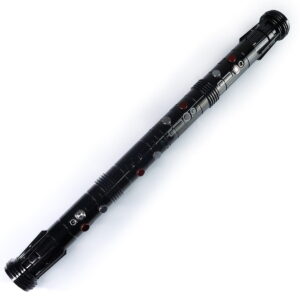
ISABER Double Bladed Lightsaber — RGB Baselit / Xenopixel Staff Saber
Accessories / RGB & Baselit Lightsabers
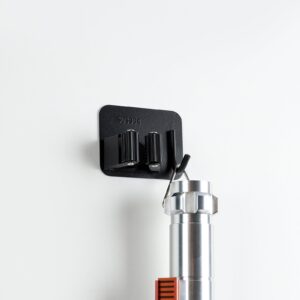
ISABER Wall Hung Saber Mount
No-drill wall mount that holds your saber hilt vertically - clamp arms with adjustment knobs, metal support hook, and 3M adhesive backing.