A double-bladed lightsaber is a lightsaber variant that emits plasma blades from both ends of a single elongated hilt. Also called a saberstaff, lightstaff, or doublesaber, the weapon functions like a traditional quarterstaff in combat — two blades, one grip, and a fighting style built on sweeping arcs rather than precise thrusts.
The original design, dating back to the ancient Sith Empire and first wielded by Exar Kun, used a single internal mechanism powering two emitter matrices. Most modern replica saberstaffs take the simpler route: two independent hilts joined at the pommels by a threaded coupler. Each half has its own battery, soundboard, speaker, and blade — which means you get three configurations out of the box. Staff mode. Dual-wield mode. Single-saber mode.
This page is the full technical breakdown. Construction methods. Internal mechanics. The six coupler types and when to use each. Single-board vs dual-board electronics. Wall thickness, blade balance, and combat weaknesses. If it’s part of a double-bladed saber, it’s here.
What’s on This Page
- Anatomy: How a Saberstaff Is Built — single mechanism vs two joined hilts
- The Five Variants of Double-Bladed Sabers — standard, split, hinged, spinning, pike
- Coupler Types: The Joint That Makes the Staff — solid, vented, adjustable, quick-release, flush, extension
- Electronics: Single-Board vs Dual-Board Configurations
- Blade Specs: Length, Wall Thickness, and Balance
- Combat Characteristics and Dueling Tradeoffs
- Notable Saberstaff Wielders in Canon and Legends
- Which Setup Is Right for You?
- Frequently Asked Questions
Anatomy: How a Saberstaff Is Built
A double-bladed lightsaber is built one of two ways: a single integrated mechanism powering both emitters from one shared chassis, or two independent hilts joined by a threaded metal coupler. The distinction determines durability, balance, and whether you can ever split your staff into two single sabers.
| Construction Method | Single Integrated Mechanism | Two Hilts + Coupler |
|---|---|---|
| How it works | One power cell, one crystal chamber, one set of internal electronics driving two emitter matrices at opposite ends of a single hilt body. Everything shares one chassis. | Two fully independent sabers, each with its own battery, soundboard, speaker, and LED driver. The pommels are removed and replaced by a threaded metal coupler that joins them end-to-end. |
| Where it appears | Exar Kun’s original saberstaff. Satele Shan’s weapon (disabled entirely when cleaved in half — proof of single-mechanism design). Some high-end custom builds. | Darth Maul’s screen-used saber (continued functioning after being cut in half in TPM). Nearly every production saberstaff sold today, including ISABER’s own double-bladed models. |
| Balance | Evenly distributed. The internal mass sits at the center. Lighter overall because there’s only one set of electronics. | Center-heavy. Two full sets of electronics meet at the coupler, creating a noticeable mass concentration in the middle. Not worse — just different. Spinners often prefer it for the gyroscopic stability. |
| Repairability | Harder. Everything shares one chassis. A single component failure can take down both blades. | Easier. Each half is a self-contained saber. If one side’s speaker blows or its board fails, you still have a working single saber while you fix the other half. |
| Versatility | Staff only. No separation possible without destructive disassembly. | Three modes. Staff, dual-wield, single saber. Unscrew the coupler and you’ve got two independent weapons. |
The Five Variants of Double-Bladed Sabers
Five distinct double-bladed saber subtypes exist across Star Wars canon and Legends: standard saberstaff, split saber, hinged/switchblade, double-bladed spinning, and lightsaber pike. Each has a different mechanical signature that changes how the weapon fights, folds, or separates.
| Variant | Mechanism | Notable Wielders | Key Trait |
|---|---|---|---|
| Standard Saberstaff | Single elongated hilt or two joined hilts. Both blades always aligned on the same axis. | Darth Maul, Savage Opress, Bastila Shan, Satele Shan | The classic. Two blades, one weapon. The silhouette everyone pictures when you say “double-bladed lightsaber.” |
| Split Saber | Locking mechanism at the coupler allows the two halves to separate and rejoin mid-combat. Each half is a fully functional single saber. | Asajj Ventress, Cal Kestis, Komari Vosa | Versatility is the point. Fight staff-style against multiple opponents, then split and dual-wield against one. Ventress’s paired curved hilts could fight independently or snap together into a staff. |
| Hinged / Switchblade | A hinge at the coupler lets the two blades fold parallel to each other or lock at an angle. When folded, the blades are side-by-side; when open, standard staff configuration. | Pong Krell (dual hinged), Jedi Temple Guards, Dark Rey (vision) | Folding changes everything. Temple Guards used the folded configuration for compact carry. Pong Krell wielded two of these simultaneously — four blades total. Dark Rey’s vision showed a hinged red staff that snapped open with a mechanical click. |
| Double-Bladed Spinning | Emitter assembly mounted on a rotating disc. Blades spin independently along a circular track while the hilt remains stationary. Micro repulsorlifts in some models enable limited flight. | Grand Inquisitor, Fifth Brother, Seventh Sister, Eighth Brother, Third Sister (Reva) | The Inquisitorius signature. Spinning blades create a terrifying visual and a deadly cutting radius. The exposed emitter disc is the weapon’s critical weakness — slice through it and the entire saber flies apart. |
| Lightsaber Pike | Extended-length hilt (longer than a standard staff) with proportionally shorter blades on each end. Often features a pointed or weighted pommel for thrusting. | Jedi Temple Guards, Kazdan Paratus | More reach than a staff. The longer hilt provides more grip positions — you can choke up for close work or extend for maximum range. The shorter blades keep the overall weapon manageable. |
Coupler Types: The Joint That Makes the Staff
The coupler is the single most important piece of hardware on a two-hilt saberstaff. Six distinct types exist — solid, vented, adjustable, quick-release, flush, and extension — and the wrong one ruins balance, blocks sound, or comes loose mid-swing.
| Coupler Type | What It Does | Use Case | Tradeoff |
|---|---|---|---|
| Solid Coupler | Simple threaded metal cylinder. No holes, no vents. Screws into both pommel sockets to create a rigid mechanical connection. | Stunt sabers without sound. Display-only staffs. Heavy dueling where joint rigidity is the top priority. | Maximum rigidity. Zero sound passthrough — if your hilt has speakers, they’ll be muffled to near-silence. Not usable with sound sabers. |
| Vented Coupler | Same threaded cylinder, but with machined slots, windows, or drilled holes that allow sound from in-hilt speakers to project outward through the center of the staff. | Any saberstaff with sound. This is the minimum requirement if both hilts have speakers and you want to hear them. | Slightly less rigid than a solid coupler (the vent windows remove material). The difference is negligible in practice — a well-machined vented coupler won’t flex under normal dueling forces. |
| Adjustable Coupler | Multi-piece design with a set screw or locking ring. Thread each half onto the coupler, then rotate to align the activation buttons and Covertec wheels on both hilts before tightening the lock. | Any staff where button alignment matters — which is most of them. Without adjustability, your buttons end up at random clock positions when the threads bottom out. | Slightly more complex setup. Once locked, alignment stays put. Most mid-range and premium couplers include adjustability as a standard feature. |
| Quick-Release Coupler | Push-button or twist-lock mechanism that lets you separate the two hilts without unscrewing threads. Connect and disconnect in under a second. | Cosplayers who switch between staff and dual-wield mid-event. Duelists who want the option to split on the fly. Anyone who values speed over absolute rigidity. | Convenience vs rigidity. Quick-release mechanisms have a tiny amount of play by design. Not enough to matter for spinning or light sparring, but heavy dueling purists will feel the micro-movement and hate it. |
| Flush / Low-Profile Coupler | Sits nearly flush with the hilt body, minimizing the visual gap between the two connected sabers. Often lacks venting and adjustability — form over function. | Display and photography. Screen-accurate Maul staff replicas where the visible gap between hilts needs to be minimal. | Cleanest look. Fewest features. Check whether your sabers need venting or button alignment before committing to a flush coupler. |
| Extension Piece | Longer than a standard coupler. Adds length between the two hilts, changing the overall staff proportions. Some have windows that double as exposed crystal chambers for customization. | Taller users who need more hand space between blades. Custom builders adding a center crystal reveal chamber to a staff build. Flow artists who want extra leverage. | Added length = added rotational inertia. Can improve spin stability. Makes the staff noticeably harder to transport and store. |
Coupler Compatibility at a Glance
Different brands use different thread pitches. A coupler from one brand may not fit another brand’s hilts. Always verify thread compatibility before buying.
Electronics: Single-Board vs Dual-Board Configurations
A saberstaff runs one of two electronic architectures: dual independent (each half has its own soundboard, speaker, and battery — the most common approach in production staffs) or single-board (one central board drives both blades simultaneously). The choice determines whether you can ignite blades independently, separate the staff into two sabers, and how clash detection works.
| Factor | Dual Independent Setup | Single-Board Setup |
|---|---|---|
| Architecture | Each hilt has its own soundboard, speaker, battery, and LED driver. Two complete sabers sharing a coupler. | One soundboard mounted in the center of a purpose-built hilt, wired to two speakers (one facing each end) and two LED connectors. |
| Blade ignition | Independent. Ignite one side, both sides, or stagger them however you want. Each blade is controlled by its own board. | Simultaneous. Both blades on, or both blades off. Single activation signal goes to both emitters. |
| Flash-on-Clash | Works properly on both ends. Each board detects impact independently and triggers its own flash. | Only one flash unless specially wired with separate clash sensors and a board that supports multi-channel FoC output. |
| Sound | Two independent sound systems. Both play simultaneously through vented pommels or a vented coupler. Community testing confirms the two boards don’t interfere when set to the same font. | One sound source split to two speakers. Quieter per speaker (power divided) but perfectly synchronized. Sound vents must be built into the center body, not the pommels. |
| Battery | Two separate 18650 cells — one per hilt. Each charges independently via its own USB-C port. Carry a spare for each. | Single larger-capacity battery (or parallel 18650 pack) powering everything. One charge port. Heavier draw — Neopixel strips at both ends pull roughly double the current. |
| Separability | Full. Unscrew the coupler and you’ve got two working single sabers. Each has its own battery, board, and speaker. This is the entire point of the design. | None. The staff is a single unified hilt. You can’t split it into two working sabers because there’s only one board. |
| Cost | Higher — you’re buying two complete sabers plus a coupler. | Lower — one board, one battery setup, no duplication. |
| Board recommendations | Xenopixel V3, Proffie 2.2, Golden Harvest V3. Use the same board model in both halves with the same sound font so the audio doesn’t clash. | Crystal Focus 7.5/8 (Trident feature for staggered ignition delay between blades). Nano Biscotte for simpler builds. |
Dual-Board vs Single-Board: Signal Flow
Blade Specs: Length, Wall Thickness, and Balance
Blade choice on a saberstaff matters twice as much as on a single saber — you’ve got two of them and they both affect balance. Length determines total reach. Wall thickness determines durability. And Neopixel vs baselit determines weight by a factor of roughly 30–40%.
Blade Length: Reach vs. Control
Wall Thickness: Weight vs. Durability
| Wall Thickness | Weight | Light Output | Durability | Recommendation |
|---|---|---|---|---|
| 2mm (standard) | Lighter | Slightly brighter — thinner wall absorbs less light | Fine for display, photography, and pulled-contact choreography | Baselit staffs for dueling. Neopixel staffs for display and cosplay — the LED strips inside can’t take hard impacts regardless of wall thickness. |
| 3mm (heavy-grade) | ~30% heavier | Slightly dimmer — thicker wall absorbs more light | Handles recreational sparring and moderate contact. The extra rigidity protects internal LED strips from flex damage. | Any staff that will see blade-to-blade contact. The weight penalty is real but the protection is worth it if you’re sparring. |
Blade Weight Comparison: Baselit vs Neopixel (32″ blades)
Neopixel blades are 30–40% heavier than baselit due to the LED strip, foam diffuser, and additional internal structure. On a staff, two Neopixel blades add roughly 150–200g more total tip weight than two baselit blades — enough to noticeably shift the center of balance away from the grip.
Combat Characteristics and Dueling Tradeoffs
The saberstaff is a quarterstaff first and a sword second. It fights differently from a single saber in six distinct ways — and each advantage has a matching weakness you need to know before you face an opponent.
| Characteristic | Advantage | Weakness |
|---|---|---|
| Reach | Forward and backward coverage simultaneously. Can engage multiple opponents from multiple angles without repositioning. | The long lever means your opponent knows where the blades will be. Predictable arcs. A fast opponent can slip inside your radius. |
| Defense | Excellent parrying surface area. Two blades cover more deflection angles than one. The rotational momentum makes sweeping parries effortless. | Open center. The middle of your body is unprotected during most staff positions. Blocking your centerline is nearly impossible without compromising blade position. |
| Offense | Rapid consecutive strikes from alternating ends. The recovery from one swing flows naturally into the wind-up for the next. | No vertical strikes. Overhead swings drive the opposite blade toward your own body. Thrusting with one blade brings the other blade awkwardly close to your side. |
| Locking | You can trap an opponent’s blade between both of yours at the coupler — a leverage position that’s hard to escape. | If an opponent locks up one half of your staff, the entire weapon is neutralized. You can’t pivot the locked blade without moving the other one too. |
| Learning curve | Once mastered, the staff is one of the most fluid and visually impressive weapon forms in lightsaber combat. | Steep. Untrained users genuinely risk self-injury. The opposite blade is always behind you, and forgetting that for half a second is how you Darth Maul yourself. |
| Spinning / flow | Staff format is designed for rotation. Balanced weight distribution. Long lever arms. Predictable gyroscopic behavior. The weapon that flow arts were built for. | Contact moves (body rolls, neck wraps) are significantly harder with a staff than a single saber. The extra length changes every pivot point. |
For heavy dueling: Baselit electronics, 3mm heavy-grade blades, fixed or tightly-locked coupler. Neopixel strips fracture under repeated hard impacts regardless of blade wall thickness — it’s not a question of if, it’s when.
For choreography and spinning: Lighter blades (28″ or 32″), a quick-release coupler for flexibility, and the brightest Neopixel you can afford. The visual payoff is why you built a staff in the first place.
Notable Saberstaff Wielders in Canon and Legends
Twelve wielders defined the double-bladed lightsaber across Star Wars history. From Exar Kun (the inventor) to Cal Kestis (the modern inheritor), each brought a distinct mechanical variant and fighting philosophy to the weapon.
| Wielder | Era | Saberstaff Type | Notable Detail |
|---|---|---|---|
| Exar Kun | Old Sith Wars (Legends) | Standard — single mechanism | Inventor of the double-bladed lightsaber. Converted his Jedi saber into the first saberstaff using schematics from a Sith holocron. His design used a single internal mechanism in a standard-length hilt — not two sabers joined together. |
| Darth Maul | Fall of the Republic | Standard — two joined hilts | The most iconic saberstaff wielder. His weapon continued functioning after being cut in half by Obi-Wan on Naboo, proving it was two independent sabers coupled together. Red synth-crystal blades. Aggressive Juyo-form combat style. |
| Savage Opress | Clone Wars | Standard | Maul’s brother and apprentice. Wielded a larger, heavier saberstaff proportional to his size. Raw power over technique. |
| Asajj Ventress | Clone Wars | Split Saber — curved hilts | Two curved-hilt sabers that could join at the pommels to form a staff, or separate for dual-wielding. The curved grip improved point control in single-saber mode. One of the few wielders who regularly switched between configurations mid-combat. |
| Bastila Shan | Jedi Civil War (Legends) | Standard | Yellow double-bladed saber. One of the few Jedi to openly wield a saberstaff despite the Jedi Council’s disapproval of the weapon as “too aggressive.” Her battle meditation ability paired naturally with the staff’s area-control fighting style. |
| Satele Shan | Great Galactic War (Legends) | Standard — single mechanism | Descendant of Bastila. Her saberstaff was cleaved in two by Darth Malgus and the entire weapon went dead — confirming it used a single integrated mechanism rather than two independent hilts. |
| Pong Krell | Clone Wars | Dual Hinged | Wielded two folding saberstaffs simultaneously — four blades total. Each could fold to operate as a single saber or open into staff configuration. The only known Jedi to dual-wield saberstaffs. |
| Cal Kestis | Imperial Era | Split Saber | Repaired his master Jaro Tapal’s damaged double-bladed saber on Ilum, combining it with Cere Junda’s hilt. Can operate as a single blade, staff, or two independent sabers. Player-configurable blade color. |
| Jaro Tapal | Clone Wars | Split Saber | Cal Kestis’s Jedi Master. His double-bladed saber was damaged during Order 66 and later repaired by Cal. The weapon’s split-saber mechanism passed to Cal. |
| Jedi Temple Guards | Clone Wars & High Republic | Hinged Pike | Anonymous Jedi security force. Uniform yellow-bladed hinged pikes that fold for compact carry and open into full-length staffs. The anonymity of the mask combined with the uniform weapon created an imposing, institutional presence. |
| The Inquisitorius | Imperial Era | Double-Bladed Spinning | Grand Inquisitor, Fifth Brother, Seventh Sister, Eighth Brother, Third Sister (Reva). Dark-side Force-sensitive hunters under Darth Vader. Their spinning saberstaffs doubled as intimidation tools and limited-use flight devices via micro repulsorlifts. |
| Dark Rey | New Republic Era (Vision) | Hinged | A vision of Rey corrupted to the dark side. Her hinged red staff snapped open with a mechanical click. Dual-blade configuration with a distinctive folding mechanism. |
Which Setup Is Right for You?
Electronics Tier Decision
Get a two-hilt + coupler setup if you want three configurations from one purchase (staff, dual-wield, single saber) and don’t mind the center-heavy balance.
Get a baselit staff if you plan to duel. Hollow blades survive impacts. Neopixel strips don’t. This isn’t opinion — it’s a mechanical reality of flexible PCBs under repeated shock.
Get a Neopixel staff if you’re building for conventions, choreography, or photography. The synchronized scrolling ignition on both ends is the single most visually dramatic effect in lightsabers.
Start with a vented adjustable coupler. It covers the two non-negotiable requirements — sound passthrough and button alignment. Upgrade to quick-release or flush later if your use case demands it.
Keep Reading
- Neopixel Lightsabers — Complete Technical Guide — how the electronics inside your blades actually work
- Lightsaber Blades — Materials, Lengths, and Wall Thickness — pick the right blade for your fighting style
- Neopixel vs RGB vs Xeno3 vs Proffie — Full Comparison — which soundboard belongs in your hilt
- Lightsaber Sound Fonts — Complete Reference — 30+ fonts compared, plus custom installation
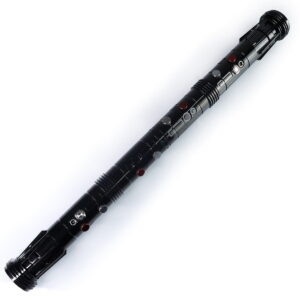
ISABER Double Bladed Lightsaber — RGB Baselit / Xenopixel Staff Saber
Accessories / RGB & Baselit Lightsabers
Frequently Asked Questions
Q1: What’s the difference between a saberstaff and a double-bladed lightsaber?
A: Nothing. They’re the same weapon. “Saberstaff,” “double-bladed lightsaber,” “lightstaff,” “doublesaber” — all different names for a lightsaber that emits blades from both ends of a single hilt. The real distinctions are between the five sub-types (standard, split, hinged, spinning, pike), not the terminology.
Q2: Can I connect any two single lightsabers to make a staff?
A: Only if they share the same pommel threading and you have a compatible coupler. Different brands use different thread specs, and even within the same brand, some models use proprietary threading. The safest approach: buy two identical hilts from the same manufacturer and use their recommended coupler. Mixing brands is a gamble that usually doesn’t pay off.
Q3: Do I need a soundboard in both halves?
A: No, but you’ll notice the difference. A sound/stunt hybrid (one side with sound, one without) works and saves money. The speaker side provides audio for the whole staff if you’re using a vented coupler. The downside: strikes on the stunt side won’t reliably trigger clash sounds because there’s no accelerometer on that end to detect them. For the full experience — independent ignition, proper dual-side clash detection, and balanced weight — both halves need their own soundboard.
Q4: Which coupler type should I get?
A: If your sabers have sound, start with a vented adjustable coupler. It covers the two non-negotiable requirements: sound passthrough and button alignment. From there, decide based on use: quick-release for cosplay flexibility, solid for heavy dueling where rigidity is everything, flush for display photos.
Q5: Are Neopixel double-bladed sabers good for dueling?
A: No. The LED strips inside Neopixel blades fracture under repeated hard impacts. A single cracked solder joint on the flexible PCB creates dead pixels. A full PCB fracture kills the blade entirely. For heavy dueling with a staff, use baselit/RGB electronics with heavy-grade polycarbonate blades. Save the Neopixel staff for display, cosplay, choreography, and light sparring where strikes are pulled.
Q6: Why do some staffs separate into two sabers and others don’t?
A: It comes down to the construction method. Two-hilts-plus-coupler designs (Darth Maul style) separate naturally — each half is a complete saber. Single-mechanism designs (Exar Kun style) are built as one piece and can’t be split without destroying the internal electronics. Most production saberstaffs sold today use the two-hilt method specifically because buyers want the versatility.
Q7: What blade length should I get for a double-bladed staff?
A: 32″ (82cm) per blade is the sweet spot for most adults. The total staff reaches about 176cm (5’9″) tip-to-tip, which is manageable in standard-height rooms and balanced enough for spinning. Go 28″ if you prioritize speed and spin tricks or you’re under 5’8″. Go 36″ if you’re tall, want maximum screen accuracy, and have high ceilings. Remember: the blades are the heaviest part of the saber. Two 36″ Neopixel blades on a staff creates significant tip weight that will fatigue your wrists faster than you expect.
Q8: How do I carry a double-bladed lightsaber on a belt?
A: You don’t — not with both blades installed. A staff with full-length blades is over 5 feet long and completely impractical for belt carry. The standard approach: remove the blades, install a Covertec wheel on the hilt, and clip the hilt-only to a Covertec belt clip. Some cosplayers use a back sling or shoulder strap to carry the fully assembled staff. For conventions, a padded saber bag or hard case is the safest option.
Q9: Can a double-bladed lightsaber have two different blade colors?
A: Yes. Since each half of a two-hilt saberstaff has its own independent electronics and LED driver, you can set Hilt A to red and Hilt B to blue with zero technical barriers. In Star Wars canon, no character has wielded a multi-colored saberstaff — a Force-user is typically attuned to one kyber crystal, so both blades would naturally be the same color. In real life, your saber doesn’t care about canon. Set each side to whatever color you want.
Q10: Is a double-bladed saber harder to learn than a single saber?
A: Yes. The learning curve is real. With a single saber, you track one blade. With a staff, you track two, and the opposite blade is always behind you. Beginners routinely hit themselves on spins and overhead transitions. The widely-circulated advice: learn single-saber fundamentals first, then add the second blade. Expect it to take a few weeks of regular practice before the staff feels natural rather than like you’re fighting your own weapon.