
A Darth Maul replica is the one saber where two documented measurements of the original exist, and almost nobody compares them. The dueling prop was 21 inches. The hero prop was 28.5. Both are the same weapon, and which one a listing is copying decides how it handles.
Everything else about the weapon is well covered elsewhere. The two crystals, the colour, the history, the coupler mechanism and the electronics all have pages on this site and we link to them rather than repeat them.
This page does the arithmetic instead. Hilt plus two blades minus what disappears inside the emitters gives the staff you will actually hold, and once you can compute that number you can tell from a listing whether the finished weapon will read like his or like a long pole with two red ends.
What’s on This Page
- The Short Answer: Two Numbers, Not One
- What the Auction Records Actually Measured
- The 3.75 Inches the Records Give You
- What Replicas Ship Instead
- The Arithmetic Nobody Does
- Putting the Staff Next to Your Body
- The Problem With a 26-Inch Hilt
- Reading a Listing Before You Buy
- What Ours Measures
- FAQ
The Short Answer: Two Numbers, Not One
Check the hilt length first, and check it against two figures rather than one: about 21 inches for the prop used in a duel and 28.5 for the hero prop that sat in close-ups.
Those two props measure different things. The 21-inch hilt is the dueling body, built so Ray Park could move in it, with blades added later in post. The 28.5-inch figure includes a threaded rod protruding from each end, and that rod is the obvious place for a blade to sit over.
So a replica between 21 and 28.5 inches is not cheating. It is picking one of the two objects the production actually built, and the choice changes where your hands sit.
The reason it matters is leverage rather than taste: a staff is held near the middle, and every inch added to the hilt pushes your hands further apart while moving the balance point away from where your grip wants it.
What the Auction Records Actually Measured
Three props have been catalogued with dimensions, and the numbers cross-check each other closely enough to trust.
The dueling hilt came in at approximately 21 by 2 inches, cast in resin with machined metal end caps and an internal steel core. Activation buttons and raised details were sanded smooth, as they are on any prop meant to be struck.
The hero double-bladed saber measured 28.5 inches with the all-thread rod protruding at both ends, and 88.5 inches with both of its 33.75-inch aluminium blades installed.
A third, a stunt saber with functional blades and a signed letter of provenance, listed the hilt at 21 inches measured without the rods and 89 inches assembled with the blades fitted.
| Component | Measurement | What it was measured on |
|---|---|---|
| Hilt, dueling | 21 in / 53.3 cm | Resin body, CGI blades added in post |
| Hilt, hero | 28.5 in / 72.4 cm | Includes the threaded rod protruding at each end |
| Hilt, stunt | 21 in / 53.3 cm | Measured without the rods fitted |
| Blade | 33.75 in / 85.7 cm | Aluminium rod, fluorescent orange coated |
| Assembled, hero | 88.5 in / 224.8 cm | Both blades installed |
| Assembled, stunt | 89 in / 226.1 cm | Both blades installed |
Notice that the two assembled figures agree within half an inch even though the two hilts were catalogued three and a half inches apart. That is not a contradiction. It means one measurement included the blade mounting hardware and the other did not.
The 3.75 Inches the Records Give You
Subtract the assembled figure from the hilt plus two blades and the remainder is the overlap the mount used, which comes to 3.75 inches per end.
The arithmetic is worth writing out because it turns a specification you would otherwise have to guess into a number taken from a physical object.
Take the hero prop: 28.5 inches of hilt plus two 33.75-inch blades gives 96 inches. The assembled weapon measured 88.5. The difference is 7.5 inches, split evenly between the two ends.
This matters because every modern replica swallows blade the same way, and no listing tells you how much. Three inches per end is a reasonable assumption for a lit hilt, and the documented prop value is 3.75.
For the general anatomy of how a staff is assembled, the coupler types and the electronics options, our technical reference on double-bladed sabers covers all of it, and this page stays on length.
What Replicas Ship Instead
Across the staff sabers we surveyed, hilt lengths run from about 16.7 inches to 26, with 21.25 as the most common figure and 26 arriving on the premium dual-hilt models.
The short end is unusual and usually means a body that splits into two very compact singles. The long end is more common than it should be, and it comes from a design decision rather than a measurement of the original.
Vendors lengthen hilts because a longer body holds more controls, a bigger battery and a second board, and because a long staff photographs as more impressive in a listing image. None of those reasons have anything to do with the film props.
| Configuration | Hilt length | Which prop it matches | Against 28.5 in |
|---|---|---|---|
| Compact dual-hilt | 42.5 cm / 16.7 in | Neither, shorter than both | 59% |
| Common replica | 54 cm / 21.25 in | The 21-inch dueling hilt | 75% |
| Premium dual-hilt | 66 cm / 26 in | Between the two, closer to the hero | 91% |
| Hero prop, rod included | 72.4 cm / 28.5 in | The reference | 100% |
The bar is hilt length on a shared axis running from zero to the 28.5-inch hero prop, so the longest documented body fills it. A 21-inch hilt is about three quarters of that, which is the gap between the two objects the production built.
The Arithmetic Nobody Does
A blade does not add its full length to the weapon, because two and a half to three and a half inches of it disappears inside the emitter.
So the finished staff is the hilt, plus each blade, minus each insertion. Written out, that is hilt plus two blades minus twice the seat, and the answer is often five to seven inches shorter than the number a buyer has in their head.
Most listings give you the hilt length, the blade length and nothing else. The swallow is the hidden third number, and the documented prop value for it is 3.75 inches per end.
Here is the whole calculation for a 21.25-inch hilt with 36-inch blades, at a 3-inch seat on each end. Two blades give 72 inches. Remove six inches of insertion and 66 remain. Add the 21.25-inch hilt and the staff is 87.25 inches, which is under two inches short of the hero prop at 88.5.
That near-match is the useful part. A common replica hilt paired with the longest blades on the market reproduces the assembled length of the original almost exactly, because the two errors cancel.
The two grey ends of the hilt are blade you paid for and cannot see, sitting inside the body rather than outside it. The prop’s own figures put them at 3.75 inches, worth 7.5 inches of staff.
| Blade pair | Finished staff at a 21.25 in hilt | Against the hero prop’s 88.5 in |
|---|---|---|
| 28 in | 71.25 in | 17.25 in shorter |
| 32 in | 79.25 in | 9.25 in shorter |
| 36 in | 87.25 in | 1.25 in shorter |
Every figure in that table assumes a 3-inch seat on each end. Change the seat and the whole row moves by twice the difference, so a deeper emitter on your model can cost you another two inches.
Putting the Staff Next to Your Body
A staff is the only saber whose proportion you can check against your own body before you buy it, and the check is simply total length against your height.
A staff that stops at your chin and one that clears the top of your head by eight inches are both sold as double bladed sabers, and they handle nothing alike. The hilt lengths of the props are documented; the ratio of staff to wielder is not, because the props were built to a camera rather than to a person.
What you can do instead is compute your own number and stand next to it. Blade length is the lever, because it is the cheapest thing to change and the only part that swaps without tools.
Ceiling height is worth a thought before you pick the long pair. A staff that clears a standard door frame by four inches is a staff you will stop carrying through doorways for fun.
For the general question of how blade length should match the person rather than the character, our guide to blade length works through it for single sabers.
The Problem With a 26-Inch Hilt
A long body forces your hands apart, and that costs the move the whole weapon exists to allow, which is spinning it in front of the chest.
On a compact staff the hands sit close to the centre and the blades sweep in a tight circle. On a long one the hands separate toward the ends, the circle widens, and the middle of the staff becomes a section you cannot easily pass through your own grip.
There is a second cost. Two long halves mean two sets of controls, two boards and two grips competing for the same span, and the seam where the coupler sits ends up further from your body than the design intends.
Long hilts are not worse weapons. They are different ones, better suited to a person who wants a two-handed staff to plant and swing rather than a spinning double blade. That is a legitimate choice and it is not the dueling prop.
Reading a Listing Before You Buy
Four numbers tell you almost everything, and listings usually print two of them while leaving the other two to be inferred.
The first is hilt length, which is usually stated and is the one to compare against 21 and 28.5 inches. The second is blade length, which is usually stated as a single number and needs doubling.
| What the listing says | What it implies | What to check |
|---|---|---|
| Hilt length | How far apart your hands will sit | Whether it is copying the 21 or the 28.5-inch prop |
| Blade length | Only half of the staff length | Whether the pair is included or sold separately |
| Blade diameter | Which blades fit later | 7/8 inch is standard, 1 inch limits your options |
| Weight, assembled | Whether it will be spun or planted | Around two kilos is normal for a metal staff |
The third and fourth are the ones that go missing. Blade diameter matters more than it looks, because a 1-inch emitter locks you out of the most common blade size on the market when you eventually want a replacement.
Weight should be read as an assembled figure. A staff below two kilograms is light enough to spin for a full evening, and one well above it starts to be a display piece that also comes outside.
What Ours Measures
Ours is a metal-bodied staff with a solid centre coupler, 36-inch blades and two electronics tiers, and it unscrews into two independent sabers.
The coupler is the part we care most about, because a plastic joint is what makes a long staff feel like two separate objects that happen to touch. A metal one keeps the assembly rigid enough that leverage passes through the seam instead of flexing at it.
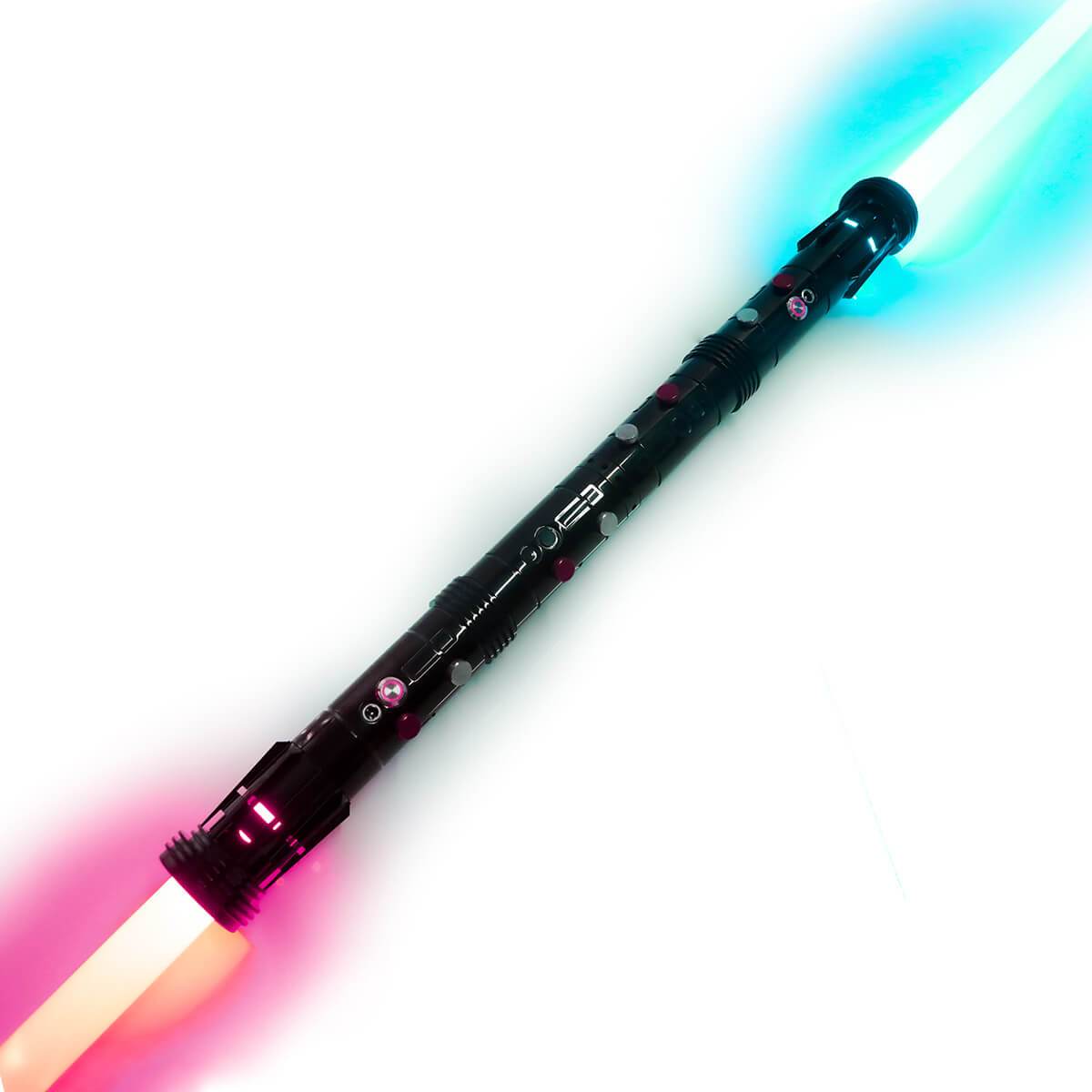
The blades are 36 inch, so the assembled staff is long, and that is a deliberate trade rather than an oversight. Long blades give reach and a wide silhouette, and a buyer who wants the tighter proportion can run a shorter pair on the same body.
Two electronics tiers are available. RGB baselit is the one to pick for contact, because nothing electronic lives inside the blade. Xenopixel puts a strip in the tube for a brighter and more even blade, and it is better kept for display and light sparring.
Because each half runs its own board, the two ends can sit on different colours at once, which is the quickest way to see for yourself that red here is a setting and not a finish of the metal.
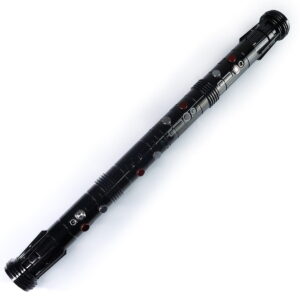
ISABER Double Bladed Lightsaber — RGB Baselit / Xenopixel Staff Saber
Accessories / RGB & Baselit Lightsabers
FAQ
Q1: How long was Darth Maul’s lightsaber hilt?
A: Two figures are documented from the props. The dueling hilt was about 21 inches and the hero hilt was 28.5 inches including a threaded rod protruding at each end. Assembled with both 33.75-inch blades, the hero saber measured 88.5 inches.
Q2: Why is my staff shorter than the listing suggested?
A: Because part of each blade sits inside the emitter. Add the hilt to twice the blade length and subtract twice the seat. The prop’s own measurements put that seat at 3.75 inches per end, so a replica at three inches loses six inches of staff.
Q3: Is a longer hilt better?
A: Not for this weapon. A longer body separates your hands and widens the rotation, which costs the spinning move the staff exists for. Long hilts suit a planted two-handed style, which is a different design.
Q4: What is the balance point of a staff?
A: The middle of the assembled length, assuming both halves are the same. On an 87-inch staff that is about 43.5 inches from either end, which is why total weight matters so much.
Q5: 28, 32 or 36 inch blades?
A: 36 on a 21-inch hilt lands within an inch and a half of the prop’s 88.5-inch assembled length. 32 gives a shorter, quicker staff, and 28 makes it compact enough for low ceilings.
Q6: Does blade diameter matter?
A: Yes, because it decides what fits later. Seven eighths of an inch is the common standard, and a one inch emitter narrows your replacement options considerably.
Q7: How heavy is a metal staff saber?
A: Around two kilograms assembled for a metal body with two blades, with the hilt alone usually between 0.7 and 1.0 kilograms. Anything much heavier becomes a display piece.
Q8: Baselit or pixel blades for a staff?
A: Baselit for anything involving contact, because the blade is a hollow tube with nothing to crack. Pixel blades are brighter and more even, and they belong to display and light sparring.
Q9: Can it split into two sabers?
A: The version we sell can, and so can most premium staffs. Check that each half has its own battery and board, because a split that leaves one half dead is not really two sabers.
Q10: Is the red the right red?
A: That depends on the emitter rather than the character. Red shades from 620 to 660 nanometres look noticeably different, and the deeper end is closer to the films and dimmer.
Q11: What should I measure first on a staff I already own?
A: Measure the hilt with no blades fitted, then measure how far one blade seats into the emitter. Those two numbers plus your blade length give you the finished length and the balance point.
Q12: Does hilt length affect dueling?
A: It changes where the force goes. A short hilt keeps both hands near the balance point, which makes deflection quick, while a long one gives leverage for a two-handed swing at the cost of recovery speed.
Conclusion
The replica market has settled on hilt lengths that suit manufacturing and photography rather than either of the objects the production built, and the two figures that matter are not printed side by side anywhere.
They are worth printing, because the arithmetic is easy. Compare the hilt to 21 and 28.5 inches, add twice your blade length, subtract twice the seat, and compare the result with 88.5 inches before you order.
If you want to see the finished proportions with your own eyes before committing, our blade length guide walks through the matching question for single sabers, and the same logic holds for a staff with two of them.
ISABER Double Bladed Lightsaber — RGB Baselit / Xenopixel Staff Saber
Accessories / RGB & Baselit Lightsabers