
Four numbers separate Darth Vader’s three original-trilogy hilts, and almost no listing prints any of them: the tube the prop was built on, the count and length of the grips, the number of bubbles in the clamp card, and what sits where the lever used to be.
A listing that says screen-accurate has told you none of that. It has told you which film the seller wants you to picture.
This site already carries the timeline of all five Vader hilts, and we link to it rather than retell it. This page does the other job: the four measurements, where each one comes from, and a check you can run in ten minutes.
What’s on This Page
- The Short Answer: Count Before You Measure
- The One Number All Three Share
- Seven Short Grips or Six Long Ones
- The Calculator Lens Was Not Cut to Seven
- The Lever That Broke, and What Replaced It
- The Third Hilt Is Not the Same Flashgun
- Checking a Replica You Already Own
- What Ours Measures
- FAQ
The Short Answer: Count Before You Measure
Two of the three hilts are the same British flash unit with different dressing, and the third is not. Telling them apart takes two glances, not a caliper.
A New Hope and The Empire Strikes Back were both built on a three-cell MPP Microflash, a 1950s British camera flashgun that the prop department gutted and dressed.
What changed between them was the dressing, and the dressing is countable. The first film took seven short grips with an angled cut. The second took six longer ones cut square.
Return of the Jedi is a different object underneath. That hilt was built on a modified stunt body from the other hero saber, which is why its emitter looks unfamiliar beside the other two.
So the first question about any replica is not how accurate it is. It is which of the three it is trying to be.
The One Number All Three Share
Every original-trilogy hilt was built on a one and a half inch tube, which is 38 millimetres, and that figure governs everything clamped to it.
Grips, clamp, shroud and the bubble card were all sourced to sit on a body of that diameter. Not one of them was designed for a lightsaber.
Treat the figure as nominal rather than exact. One builder who test-fitted a vintage clamp to a 1.5 inch tube found it loose, and finished with a body just under 39 mm so the clamp would grip.
Half a millimetre sounds like nothing, but it is the difference between a clamp that clamps and one that turns on the tube.
| Component | Measurement | What it was sized to |
|---|---|---|
| Body tube, outside diameter | 1.5 in / 38 mm nominal | The flash unit the prop was built on |
| Body tube, one documented build | just under 39 mm | A vintage clamp that would not grip at 38 |
| Blade, outside diameter | 1.0 in / 25.4 mm | The current standard across sabers |
| Gap left each side of the blade | about 6 mm | Bore wall plus the room for a set screw |
The consequence is practical: a replica can carry the right grip count and the right card and still read thin, because the surface every part was sized to came up short.
Seven Short Grips or Six Long Ones
The grip count sorts a Vader replica faster than anything else, and the stock lengths tell you which prop the maker worked from.
A New Hope used seven grips cut from four inch T-track stock, angled at the end, finishing at about three and five eighths of an inch, with a bare stretch of tube left before the clamp.
Empire used six from five inch stock, cut square, running the full distance from the clamp down to the ridge at the base.
Those Empire grips are also slightly narrower than the classic T-track, and carry a notch at the rear so the flash unit’s screw cap stays reachable.
The Jedi stunt hilt went back to seven angled grips at the same three and five eighths of an inch, mounted on a different body.
| Version | Grips | Grip length | End cut | Runs to |
|---|---|---|---|---|
| A New Hope | 7 | about 3⅗ in / 96 mm, cut from 4 in stock | Angled, roughly 22 to 30 degrees, by hand | Stops short of the clamp |
| Empire Strikes Back | 6 | longer than the first, from 5 in / 125 mm stock | Square | Clamp down to the base ridge |
| Jedi, bladed stunt | 7 | 3⅗ in / 96 mm | Angled | Clamp down to the base |
Six grips do not just mean fewer blocks. They mean each one starts at a wider angle around the tube.
This is why a photograph from one angle can mislead. A hilt shot along the body shows three grips on either version, and the count only appears when you can see the whole circumference.
The Calculator Lens Was Not Cut to Seven
The clear card inside the clamp is a lens lifted from a desktop calculator, and the Vader hilt took a shorter piece of it than the other hero saber did.
The part comes from an Exactra 19 or 20 calculator, one of the few models with a lens long enough to fill the clamp.
As it leaves the calculator the lens carries seven bubbles. The Vader clamp takes about an inch and a half of it, which leaves six.
The other hero saber of the era kept all seven. That is why the two most famous original-trilogy hilts do not carry the same card, even though the part underneath is identical.
This check takes five seconds: count the bubbles and you know which cut the maker used.
One bubble narrower, and that is the whole difference between the two cards.
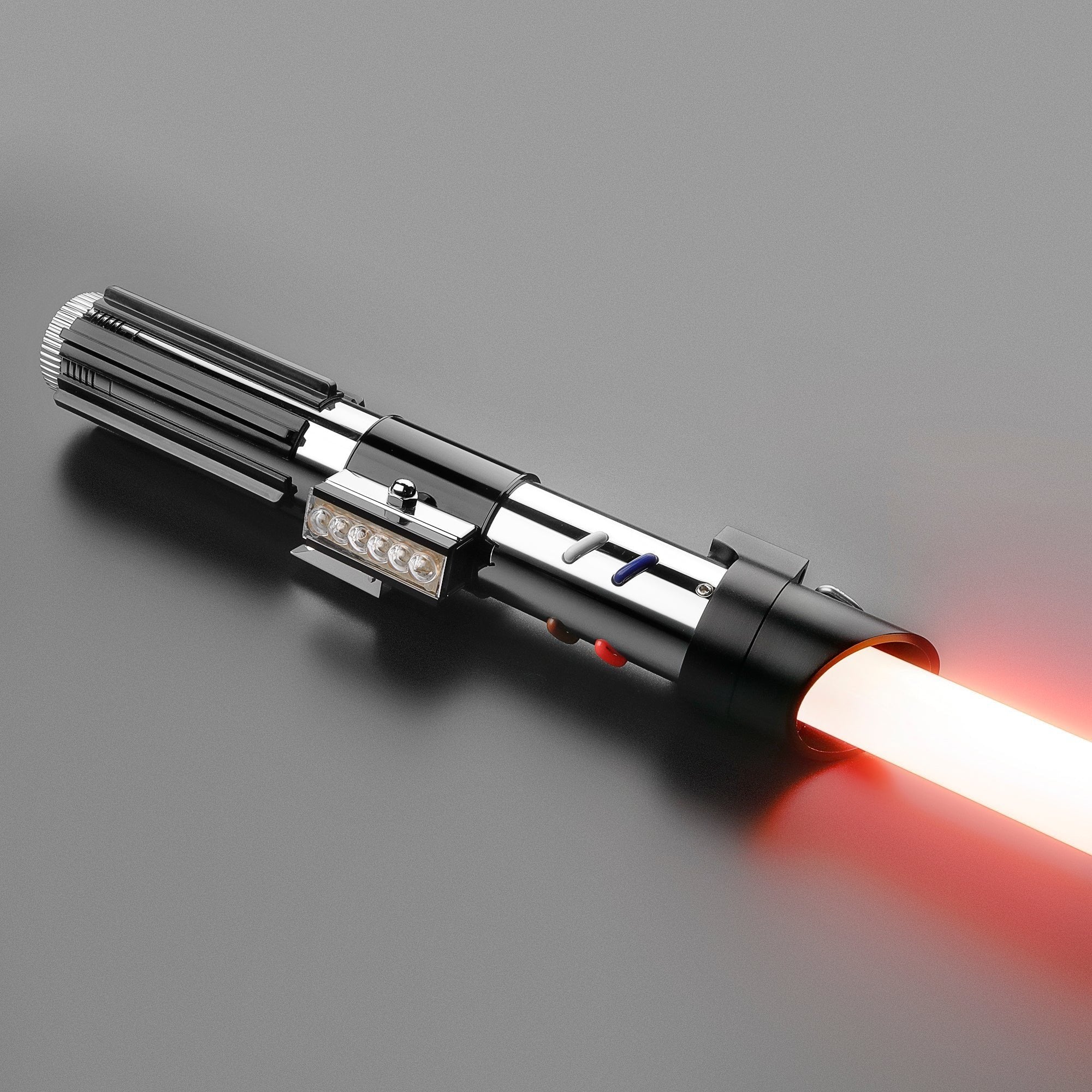
Ours shows six, which is the Empire cut, and it is the detail we would want a buyer to check first because it costs nothing to look at.
The Lever That Broke, and What Replaced It
The first hilt carried a lever on the side of the clamp. The second carried a post and a washer, and that swap is the second fastest check.
The lever on the earlier prop broke during filming and was repaired with a nail, a detail that survives only in prop documentation.
By Empire the lever was gone. What remains is the post it turned on, plus a washer, and the clamp sidebars went from bright aluminium to plain black.
Several smaller changes arrived with it. Three engraved lines around the endcap, a wider port on the clamp, flat screws in place of the bulb release, a thicker steel shroud wall, and diamond knurling on the clamp knob.
| Feature | A New Hope | Empire Strikes Back |
|---|---|---|
| Clamp sidebars | Bright aluminium on the common variant | Plain black, tapered |
| Lock | Lever on a post, broken and repaired on set | Post and washer, no lever |
| Clamp knob | Smooth | Diamond knurling |
| Endcap | Plain | Three engraved lines |
| Side port | Narrow | Wider |
| Shroud wall | Thin | Thick steel |
None of this appears in a listing. All of it is visible in a decent photograph, provided you look in the right order. Sidebars first, then the lock, then the knob.
The Third Hilt Is Not the Same Flashgun
Jedi’s Vader hilt was built on the stunt body of the other hero saber rather than on the flash unit behind the first two, and its emitter gives that away.
The familiar shroud at the top of the first two hilts is replaced by a boxier profile, and the grips return to seven but shorter.
What carried over is the black finish and the grip layout. What did not is the clamp and the shroud, because the body underneath them changed.
For a buyer the consequence is simple: if you want the hilt most people picture, that is Empire. If you want the one that does not look like every other Vader saber on a shelf, that is Jedi.
Checking a Replica You Already Own
Three tools do the whole job: a ruler, a pair of calipers, and enough light to count bubbles under the clamp.
Start with the calipers across the body, somewhere clear of the grips and the clamp. Anything meaningfully under 38 mm means the shell was sized to the blade rather than to the prop.
Then count the grips and measure one from the clamp end. Seven short with a gap, or six long meeting the clamp, tells you which film.
Then count the bubbles. Six points to the Empire cut. Seven points to a card taken from the other hero saber, which usually means the hilt was built from whatever parts were on the bench.
| What you measure | What it points to | What to look at next |
|---|---|---|
| 7 short grips, gap before the clamp | A New Hope | Sidebars should be bright, not black |
| 6 long grips meeting the clamp | Empire | Post and washer, no lever |
| 7 short angled grips, boxy emitter | Jedi stunt | Expect a different shroud from the other two |
| Seven bubbles in the card | A part taken from the other hero saber | Not wrong, but not Empire either |
| Body under 38 mm | Shell sized to the blade | Expect grips and clamp to be undersized too |
A listing that names the film and stops there has skipped every number on this page. Ask for the body diameter and the grip count before you ask for another photograph. A seller who has measured the object will answer both in one sentence.
What Ours Measures
Our Vader hilt is 28 centimetres, takes a one inch blade in 32 or 36 inches, and carries the Empire dressing: six grips, six bubbles, knurled knob.
The body is polished nickel chrome over alloy, with a black polymer grip laid out in the three band pattern of the Empire prop.
The emitter carries the ventilated section, and the shroud is cut to the Empire profile rather than the New Hope one.
Electronics come in three tiers. An in-hilt LED board built for contact work, a pixel blade on an app controlled board, and an open-source board for people who load their own fonts.
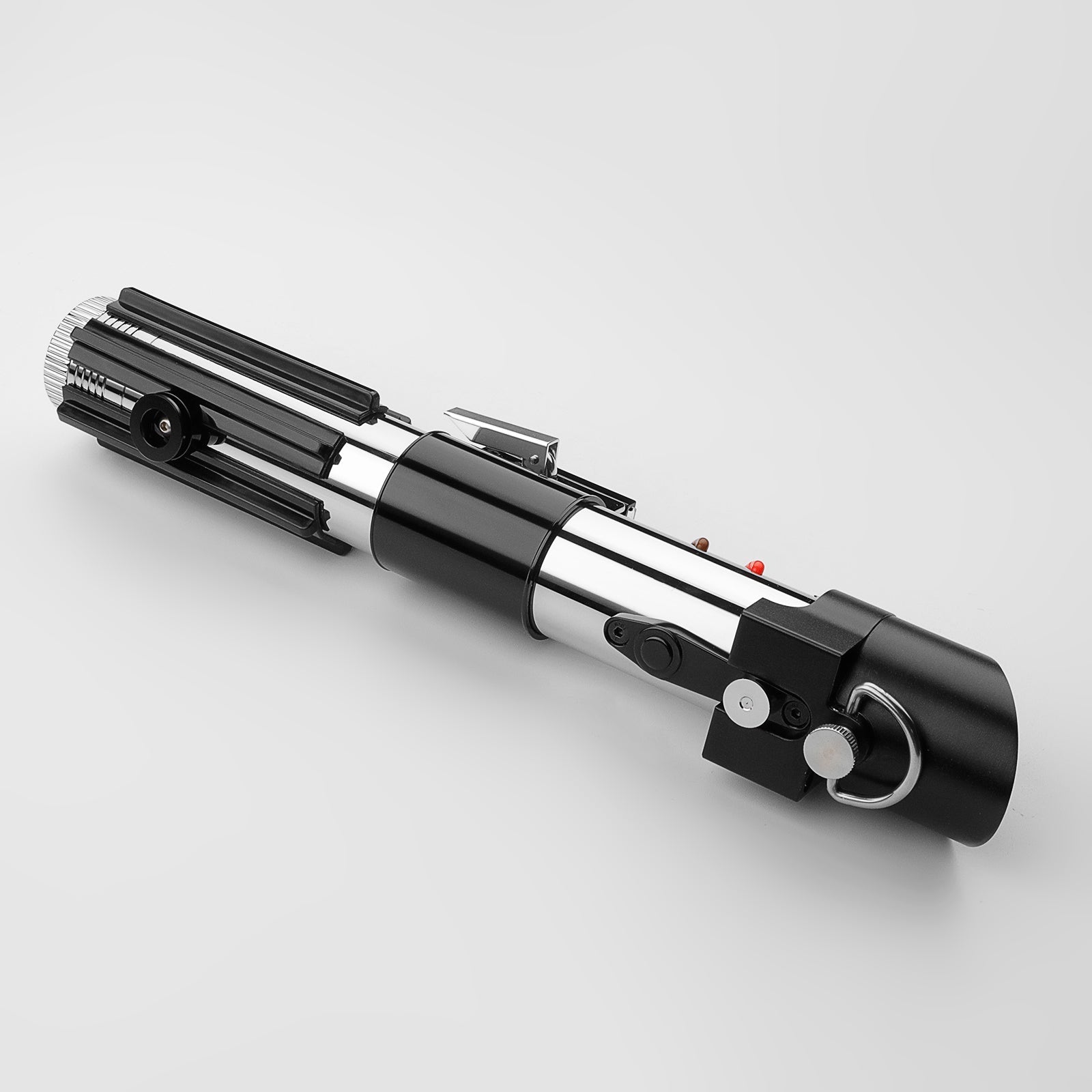
The length is where our hilt and the props separate least. At 28 centimetres the body is a fraction under eleven inches, which is the flash unit’s own range.
What the measurements buy you is not a better number. It is knowing which game the hilt is playing before you spend anything on it.
Darth Vader Lightsaber — Xenopixel V3 / Proffie 2.2 ESB Replica
Character Lightsabers / Darth Vader Lightsaber
Anakin, and the 1.25 inches between his props
Obi-Wan, two hilts an eighth of an inch apart
What a hilt is made of
Choosing a blade length
FAQ
Q1: How long is Darth Vader’s lightsaber?
A: The hilt alone runs about 28 centimetres, or a fraction under eleven inches, on both the props and our replica. The finished weapon adds your blade and subtracts however far it seats inside the emitter, so measure that seat before you trust an overall figure.
Q2: What was Vader’s lightsaber made from?
A: A three-cell MPP Microflash, a 1950s British camera flashgun. The prop department gutted it, fitted a calculator lens into the clamp and added T-track grips sourced from something else again.
Q3: How many grips does a Vader lightsaber have?
A: Seven short ones on the New Hope hilt, six longer ones on the Empire hilt, and seven short angled ones on the Jedi stunt. The count alone tells you which film a replica copied.
Q4: How many bubbles should the clamp card have?
A: Six for the Empire cut. The calculator lens carries seven, and the Vader clamp takes a shorter piece of it, leaving six. The other hero saber of the era kept all seven.
Q5: How do I tell a New Hope replica from an Empire one?
A: Count the grips, then look at the lock. New Hope has seven short grips, bright clamp sidebars and a lever. Empire has six long grips, black sidebars and a post with a washer.
Q6: Why is my Vader hilt thinner than the photos?
A: The shell was probably sized to the blade rather than to the prop. The original tube is one and a half inches, or 38 mm. Calipers across the body settle it in a minute.
Q7: Is the Return of the Jedi version worth choosing?
A: It is if you want a Vader hilt that does not look like every other one. It was built on a different stunt body, so the emitter profile differs from the first two films.
Q8: What blade length suits this hilt?
A: 32 inches balances better in a small room, and 36 inches gives the longer reach the character is known for. Both are one inch in diameter and interchangeable.
Q9: Why does Vader’s blade glow red?
A: In the stories, a red blade comes from a crystal forced out of its natural colour. That is a question about the character rather than the prop, and our timeline covers it.
Q10: Can I duel with an Empire style hilt?
A: Yes, if you take the in-hilt LED tier. The pixel tiers are built for display and light contact, and the blade is the part carrying the risk either way.
Conclusion
Four numbers decide which Vader hilt you are looking at, and none of them is a matter of taste.
The tube is one and a half inches across. The grips are seven short or six long. The card is six bubbles rather than the seven the lens arrived with. The lock is a lever, or a post and a washer.
We put those four on this page because they are the ones we can show you on our own hilt, and because a buyer who knows them stops being dependent on the word accurate.
For the story of how the hilts changed rather than the measurements, the film by film timeline is the place to start. For the saber this design grew out of, we did the same treatment on Anakin’s two props.
ISABER Double Bladed Lightsaber — RGB Baselit / Xenopixel Staff Saber
Accessories / RGB & Baselit Lightsabers