
Anakin Skywalker had more than one hero hilt, and the auction catalogues put them one and a quarter inches apart. The fighting prop from the second film measured 10 inches. The machined hero from the third measured 11.25.
Almost no listing tells you which of those two numbers it copied, and the gap between them is the difference between a hilt that fills your hand and one that leaves your lower fingers hanging off the pommel.
Nearly everything written about this weapon is about the character. This site already has two of those histories, and we link to both below rather than write a third. This page does the measurements instead.
It takes the four figures the catalogues recorded, compares them with what reproductions actually measure, and shows how a hilt length plus a blade length minus a blade seat gives you the object you will hold.
What’s on This Page
- The Short Answer: Ten Inches or Eleven and a Quarter
- What the Auction Records Measured
- Why One Hilt Is a Shell and the Other Is Solid
- Why This Hilt Is Not a Graflex
- What the Licensed Copy Did With Those Numbers
- The Number No Listing Prints
- The Finished Length, Worked Out
- Reading a Listing Against Both Props
- What Ours Measures
- FAQ
The Short Answer: Ten Inches or Eleven and a Quarter
Check the hilt against two figures rather than one, because the 10-inch fighting prop and the 11.25-inch hero prop are different objects built for different jobs.
The 10-inch figure comes from a painted resin body made for a fight sequence. The glowing blade was added afterwards, and on set the actor held a painted aluminium rod bolted to the end of the hilt.
The 11.25-inch figure comes from a machined metal hero hilt catalogued at 11.25 by 2 inches and finished with dense rubber grip strips instead of paint.
A replica anywhere between those two numbers is not cutting a corner. It is copying one of the two objects the production actually built, and the one it copied decides how much of the body your second hand gets.
What the Auction Records Measured
Four figures come from the catalogues, and two of them were taken from props built on two different productions with two different budgets.
The fighting saber was listed at 10 inches long with a 38-inch aluminium rod as its blade. The rod was painted, carried no light, and attached to the body with a bolt rather than sliding inside it.
A second catalogue record for a stunt hilt from the same film gives the same 10 inches. Two independent measurements of the same prop family landing on the same number is the closest this hobby has to a settled fact.
The later hero hilt was catalogued at 11.25 inches long and 2 inches across at its widest point, machined from metal and fitted with a dense rubber grip in place of a painted shell.
| Component | Measurement | What it was measured on |
|---|---|---|
| Hilt, fighting prop | 10 in / 25.4 cm | Painted resin body, blade bolted to the end |
| Blade rod | 38 in / 96.5 cm | Painted aluminium, no light source |
| Hilt, stunt prop | 10 in / 25.4 cm | Separate catalogue record, same film |
| Hilt, hero prop | 11.25 in / 28.6 cm | Machined metal, rubber grip strips |
| Hilt width, hero | 2 in / 5.1 cm | Widest point across the body |
| Licensed replica, 2005 | 11.5 x 1.5 in | Commercial reproduction, never a prop |
The dashed block is the inch and a quarter the hero prop gained over the fighting prop.
Why One Hilt Is a Shell and the Other Is Solid
The earlier hilt was a painted shell with a bolted-on rod and the later one was machined from metal, which is the likeliest source of the extra inch and a quarter.
A fighting prop does not need an interior. It needs an outline that reads correctly in motion and a surface that photographs under stage light, and a resin shell delivers both at a fraction of the weight.
The catalogue description for that saber says exactly this much and no more. Painted resin body, a 38-inch painted aluminium rod for the blade, fixed with a bolt, and nothing inside the body that could light up.
The later hero prop is the opposite kind of object. Machined metal at 11.25 by 2 inches, with dense rubber grip strips that exist because the camera was going to be close to it for close-ups.
We should be clear about what that explanation is worth. A catalogue tells you what an object measures, not why it was built that way. The construction difference is an inference, and a reasonable one, but an inference and not a record.
Why This Hilt Is Not a Graflex
Anakin’s hilt is not a Graflex, and the confusion comes from Luke’s first saber being one.
A Graflex is a photographic flashgun. The original trilogy prop department wrapped one in T-track and called it a lightsaber, and that body is behind Luke’s first two films.
Anakin’s is a purpose-built machined body. It runs a ribbed black grip section, a squared clamp block carrying a connector card, and a shroud at the emitter, and none of those parts comes from a flashgun.
The tell is the clamp, because a Graflex has a round tube with a rectangular band clamped around it, while this hilt has a rectangular block sitting proud of the body, and that block is where the activation card lives.
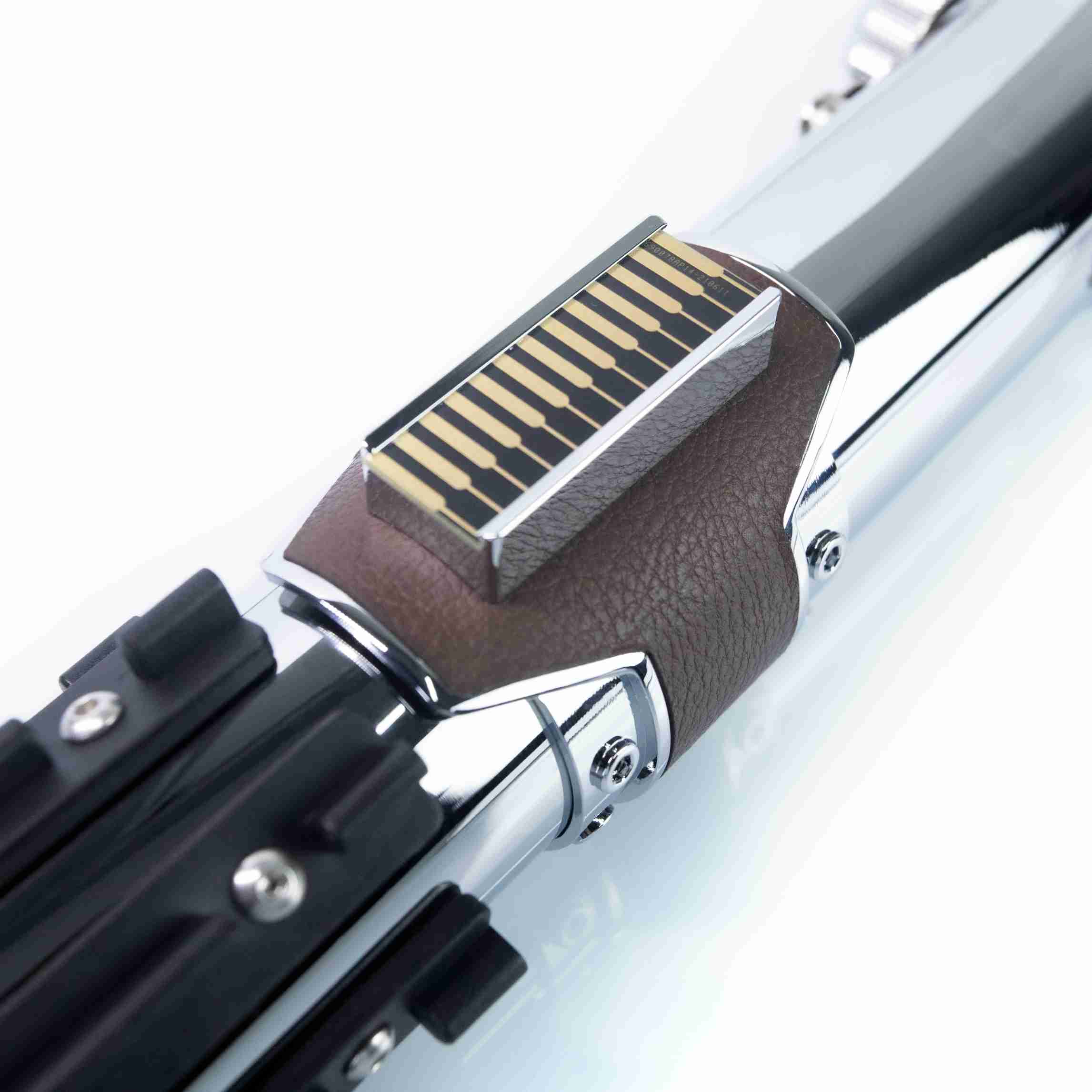
If you are shopping for a Graflex-shaped replica then you are shopping for Luke rather than Anakin, and our timeline of every Luke Skywalker prop covers the versions that matter.
What the Licensed Copy Did With Those Numbers
The best-known licensed replica of the 2000s measured 11.5 inches long and 1.5 inches across, which is a quarter inch too long and half an inch too slim.
We do not name the maker, and the numbers are worth repeating anyway because they became a template. A generation of replicas was cut to that body rather than to the catalogue record.
Set the two side by side. The hero went 11.25 by 2, and the licensed object arrived at 11.5 by 1.5. It grew a quarter inch in length and lost half an inch in girth.
The girth is the more noticeable error. Half an inch off a hilt’s diameter is the difference between a body that fills a two-handed grip and one your fingers close around completely, and it is why some replicas feel like toys next to the real object.
A licensed object is not a prop and nobody claims it is. The useful lesson is narrower. A commercial reproduction can be off by a quarter inch on one axis and half an inch on another while still being sold as accurate, so a quoted length is not evidence of much on its own.
The Number No Listing Prints
A blade does not add its full length to the weapon, because two to three inches of it sit inside the emitter, and almost no listing prints that figure.
The seat is the depth of the bore the blade slides into. It exists because a blade has to be held straight under load, and the deeper it sits the less leverage the blade has at the emitter rim.
Across the sabers we handle, the range runs from about an inch on compact production hilts to about two inches on modular systems built to interchange parts.
| Saber type | Blade seat | What that seat gives you |
|---|---|---|
| Compact production hilt | 1.0 to 1.25 in | Held by a single set screw, fine for display |
| Dueling-grade hilt | 1.5 to 2.0 in | The practical minimum for contact work |
| Modular hilt system | about 2.0 in | Standardised so parts interchange across a range |
| Thin-neck design | 1.0 in or less | The neck leaves no depth to spare |
| Fighting prop, for comparison | almost none | The rod was bolted on rather than seated |
The pale band inside the hilt is the blade you paid for and cannot see.
The prop gives you the extreme case for free. The fighting saber’s rod was bolted to the outside of the body, so essentially none of its 38 inches disappeared, which is why 10 plus 38 comes to the full 48-inch weapon.
That sets the ceiling. No replica with a seated blade will reach 48 inches from a 10-inch hilt and a 36-inch blade, and any listing implying otherwise is quietly ignoring the seat.
The Finished Length, Worked Out
Run the formula on a 10.2-inch hilt with a 2.5-inch seat and a 36-inch blade, and the answer is 43.7 inches, about four inches short of the prop.
The arithmetic is short enough to do in your head once you have the three numbers. Hilt plus blade minus seat, with the seat counted once because only one end takes a blade.
Our hilt measures 26 centimetres, which is 10.2 inches. That lands within a fifth of an inch of the fighting prop and a full inch under the hero, so against a catalogue record it is the earlier of the two that ours answers to.
| Blade fitted | Finished length | Against the 48-inch prop |
|---|---|---|
| 28 in | 35.7 in / 90.7 cm | 74% |
| 32 in | 39.7 in / 100.8 cm | 83% |
| 36 in | 43.7 in / 111.0 cm | 91% |
| Prop, as catalogued | 48 in / 121.9 cm | 100% |
The bar runs on a shared axis from zero to the prop’s 48 inches, so the catalogue figure fills it and each blade choice sits somewhere below.
The shortest of those leaves you a weapon that reads as a saber rather than a staff, which is the point of a one-handed design. The longest gets you within four inches of the prop and is as close as a seated blade will come.
Reading a Listing Against Both Props
Five phrases cover almost every listing, and each one points at one of the two props without the seller ever saying which.
The useful habit is to read a stated length as a claim rather than a specification. A number with no source behind it is the usual reason a hilt arrives and feels wrong in the hand.
| What the listing says | Which prop it points to | What to ask before you buy |
|---|---|---|
| 26 cm hilt | The 10-inch fighting prop | How deep does the blade seat? |
| Screen-accurate hero | The 11.25-inch hero prop | Hilt length in millimetres, please |
| 11.5 inch hilt | Neither, it is the licensed body | Which record was this copied from? |
| 1 inch blade | Modern standard, not the prop | What is the emitter bore? |
| No length stated | Unknown | Ask, and treat a vague answer as an answer |
The last row is the one that saves money. A listing with no length at all is usually telling you that nobody measured the object, and that is information you can use before you spend anything.
What Ours Measures
Our Anakin hilt measures 26 centimetres or 10.2 inches, takes a 1 inch blade with a 36 inch standard, and comes in three electronics tiers.
The three tiers are a baselit board with an in-hilt LED, a pixel blade on the third generation of that board, and an open-source board for people who load their own sound fonts.

What the length means in practice is that this is the fighting prop’s silhouette rather than the hero’s. Your lower hand sits closer to the pommel than it would on an 11.25-inch body, which suits a grip you choke up on rather than one you plant.
The clamp block, the ribbed grip and the shroud are all present, and the connector card sits in a leather-toned wrap rather than a flat plate. That is a finish choice rather than a measurement, and we would rather say so than let a photograph imply otherwise.
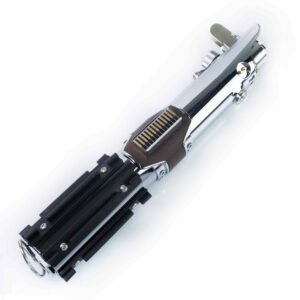
Anakin V2 Lightsaber
Anakin Lightsabers / Character Lightsabers
Every Luke Skywalker prop
What a hilt is made of
Choosing a blade length
The thinnest hilt of the era
FAQ
Q1: How long is Anakin Skywalker’s lightsaber?
A: Two figures are documented, and the fighting prop from the second film measured 10 inches while the machined hero from the third measured 11.25 inches. A replica between them is copying one of those two real objects.
Q2: What colour was Anakin’s blade?
A: Blue, and that colour has a page of its own on this site, because what a colour means and how a hilt is built are two separate questions.
Q3: Is Anakin’s lightsaber a Graflex?
A: No. A Graflex is a photographic flashgun, and that body is behind Luke’s first saber. Anakin’s is a purpose-built machined body with a ribbed black grip and a squared clamp block.
Q4: Why is my replica shorter than the listing suggested?
A: Because part of the blade sits inside the emitter. Add the hilt to the blade and subtract the seat, which usually runs two to three inches. A 10.2-inch hilt with a 36-inch blade at a 2.5-inch seat comes out at 43.7 inches.
Q5: How much blade should sit inside the hilt?
A: About an inch to an inch and a quarter holds a blade for display with a single set screw. For contact work, 1.5 to 2 inches is the practical minimum, because a shallow seat puts the bending load on the emitter rim.
Q6: Which film’s version should I buy?
A: The earlier one if you want the length most replica hilts are already built to. The later one if you want the heavier machined body, though most listings do not actually deliver it at 11.25 inches.
Q7: Was the blade detachable on the film prop?
A: The fighting prop’s blade was a separate rod bolted to the body, so in the literal sense yes. It was not a slide-in blade, and nothing about it illuminated on set.
Q8: Does hilt length change how it handles?
A: It changes where your hands sit. One and a quarter inches is roughly a finger’s width, which is enough to move your lower hand off the grip ribs and onto the pommel.
Q9: What blade length suits a 10.2-inch hilt?
A: 36 inches brings the finished weapon within about four inches of the prop’s overall 48, and 32 inches makes it quicker to swing in a smaller room.
Q10: What should I measure on a replica I already own?
A: The hilt with no blade fitted, and how far one blade enters the emitter. Those two numbers plus your blade length give the finished length and the balance point.
Conclusion
The two Anakin hilts are one and a quarter inches apart, and that single number is the whole argument for asking one question before you buy anything.
Ask how long the body is, then ask how deep the blade seats. Those two answers plus the blade length give you the finished weapon, and the finished weapon is the thing you will actually hold.
The prop itself measured 48 inches from pommel to tip because its blade was bolted on and nothing was hidden inside. A seated replica cannot reach that, and knowing why is more useful than any accuracy claim.
If you want the matching question for a single blade, our blade length guide covers it, and the arithmetic here runs exactly the same way.
ISABER Double Bladed Lightsaber — RGB Baselit / Xenopixel Staff Saber
Accessories / RGB & Baselit Lightsabers