
Obi-Wan Kenobi carried three hilts across three films, and the two you will be offered as replicas sit an eighth of an inch apart in body diameter, an inch and a half for A New Hope against an inch and three eighths for Revenge of the Sith.
That difference is far too small to judge from a photograph. What a photograph does show is where the hilt hangs from. The A New Hope hilt ends in a D-ring drilled through one arm of a tap handle.
The Revenge of the Sith hilt ends in a Covertec wheel. One look at the base tells you which one a listing is selling.
The rest of this page stays with the A New Hope end of that pair, because that hilt is the one assembled from six industrial parts that mostly stopped being made in the 1950s.
The supply of those parts is why an accuracy-obsessed copy of it runs into four figures while a machined one runs into hundreds.
Two of the six were misidentified in print for years, and one of them still carries an old name in listings written before anyone worked out what it was. Both cases are worth knowing before you compare two prices.
What’s on This Page
- The Short Answer: One Number, Two Hilts
- An Eighth of an Inch, Drawn at True Scale
- Three Checks That Settle Which One You Have
- Six Parts From Six Industries
- The Part Nobody Could Name
- Seven Bubbles in Two Inches
- The Pommel Came Out of a Bathroom
- Where the Real Parts Run Out
- What Ours Carries
- FAQ
The Short Answer: One Number, Two Hilts
Ask which film the hilt is from before you ask how accurate it is, because the A New Hope and Revenge of the Sith designs are different objects built to different diameters, and most listings never say which one they are copying.
The A New Hope prop was assembled in 1976 from parts the production bought or scavenged. Its body measures about an inch and a half across, and auction catalogues record the finished length as ten and three quarter inches, or twenty seven centimetres.
The Revenge of the Sith hilt was made almost thirty years later, when the prop department could machine whatever it wanted. It is a design drawn to echo the 1977 silhouette, and it comes out slightly narrower, at roughly an inch and three eighths.
Both are legitimate Obi-Wan sabers, and both look correct in a photograph at a glance. Only one of them is the object that was built out of a grenade.
An Eighth of an Inch, Drawn at True Scale
The two diameters are 38.1 millimetres and 34.9 millimetres, and the 3.2 millimetre gap is visible when the bars are drawn side by side but not when you hold one at a time.
The practical consequence of that gap shows up the moment somebody tries to fit a blade socket into the narrower body. A hilt an inch and a half wide takes a standard one inch blade with room to spare for a socket wall.
The narrower prequel design has less metal to work with at the same nominal blade size, which is why the two are not interchangeable hosts for the same internals.
Collectors describe the split this way rather than by length, because both hilts land close to eleven inches overall once the pommel is counted, and length has never been the thing that separates them.
Same scale, same drawing rules, an eighth of an inch between them. The base and the control box differ far more than the diameter does.
Three Checks That Settle Which One You Have
The pommel attachment, the control box and the measured width will between them identify any Obi-Wan hilt in any photograph clear enough to show the whole thing.
The first check is decisive and needs no measuring. Turn the hilt base toward the camera. A D-ring hanging from a drilled hole means the 1977 prop.
A round plastic or metal disc set into the side of the body means a prequel saber, which uses a Covertec clip on the belt instead of a ring.
The second check is the control box on the middle of the body. On the 1977 hilt it is a clamp taken from a photographic flashgun, and it carries a clear strip with a row of small convex lenses set into it.
On the prequel hilts the box is machined as part of the design and carries no lens strip at all.
The third check needs a ruler and is the least useful of the three, because a seller quoting an inch and a half may have measured the emitter flange rather than the body. Use it to confirm what the other two already told you.
| Feature | A New Hope, 1977 | Revenge of the Sith, 2005 |
|---|---|---|
| How it hangs | D-ring through a drilled hole | Covertec wheel on the body |
| Control box | Flashgun clamp with a lens strip | Machined box, no lens strip |
| Body width | About 1.5 in / 38.1 mm | About 1.375 in / 34.9 mm |
| Neck | Exposed brass, shorter run | Copper and brass section |
| How it was made | Six industrial parts bolted together | Machined to a new drawing |
| What it copies | Nothing, it is the original | A 1977 silhouette redrawn |
One caution on the neck row. The brass section on the 1977 hilt was kept bright only where a locking sleeve had covered it, and the rest of the brass on that prop oxidised, which is why so many photographs of it show two different brass tones on one part.
A replica with a uniformly bright brass neck is not necessarily wrong, but it is copying a cleaner object than the one that was filmed.
For the general question of what separates a careful replica from a casual one, our reference on judging screen accuracy covers materials, scale and finish, and this page stays with the identification question instead.
Six Parts From Six Industries
The 1977 hilt was not designed, it was assembled, and the six donors came from aerospace, ordnance, photography, consumer electronics, firearms and plumbing.
That is the single most useful thing to understand about this prop. Every other hero saber of the original trilogy is built around one donor object with small additions. This one is a stack of six, and the seams between them are visible on the finished hilt.
The stack runs from emitter to pommel, and the order matters because each section arrives at a different width. The emitter is a fitting from a Rolls-Royce Derwent jet engine.
Below it sits a large section of a First World War British rifle grenade used as the grip, then the flashgun clamp with its calculator lens, then the section from an aircraft machine gun, and finally a bathroom tap handle as the pommel.
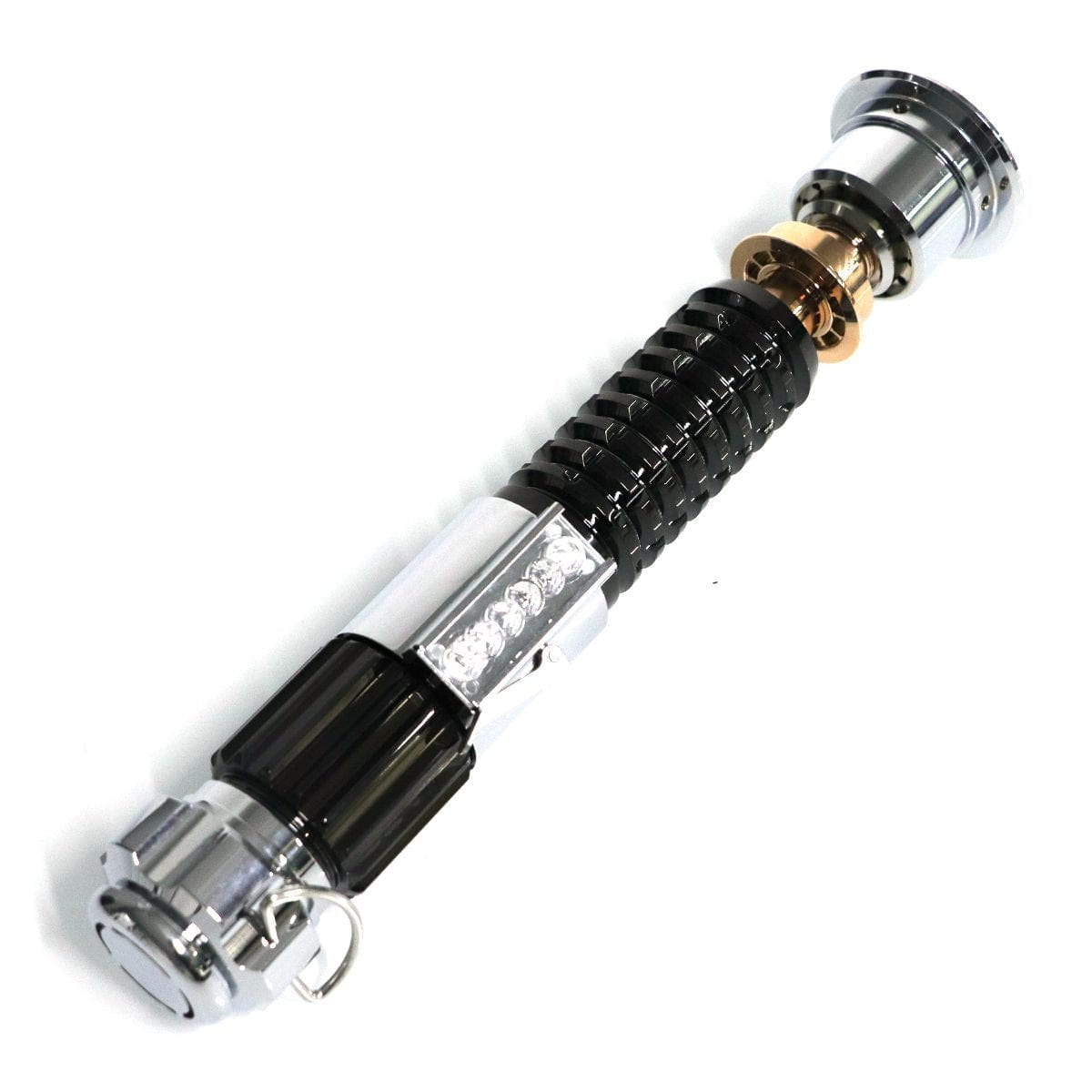
Once you know the two ends, the middle becomes readable. The ribbed section is the grenade body, and the bright band above it is the brass ring the grenade’s arming vanes were soldered to. The clamp sits where a photographer’s hand would have gripped a flash.
Six bands, six supply chains, and no single supplier could have shipped this hilt. That is why copying it honestly costs more than copying a one-donor design.
The Part Nobody Could Name
For roughly thirty years the emitter on this hilt was published as a sink drain, a gas burner tip or a flame tube, and the current answer is a balance pipe from a Rolls-Royce Derwent engine.
The confusion was reasonable, because the part is a machined ring with a groove that resembles half a dozen plumbing and torch fittings. Early collector writing offered a vanity drain, a rosebud torch tip used in sheet metal work, and a piece of fire suppression equipment, and none of those were right.
The identification that stuck came from aviation rather than film. The Derwent 8 and 9 were centrifugal jet engines, and the balance pipe is a small fitting in their fuel pressure system.
The version used on the saber is the female one, which is the piece collectors chase hardest and the piece most often machined rather than sourced.
The practical upshot for a buyer is a dating test. Listings and auction entries written before the identification still call this section a flame tube, because that was the best guess in circulation at the time.
A listing using the older word is not lying, but the word tells you the copy was written from an older source and probably not checked against the part.
Seven Bubbles in Two Inches
The control box carries a strip of seven convex lenses two inches long, taken from a calculator display, and the count of seven is what identifies which calculators it could have come from.
The strip is a light emitting diode magnifier, the kind that sat over a red numeric display so the digits could be read at an angle. A complete strip is two inches long and carries seven lenses. Very few calculators used a seven lens strip, and only two models are known to have supplied them.
That gives you a check anybody can run on a product photo. Count the bubbles. Seven means the maker copied the strip or sourced one.
Six or five means a generic magnifier strip was substituted, which is a small thing until you notice that the strip is the only colour break in the middle of an otherwise metallic hilt. On an angled photograph the edge of the clamp can cut off the last bubble, so treat a count of six as a reason to look again rather than a verdict.
Two small metal buttons sit beside the strip, and the prop team used transistors for them with metal rings around each one. Photographs taken during the location shoot show a ring on both. Photographs taken later show the upper ring missing, which suggests it came off during filming and was never replaced.
So a replica showing two rings is copying the hilt as it was filmed, and a replica showing one ring is copying the hilt as it survives. Neither is wrong. A listing that presents one of those states as the only correct answer has picked a side without saying so.
The Pommel Came Out of a Bathroom
The end cap is a chrome tap handle made in England, where the part is called a handwheel, and the manufacturer still makes a similar shape in plastic rather than metal.
The prop part is a four spoke handwheel, and the assumed maker is Armitage Shanks. The modern equivalent is still catalogued, as a Millennia traditional handwheel, and its packaging calls it a Starlite universal chrome handwheel.
The modern version differs from the vintage one in three ways that matter here. It tapers toward the top where the original did not. It carries a coloured plastic ring at the crown, which comes off easily.
It is plastic with a vacuum metallised finish, where the original was metal, probably brass, plated in nickel or chrome.
A hole was drilled through one of the spokes to take a D-ring, and that is the detail that ends the whole identification question. The D-ring is not a design feature of any prequel hilt, so its presence means the 1977 prop and its absence points to a prequel design.
Where the Real Parts Run Out
The six donors were all products of supply chains that ended decades ago, and the two hardest to find are the jet engine fitting and the machine gun section, which is what caps how many genuine-parts builds can exist.
Take the emitter alone. The Derwent 8 powered the Gloster Meteor F.8, and a little under twelve hundred of that mark were built, with two engines on each airframe. Total Meteor production across every mark came to just under four thousand aircraft, and it stopped in the mid 1950s.
Those engines were consumables on airframes that were scrapped. A small internal fitting on a scrapped engine does not get warehoused, it goes into the same skip as everything else.
That is why the female balance pipe and the Browning booster are named by collectors as the two parts that decide whether a build is possible at all.
The result is two markets that look similar in photographs and nothing alike in cost. A build using genuine donor parts runs into four figures and is limited by what survives.
A build using machined copies of those parts costs a fraction of that and can be made indefinitely, which is what most buyers are actually purchasing.
| Tier | What the parts are | What it costs | What limits it |
|---|---|---|---|
| Genuine donor parts | Real surplus components, some over 80 years old | Four figures | How much hardware survives |
| Machined replica parts | New parts cut to copied dimensions | Hundreds | Nothing, limited only by demand |
| Single-piece machined hilt | One body turned to the silhouette | Low hundreds | Detail is simplified by design |
| Consumer electronics hilt | Mass produced with a blade and sound | Low hundreds | Body is usually scaled up to fit electronics |
That last row is worth its own warning. When a hilt has to hold a battery, a speaker and a sound board, the easiest way to make room is to enlarge the body.
Buyers report that at least one licensed electronic replica runs noticeably wider than the prop it copies, which is why its grip feels different in the hand from a machined hilt of the same design.
What Ours Carries
Our Kenobi v2.0 is the A New Hope configuration rather than the prequel one, which you can confirm against all three checks in the photographs below.
Start at the base, where a D-ring hangs from the pommel and places the design on the 1977 side of the split. Move up to the control box and the clamp carries a clear lens strip set into it.
Check the body and it measures the wider of the two diameters, taking a standard one inch blade.
The finish is three tone rather than uniform, which is what the original hilt does and what a single-piece machined body cannot do. A polished steel emitter, a brass choke section below it, and a black ribbed grip standing in for the grenade body.
The ribbing is the part your hand reads, and it is what makes this hilt comfortable to spin without the neck catching your palm.
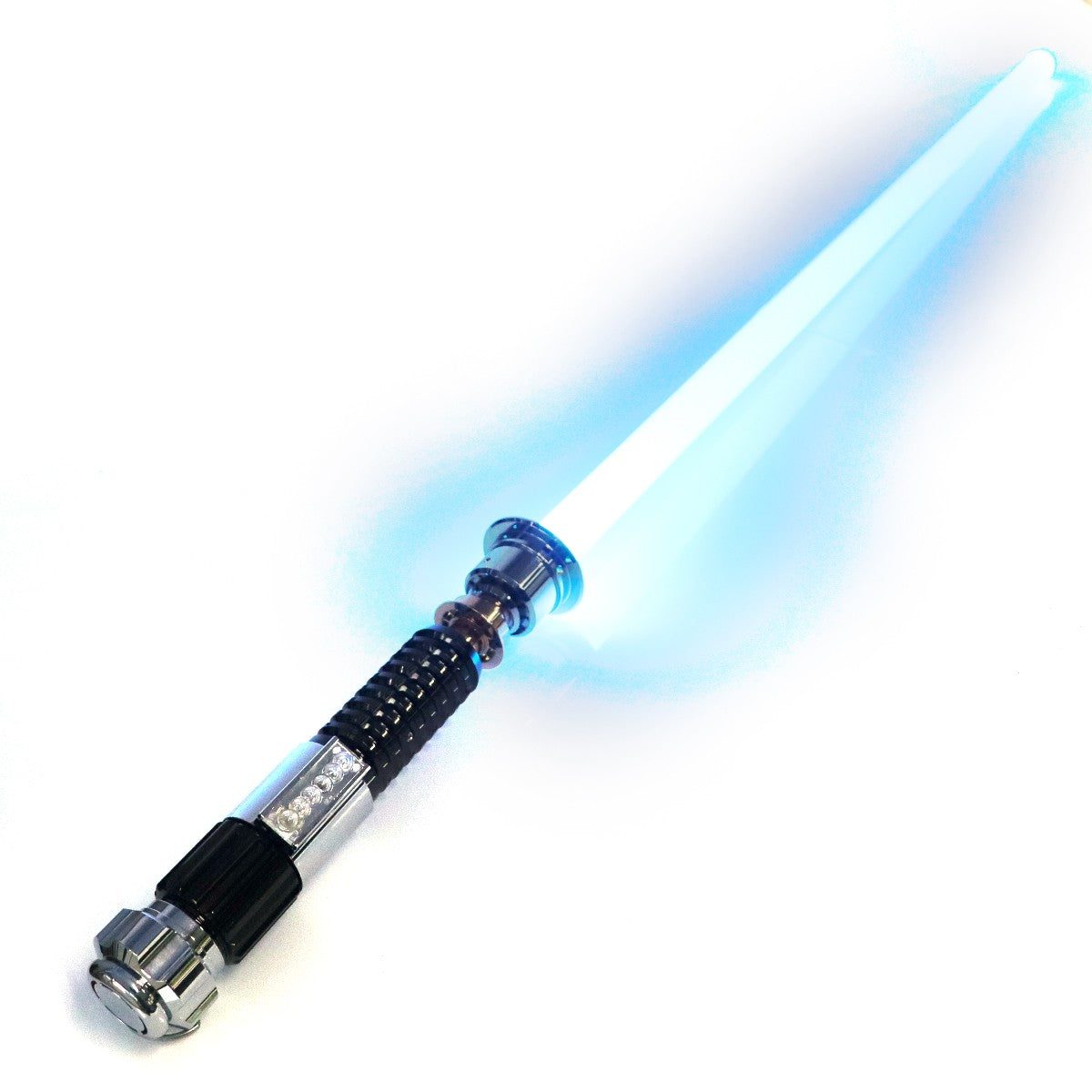
The electronics come in three configurations: a baselit board with the LED in the hilt, a pixel strip board with a colour cycle, and an open source board for people who load their own sound fonts. Blades run 36 inches as standard.
Two things this hilt is not, and both matter before you order. It is not a genuine-parts build, because nobody is sourcing eighty year old jet engine fittings for a product that ships from a warehouse.
The second is that it is not a prequel replica, so if you want the narrower Covertec version with the plain box, this is the wrong listing and the checks above will tell you so before you order.
Kenobi Lightsaber v2.0
Character Lightsabers / Obi-Wan Kenobi Lightsaber
How screen sabers were built
What a hilt is made of
Judging screen accuracy
The same question for Luke’s saber
Every Kenobi hilt we carry
FAQ
Q1: How do I tell an A New Hope Obi-Wan replica from a Revenge of the Sith one?
A: Look at the base. A D-ring means the 1977 design. A Covertec wheel means a prequel design. Then check the control box: the 1977 hilt has a lens strip set into a flashgun clamp, and the prequel hilts have a plain machined box.
Q2: How wide is Obi-Wan’s A New Hope lightsaber?
A: About an inch and a half across, or 38.1 millimetres, which matches the auction cataloguing for the prop. The Revenge of the Sith hilt measures roughly an inch and three eighths, or 34.9 millimetres, on collector measurements.
Q3: How long is it?
A: Ten and three quarter inches, or twenty seven centimetres, is the figure in the auction cataloguing. Treat it as a catalogue number rather than a factory drawing, because no production paperwork for the prop is known to survive.
Q4: What was Obi-Wan’s lightsaber made from?
A: Six industrial parts. A Rolls-Royce Derwent balance pipe, a First World War British No. 3 Mk. 1 rifle grenade, a Graflex flashgun clamp with a calculator lens strip and two transistors, a Browning ANM2 machine gun booster, and an Armitage Shanks tap handwheel.
Q5: What is the emitter made from?
A: A female balance pipe from a Rolls-Royce Derwent 8 or 9 jet engine, a fitting in the engine’s fuel pressure system. Earlier published guesses included a sink drain, a gas burner tip and a flame tube, and listings still using those words are working from older sources.
Q6: Why does the number of bubbles on the control box matter?
A: The lens strip is two inches long with seven lenses, and very few calculators used a seven lens strip. Only two models are known to have supplied them. Counting the bubbles tells you whether a replica copied the strip or substituted a generic magnifier.
Q7: Is the pommel really a bathroom tap handle?
A: Yes. It is a four spoke chrome handwheel, probably made by Armitage Shanks, and the company still sells a similar shape. The modern one is plastic with a taper and a coloured ring, where the original was plated metal without a taper.
Q8: Why are real-parts builds so expensive?
A: Because the supply is fixed. The jet engines that supplied the emitter went out of production in the 1950s and were scrapped rather than stored, so a build using genuine parts is limited by what survives. That runs into four figures, where machined copies cost a fraction of it.
Q9: Does Obi-Wan’s saber use a Covertec clip?
A: Not on the A New Hope hilt, which uses a D-ring. The prequel hilts use a Covertec wheel, which is the single clearest way to separate the two designs in a photograph.
Q10: Which one should I buy?
A: Decide the era first and filter listings by it, because unspecific listings are the most common way people end up with the wrong hilt. If you want the object built from a grenade, take the D-ring version. If you want the sleeker prequel silhouette, take the Covertec version.
Conclusion
The useful question to ask about an Obi-Wan replica is not how accurate it is. It is which of two hilts it is, and that question has a photographic answer in three places on the object.
The base settles it, the control box confirms it, and the diameter backs it up if you have a ruler and a cooperative seller. Everything else about the hilt, including the price, follows from that first answer.
The 1977 prop rewards that discipline more than most. Six parts from six industries, two of them misnamed in print for decades, and a supply chain that ended before most of the people buying replicas were born. Knowing which part is which is the difference between buying a shape and buying the object.
If you want the version assembled from a grenade, our Kenobi v2.0 is the configuration built for it.
ISABER Double Bladed Lightsaber — RGB Baselit / Xenopixel Staff Saber
Accessories / RGB & Baselit Lightsabers