
Three Return of the Jedi sabers have been catalogued with dimensions, and they measure 11.25, 11.5 and 11.75 inches. The whole spread is smaller than your thumb, which makes length the one specification that cannot tell you which version you are holding.
What can tell you is the neck and the control box. The hero prop carries a copper-toned neck and a scratch-built box with arrows on it. The fighting prop carries a dark neck and a clamp off a camera flashgun. Those two look nothing alike once you know where to look.
The consequence runs further than cosmetics, because a neck that narrow caps the blade at 7/8 of an inch, or 22.2 millimetres, instead of the 25.4 that a full inch barrel allows. That 3.2 millimetre difference decides which replacement blades will fit for the life of the hilt.
The colour has a page of its own on this site and we link to it rather than repeat it, because this page is about the object.
What’s on This Page
- The Short Answer: Half an Inch of Spread
- What the Four Records Measured
- Why Length Cannot Tell You Which One
- The Three Tells That Can
- Why the Thin Neck Costs You Blade Options
- Reading a Listing Against the Tells
- What Ours Carries
- FAQ
The Short Answer: Half an Inch of Spread
Check the neck and the control box before you check the length, because three separate screen props agree on length to within half an inch and disagree on almost everything else.
The hero hilt, the one built for close-ups and worn on the belt, has a copper-toned neck and a box mounted on it carrying small triangular pointers and two buttons.
The fighting hilt is a repainted stunt body made years earlier for a different character. It has a dark neck, a clamp taken from a camera flashgun, and a D-ring at the base.
Both are real Return of the Jedi sabers. Both are around eleven and a bit inches long. A listing that quotes a length has told you almost nothing about which of them you are looking at.
What the Four Records Measured
Four props have been catalogued with usable dimensions, and one of them was pulled from its sale, which makes the remaining evidence thinner than the count suggests.
The first is a cast resin stunt body, studio-painted metallic silver with black and copper detailing and static red and green buttons, recorded at about 11.25 inches. It came from the estate of an effects modelmaker who worked on the film.
The second is a production-made cast resin body taken from the moulds of a touring saber, catalogued at 11.5 by 2.25 inches. It sold for 25,600 against an estimate of ten to fifteen thousand.
The third was catalogued at 11.75 inches long and 2 inches across, described as cast metal, brass and rubber, with an estimate of 150,000 to 250,000. It was withdrawn before its sale after questions were raised about where it had come from and about an earlier listing of the same object.
| Record | Hilt | Construction | Status |
|---|---|---|---|
| Stunt body, modelmaker’s estate | 11.25 in / 28.6 cm | Cast resin, painted, static buttons | Sold |
| Touring-mould production body | 11.5 x 2.25 in | Cast resin and aluminium, copper-tone at the emitter | Sold |
| Close-up body | 11.75 x 2 in | Cast metal, brass and rubber | Withdrawn |
| Hero, hobbyist measurement | about 11 in | Machined body, copper-painted neck | Reference only |
| Thin-neck replicas surveyed | 11.0 to 11.6 in | Machined aluminium, copper or dark necks | Current market |
The two red lines bound the entire spread across four separate measurements of the same weapon family.
Notice what the table does not contain: there is no catalogue record of the hero prop that carries a dimension from the film’s own production paperwork, only a hobbyist measurement that has been repeated for years.
That is worth sitting with before quoting any of these numbers at a seller.
Why Length Cannot Tell You Which One
The props agree because they were built to the same rough envelope rather than to a drawing, so the differences landed in details instead of dimensions.
Return of the Jedi needed several of these objects. One sat on a belt and looked right in close-up. Another had to survive being swung at a stunt performer. A third had to be fired out of a droid on camera.
Each of those jobs pushed the same rough shape in a different direction, and none of them pushed the overall length far enough to notice, so what changed was the surface and the fittings.
So a seller quoting eleven and a half inches has quoted the most consistent number in the whole family. It is the number least able to separate one version from another.
The Three Tells That Can
Three features separate the versions, and all three are visible in any photograph that shows the whole hilt.
The first is the neck, which on the hero hilt reads as copper or bronze and forms a thin section between the emitter and the body, while on the fighting hilt it reads dark, either black or worn silver, with a small notch cut near the emitter.
The second is what sits in the middle of the body, where the hero has a box built for it carrying small triangular pointers and two buttons, and the fighting hilt instead carries a clamp from a photographic flashgun, complete with the flat card that sits under it.
The third is the base, where the hero ends in a triangular ring and the fighting hilt ends in a round D-ring.
| Feature | Hero version | Fighting version |
|---|---|---|
| Neck colour | Copper or bronze tone | Dark, black or worn silver |
| Neck detail | Smooth, unbroken | Notch cut near the emitter |
| Mid-body fitting | Purpose-built box, arrows and buttons | Flashgun clamp with a flat card |
| Emitter shape | Smaller | Wider and shallower |
| Pommel | Triangular ring | Round D-ring |
| Body width | About 1.38 in | About 1.5 in at the clamp |
One caution on the neck, and it comes from people who have examined the actual prop. The copper is paint over aluminium, not solid copper. Replicas frequently use real copper because it looks better, and that makes a replica more convincing than the object it copies.
For the general question of what separates a good replica from a bad one, our reference on judging screen accuracy goes through materials, scale and finish in detail. This page stays on which version you are looking at.
Why the Thin Neck Costs You Blade Options
The neck is hollow, so its diameter caps how wide a blade can pass through it, and that cap decides both the blade you can fit and how well the saber takes a hit.
A blade is held by friction and one or two screws pressing it against the inside of a bore. The deeper that bore runs, the more of the blade is supported and the less it can rock under load.
Typical sabers run a socket somewhere between 1 and 4 inches deep, with dueling builds targeting 1.5 to 2. The thin-neck hero is on the shallow end, at roughly 1 inch or less, which is 25 millimetres of supported blade against 38 to 51 on a dueling build.
Put a 36 inch blade into each. The hero shows 35 inches of it. The dueling build shows 34. The visible length barely changes, and the amount held in place doubles.
| Build | Socket depth | Blade it takes | What it is for |
|---|---|---|---|
| Thin-neck hero style | 1 in or less | 7/8 in, by necessity | Display, spinning, light contact |
| Standard production hilt | 1.0 to 1.25 in | 1 in | Display and casual use |
| Dueling build | 1.5 to 2.0 in | 1 in | Contact work |
| Modular hilt system | About 2.0 in | 1 in | Interchangeable parts |
Twice the supported length, on the same blade, is the whole difference between a display hilt and a dueling build.
The second reason is the material at that joint. A thin aluminium neck flexes and eventually cracks under repeated hard contact, so builders who intend a saber to be fought with tend to substitute steel or titanium at the same 25 millimetre section.
Neither of those points is a criticism of the thin-neck design, which is the design Luke’s saber actually had and the reason that saber looks the way it does. It simply belongs to a different job from the one a dueling build is made for.
Reading a Listing Against the Tells
Five phrases cover most listings, and the useful reading is not what each one claims but which tell it points at.
Photographs settle it faster than words, so ask for a shot that shows the full hilt from the emitter to the base, and then look at the neck colour, the fitting in the middle, and how the base ends.
| What the listing says | Which tell it points at | What to check yourself |
|---|---|---|
| Hero version | Neck and box | Copper tone, arrows on the box, triangular ring |
| V2 or stunt version | Clamp and pommel | Flat card under a clamp, D-ring, notched neck |
| A length in inches | None, all of them agree | Nothing, this is the least useful number |
| 1 inch blade | Socket width | Physically impossible on a true thin neck |
| Duel ready | Neck material | Ask what the neck is made of, not how thick it is |
That fourth row is the one that catches people out. A listing claiming a true thin neck and a one inch blade in the same breath is claiming two things that cannot both be true, because the blade has to pass through the neck.
What Ours Carries
Our Luke V1.0 is built to the hero version rather than the fighting version, which you can check against the three tells in any photograph on this page.
The neck carries a bronze tone just below the emitter. The fitting in the middle is a purpose-built box sunk flush into the body rather than a clamped band. The base ends in a triangular ring.
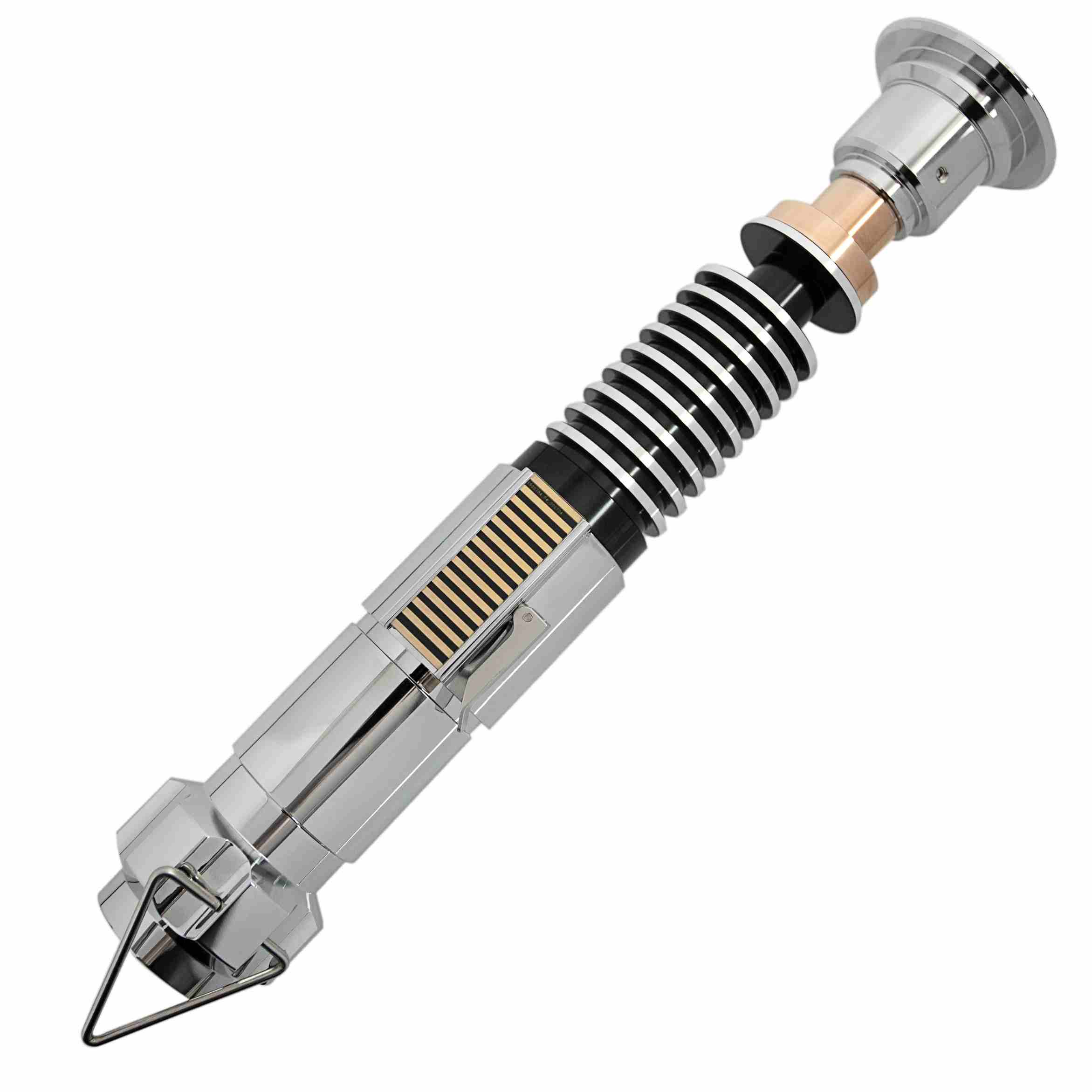
The body is a tri-tone build: a polished silver main section, a black ribbed grip, and the bronze choke point. The grip ribbing is the part your hand actually reads, and it is why this hilt spins without the neck catching your palm.
What we do not print on this listing is an overall hilt length, and that is a deliberate choice rather than an omission. Every version of this weapon lands between eleven and eleven and three quarter inches, so a length would tell you nothing you could act on, and the features are the useful information.
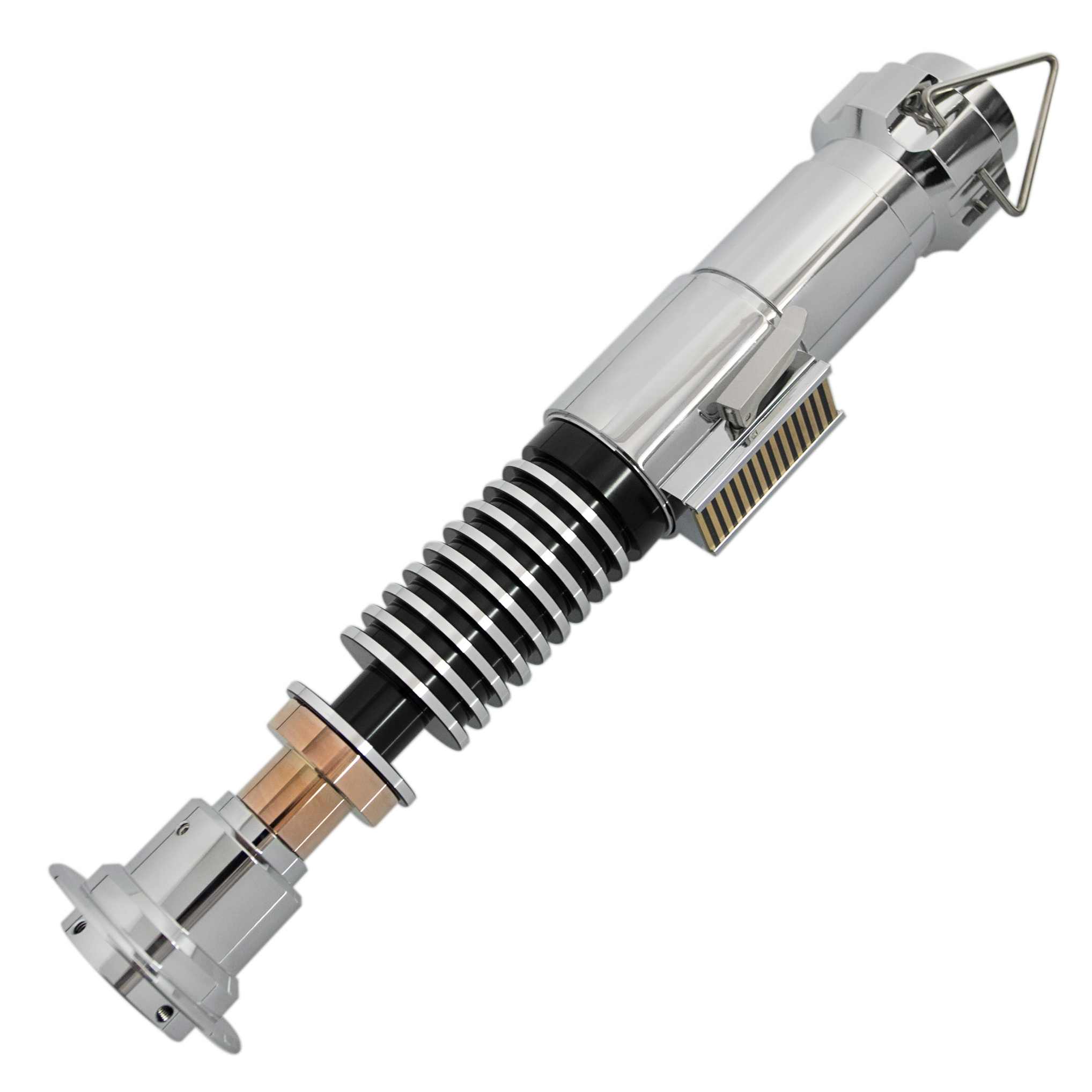
Blades run 36 inches as standard, and the electronics come in three tiers: a 12W baselit board with an in-hilt LED, a 50W pixel strip on a configurable board, and a 50W pixel strip on an open-source board for people who load their own fonts.
One honest note on contact. The neck on this build is a thin aluminium section, which is what the design calls for. That makes it a display and spinning saber that will take light contact, not a weapon for full-speed dueling.
Luke V1.0 Lightsaber
Character Lightsabers / Luke Skywalker Lightsaber
The standard thin-neck version
What green means, and why
Judging screen accuracy
What a hilt is made of
Choosing a blade length
FAQ
Q1: How long is Luke’s Return of the Jedi lightsaber?
A: Three catalogued props measure 11.25, 11.5 and 11.75 inches. A long-running hobbyist measurement puts the hero at about eleven. The spread is under three quarters of an inch, so length is not a useful way to tell the versions apart.
Q2: How do I tell a hero version from a V2?
A: Look at the neck, the mid-body fitting and the base. The hero has a copper or bronze neck, a purpose-built box with arrows and buttons, and a triangular ring. The V2 has a dark notched neck, a flashgun clamp with a flat card, and a D-ring.
Q3: Is the copper neck actually copper?
A: On the screen prop it is copper paint over aluminium rather than solid copper. Many replicas use real copper, which makes them look more authentic than the original did.
Q4: Why is Luke’s green saber also called the V2?
A: The V2 is a stunt body made years earlier for another character and repainted for this film. It is the one built to be swung, while the hero was built to be looked at.
Q5: Can a thin-neck saber be used for dueling?
A: Light contact, yes. Hard contact is a different matter, because the neck is a thin aluminium section and the blade socket behind it runs about an inch deep or less. Both limits come from the same design.
Q6: What blade does a thin-neck hilt take?
A: Usually seven eighths of an inch, because the blade has to pass through the neck. A true one inch blade on a true thin neck is a contradiction, and a listing that claims both is worth questioning.
Q7: Why do all the versions measure about the same?
A: Because they were built to a rough envelope rather than to a drawing. The production needed several objects for different jobs, and the variation landed in fittings and finish rather than overall length.
Q8: Is a number from an auction always reliable?
A: Not on its own. One of the three catalogued props was withdrawn before its sale after questions about its provenance, so check where a figure came from before repeating it.
Q9: Which version should I buy?
A: The hero version if you want the object that matches how the saber looks at rest in close-up. The fighting version if you care about the notch, the clamp and the D-ring, which are the details collectors argue about.
Q10: Does the neck affect how it spins?
A: Yes, in a way most listings never mention. A thin neck leaves more of the body free for your hand, which is why this design is popular for spinning despite being a poorer dueling build.
Conclusion
The length is the one number this family of sabers agrees on, which makes it the one number that cannot answer the question buyers actually have.
Ask about the neck, the fitting in the middle, and the base instead. Those three features are visible in any photograph, and between them they will tell you which of the production’s objects you are being sold.
Then look past the surface to the neck’s purpose. A thin neck is why this saber looks the way it does, and it is also why it belongs in the display and spinning class rather than the dueling class. Neither of those facts is a flaw, as long as you know which one you are buying.
If you want to see the same question worked through for a single full-diameter hilt, our blade length guide covers how blade and body are matched.
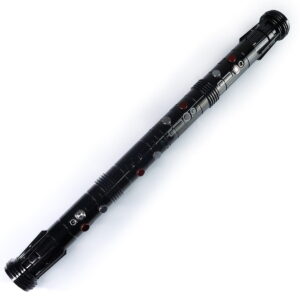
ISABER Double Bladed Lightsaber — RGB Baselit / Xenopixel Staff Saber
Accessories / RGB & Baselit Lightsabers