
Announced October 30, 2012. Closed December 21, 2012. Disney bought Lucasfilm, the studio that owns Star Wars, for $4.05 billion in cash and stock, settling at $4.06 billion at closing. One film did not come with it until 2019.
What’s on This Page
- The two dates, and why both are correct
- What was actually in the sale
- The film Disney did not get until 2019
- The partnership started in 1986
- Fourteen years in order
- What the sale did to continuity
- What the sale did to lightsaber design
- Then Disney started selling lightsabers
- Four things most answers get wrong
The Two Dates, and Why Both Are Correct
October 30 is the announcement and December 21 is the closing. They sit seven weeks apart because they measure two different events, and running them together is the most common error in answers to this question.
Announcing a deal means the two boards have agreed a price and signed a document saying so. Closing means the shares have actually changed hands, the regulatory review has finished, and the buyer legally owns the company.
Plenty can still go wrong between those two points, which is why the press treats them as separate events rather than as one transaction with a date attached to it.
The headline number moved between them as well, and the movement was arithmetic rather than negotiation. At announcement the figure was $4.05 billion, and at closing it was $4.06 billion, with nothing renegotiated to produce that ten million dollar difference.
Roughly half the consideration was paid in Disney shares. The share count was fixed when the agreement was signed, but the value of each share was set on the closing date instead, and the stock closed at $50.00 that Friday.
Disney’s own filing then rounds the total again to $4.1 billion, so three defensible figures exist for a single transaction and none of them is the tidy round number people usually quote.
| Item | Figure |
|---|---|
| Announced price | $4.05 billion |
| Cash at closing | $2.21 billion |
| Shares issued | About 37.1 million at $50.00 |
| Total at closing | $4.06 billion |
| Figure in Disney’s filing | Rounded to $4.1 billion |
| Comparable purchases | Pixar at $7.4 billion in 2006; Marvel at about $4 billion in 2009 |
The cash and stock split matters more than it first appears, because it turned the seller into a shareholder rather than a vendor collecting a cheque and walking away. He ended up holding roughly 2.2% of the company, reported at the time as the second-largest individual stake, and he took no board seat alongside it.
What he did take was a consulting title tied to the films. That sounds like influence and legally is not, and the gap between the two is the whole reason the following few years turned out the way they did.
If you want the release chronology that the acquisition created, our guide to the films in release order lays all thirteen out with runtimes.
What Was Actually in the Sale
Lucasfilm Ltd. was bought whole, which meant the franchise plus a visual effects house, a sound facility, a game studio and a merchandise division, while the ranch itself stayed with the founder.
The transaction bought Lucasfilm Ltd., a private company the founder owned outright, and its holdings were considerably wider than the films people associate with the name.
- Star Wars as a franchise, covering film, television and publishing rights
- Industrial Light & Magic, the visual effects house founded to build the models the original film needed
- Skywalker Sound, the audio post facility that grew out of the same production
- LucasArts, the game studio
- The consumer products division that licensed merchandise worldwide
Industrial Light & Magic is the part of that list investors paid closest attention to, because it was not a Star Wars department. It was the leading effects vendor in the industry and it took work from every major studio, including the ones that would now be competing with its new owner.
Buying Lucasfilm therefore meant buying a supplier that half of Hollywood depended on, and the internal logic of the deal is easier to follow once you see that. The franchise brought the upside while the facilities brought an existing business with contracts already signed.
The consumer products division deserves its own note, because it existed at all thanks to a trade the founder made in 1977. He took a reduced directing fee on the original film in exchange for retaining the merchandising and sequel rights, which at the time looked like accepting worthless paper in place of real money.
It turned out to be the most valuable clause in the picture. By 2012 that division was drawing licensing revenue from toys, games, books and clothing in every market where the films had played, and it formed a large share of what the $4 billion was actually buying.
Three things stayed behind, and each of them explains a later surprise. The founder kept Skywalker Ranch and his other Marin County properties, which were personal real estate rather than studio assets, and he kept no operational role in the company he had just sold.
The creative direction of the next films, which is the part that later became a public disagreement, was never his to keep either.
The Film Disney Did Not Get Until 2019
The 1977 film stayed with another studio until March 20, 2019, because Fox held its distribution rights in perpetuity.
The 1977 original was co-financed and distributed by 20th Century Fox, which put up money and carried the risk on a film almost nobody expected to work. The contract reflected how much risk that was.
In exchange for financing a picture the studio did not understand, Fox took the distribution rights in perpetuity. Perpetuity is the operative word, because it means no expiry date and no automatic reversion, and the sale of Lucasfilm in 2012 could not move a right that a third party already owned.
So for seven years the position was genuinely split. The new owner controlled the franchise, published the books, licensed the toys, and still could not distribute the first film in it.
The other five were on a timer rather than a permanent grant, and the rights to The Empire Strikes Back, Return of the Jedi and the three prequels were scheduled to move across in 2020 without anyone having to negotiate anything at all.
That gap closed on March 20, 2019, when Disney’s $71.3 billion purchase of most of 21st Century Fox’s entertainment assets completed and carried the Episode IV distribution rights across with it. From that date the franchise was whole for the first time since 1977.
This is why a single date reads as incomplete rather than wrong. For the company, the answer is 2012. For the specific film that started everything, the answer is 2019, and the second question is usually the one that turns a short answer into an argument.
The Partnership Started in 1986
The two had worked together since 1986, and the first ride built on someone else’s property opened in the parks in January 1987.
Neither side was a stranger, and the working relationship was already twenty-six years old by the time anyone opened a discussion about ownership.
Captain EO, a 3D short the founder wrote and executive produced, opened in the company’s parks in 1986. Star Tours followed on January 9, 1987, at a reported cost of roughly $32 to $35 million, which was an extraordinary sum for a single ride at the time.
Star Tours is the more revealing of the two, because it was the first attraction the parks built on intellectual property the company did not own. It replaced an existing Tomorrowland ride and reused flight simulators that had originally been built for a cancelled project, which is why the budget went where it did rather than into new construction.
A refreshed version with new destination sequences and 3D projection opened in 2011. That relaunch is where the account of the acquisition usually begins, since the founder reportedly met the company’s chief executive around it and the conversation drifted from ride refurbishment to something much larger.
None of that is contract law, but it changes how the purchase reads. It looks less like a cold acquisition and more like the formalising of a vendor relationship that had already shaped twenty-five years of park design.
Fourteen Years in Order
Story group in 2013, canon reset in 2014, first film in 2015, Fox rights in 2019, first yellow blade in 2019, lightwhip in 2024.
The dates after the sale are the ones that changed what Star Wars is, and they arrive in a sequence where each one explains the next.
| Date | What changed |
|---|---|
| 2013 | A story group is formed to hold one continuity across film, print and games |
| April 25, 2014 | The Expanded Universe is renamed Legends and ruled non-canon |
| December 2015 | The first film made under the new ownership opens |
| March 20, 2019 | The Fox purchase closes and the 1977 distribution rights arrive |
| 2019 | Build-your-own sabers open in the company’s own parks at $199.99 |
| December 2019 | The first live-action yellow blade appears at the close of the sequel trilogy |
| 2020 | Distribution rights to Episodes V, VI and I to III revert as originally scheduled |
| 2024 | A lightwhip appears in live action for the first time |
| May 2026 | The next theatrical film opens, fourteen years after the purchase |
The sequence is not arbitrary. The story group came first in 2013, because you cannot coordinate a continuity that nobody is holding. The reset followed in 2014, because the group needed a clean starting point before it could decide what counted. The first film arrived in 2015, once both of those existed.
Read it that way and the eighteen months between closing and reset stop looking like hesitation. They were the time it took to settle the question of what was real, which had to happen before anything new could be written into a shared timeline.
What the Sale Did to Continuity
On April 25, 2014 the Expanded Universe became Legends and stopped counting, leaving only the six films and The Clone Wars.
The largest creative consequence had nothing to do with hardware. On April 25, 2014, Lucasfilm announced that the Expanded Universe would be renamed Star Wars Legends and treated as a separate continuity from the films.
That category covered several decades of novels, comics and games that had carried the story forward past the end of the original trilogy. It was a very large amount of material, and until that morning nearly all of it had counted as real.
Only two things kept their status. The six saga films kept theirs, and The Clone Wars kept its own in both the film and series forms, which is why our chronological order for that series still describes canon events rather than legends.
Everything published after the announcement would count equally with the films, coordinated by the story group formed the year before.
The timing supplies the reason, and the reason is structural rather than editorial. A new trilogy needed room to exist, and writing one inside a continuity that already contained a detailed account of what happened after the last film would have meant either contradicting that account or obeying it.
For anyone buying a replica this has a practical edge that is easy to miss. Designs that only ever appeared in Legends still exist as physical objects that people build and sell, and some of them look better than anything that made it into the films.
They simply belong to a parallel timeline, so a hilt can be entirely accurate to a source and still be outside what the studio counts as real.
What the Sale Did to Lightsaber Design
Three new silhouettes arrived after the sale, and only one of them created a lasting market.
The era that followed introduced three silhouette changes the first six films had not attempted, and a fourth arrived on television once the films had established the licence to try.
- The crossguard. A main blade with two short vents set at right angles, first shown in 2015. Canon explains the vents as outlets for an unstable crystal rather than as a decorative choice, which is why the blade visibly sputters instead of burning clean. Our history of the broken blade traces it back through the canon sources if you want the longer version.
- The black blade. A weapon that had existed in animation since 2010 moved into live action in 2019 and immediately became a plot object rather than a piece of set dressing, changing hands on screen more than once. Its thousand-year lineage is covered in our history of the darksaber.
- The yellow blade. It closed the sequel trilogy in 2019 and was the first yellow blade to appear in a live-action film. Yellow had existed in animation for years, so it read to longtime viewers as a return rather than an invention. The build and the film context are in our breakdown of that hilt.
- The lightwhip. A flexible variant that reached live action in 2024, and the hardest of the four to reproduce, because a whip has to bend along its length and a blade strip inside a rigid tube does not.
Of the four, only the crossguard produced a durable market. It is the shape customers ask us to match more than any other, and it is the one cheap replicas most often get wrong, usually by making the lateral vents solid blocks instead of lit emitters.
That single detail is the difference between a shelf piece and something that reads correctly from three metres away.
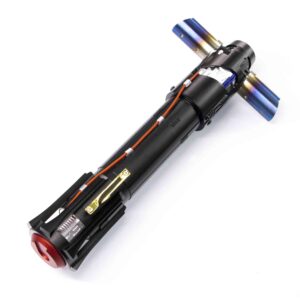
Kylo Ren Crossguard Lightsaber — Kylo Ren Replica from ISABER
Character Lightsabers / Replica Lightsabers
Then Disney Started Selling Lightsabers
In 2019 the company began selling its own sabers in its parks at $199.99, with one blade length, no refunds and no discounts.
This is the part that changed a market rather than a story. In 2019 the company opened a build-your-own saber experience inside its own theme parks, and it has been the reference point for the category ever since.
Guests choose from a small set of hilt themes, assemble the components at a bench under direction, and leave with a working blade in roughly twenty minutes. As theatre it is genuinely well built, and it is priced like theatre.
| Item | Detail |
|---|---|
| Opening price, 2019 | $199.99 |
| California resort, 2026 | $249.99 plus tax |
| Florida resort, 2026 | $274.99 plus tax |
| Session length | About 20 minutes |
| Builders per session | Up to 14 |
| Blade included | One 31-inch blade |
| Extra crystal | About $17.99 |
| Refunds | None |
| Discounts | Excluded, including annual passholder rates |
Read that as a specification rather than as an experience and the product becomes clear. One blade length, one session length, no returns and no discounts. It sits at the top of the souvenir band and the bottom of the enthusiast band, which is a deliberate position rather than an oversight in the pricing.
What we sell is a different object entirely, because it is a hilt with a blade you can replace, a board you can reflash with new sound and motion profiles, and a blade length you choose rather than accept. The park version sells twenty minutes and a display piece, and it does that job well enough that we do not pretend otherwise.
The practical consequence for a buyer is that the two stopped competing around 2019 and started sitting on different shelves. The lines that actually matter are the fixed 31-inch blade and the no-refund policy, because those two constraints together rule out duelling and rule out repair.
Both facts come from the same decision, since a company that owns the fiction decided to manufacture inside it at scale, and the first thing that did was put a ceiling on how far the official object would go.

Four Things Most Answers Get Wrong
The four errors are a rounded price, a wrong object of purchase, a reset dated too early, and a story handed over in a form it never took.
Short answers to this question repeat a small set of errors. Each one is easy to check once you know what to look for, and each one changes the shape of the answer.
- Treating $4 billion as the number. The announced figure was $4.05 billion, the closing figure was $4.06 billion, and the filing rounds up again to $4.1 billion. Three totals are defensible and none of them is the round figure that circulates in lists of famous acquisitions.
- Saying the company bought Star Wars. It bought Lucasfilm, which owned Star Wars along with three other businesses. The ranch stayed with the founder, and one film’s distribution rights stayed with another studio until 2019.
- Saying the Expanded Universe was wiped on day one. The reset came about eighteen months after closing, on April 25, 2014, and it was a deliberate decision taken to clear space for new films rather than housekeeping at handover.
- Saying the founder handed over his story. His treatments were part of the purchase, and the agreement did not oblige the buyer to follow them. Disney’s chief executive later wrote in his memoir that the founder felt betrayed when the direction changed, and that on seeing an early cut of the first new film he said there was nothing new in it. The studio’s president has since said publicly that the material handed over amounted to a couple of paragraphs rather than full treatments, so the two accounts do not match and are best treated as disputed.
The fourth point is worth handling carefully, because it is where most retellings stop being reliable. The treatments were real enough that their existence appears in coverage of the deal, and they were also not binding, and both of those can be true at once without anyone having misremembered the transaction.
Clone Wars Episode Order
Best Star Wars Movie
Crossguard Buying Guide
Rey’s Yellow Blade
Frequently Asked Questions
Q1: What date did Disney buy Star Wars?
A: Two dates, depending on what you mean. October 30, 2012 is when the deal was announced. December 21, 2012 is when it closed and Lucasfilm became a subsidiary. For historical purposes the announcement date is the one usually quoted, and the closing date is the one that actually moved ownership.
Q2: How much did Disney pay for Star Wars?
A: $4.05 billion at announcement and $4.06 billion at closing. The price was roughly half cash and half Disney shares, so the exact total depended on the share price on the closing day. Disney’s own filing rounds the figure to $4.1 billion, which is where some of the variation between sources comes from.
Q3: Did Disney buy Star Wars or Lucasfilm?
A: Lucasfilm. The company owned Star Wars along with the visual effects house, the sound facility, the game studio and the merchandising business. Buying the company was the only route to the franchise, because the franchise was never offered separately.
Q4: Why is 2019 sometimes given as the answer?
A: Because of one film. The 1977 original was co-financed and distributed by 20th Century Fox, which held its distribution rights in perpetuity. Those rights only moved when the purchase of most of Fox’s entertainment assets closed on March 20, 2019.
Q5: What happened to the Expanded Universe?
A: On April 25, 2014 it was renamed Star Wars Legends and declared non-canon. Only the six saga films and The Clone Wars kept their status. Material published after that date counts equally with the films, and the decision was taken to give a new trilogy room to exist.
Q6: Did the creator have a say after the sale?
A: He held a consulting title and no authority over the films. His treatments for a sequel trilogy were part of the purchase, but the agreement did not require the buyer to follow them, and the films that were made went a different way. How much material those treatments contained is disputed between the two sides.
Q7: What did the sale change about lightsabers?
A: Three new silhouettes in the films. The crossguard arrived in 2015, the black blade reached live action in 2019, and the first yellow blade in a live-action film closed the sequel trilogy later the same year. A flexible lightwhip reached live action in 2024.
Q8: Does Disney sell lightsabers itself?
A: Yes. A build-your-own experience opened in its parks in 2019 at $199.99 and runs $249.99 to $274.99 in 2026 before tax, depending on the resort. It includes a fixed 31-inch blade, is non-refundable, and is excluded from discounts.
Q9: Is a theme-park saber the same as a replica?
A: No. The park version is a fixed configuration assembled in a session, with a single blade length and no returns. A replica typically has a replaceable blade, a reprogrammable sound board and a choice of blade length, which is what makes duelling and repair possible in the first place.
Q10: When did the first Star Wars film come out after the purchase?
A: December 2015, three years after the deal closed. A story group had been formed in 2013 and the canon reset had run in 2014, so both the continuity and the production pipeline were rebuilt before anything reached cinemas.
Q11: Does any of this affect which lightsaber I should buy?
A: Only in one way, and it is a useful one. If you want a display piece and the memory of having built it, the park experience delivers that. If you want something you can duel with, reflash or repair, the fixed blade and the no-returns policy are the two limits that decide the question for you.
What This Means If You Are Buying a Saber
The date answers the question while the split answers the purchase, since one product is an experience with a ceiling and the other is an object you can take apart.
The purchase date is a clean answer to a clean question, and it stays clean as long as you accept that a company can own a franchise without owning every part of it on the same day.
What the date actually bought, for anyone shopping on the other side of it, is a split. The fiction gained a single authority and a reset continuity that has held for over a decade. The hardware gained an official option with a hard ceiling built into the specification.
So the version of the question worth answering is not when the deal closed. It is which of the two products you are actually shopping for. One is a twenty-minute experience with a fixed blade and no refund, sold at the top of the souvenir band and priced accordingly.
The other is an object you take apart, adjust and eventually repair. We build the second kind, and the crossguard is the shape most people arrive asking about, because it is the one design the purchase produced that outlived the film that introduced it.
If you are still working out which hilt to start with, our breakdown of why every ranking disagrees is a useful reminder that a taste argument rarely settles anything.
Either way, knowing the two dates does one practical thing. It stops you being surprised by the two features that do not come with the official version, which are a blade you cannot change and a purchase you cannot undo.