
The best Star Wars movie is The Empire Strikes Back. It is the only film in the series that no scoreboard ranks badly — first on IMDb, first with critics, first with audiences, first in a fan poll of 25,000 votes. Everything else moves with the method.
What’s on This Page
- The short answer, and what it leaves out
- Five scoreboards, side by side
- Where critics and audiences split, and what the gap means
- Why Revenge of the Sith keeps climbing
- Which one you should actually watch
- The saber question
- What not to do
- FAQ
The Short Answer, and What It Leaves Out
If you want one name, it is The Empire Strikes Back. If you have already seen the films, that name is useless to you — you are not looking for the best one, you are looking for the one that fits tonight.
Empire wins because it wins everywhere. IMDb has it at 8.7, the highest in the series. Critics sit at 94%.
Audiences sit at 97%, also the highest. In an IGN reader poll that drew about 25,000 votes it took 51% for best film, and nothing else in that poll reached 12%.
That is not a close result, and it does not depend on method. Weight the numbers however you like and Empire stays on top.
Every ranking list that puts something else first is making an argument, not reading a table.
The one title Empire loses is “best first film.” That belongs to A New Hope, and the reason is structural rather than artistic.
A New Hope was written and shot by people who did not know a sequel was coming. It builds its world from zero and explains every rule as it goes. Empire assumes you already care who these people are.
A newcomer who starts there gets the better film and the worse introduction.
That is the first of several splits, and the rest of this page is about the others. If the sequencing question is the one you actually have, that is a different problem.
The watch-order guide handles release order, chronological order and the fan-made variants. This page is about which film is best and why the answer keeps changing hands.
Five Scoreboards, Side by Side
Five scoreboards are in common use: IMDb’s all-time crowd, critics, audiences, Metacritic’s reviewers, and reader polls. They measure different things with different people, and they do not agree.
Here are thirteen theatrical films against the three measures that are easiest to compare. None of them is a score out of ten, and none is the same kind of number. That is the first reason lists disagree before anyone starts arguing.
IMDb is a lifetime average with no floor and no threshold. The critics figure is the share of professional reviews that were positive. The audience figure is the share of user ratings that were positive.
| Film | IMDb | Critics | Audience |
|---|---|---|---|
| The Empire Strikes Back (1980) | 8.7 | 94% | 97% |
| A New Hope (1977) | 8.6 | 93% | 96% |
| Return of the Jedi (1983) | 8.3 | 83% | 94% |
| Rogue One (2016) | 7.8 | 84% | 87% |
| The Force Awakens (2015) | 7.8 | 93% | 84% |
| Revenge of the Sith (2005) | 7.7 | 79% | 66% |
| Solo (2018) | 6.9 | 69% | 63% |
| The Last Jedi (2017) | 6.9 | 91% | 41% |
| The Mandalorian and Grogu (2026) | 6.8 | 62% | 88% |
| Attack of the Clones (2002) | 6.6 | 65% | 56% |
| The Phantom Menace (1999) | 6.5 | 52% | 59% |
| The Rise of Skywalker (2019) | 6.3 | 51% | 86% |
| The Clone Wars (2008) | 6.0 | 19% | 40% |
Now read the columns instead of the rows.
Down the IMDb column you get the order almost every ranking article reproduces without saying where it came from. It is a lifetime popularity average, weighted by everyone who has ever rated the film. It rewards films that a lot of people saw and liked.
It is also the most stable column and the least interesting, because it moves about as fast as a glacier.
Down the audience column, The Rise of Skywalker climbs from twelfth to sixth. It finishes ahead of Revenge of the Sith, Solo and The Last Jedi.
The Mandalorian and Grogu lands fourth, above Rogue One. The Last Jedi falls to last among the live-action films.
None of those three movements is subtle, and all three happen inside the same set of thirteen films.
Down the critics column, The Last Jedi arrives fourth, and The Force Awakens ties A New Hope at 93% for joint second. Return of the Jedi drops to sixth, and Revenge of the Sith to seventh.
That is a different top three from either of the others.
So the honest statement is not “Empire is the best.” It is “Empire is the only film that survives every column.”
A New Hope is second everywhere. Return of the Jedi is top three in two columns and sixth in the third. Everything below the top three is a coin flip decided by method.
One caution before you screenshot that table. These are live numbers, and they drift by a point or two between snapshots.
One of them drifts much more than that, for a reason covered in the next section.
Where Critics and Audiences Split, and What the Gap Means
The distance between the critics figure and the audience figure says more than either number alone, because the direction of the gap tells you what kind of film you are looking at.
| Film | Critics | Audience | Gap | Who is ahead |
|---|---|---|---|---|
| The Last Jedi | 91% | 41% | 50 points | Critics |
| The Rise of Skywalker | 51% | 86% | 35 points | Audience |
| The Mandalorian and Grogu | 62% | 88% | 26 points | Audience |
| Revenge of the Sith | 79% | 66% | 13 points | Critics |
| The Phantom Menace | 52% | 59% | 7 points | Audience |
The direction column is consistent enough to use as a rule.
Critics ahead means the film did something formally interesting that the audience did not ask for. The Last Jedi is the extreme case at fifty points, and it is not a mystery.
It is well made, it is deliberately uninterested in giving fans the beats they came for, and it puts a beloved character where the audience did not want him to end up. A critic reads that as ambition.
A fan reads it as being told no.
Audience ahead means the film delivered what the people in the seats came for, and critics found nothing underneath it. The Rise of Skywalker and The Mandalorian and Grogu are both in this category.
They are not the same film and not the same quality of film, but they share a shape. They resolve, they reassure, and they give the audience the version of the story it already had in its head.
Critics mark that down as an absence of ideas. Audiences mark it up as a good time. Neither direction is a verdict on quality — they are votes on two different questions asked at the same time.
Then there is the number that moves. The Last Jedi’s audience figure has been reported anywhere between 41% and 51% depending on when someone captured it.
That is a ten-point swing on a page most people treat as a fixed fact.
Set it against CinemaScore, which polls people on the way out of the cinema rather than into a comment box, and the same film gets an A. The online figure moves. The exit poll does not.
That does not make the audience score useless. It makes it a measure of the people who choose to rate films online, which is a different population from the people who bought a ticket.
Once you know that, “41% audience” stops reading as “bad film” and starts reading as “unusually motivated opposition.”
Why Revenge of the Sith Keeps Climbing
Revenge of the Sith is seventh on IMDb, seventh with critics and seventh with audiences — and second in a 25,000-vote fan poll. It has the widest spread between the aggregate measures and the people who bother to vote.
Look at the gap table again. Revenge of the Sith sits at 79% with critics and 66% with audiences, which makes it a critics-ahead film.
In the IGN poll it finished second with 11%, behind Empire’s 51% and ahead of Return of the Jedi’s 9%. On community sites that run films head to head instead of averaging stars, it has finished first outright.
Those results are not compatible with a 7.7 IMDb rating unless something is happening underneath the numbers. Three things are.
The first is arithmetic, and it is boring but it explains most of it. An average is a memory of everyone who has ever voted. A poll is a snapshot of who is paying attention now.
The people who were ten years old in 2005 were thirty-one in 2026. They are now old enough to write the lists instead of reading them.
Revenge of the Sith is their Star Wars the way the original trilogy is someone else’s. Nobody changed their mind. The population changed.
The second is that the animated series did the work the films skipped. The Clone Wars ran seven seasons between 2008 and 2020 and spent them building a relationship the prequel films compressed into two hours.
A viewer who has watched it brings an emotional debt to Revenge of the Sith that the film never earned on its own. The third act lands differently when you know what the order cost.
The third is that the film turned out to be quotable in a way nobody predicted. The line about liberty dying to thunderous applause re-circulates every election cycle, whether or not the person posting it has seen the film.
Meme circulation is not a quality measure. It does keep a twenty-year-old film in front of people who would otherwise never open it.
The box office agrees with the poll rather than the aggregate. A twentieth-anniversary re-release in April 2025 opened to about $42 million worldwide in its first weekend.
It went on to a re-release total reported between $52 and $67 million, and pushed the film’s lifetime gross past $900 million two decades after it came out.
For comparison, the Titanic re-release took about $17 million and the Empire re-release about $22 million. A 2005 film plenty of people called a disappointment outdrew both of them on its second theatrical run.
So when one site ranks Revenge of the Sith first and another ranks it seventh, both are reporting real data. One reads an average of twenty years of votes, the other reads a poll taken this month.
The pool is the same. The window is not.
Which One You Should Actually Watch
“Best” is not one question. The answer changes with what you are doing tonight, and four situations cover almost everyone.
Four situations, four different correct answers. Only one of them is the film that wins the scoreboards.
Never seen one. Start with A New Hope. Not because it is the best film — it is second in every column — but because it is the only one written to be understood by someone who knows nothing.
Its scope is small, its cast is introduced properly, and it does not require you to already care about anyone. Watching Empire first is a better two hours and a worse investment in the next eleven.
Seen them all, want the best one. Empire. There is no argument left to make here that the numbers have not already made, and a rewatch of the middle chapter pays off differently once you know where it ends.
Want the film everyone fights about. The Last Jedi. A fifty-point critic-audience gap is the widest in the series by a factor of 1.4, and it is not the product of a bad film.
It is the product of a film that made decisions people had opinions about. If you want to understand the fandom rather than the franchise, this is the one that explains it.
Want the best of the recent run. Rogue One. Fourth on IMDb at 7.8, fifth with critics at 84%, fifth with audiences at 87% — top five on all three columns, which no other film released after 2010 manages.
It also asks nothing of you. You do not have to have made peace with the sequel trilogy to enjoy it.
If you are rewatching and already know how Empire ends, the sequencing constraint disappears and chronological order becomes legitimate. That is George Lucas’s own stated preference, and it turns nine films into one long fall from grace instead of three separate stories.
The order guide covers the variants and what each one costs you.
The Saber Question
The film you rate highest and the hilt you would actually want to own are rarely the same film. That is not sentiment — the three eras were designed by people solving three different problems.
The original trilogy built its hilts out of found objects. A camera flash handle, a windshield wiper blade, a clamp from a photographic supply catalogue.
The result is skinny, slightly improvised, and covered in details that exist because a real object had them. Nothing about them was designed as a product, which is exactly why they read as tools.
The prequels started over. Those hilts were drawn as objects first and props second, so they are cleaner, longer, and more varied — a curved duelling grip for one character, a two-hand length for another.
The curved hilt is the clearest example. No original-trilogy saber bends, and after it only one other design does.
The sequels went the other way again — heavy and exposed, wiring on the outside, and a crossguard that needed a whole fight scene to justify itself.
Two consequences matter if you are going to own one.
Vader’s saber is not one prop. It changes across the three original films, and the version people picture when they picture it is usually the middle one.
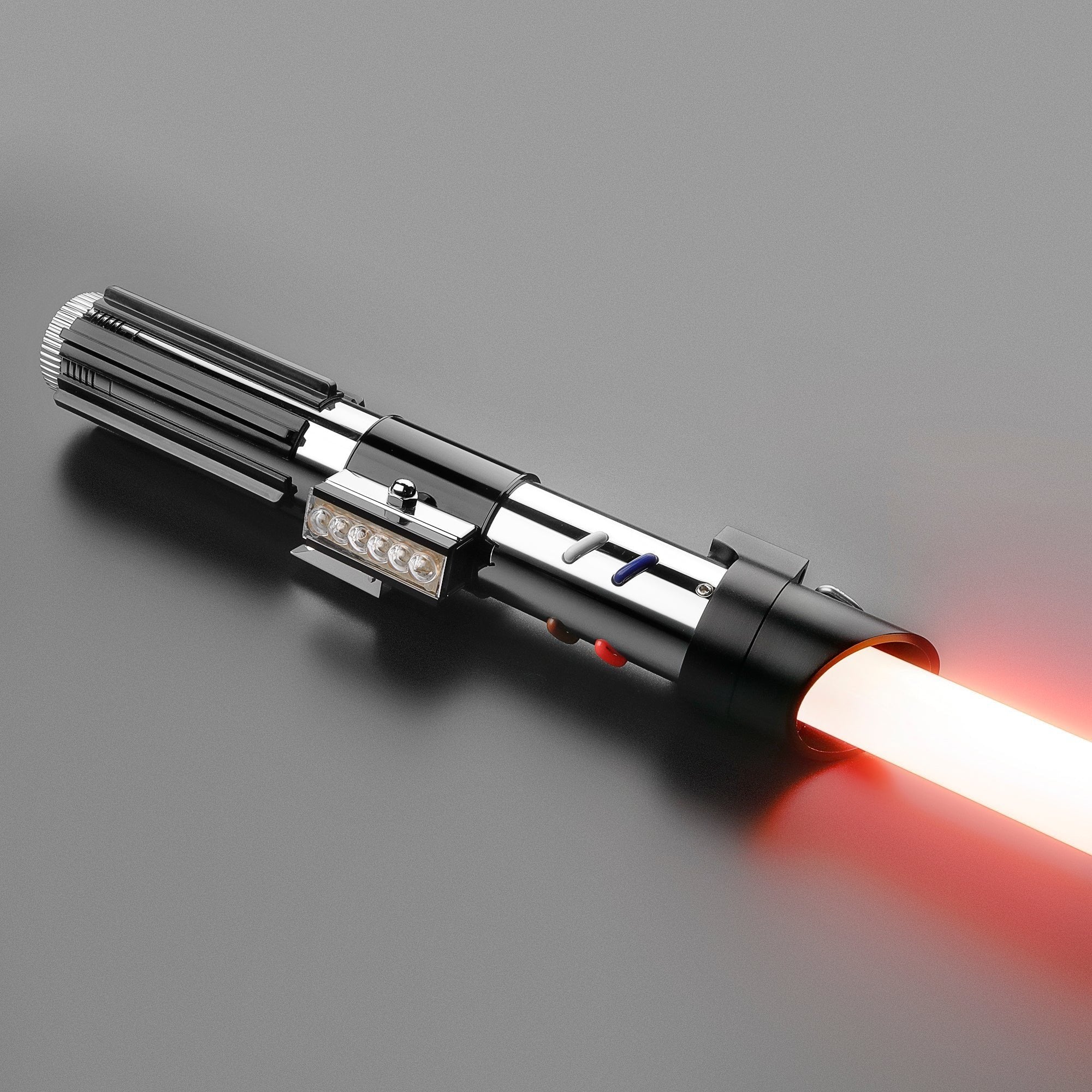
The film-by-film timeline lays out which is which. The saber we carry is the Empire version specifically, the one with the most screen time in the film that wins every scoreboard on this page.
Anakin’s hilt is the same object Luke carries in A New Hope. That is the one genuinely unusual fact in the whole prop lineage.
A design drawn for a 2005 film is meant to be the identical object a character holds in a 1977 film, because in story order the 2005 film happens first. One prop, three films, and the only saber in the series with that continuity claim.
The full history of that blade traces it from Tatooine to Bespin.
So the choice usually comes down to which era’s design language you like holding, not which film you ranked first.
If the answer is the original trilogy’s improvised, skinny look, the Vader hilt is the purest version of it. If the answer is the prequel’s engineered look, Anakin’s is the one that also happens to be Luke’s.

Darth Vader Lightsaber — Xenopixel V3 / Proffie 2.2 ESB Replica
Character Lightsabers / Darth Vader Lightsaber
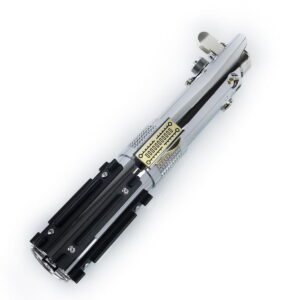
What you should not do is buy by ranking. A replica of the hilt from the film you rate highest is a fine reason to buy a replica, right up until you discover you do not like how a chrome shroud feels in the hand.
The screen-accuracy reference covers what to compare before you spend anything.
What Not to Do
Five things account for most of the bad decisions people make after reading a ranking, and four of them are mistakes made by the ranking rather than by the reader.
- Do not start with The Phantom Menace. It is last or near-last on every column, and it assumes a world the viewer has not been given yet. Whatever its defenders are right about, it is not an on-ramp.
- Do not trust a list that does not name its method. “Ranked” can mean IMDb average, a staff vote, a reader poll, or one person’s afternoon. Those produce four different orders from the same thirteen films, and the list rarely says which one it used.
- Do not read a percentage as a fixed measurement. The Last Jedi’s audience number has moved ten points between snapshots. If a claim depends on a two-point difference between two films, the claim is inside the noise.
- Do not skip Rogue One because it is a spin-off. It is top five on all three columns, and the only film released after 2010 that manages that.
- Do not assume the best film is the best gift. It usually is not. If the person already owns a saber, the film they love is not the object they are missing — the gift guide starts from what they already have for exactly that reason.
There is a single idea under four of those five. A ranking is a measurement of one population at one moment, published without its units.
The moment you know which population and which moment, most of the disagreement dissolves and the remaining argument is the interesting one.
Which leaves the only question worth arguing about: whether a film 97% of people like is actually better than a film 41% of people love and 51% of critics defend.
That is not a data question. The numbers on this page can tell you the split exists and roughly how big it is, and then they stop helping.
Best Sci-Fi by IMDb
Vader’s Every Film Version
Anakin’s Hilt History
Screen Accuracy Reference
Star Wars Gift Guide
FAQ
Q1: What is the best Star Wars movie of all time?
A: The Empire Strikes Back, by every measure that is not one person’s opinion. First on IMDb at 8.7, first with critics at 94%, first with audiences at 97%, first in a fan poll of roughly 25,000 votes with 51%. No other film in the series leads all four.
Q2: What is the best Star Wars movie to watch first?
A: A New Hope. It is second on every scoreboard, but it is the only film written for someone who knows nothing about the setting, so it explains its own rules as it goes. Starting with Empire gives you a better film and a worse introduction to the next eleven.
Q3: Is The Empire Strikes Back really the best one?
A: On the aggregate measures, yes, and not narrowly. The only real challenge comes from reader polls and head-to-head community rankings, where Revenge of the Sith has finished first. Those measure who is voting this year rather than how good the films are, but they are reporting real numbers.
Q4: What is the worst Star Wars movie?
A: On the numbers, The Clone Wars animated film is lowest on all three measures — 6.0 on IMDb, 19% with critics, 40% with audiences. Among the live-action films, The Rise of Skywalker is lowest on IMDb at 6.3 and The Last Jedi is lowest with audiences at 41%.
Q5: Should I watch in chronological order or release order?
A: Release order for a first viewing, because it protects the twist in Empire. Chronological order is legitimate for a rewatch and is George Lucas’s own stated preference — it turns nine films into one continuous fall instead of three separate stories.
Q6: Why do critics and audiences disagree about The Last Jedi?
A: Because they were asked different questions. Critics scored it on execution and on whether it did something formally interesting. A large share of the audience scored it on whether it gave them what they came for, and it deliberately did not. That produces a fifty-point gap, the widest in the series.
Q7: Is the audience score on Rotten Tomatoes reliable?
A: It is reliable as a measure of people who choose to rate films online, which is not the same population as ticket buyers. The Last Jedi’s figure has been reported anywhere from 41% to 51% depending on when it was captured, while CinemaScore, which polls people leaving the cinema, gave the same film an A.
Q8: Is Rogue One worth watching?
A: Yes. It sits at 7.8 on IMDb, 84% with critics and 87% with audiences — fourth, fifth and fifth on the three columns, which makes it the only film released after 2010 in the top five on all three. It also needs no prior investment in the sequel trilogy.
Q9: How many Star Wars movies are there?
A: Thirteen theatrical films. Three prequels, three original-trilogy films, three sequels, two standalone films, one animated theatrical release, and The Mandalorian and Grogu, which opened in May 2026.
Q10: What is the best Star Wars movie for kids?
A: A New Hope, for the same reason it is the best first film for anyone. The scope is small, the stakes are explained, and nothing in it depends on a viewer having seen something else. The prequels are more visually busy and harder to follow for a first-timer of any age.
Q11: Which Star Wars movie has the highest critic score?
A: The Empire Strikes Back at 94%, with A New Hope and The Force Awakens tied at 93%. On Metacritic the order flips — A New Hope holds a 90 to Empire’s 82 — which shows how much the choice of scoreboard decides the answer before any film is even discussed.
Q12: What is the best Star Wars movie to rewatch?
A: The Empire Strikes Back if you want the craft, and Revenge of the Sith if you want the one that improved. Revenge of the Sith reads differently once the animated series has filled in the relationship the film compresses. Its twentieth-anniversary re-release took about $42 million worldwide in its opening weekend, two decades after release.
The short version: one film wins every scoreboard, and every other position on every list is a statement about which scoreboard the writer picked. Now you know which one you are reading.