
Two. Maul’s staff is not one lightsaber with an emitter at each end — it is two complete lightsabers joined at their pommels, and each half carries its own crystal. That is why every account of the weapon describes it as two sabers fused together, and why half of it was still igniting decades after the hilt was cut through.
The crystal count sounds like trivia. It is not, because it decides what happens when the weapon fails. One crystal feeding two emitters is a single system with two mouths. Two crystals is two systems sharing a length of tube.
The fiction ran the test on that difference by accident, in the middle of a duel, and never remarked on it. That is the strongest kind of evidence: a consequence nobody was trying to demonstrate.
What’s on This Page
- The Short Answer, and Why It Is Two
- The Test the Film Actually Ran
- What the Count Really Counts
- Why Some Accounts Give a Different Number
- Nobody Has Shown Where the Crystals Came From
- What the Count Changes for a Buyer
- What to Ask Before Buying a Staff
- FAQ
The Short Answer, and Why It Is Two
Two crystals, one behind each emitter, because the weapon is built as two lightsabers joined end to end rather than as one lightsaber with a blade at both ends.
Every description of the staff uses the same construction: two hilts mated at the pommel by a coupler, each carrying its own blade.
That framing is doing the work. A saber with one crystal and two emitters would be one weapon with a doubled end. A staff of two mated sabers is two weapons that agreed to travel together.
So the crystal count follows from the construction, and not the other way round. Once the object is two hilts, “two crystals” stops needing separate proof — it is simply what a hilt is.
Which is why the more interesting question is not what the count is, but what would show it wrong. That turns out to be answerable from the films.
The Test the Film Actually Ran
The hilt was cut through in the middle of a duel, and the surviving half kept igniting. A half that still switches on has to contain a complete system.
During the duel at the end of the 1999 film, the staff is bisected in a single strike through the body of the hilt. The fight continues, and the surviving half leaves with him, still a working weapon.
Accounts of that moment vary on one detail. One reference describes the other half as left non-functional. That variation matters less than the fact that does not vary: the half he kept still lit.
That is the entire argument in one observation. If a single crystal had been feeding both ends, a cut through the middle would have put the crystal in one half and left the other sharing only an emitter, with nothing behind it.
Instead the surviving end behaved like a weapon rather than a fragment, because behind that blade there was a crystal, a power source, a control board and an emitter — all on his side of the cut.
The years after are a second, slower confirmation. He carries the half as a single-bladed saber for a long stretch, then later has the broken end rebuilt into a staff again. Replacing an end is a repair no single-core weapon can be given.
The form-by-form history of which version he carried when is its own subject, and this page does not retell it.
| What the weapon does | If there were one crystal | If there are two | Which it fits |
|---|---|---|---|
| Either blade ignites on its own | Needs a switch that routes to one emitter | Expected — two separate switches | Two |
| Cut through the middle, one half still lights | Not possible — the crystal ends up in one half only | Expected — each half holds a complete chain | Two |
| The severed end is later replaced, not the whole weapon | Rebuilding would have to start from the crystal outward | Expected — swap an end unit | Two |
| Both blades are the same colour | Expected — one crystal, one colour | Expected only if the two match | Neutral |
Three of those four rows point the same way, and the fourth refuses to. A table where every line agrees is usually a table that was written after the conclusion.
What the Count Really Counts
“Two crystals” is shorthand. What is actually duplicated is the whole chain behind each blade.
A crystal does not make a blade on its own. It has to be held in place, its output aimed through an emitter, fed by a power source, and released by something that switches.
A crystal with no cell is inert. A cell with no switch is a battery in a tube. So wherever there is a second crystal, there is also a second everything else.
That is what makes crystal counts easy to argue about and hard to fake. A count of crystals is really a count of complete chains that happen to share a piece of aluminium.
Both diagrams in the next figure are double-bladed. Only one of them can lose half of itself and carry on.
Same outline, same blade count, different number of complete systems inside it.
The distinction is not cosmetic. It is the difference between a weapon with two ends and two weapons that each have one.
Why Some Accounts Give a Different Number
The count has been written as one, two and four at different times, in different continuities, by people describing different objects.
The current account is two. It is the one that matches how the weapon is constructed and how it behaves when damaged, which is why it is the answer here.
The older continuity gave its own version, and did not stop at two. A 2001 novel has him spend days beside a furnace, working the growing crystals with the Force, until the story calls the result his four perfect crystals.
Four, for one blade at each end.
Four is not a refutation of two. Older material allowed a blade more than one crystal, with a second one shaping and focusing what the first produced — so “four” and “two” are counting at different levels.
A third reading is the one that names a single crystal. Older reference material permitted a large sabrestaff stone driving both emitters from one chamber, and that is where the “one crystal” answer comes from when it comes from a source rather than a guess.
None of these is carelessness. Each is internally consistent inside the continuity that produced it. Which number is right depends on which continuity you are standing in.
| Account | Crystals | What it is describing |
|---|---|---|
| Current canon | Two — one per blade | Two complete sabers mated at the pommel; each end ignites, and fails, on its own |
| Older continuity, one novel | Four — two per blade | Crystals forged in a furnace over days; each blade given a primary and a shaping crystal |
| Older reference material | One large crystal, two emitters | A single chamber driving both ends through one mechanism |
There is one further explanation in circulation that deserves an honest label. It holds that the two crystals have to be matched in frequency, and that the coupler exists to hold them in the correct relationship.
It is a tidy account of why the joint matters, and it may well be how the fiction intends it. But the sourced descriptions establish two crystals and stop there. The matching claim is reasoning built on top of the record, not a line from it.
That is worth saying plainly, because it changes what you can assert. “There are two” is a fact about construction. “They must be tuned to each other” is a plausible story about why.
Nobody Has Shown Where the Crystals Came From
The count is settled. The supply is not: canon has never shown him obtaining either crystal, and his weapon predates the event that would normally explain it.
The usual Sith route is documented elsewhere. A dark side user takes a crystal from a Jedi, then forces it to red — the process is called bleeding, and it is the reason Sith blades are the colour they are.
That route is closed to Maul, for a reason that is easy to walk past. His staff is already in his hands before he kills his first Jedi.
The kill in question is a captured Padawan he duels on a moon, in a 2017 comic run set shortly before the film — and the staff appears in that story, already built. Whatever he is carrying, it did not come out of her.
So the weapon predates the only Jedi death available to explain it. A crystal taken from that duel cannot be the crystal in a weapon that was already working before the duel happened.
What the material does describe is the design coming from old Sith records. The reading most people settle on is that the weapon and its crystals arrived through his master rather than through a battlefield.
That reading is inference and should be labelled as such. The count is a fact about how the object is built. The origin is a blank the fiction has chosen to leave open, and the blank is old enough that it is probably deliberate.
It is also the one part of this question that could be closed in a single scene. The count was settled by watching a hilt get cut in half. The supply would be settled by watching him make one — and no film, series or comic has yet shown it.
What the Count Changes for a Buyer
On a physical staff the same count decides whether a fault costs you one blade or the whole weapon — and it decides what is actually in the box.
Production staffs are built the way the fiction describes them: two hilts meeting at a machined collar, each one a complete saber in its own right.
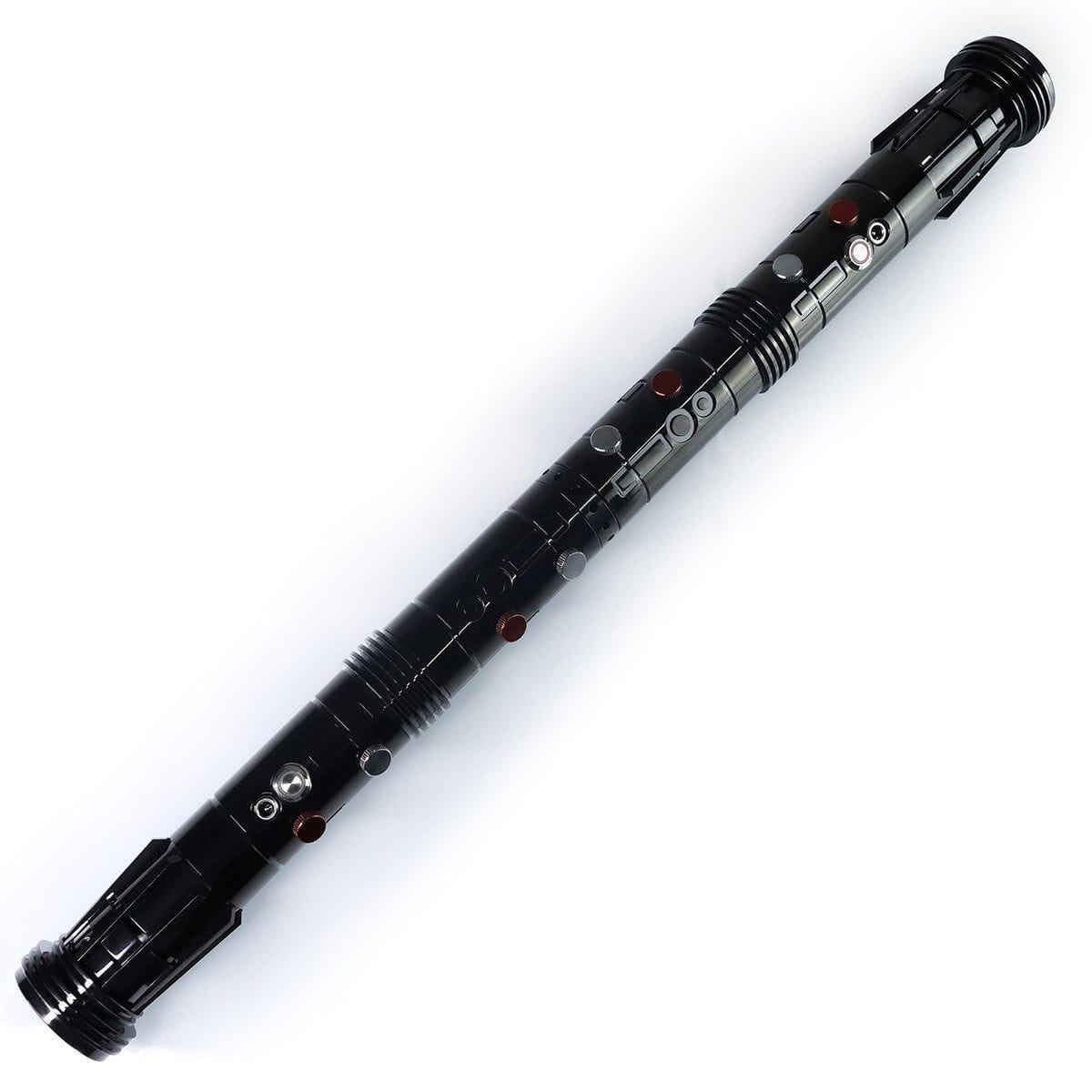
You can see the count in that photo before anything is switched on. The two ends are mirror images, and the collar in the middle is where the second system begins.
The first consequence is failure. On a staff with two cores, a flat battery or a loose connection costs you one blade and the fight continues at half length. On a single-core staff the same fault costs you the weapon, because there was only ever one of everything.
The second consequence is the box. A double-bladed hilt and a double-bladed setup are two different purchases. This one separates into two complete sabers, but it ships with one blade — the second blade is a separate item, because the second half needs its own tube.
The third is how it behaves in the hands. A staff with both blades fitted runs about 184 cm and roughly 2.5 to 3.0 kg, with the balance point at the collar. That is a two-handed weapon, not a long sword.
The electronics side of this — board by board, including what a single-board staff can and cannot do — belongs to the double-bladed technical reference. The joint has its own guide covering threads, alignment and wear.
ISABER Double Bladed Lightsaber — RGB Baselit / Xenopixel Staff Saber
Accessories / RGB & Baselit Lightsabers
What to Ask Before Buying a Staff
Four questions separate a genuinely two-core staff from a hilt that only looks like one from the outside.
The first question is the one the film answered with a slash: does it come apart into two working sabers, or does it merely come apart? A staff that separates into two complete weapons is two systems. A staff that only unscrews is one system in two pieces.
The way to ask it is concrete. Ask whether each half has its own battery and its own switch. Two yeses means the halves are independent.
If they share a power source instead, the second crystal is not there to make a second weapon. It is there to make a second blade.
The second question is how many blades are in the box. A staff hilt with one blade is a staff you cannot ignite at both ends on the day it arrives.
The third is charging. Two independent halves should charge independently, and a staff that needs one port for the whole weapon is telling you which architecture you bought.
The fourth is the collar. Machined metal holds tolerance; moulded plastic deforms under load, and a staff that wobbles at the joint is the two pieces announcing themselves every time you swing.
Nothing on that list requires opening the hilt or trusting a spec sheet. All four answers are things a seller either knows or does not.
FAQ
Q1: Does Darth Maul’s lightsaber have two kyber crystals?
A: Yes — one per blade. The staff is built as two complete lightsabers joined at their pommels, so each half has its own crystal behind its own emitter rather than one crystal feeding both ends.
Q2: Why does it have two instead of one?
A: Because of how it was built, not because of a rule about crystals. Once the object is two hilts mated together, each hilt needs everything a hilt needs, and a crystal is on that list.
Q3: What proves it had two?
A: The bisection. The hilt was cut through during a duel and the surviving half still ignited, which is only possible if that half contained a complete system, crystal included.
Q4: Could one crystal power both blades?
A: The older reference material allowed it, describing a single large stone driving two emitters. That is a different architecture, and it would not survive being cut in half.
Q5: Did he use a single-bladed saber later?
A: Yes, for a long stretch — the surviving half, as a single blade. That period is one of the strongest arguments for the count, because the half had to be self-sufficient to be usable.
Q6: How many crystals did the older stories give him?
A: Four. A 2001 novel has him forge the crystals himself, two per blade, which counts a shaping crystal alongside the primary one rather than contradicting the two-crystal reading.
Q7: Are the two crystals different colours?
A: No. Both blades are the same red. A matched pair, or two crystals bled the same way, produces one colour across the staff — the count never implied two hues.
Q8: Where did his crystals come from?
A: Canon has never shown it. The usual Sith method is to take a crystal from a slain Jedi, but his weapon predates his first Jedi kill, so that route does not fit. The common reading is that they came through his master.
Q9: Do double-bladed replicas have two separate cores?
A: The good ones do. A staff that separates into two complete sabers — each with its own battery, board and blade — is the physical version of the two-crystal design, and it fails one blade at a time rather than all at once.
Q10: Does a staff saber arrive with two blades?
A: Check before ordering. Many double-bladed hilts ship with one blade, because the hilt and the full two-blade setup are priced as different purchases.
Q11: Is a staff harder to use than one saber?
A: Yes, and the difficulty is geometry rather than weight. The second blade shortens the safe distance to your own body, which is why the stance has to change before the length becomes an advantage.
Q12: Which version should a replica be based on?
A: The original staff, if recognisability is the goal. The later single-bladed and disguised forms are deep cuts, and the staff is the version the design is remembered for.
ISABER Double Bladed Lightsaber — RGB Baselit / Xenopixel Staff Saber
Accessories / RGB & Baselit Lightsabers