
“Strongest” is two different questions wearing one word. In canon, there is no strength ranking at all — the Darksaber is the most discussed blade, not the most powerful, and the people who made the shows say so. Physically, strength is five independent measurements, and the saber that wins on one of them usually loses on another. Anyone who answers with a single model name has answered a different question than the one being asked.
The two questions pull in opposite directions. The canon answer is about legend and symbolism, and it deliberately refuses to hand out power levels. The real answer is about wall thickness, thread engagement and what happens to a polycarbonate tube when it hits another polycarbonate tube at speed.
So this page answers both, in that order, and then puts them side by side to show why they do not line up.
What’s on This Page
- The Canon Answer: No Ranking Exists
- Why the Darksaber Is Not the Strongest
- The Five Things Strength Actually Measures
- Ranked: Canon Versus Physical
- Why the Two Lists Don’t Match
- Building for Strength, Not for Show
- FAQ
The Canon Answer: No Ranking Exists
Canon has no strength tiers. All lightsabers cut the same things, block the same things, and stop each other in a blade lock. There is no scene in which one blade overpowers another because it is a better blade.
That absence is not an oversight. A weapon that can already cut through a blast door does not need a stronger version, and a story that graded its sabers would have to explain why weaker ones still get used.
What canon does vary is not strength but the wielder. Duels are decided by form, reach, timing and Force ability, and every one of those belongs to the person holding the hilt. A shoto in the right hands beats a standard blade in the wrong ones, and the films show that repeatedly.
There are exactly two exceptions worth knowing, and neither is a power ranking.
The blade lock
When two blades press together, the winner is decided by leverage, footing and mass — the same things that decide an arm wrestle. In the duel on Mustafar, the lock is broken by a shift in position, not by one saber being hotter.
The beskar exception
Mandalorian iron resists a lightsaber. That is a property of the armour, not of any blade, and it means the answer to “what beats a lightsaber” in canon is a material rather than a weapon.
For what actually happens when a blade meets each kind of material, the page on whether lightsabers can cut through anything covers the four canon exceptions.
The wavelength calculation, and what it measures
There is one numerical answer to this question that circulates widely, and it deserves an honest hearing before it is set aside.
A student paper published in 2017 took the blast-door scene from the first prequel as its baseline — a green blade cutting through in about eleven seconds, which works out to 6.96 MW — and then recalculated that figure for the other blade colours, assuming a saber emits pure photon energy.
The results run in a clean order. Purple comes out at 9.34 MW and 8.2 seconds to cut the door. Blue at 7.97 MW. Green at 6.96 MW. Yellow at 6.38 MW. Red at 5.47 MW and 14 seconds.
So purple is strongest and red is weakest, by a factor of about 1.7. That is the answer most often quoted, and the arithmetic behind it is sound.
Why it doesn’t answer the question
The paper’s own conclusion is the reason. Its author notes that the result contradicts canon, where sabers are explicitly equal, and concludes that the blade must therefore be plasma rather than a beam of photons — a conclusion that removes the premise the calculation was built on.
The calculation measures energy per photon multiplied by photon count. That is a real quantity. It is not a measure of cutting power, because cutting power depends on how the energy is delivered to the target, and a contained plasma delivers heat by contact rather than by illumination.
It is also, in the strict sense, not an answer about sabers at all. It is an answer about a hypothetical light source shaped like a saber.
And on a real saber
Blade colour on a saber you can buy is a dye and a firmware setting. A baselit blade gets its colour from the LED behind it and a coloured film in the tube; a pixel blade gets it from which diodes the board drives.
Changing colour changes how bright the blade looks, because the eye is not equally sensitive across the spectrum. It does not change the wall thickness, the threads, the retention or the current.
Which means: on every axis that decides whether a saber survives a strike, colour is not a variable at all.
Why the Darksaber Is Not the Strongest
The Darksaber is old, flat-bladed, beskar-hilted and heavy in the hands of anyone who doubts their claim to it. None of those makes it more powerful, and the people who wrote it have said exactly that.
This is the single most common wrong answer to the question, so it deserves a direct rebuttal rather than a hedge.
The showrunner’s own position, given in an interview, is that the Darksaber is not necessarily more powerful than any other lightsaber, and that a strong case can be made that it is less. He describes it as a very old weapon that may carry limitations, with a Mandalorian design twist that has never been reproduced.
What is actually different
Three things, and all three are design rather than power.
The blade is flat rather than round — an energy blade with a defined edge and a defined plane, which is unlike every other saber in the setting.
The hilt is beskar. That is a durability advantage for the object you are holding, not for the blade you are swinging.
The weight is the famous one. The blade becomes disproportionately heavy for a wielder whose claim to it is unresolved, and light for one whose claim is settled. Canon treats this as a property of the weapon’s history rather than a power setting.
Why the reputation outruns the fact
Because the Darksaber is not primarily a weapon in the story. It is a title. Whoever holds it can claim rule of Mandalore, which means every fight over it is a fight about legitimacy rather than about cutting power.
That is exactly the kind of object that accumulates a reputation for being the strongest. Its page on the thousand-year history of Mandalore’s blade follows what the object means rather than what it can cut.
The Five Things Strength Actually Measures
On a real saber, “strong” is not one number. It is blade wall, blade diameter, hilt thread engagement, board current headroom and how the blade is retained — five axes that trade against each other.
Here is the useful version of the question. Each axis below runs from weaker to stronger, and the numbers on each end are the ones that actually change.
What each slider costs
- Blade wall. 3 mm holds up to full-contact duelling and 2 mm does not, but the thicker blade is heavier at the tip and eats more of the hilt’s balance.
- Blade diameter. A 1 inch blade has more material at the wall than a 7/8 inch blade of the same thickness, and it needs a 1 inch emitter to fit.
- Thread engagement. Deep threads survive a joint impact; shallow cosmetic threads strip, and a stripped joint cannot be repaired with tape.
- Current headroom. A board driven at its limit runs hot, and heat is what shortens the life of every component downstream of it.
- Retention. One screw holds a blade in place. Two screws hold it in place after the first one works loose.
This is why a single model name cannot answer the question. Two sabers from the same line can differ on three of these five axes depending on which blade and which board were fitted.
Blade wall: the 2 mm and 3 mm line
The blade is a polycarbonate tube. Wall thickness is the number that decides whether it survives a full-force strike or cracks at the impact point, and the hobby splits at 2 mm and 3 mm.
2 mm is the light and mid-grade tube. It is bright, it is light, and it is fine for choreography and spinning. 3 mm is the heavy grade, and it is what you fit if the sabers will actually hit each other hard.
The catch is that heavy blades need matching hilts. A 3 mm blade on a hilt built for a light tube moves the centre of mass forward and puts more load on the emitter than the design intended.
The blade reference covers the full construction and the diffuser inside; the blade length page covers what 28, 32 and 36 inches feel like in the hand.
Blade diameter: 7/8 inch versus 1 inch
A 7/8 inch blade is thinner and lighter, and it suits shorter hilts and thinner designs. A 1 inch blade carries more material at any given wall thickness, which is why heavy-grade duelling builds tend to be 1 inch.
Diameter and wall thickness multiply. A 1 inch tube at 2 mm wall is not the same blade as a 7/8 inch tube at 3 mm, and the two behave differently at the same impact.
Thread engagement: where hilts actually fail
A hilt is a stack of machined sections screwed together, and every impact travels through those joints. Deep thread engagement distributes the load across more turns of aluminium; shallow engagement concentrates it on two or three.
This is the axis most buyers never check, because it is invisible from the outside. It is also the one that decides whether a hilt develops a rattle after a season of duelling.
Current headroom: heat is the failure mode
Every board has a current it can pass continuously and a current it can survive briefly. A build that runs near the first number is a build that gets warm in the hand and stays warm.
Heat does not fail a saber immediately. It shortens the life of the cell, softens solder joints over time, and makes an intermittent fault that is very hard to diagnose because it only appears after twenty minutes of use.
Retention: the cheapest axis to get right
One retention screw is the standard. A second screw is the difference between a blade that stays put and a blade that ejects on a hard strike — and blade ejection is how most duelling injuries happen.
This is also the axis a buyer can verify in ten seconds, with no tools and no spec sheet.
Ranked: Canon Versus Physical
Two lists, answering two questions. The canon list ranks by story importance; the physical list ranks by what survives a hard strike. They share almost no entries.
The canon list is not a power ranking, because canon has none. It is a ranking of which blades the story treats as consequential.
| Rank | Canon: most consequential blade | Why it ranks |
|---|---|---|
| 1 | The Darksaber | Carries a claim to rule Mandalore; every fight over it is about legitimacy |
| 2 | The Skywalker saber | Three generations of ownership; the only blade whose history is the plot |
| 3 | The Grand Inquisitor’s ring saber | A hilt that flies; the only canonical mechanism-based design |
| 4 | Kylo Ren’s crossguard | A cracked crystal and a vented design; a weapon that shows damage as identity |
| 5 | Any standard blade | Interchangeable by design; the setting deliberately makes them equal |
The physical list is a different kind of object. It is not ranking models — it is ranking configurations, because configuration is what decides strength.
| Rank | Physical: strongest configuration | What it wins on |
|---|---|---|
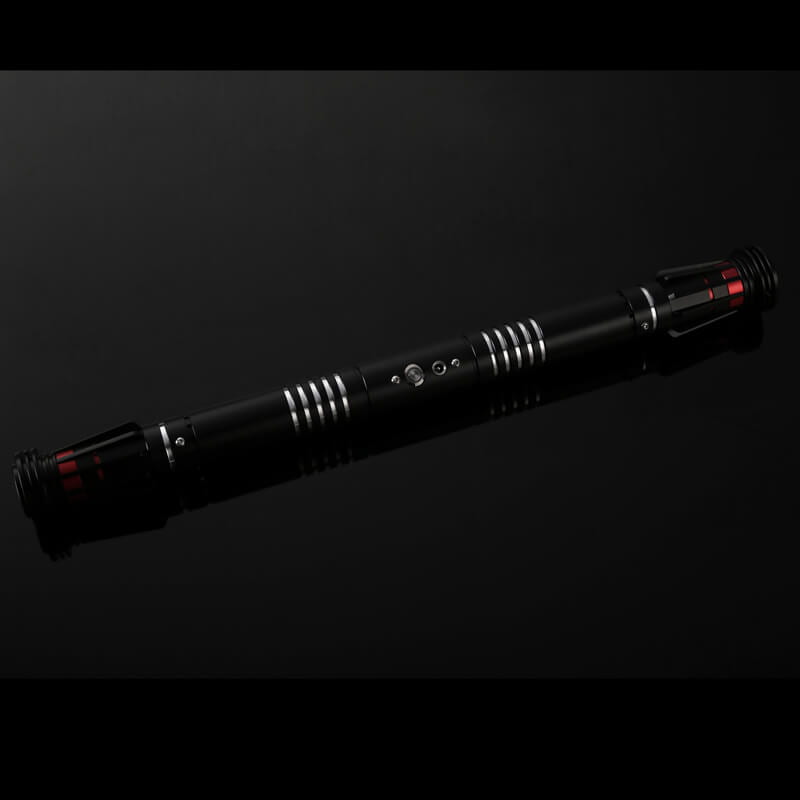
| 1 | Baselit hilt, 1 inch heavy-grade blade, two retention screws | Nothing electronic inside the tube to break, and a thick wall to absorb the hit |
| 2 | Neopixel hilt with a separate baselit duelling blade | Cinematic blade for display, sacrificial blade for contact |
| 3 | Neopixel hilt with a heavy-grade pixel blade | Effects survive longer, but the strip is still inside the impact path |
| 4 | Any thin-wall 2 mm blade build | Bright and light, and the first thing to crack at the strike point |
| 5 | Display builds with no retention hardware | Not built to be swung, and should not be |
Why the Two Lists Don’t Match
The Darksaber tops the canon list and would be a poor duelling build. A plain baselit hilt tops the physical list and has no story at all. Both statements are true at once.
There are three reasons the lists diverge, and each one is worth understanding before you spend money.
Canon ranks meaning, not capability
An object becomes important in a story by being contested. The Darksaber is contested constantly, so it accumulates significance, and significance reads as power to anyone who is not counting carefully.
That is a narrative mechanism, not a technical one. It has no measurable consequence for a saber you can hold.
Physical strength is about what breaks first
A duelling saber fails at a specific place: the blade wall at the impact point, the thread joint, or the retention screw. Everything else in the build is downstream of those three.
Which means the strongest saber is the one that puts the most material at those three points — and none of that has anything to do with which saber the story cares about.
The strongest saber is usually the least interesting one
A baselit hilt with a thick blade looks plainer than a pixel blade with a character-accurate hilt. It has fewer effects, a dimmer blade and no scroll-through fonts.
It is also the one that comes back from a fight night in one piece. That trade is the real decision, and it is covered properly in the comparison of neopixel against baselit.
Building for Strength, Not for Show
If the question is genuinely about strength, the answer is a configuration rather than a model: hollow blade, thick wall, deep threads, two screws, and a board with current to spare.
Four decisions, in the order they matter.
Choose the blade architecture first
A baselit blade has nothing inside the tube. A neopixel blade has a strip of addressable LEDs running its whole length, sitting directly behind the impact surface. That single difference decides how the blade fails.
Everything else — brightness, effects, battery, replacement cost — follows from it. If contact is the point, the hollow blade is the answer.
Then choose the wall
3 mm heavy grade for anything that will be struck. 2 mm only if the sabers are for spinning, choreography at low force, or display.
Buy two blades rather than compromising on one. A heavy blade for contact and a thin blade for display costs less than replacing a cracked pixel blade.
Then check the joints
Ask how many sections the hilt breaks into and how they are held. More sections means more joints, and more joints means more places for rattle to develop.
A hilt that unscrews into four pieces for a crystal chamber is a beautiful object. It is also four thread joints instead of one.
Then check the retention
Two screws, or one screw plus a machined seat. This is the cheapest and most effective upgrade on any duelling build, and it is the one most often skipped because a single screw looks sufficient on a new saber.
For the parts and the compatibility rules behind those four decisions, the technical reference on lightsaber parts is the place to start. For how the electronics are laid out inside the hilt, the page on how lightsabers work walks the chain stage by stage.
FAQ
Q1: What is the strongest lightsaber?
A: In canon, none — there is no strength ranking, and all blades cut, block and lock the same. Physically, the strongest configuration is a baselit hilt with a 1 inch heavy-grade blade and two retention screws.
Q2: Is the Darksaber the strongest lightsaber?
A: No. The people who made the shows describe it as not necessarily more powerful than any other saber, and possibly less, because it is very old. It is the most politically consequential blade, not the most powerful one.
Q3: Which lightsaber is the most powerful?
A: Canon gives no power levels, so the question has no canon answer. What canon varies is the wielder, not the blade — duels turn on form, reach and Force ability.
Q4: Why is the Darksaber heavier than other lightsabers?
A: Canon treats the weight as a property of the weapon reacting to a wielder whose claim to it is unresolved. It becomes manageable once the wielder’s claim is settled. It is not a mass measurement.
Q5: What is the strongest lightsaber blade material?
A: Polycarbonate, and thickness matters more than the name. A 3 mm heavy-grade tube absorbs impacts that crack a 2 mm blade, and both are the same material.
Q6: Are neopixel or baselit sabers stronger?
A: Baselit is more durable for full contact, because the blade is hollow and there is nothing inside it to break. Neopixel blades carry an LED strip behind the impact surface and are rated for moderate duelling.
Q7: Can a lightsaber cut through beskar?
A: No. Beskar resists a lightsaber blade, which makes it the canon answer to what beats one. That is a property of the armour, not a weakness of any particular saber.
Q8: What breaks on a lightsaber first?
A: In a duelling build, the blade wall at the impact point, the thread joint between hilt sections, or the blade retention screw. Electronics fail second, usually as a consequence of heat.
Q9: How thick should a duelling blade be?
A: 3 mm wall for anything struck at force. 2 mm is the light and mid grade used for spinning, choreography and display.
Q10: Is a bigger lightsaber stronger?
A: Not automatically. A longer blade moves the centre of mass forward and loads the emitter more, and a 7/8 inch blade can be stronger at the same wall thickness than a long 1 inch blade with a thinner wall.
Q11: What is the strongest hilt material?
A: Aluminium alloy is the standard, and thread depth matters more than which alloy. Steel is heavier and stronger but changes the balance, and a titanium hilt is expensive without solving the joint problem.
Q12: Does a stronger saber cost more?
A: Not reliably. A baselit hilt with a heavy blade is usually cheaper than a pixel build, and it wins on every durability axis. What costs money is effects and character accuracy, not strength.
Q13: Does lightsaber colour affect its power?
A: In canon, no. A 2017 student paper calculated that if a blade emitted pure photons, purple would be strongest at 9.34 MW and red weakest at 5.47 MW — but the paper’s own conclusion is that this contradicts canon and the blade must be plasma. On a real saber colour is a dye and a setting, not a strength variable.
The short version: if someone asks which saber is strongest and answers with a character name, they are answering the story question. If they answer with a wall thickness and a screw count, they are answering the physical one. Only one of those describes an object you can buy.