
A lightsaber runs on two separate chains. In canon, a power cell feeds a kyber crystal that shapes plasma held inside a containment field, and the field returns the energy to the hilt. In a saber you can buy, a cell feeds a driver board, the board feeds an LED, and the return path is an ordinary electrical circuit. Only the second chain has ever been built.
Both chains answer the same questions, and they answer them differently: why the blade stops at a fixed length, why the hilt does not melt, why two blades press against each other instead of passing through, and why a real saber needs charging while a fictional one almost never does.
This page walks both, in order. Energy in, energy shaped, light out, and what happens on the way back.
What’s on This Page
- The Canon Chain, Start to Finish
- Why the Blade Stops
- The Return Path
- The Real Chain, Start to Finish
- The Two Chains Side by Side
- Where the Real Chain Breaks Down
- What’s Inside a Saber You Can Buy
- Frequently Asked Questions
The Canon Chain, Start to Finish
A saber takes energy from a power cell, passes it through a kyber crystal, and emits it as plasma that a containment field holds in the shape of a blade. The hilt is the housing and the control surface, not the weapon.
On screen the sequence is never explained. What the films give is behavior, consistent across nine episodes and every series since.
The component names, though, come from reference and technical writing rather than dialogue. Several of them — the diatium power cell, the flux aperture, the superconducting return loop — originated in the pre-2014 Expanded Universe and are no longer canon.
They are still the clearest description anyone has written, which is why they keep getting repeated. Treat them as a model, not as scripture.
The power cell
Canon shows a saber being assembled around a core that holds the crystal and the cell. The cell is the part that runs out.
That is the one piece of the fictional chain with a real analogue, and it is the piece that decides how long a blade stays lit.
The crystal
The kyber crystal does three jobs at once in canon: it colours the blade, it sets its length, and it shapes the containment field that gives the plasma an edge.
A cracked crystal produces an unstable blade, which is the explanation given for the crossguard saber’s flicker and its two venting quillons. A bled crystal turns red. A healed one turns white.
Those are story mechanics rather than engineering, but they are consistent, and they explain every visual variation the films have shown.
The emitter stack
Reference material puts three stages between the crystal and open air: field energizers that convert the cell’s output into plasma, an emitter matrix that aligns it, and a lens at the emitter face that launches it.
The emitter matrix is the part with a documented failure mode. Installed backwards, it shorts the saber out — which is why building one is treated as dangerous work rather than assembly.
Why the Blade Stops
The containment field has a finite range, so the plasma stops where the field ends instead of expanding. Canon blades sit near a metre, and the length is adjustable on most builds.
This is the single most useful thing the field explains, because a plasma with nothing holding it does not form a blade. It expands.
The field also explains the two other odd behaviours. A blade meets another energy field — a bolt, a staff, another saber — and stops, because two fields push against each other. It meets ordinary matter and passes through, because the field passes through and the plasma follows.
Translation for a physical saber: the equivalent design decision is blade length and blade fit, which is why a real blade slides into an emitter socket and is locked by a retention screw rather than grown from the hilt.
The Return Path
In the reference model the blade is a closed circuit: the beam arcs back to a charged aperture at the emitter and a superconductor carries the energy into the cell. The cell only drains when the loop is broken.
This is the piece most people have never heard, and it is the piece that makes the fictional saber self-consistent.
Energy leaves through a positively charged lens at the emitter’s centre, arcs back to a negatively charged aperture around the emitter, and returns to the cell. Very little is lost on the way round.
Two consequences follow. A saber runs for years without recharging. And a saber drains when it cuts something, because cutting is what breaks the loop.
Clashing does not drain it in this model. Only contact that the blade actually cuts through does.
Five stages, one loop
- 1 — Power cell. Holds the energy. Drops only when the loop is broken.
- 2 — Crystal. Sets colour, length and the shape of the containment field.
- 3 — Emitter. Converts and launches the output as plasma.
- 4 — Blade. Plasma held in blade shape for as far as the field reaches.
- 5 — Return path. The beam arcs back to the aperture and the energy goes home.
The loop is the reason a fictional saber barely needs charging, and the reason cutting drains it. Nothing about the diagram is measured; it is the model the reference material describes.
What breaks the loop
Contact with something the blade is cutting. In the reference model that is the drain event, and it is why duelling against another blade is described as cheap while cutting through a blast door is described as expensive.
It also sets up the most useful contrast on this page. A real saber’s loop is never broken, because it is not a loop at all. It is a one-way circuit that has to be refilled.
The Real Chain, Start to Finish
A real saber is a battery, a controller board, a driver stage and an LED, in that order, with the blade acting as a light pipe. Every stage has a measurable cost, and the current draw is what shapes the whole design.
This chain is short enough to list, and every part is something you can buy and test.
The cell
Nearly every modern hilt runs a single 18650 lithium-ion cell, or two in a stick. Nominal voltage is 3.7 V, fully charged it is 4.2 V, and the useful floor is around 3.0 V.
Cell choice is not about capacity alone. A Neopixel blade under full white pulls hard enough that a low-drain cell sags or trips its protection circuit, which is the usual cause of a saber that browns out on a bright colour.
High-drain cells rated around 15 A are the community standard for that reason, not for the extra milliamp-hours.
The board
The board is the brain, and it is doing four jobs at once: driving the light, playing sound, reading motion, and watching the switch.
Sound lives on a microSD card as WAV files grouped into fonts — hum, swings, clashes, ignition, retraction. Motion comes from an accelerometer and gyroscope, which is how a swing triggers a swing sound within milliseconds of the movement.
That sensor is also the reason a saber feels responsive at all. Without motion input, a swing sound can only be played on a timer.
The driver stage
Two architectures exist and they behave very differently at this point in the chain.
An in-hilt LED build runs a high-power triple LED in a heatsink at the emitter, driven at constant current, usually a few amps total. The blade is an empty polycarbonate tube with a diffuser, and light is pushed into it from one end.
A pixel build runs an addressable strip up the inside of the blade. Every pixel takes its own data, which is what produces ignition animations, per-pixel effects and full colour change.
The cost of that is current. Datasheet figures for a full-white pixel blade land in the 12 to 16 A range, while measured draws on real sabers come in lower, around 9 to 10 A for a two-strip full-white blade.
Either way it is an order of magnitude more than the in-hilt design, and it changes the wiring, the cell and the heat budget.
The blade and the speaker
The blade is a polycarbonate tube. It carries light, and in a pixel build it also carries the heat source, which is why blade wall thickness ends up doing two jobs at once.
The speaker is a small 2 W driver, typically 20 to 28 mm, sitting in the pommel or low in the hilt. It is the last stage in the chain and the first thing that sounds wrong when the board is under-volted.
The Two Chains Side by Side
The two chains line up stage for stage until the blade, then diverge completely: one ends in contained plasma, the other ends in a plastic tube full of LEDs.
| Stage | Canon model | Real saber |
|---|---|---|
| Energy source | Power cell, cycled through the blade loop | 18650 or similar lithium-ion cell, one-way |
| Conversion | Kyber crystal and field energizers | Driver board and constant-current stage |
| Emission | Emitter matrix and lens, launching plasma | Triple LED in a heatsink, or an addressable strip |
| Containment | Field generated by the crystal | None required; the polycarbonate tube is the container |
| Blade length | Set by field range, adjustable | Set by the tube you fit, from 28 to 36 inches |
| Return path | Beam arcs back; superconductor returns the energy | Closed electrical circuit inside the hilt |
| Recharge | Rare; drains only when cutting | Every session; drains with brightness and time |
| Waste heat | Held inside the field | Generated in the strip or the LED, removed through the tube |
| Failure mode | Damaged crystal, broken field | Cell sag, burnt pixel, cracked blade, loosened screw |
Read down the middle column and the fictional design is elegant and self-consistent. Read down the right column and the real design is a set of compromises that all trace back to the same limit: current.
Where the Real Chain Breaks Down
A physical saber cannot hold plasma at all, so the whole middle of the canon chain is missing. The published energy estimate for a steel-cutting blade is 63.6 MW; a real saber runs on roughly 30 to 40 W.
That gap is not a matter of better materials. It is six orders of magnitude.
The published estimate comes from a University of Leicester paper that worked the problem from the energy side and landed near 7,680 K for a blade that cuts steel. Nothing in a handheld object gets close.
The alternatives people propose — lasers, plasma torches, high-energy filaments — each fail a different requirement. A laser does not stop at a metre, a torch needs gas, and a plasma needs a magnetic bottle far larger than a hilt.
So the real chain does not fail because engineers chose LEDs. It fails because the containment stage has no physical realisation, and everything downstream of it depends on that stage.
For the temperature side of this argument, the numbers and their sources are laid out in how hot a lightsaber would be.
What’s Inside a Saber You Can Buy
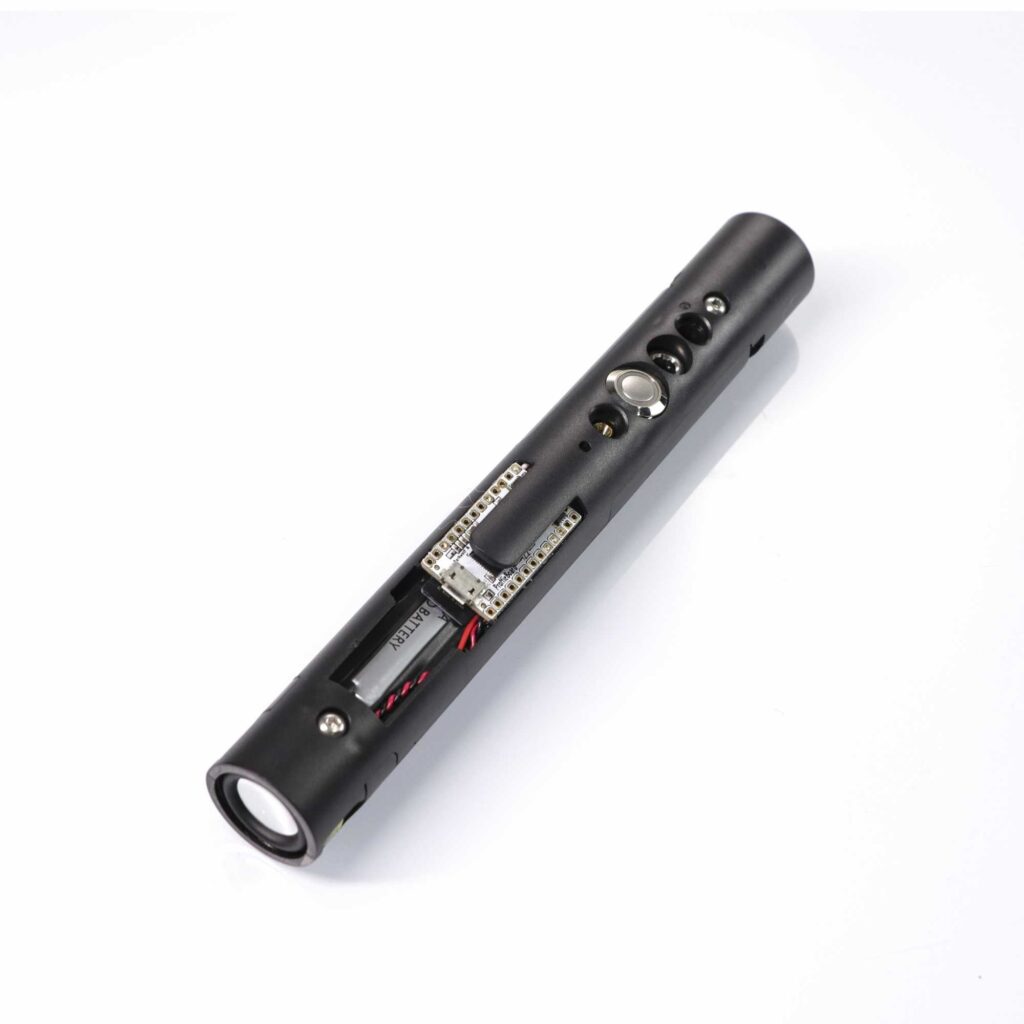
A purchasable saber contains six serviceable parts: cell, board, driver or strip, blade, speaker and switch. Knowing which one is which turns most faults into a diagnosis instead of a return.
The fictional part names map onto real ones closely enough to be useful.
| Fictional part | What it is in a real hilt | What it decides |
|---|---|---|
| Power cell | 18650 cell, often protected and high-drain | Runtime, and whether full white browns out |
| Crystal | Sound font and colour profile on the board’s SD card | Colour, effects, sound behaviour |
| Emitter | LED module in a heatsink, or the strip connector | Brightness, and where heat collects |
| Blade | Polycarbonate tube with diffuser, 2 mm or 3 mm wall | Durability, and how evenly light travels |
| Field | Nothing physical; the tube is the containment | Nothing, but it is why a blade can be swapped |
| Loop | Wiring and the board’s power path | Voltage drop, and whether pixels dim toward the tip |
That mapping is the practical takeaway. When a saber misbehaves, the question is which stage of the chain failed, and the answer is usually visible: a dim tip is wiring, a flicker is the cell sagging, a dead section is a pixel, a loose blade is a retention screw.
None of those faults involve the parts the films talk about, which is why troubleshooting a real saber is closer to maintaining a torch than to repairing a weapon.
For the wiring and power differences between the two real architectures, the baselit and Neopixel comparison goes deeper than this page does.
Neopixel Lightsaber Soundboard Kit Proffie 2.2
Accessories / Neopixel Lightsabers
Frequently Asked Questions
Q1: How do lightsabers work?
A: In canon, a power cell feeds a kyber crystal that turns the output into plasma, and a containment field holds that plasma in a blade shape while returning most of the energy to the hilt. A real saber does the same job with a battery, a controller board and an LED, and the blade is a tube of light rather than plasma.
Q2: What is inside a lightsaber?
A: A real hilt holds a lithium-ion cell, a controller board with sound and motion sensing, a driver stage, a speaker, a switch and the wiring between them. The fictional hilt holds a power cell, a kyber crystal, energizers, an emitter matrix and a lens.
Q3: What are lightsabers made of?
A: Canon hilts are metal alloy, sometimes wood, bone or gemstone, and the blade is plasma. A real hilt is machined aluminium and the blade is polycarbonate with a diffuser inside.
Q4: What powers a lightsaber?
A: Canon names a power cell, with the crystal shaping the output. A real saber is powered by a single 18650 lithium-ion cell in most modern builds, sometimes two.
Q5: Why do lightsabers stop at a certain length?
A: The containment field has a finite range, so the plasma ends where the field ends. Blade length is adjustable on most sabers in canon, and on a real saber it is set by the tube you fit.
Q6: Do lightsabers need recharging?
A: Rarely in canon, because the reference model has the energy looping back into the cell and draining only when the blade cuts. A real saber needs charging after every session or two of use.
Q7: How does a lightsaber turn on?
A: Canon uses an activation stud on the hilt. A real saber uses a momentary switch, held or double-tapped depending on the board, which is also how fonts and colours are selected.
Q8: Why do lightsabers clash instead of passing through each other?
A: Two containment fields push against each other, so the blades stop where the fields meet. Real sabers clash because they are solid tubes of polycarbonate hitting each other.
Q9: Can someone who is not Force-sensitive use a lightsaber?
A: Canon shows several non-Force users handling them, so yes. Weight and balance matter, and the Darksaber specifically is shown to feel heavy to wielders who resist it — a mystical property, not a mechanical one.
Q10: How does a real lightsaber make its sound?
A: A speaker in the hilt plays WAV files from the board’s memory card, and an accelerometer and gyroscope decide which file to play and when. The sound is not synthesised; it is triggered from a library.
Q11: Does a kyber crystal exist?
A: No. Kyber is fictional, and no natural crystal has the described effect on energy. The closest real components are the synthetic crystals used in oscillators, which shape frequency rather than plasma.
Q12: How long does a real saber battery last?
A: Work it from the current. A full-white pixel blade measured at 9 to 10 A on a 3,000 mAh cell works out to roughly twenty minutes of continuous full output, and an hour or more at moderate brightness in colour.