Orange is the rare lightsaber color whose meaning comes almost entirely from Legends rather than canon — canon assigns it no defined significance at all — while on the hardware side it is one of the few colors that has to be mixed rather than simply driven, which is why orange blades vary so much between one saber and the next.
The lore story and the electronics story are usually told separately. They explain the same thing: the color sits between blue and red spiritually, and it sits between red and green electronically.
This page covers both — the Legends association with the Sentinel path and the balance tradition, the canon record of where orange has actually appeared, and the LED mixing ratios and resistor values that decide whether an orange blade reads as true orange or as blood orange.
What’s on This Page
- Canon: What Orange Officially Means — and where it has appeared
- Legends: The Sentinel Association and the Middle Path
- Notable Orange Wielders — canon and Legends separated
- How an Orange Blade Is Actually Produced
- Resistor Values and the Burnout Constraint
- Neopixel and Direct Drive: Why Orange Shifts
- Why Two Orange Sabers Look Different
- Frequently Asked Questions
Canon: What Orange Officially Means
In current canon, orange carries no defined meaning at all — it entered through a 2019 video game as a player color choice with no lore attached, and made its live-action debut in 2024 as a deliberate visual signal of ambiguous allegiance.
This is the part most color explainers get wrong. The elaborate meanings usually attached to orange come from Legends material, and in canon those associations do not hold.
The first canon appearance was in Jedi: Fallen Order in 2019, where orange was simply one option among several a player could choose. No character in that story comments on it and no source assigns it significance.
The live-action debut came later, in the Ahsoka series, where two antagonists wield orange blades. The choice was intentional on the production side rather than a lore statement.
That distinction is the whole appeal. An orange blade’s canon meaning is genuinely undefined, which makes it the only major color an audience cannot read on sight.
Legends: The Sentinel Association and the Middle Path
Legends material ties orange to the Jedi Sentinel path, to so-called Gray Jedi who answered to neither the light nor the dark, and to a tradition of diplomacy and pragmatic balance — with one important catch about the canon standard.
The Sentinel association is real but needs a qualifier. Sentinels were the Jedi who guarded the Temples and Archives and balanced combat training with scholarly work.
Their color in canon is yellow, not orange. Orange was used by Sentinel-class Jedi in Legends and was effectively replaced by yellow when the canon was re-established.
That single fact explains most of the confusion around orange. A reader encounters the Sentinel association, then encounters a yellow-bladed Sentinel in canon, and the two seem to contradict.
They do not. Orange and yellow are adjacent positions on the same spectrum of meaning: both sit between the blue of the classic Guardian and the green of the Consular, and both signal a Jedi whose role does not fit either archetype.
| Tradition | Associated Color | What It Signals |
|---|---|---|
| Guardian | Blue | Combat focus, direct action |
| Consular | Green | Force study, diplomacy over combat |
| Sentinel | Yellow (canon) | Balance of combat and scholarly pursuits; Temple and Archive guardians |
| Sentinel (Legends) | Orange | The same balance role, in the pre-canon continuity |
The Legends reading of orange goes further than the Sentinel role alone. It also appears in association with Force-users who declined to commit to either side of the conflict.
One common fan explanation for a red-to-yellow shift treats orange as the midpoint of a botched purification — a dark-side crystal partially cleaned rather than fully restored.
That reading has no canonical support, but it captures why the color reads the way it does. Orange looks like red that has been partly cooled, or yellow that has been partly heated.
Notable Orange Wielders
The orange-wielder list splits cleanly by continuity: in Legends it includes Plo Koon during the Stark Hyperspace War, Yaddle, and even Darth Bane, while canon’s list is essentially empty outside one player-choice character and two live-action antagonists.
Plo Koon is the most frequently cited name, and the citation is specific. His orange blade appears in Legends-era comics set during the Stark Hyperspace War, which predates the Clone Wars.
By the time those same characters appear in canon, their blades are blue or green. This is not a retcon of the character so much as a consequence of which continuity the later appearances belong to.
Yaddle is a second example, carrying an orange blade in Legends before moving to blue or green in canon. Her master, from roughly two centuries before the Clone Wars, is also recorded with one.
Darth Bane carrying an orange saber is the detail that most clearly breaks the “orange means balance” reading. Whatever the color signified, it was never restricted to one side.
The canon list is much shorter and worth stating plainly: one video-game character whose color is a player choice, plus two live-action antagonists chosen specifically for their opacity.
How an Orange Blade Is Actually Produced
A true orange blade is produced by mixing red and green light rather than by driving a dedicated orange emitter, because a red-plus-amber combination yields a blood orange rather than a true orange.
This is the single most useful fact for anyone comparing orange blades. Two sabers can both be sold as orange and be built from completely different emitter combinations.
The red-and-green pairing is the standard route. Varying the ratio between the two produces everything from a bright yellow through to a deep red-orange, which is what makes orange a tuning problem rather than a fixed output.
Amber behaves differently. It is generally treated as its own emitter color rather than a mix, and pairing it with red gives the deeper, browner tone builders call blood orange.
Where each blade color comes from
Orange and yellow share the same red-and-green pair, which is why the boundary between them comes down to the mix ratio rather than to a different component.
Because orange and yellow come from the same two emitters, the line between them is a ratio rather than a component change. A saber tuned slightly green-ward reads yellow; slightly red-ward, it reads orange.
Blood orange and true orange are two different build routes that land near each other on the same spectrum, which is why sabers sold under one name can look like the other.
One wiring detail follows directly from the voltage difference between the two colors. When a red and a green emitter are wired in series, the green goes first, because it has the higher forward voltage.
Resistor Values and the Burnout Constraint
Red, orange, and amber emitters need current-limiting resistors while green, blue, cyan, and white generally do not, because the red-family colors operate at a lower current and will burn out if driven at the same level.
The physical reason is a difference in current rating. A red-family emitter commonly runs around 700 mA while the other colors can accept roughly 1000 mA.
Drive both at the same level without a resistor and the red family is the one that fails. This is why the resistor on a red die is a protection measure first and a tuning tool second.
A commonly cited field value is a 3 W, 2.7 ohm resistor for red, orange, and violet shades, and a 3 W, 2 ohm resistor for the other colors. The higher resistance pairs with the lower-current emitters.
There is a counterintuitive rule about tuning color that follows from this. To shift a mix, add resistance to the dominant color rather than removing resistance from the red — the red resistor is protecting the emitter, not shaping the shade.
Where the saber runs on a lithium-ion cell with a current-regulating driver, only the red and possibly amber emitters need a resistor at all. Without that driver, each emitter needs its own calculated value, usually wired in parallel.
Builders chasing a precise shade sometimes fit an adjustable resistor per color, tune by eye, then measure the resistance and replace the adjustable part with a fixed one of the same value.
Neopixel and Direct Drive: Why Orange Shifts
In a direct-drive setup with no driver board, an orange blade drifts toward red as the battery drains, because the green and blue emitters dim faster than the red one and the mix loses its green half.
This is a color-stability problem rather than a color-accuracy problem, and it affects exactly the colors that depend on mixing. A single-emitter color does not drift in the same way.
In an addressable-LED blade the color is set digitally rather than by mixing discrete emitters, so the drift problem largely goes away. The blade holds its color as the cell drains because the output is regulated rather than analog.
The trade is different. An addressable-LED blade produces its color from the same emitters along the whole strip, so the orange is consistent down the length of the blade rather than brightest at the base.
Both routes can produce a good orange. The difference is where the variation shows up — over time in the direct-drive case, and not at all in the regulated case.
Why Two Orange Sabers Look Different
Two sabers both described as orange can differ because orange is a mixed color, and the mix depends on four independent variables: the emitter combination, the resistance values, the drive method, and the battery state.
Start with the emitters. A red-plus-green build and a red-plus-amber build are both legitimately orange, and they do not look alike.
Then the ratios. Because red and green span yellow through red-orange, the same two emitters can be tuned across a range wide enough to change what the color is called.
Then the drive method, which decides whether the color holds steady or shifts as the cell drains. Then the tuning tolerance, which is a matter of how carefully the builder set the levels rather than a property of the design.
The practical consequence is that an orange blade should be judged on its own rather than against a name. Two sabers sharing the label can sit at opposite ends of the same spectrum.
This is also the reason orange sits in an odd position among blade colors generally. Most colors are a component choice that anyone can specify exactly; orange is a tuning outcome that depends on how the build was executed.
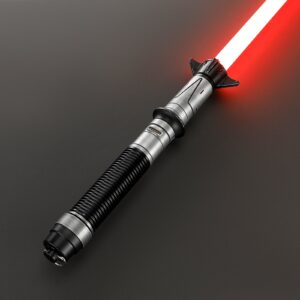
Baylan Skoll Lightsaber — Orange Blade Neopixel Replica, Fallen Jedi Master | ISABER
33cm weathered hilt, heavy greatsword feel. Orange Neopixel blade. XRGB3.0/Xenopixel V3/Proffie 2.2. Ahsoka series. The saber that beat Ahsoka Tano.
Frequently Asked Questions
Q1: What does an orange lightsaber mean?
A: In Legends, it is associated with the Jedi Sentinel path, with Force-users who declined to commit to either side, and with diplomacy and balance. In current canon, orange has no defined meaning at all — it entered through a video game as a player color choice.
Q2: Is orange a canon lightsaber color?
A: Yes, in the sense that orange blades have appeared in canon. The first was a player-selectable color in a 2019 game, and the live-action debut came in 2024 with two antagonists whose orange blades were chosen deliberately to leave their allegiance unclear.
Q3: Why did the Sentinel color change from orange to yellow?
A: The Sentinel association with orange comes from Legends material. When canon was re-established, yellow became the standard Sentinel color. The two are adjacent positions on the same spectrum of meaning, not a contradiction.
Q4: How is an orange lightsaber blade made?
A: By mixing red and green emitters rather than driving a dedicated orange emitter. Varying the ratio between the two produces anything from bright yellow to deep red-orange. A red-plus-amber combination gives a browner blood orange instead.
Q5: Why does my orange blade look red sometimes?
A: If the saber runs direct-drive without a regulating driver, the green and blue emitters dim faster than the red as the battery drains, so the mix loses its green half and drifts toward red. A regulated blade does not drift the same way.
Q6: Do orange blades need a resistor?
A: Yes. Red-family colors including orange operate at a lower current, commonly around 700 mA, versus roughly 1000 mA for green, blue, cyan, and white. Without a limiting resistor the red-family emitter is the one that fails.
Q7: Who used an orange lightsaber?
A: In Legends, Plo Koon carried one during the Stark Hyperspace War, Yaddle carried one, and Darth Bane did as well. In canon the list is much shorter, essentially one player-choice character and two live-action antagonists.
Q8: Why do two orange lightsabers look different from each other?
A: Because orange is a mixed color rather than a fixed output. The emitter combination, the resistance values, the drive method, and the battery state all change the result, so two sabers sharing the name can sit at opposite ends of the same spectrum.