
There is a moment in The Force Awakens when Kylo Ren ignites his lightsaber for the first time, and the audience sees it: a crossguard. Not a clean beam like every other lightsaber in the franchise — a jagged, unstable, flame-like blade with two side quillions jutting out below the main blade.
A lot of fans hated it at first. Too busy. Too weird. “How does that even work?”
But after years of building replicas of it at ISABER, I have come to appreciate that Kylo Ren’s crossguard saber is one of the most thoughtfully designed weapons in the Star Wars universe. Not because it looks cool (it does), but because it solves real problems that traditional lightsaber designs have ignored for decades.
The Problem with Traditional Lightsabers
A standard lightsaber has one blade and a smooth hilt. On screen, that looks clean and elegant. In practice, it means:
- Your opponent’s blade can slide down yours and hit your fingers. There is no hand guard.
- You cannot use the same bladework you would with a real sword — there is no crossguard to trap or bind an opponent’s blade.
- One blade equals one attack vector. You stab, they dodge. You swing, they parry. It is linear.
What the Crossguard Does
The crossguard fixes all three problems in one move.
The quillions act as a hand guard. When an opponent’s blade slides down yours, it hits the side blades instead of your fingers. That is not just cosmetic — in a real duel, that means you can press an attack without worrying about losing your hand.
The side blades also give you a secondary trapping surface. You can pin an opponent’s blade between your main blade and a quillion, then disarm them.
And the unstable blade? That is not a design flaw — it is a feature. The flickering, raw-energy look creates an unpredictable attack profile. A clean blade follows a predictable arc. An unstable blade flickers and shifts as it moves, making it harder to parry.
The Real-World Engineering Parallel
The crossguard saber follows the same logic as real-world broadswords and longswords. Medieval sword makers figured out centuries ago that a crossguard is essential for hand protection in combat. Lightsabers skipped this feature for elegance. Kylo Ren’s saber brings it back.
The unstable blade also parallels plasma cutting torches. A stable plasma arc cuts cleanly. An intentionally destabilized arc creates a wider, more aggressive cut. That is exactly what Kylo Ren’s blade does.
What Makes a Good Kylo Ren Replica
Three things separate a good replica from a bad one:
1. Quillion lighting sequence. The side blades must light up after the main blade and turn off before it. A good replica uses independent LEDs for each quillion to match the movie behavior.
2. Soundboard crossguard support. The electronics need to handle three ignition events — main blade first, then each quillion. Xenopixel handles this out of the box.
3. Good weight distribution. The crossguard adds mass. A well-balanced replica feels solid in two-handed swings. The ISABER version is designed for two-handed combat use.
The Unstable Blade Effect
The Xenopixel version offers multiple unstable blade styles — rainbow, candy, fire, unstable, crackle, and more — that simulate the flickering raw energy look from the films.
Bottom Line
Kylo Ren’s crossguard lightsaber is not just a costume prop. It addresses real limitations of the traditional lightsaber — hand protection, trapping surfaces, and aggressive blade behavior. Whether you love or hate the sequel trilogy, the crossguard saber is one of the most innovative additions to Star Wars mythology.
Looking for a Kylo Ren crossguard replica? Check out the ISABER Kylo Ren Crossguard Lightsaber with Xenopixel soundboard. Free shipping worldwide on orders over $75.
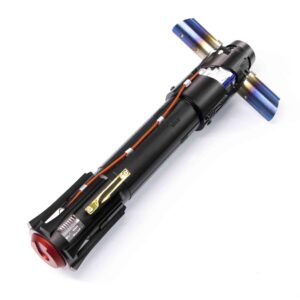
Kylo Ren Crossguard Lightsaber — Kylo Ren Replica from ISABER
Character Lightsabers / Replica Lightsabers