
A Jedi outfit is six layers, not one robe: an inner tunic, an outer tunic, two tabard panels, an obi, a belt, and the hooded robe on top. Most costumes fail because they skip three of those layers and cut the rest from one shiny fabric.
Search for a Jedi robe and you get a brown cloak with a hood. That is the sixth layer, and on its own it is not the costume.
The outfit underneath is what reads on camera, and it is built from separate pieces with different weights. We counted the layers, checked what the films actually used, and wrote down where a home build goes wrong.
One thing up front: there is no official Jedi uniform. Once a student becomes a Padawan they may dress as they choose, and most simply follow the earth-tone tradition. So the goal is not to match a regulation. It is to match a look that was built from layers.
What’s on This Page
- The Short Answer: Six Layers and Three Fabrics
- Two Tunics, Not One
- The Tabard: Two Panels, Held by the Belt
- The Obi, and Why It Is Wider Than You Think
- The Outer Robe: Weight Decides Everything
- The Colours: No Uniform, Just a Pattern
- Why a Cosplay Robe Reads Wrong
- What to Build First
- The Weapon Is the One Part You Cannot Fake
- FAQ
The Short Answer: Six Layers and Three Fabrics
Count outward from the skin: inner tunic, outer tunic, tabard, obi, belt, robe. Three fabrics carry the whole outfit in the prequels: a light hand-spun cotton for the inner layer, a mid-weight linen or crinkle cotton for the tunics, and a heavy wool for the robe.
The inner tunic is the lightest garment and the one closest to the body. In the prequels it was made from a hand-spun, cross-over cotton, the kind you would recognise as khadi.
The outer tunic is heavier, with a skirted lower edge, tucked shoulders, and a wrap front rather than a placket, and it is what gives the torso its shape.
The tabard and the obi sit over that, and the belt goes over both. The robe is the outer shell and the only piece most people own.
| # | Layer | What it is | Screen fabric | Job |
|---|---|---|---|---|
| 1 | Inner tunic | Light cross-over underlayer | Hand-spun cotton (khadi) | Collars the neck, shows at the chest |
| 2 | Outer tunic | Heavier wrap tunic, skirted hem | Crinkle cotton or linen | Builds the torso silhouette |
| 3 | Tabard | Two hanging panels, front and back | Same cloth as the outer tunic | The vertical line people read as Jedi |
| 4 | Obi | Wide wrapped sash | Same cloth, or leather in some eras | Holds the tabard, closes the tunic |
| 5 | Belt | Leather belt with a saber hook | Leather | Carries the weapon on the left hip |
| 6 | Robe | Open-front hooded cloak | Heavy wool, 280 GSM and up | Outer shell, drape, silhouette |
Two of these six are easier to skip than to make, and skipping them is what collapses the costume. The next section is about the one that gets skipped most.
Two Tunics, Not One
The garment people call a Jedi robe is usually two tunics, and collapsing them into one is the most common reason a build reads flat.
A single tunic gives you one neckline and one hem. The screen outfit gives you two of each, stacked about two centimetres apart, which is what creates the double collar at the throat.
Look at any prequel photograph of Obi-Wan and count the collars at the neck. There are two edges, and the inner one sits lower and lighter.
The fabrics differ as well: the inner layer is thin and matte, and the outer layer has visible texture. That contrast survives distance in a way that two identical garments never will.
The prequels had a fabric problem in the first film, where silk tunic cloth behaved badly under the lighting used for a desert shoot. From the second film onward the tunic standard moved to crinkle cotton and linen, which is what most costume standards now reference.
For a home build this is good news, because linen and crinkle cotton are cheap, they hold a fold, and they photograph matte.
The Tabard: Two Panels, Held by the Belt
The tabard is two panels roughly 12 to 15 cm (5 to 6 in) wide that hang front and back, and they are held in place by the obi rather than sewn to the shoulders.
That single construction detail explains why tabards move the way they do on screen. Sewn to the shoulders, they swing with the tunic. Held by the sash, they lag behind the body and settle on their own.
The width is not decoration: at 5 to 6 inches the panel is wide enough to read as a deliberate garment and narrow enough to leave the chest visible between the two.
The common mistake is to make them look like straps: 5 cm wide, stitched at the shoulder, and hanging flat, which reads as a harness rather than a robe.
Two panels, one front and one back, is the minimum. Some builds add a second pair at the sides, which is a later-era detail rather than the prequel default.
The Obi, and Why It Is Wider Than You Think
The obi is a wide wrapped sash, usually 15 cm or more deep, and it is what lets the tabard and the tunic move independently.
Most home builds make it a narrow belt, about 8 cm, and the whole middle of the costume goes stiff. The obi has to be wide enough to hold the tabard panels without pinning them flat.
It wraps two or three times and knots at one side, and nothing about it is elastic, because elastic waists photograph as a horizontal seam and they bunch the tunic underneath.
The obi also hides the join between the tunic and the trousers, which is the one place where a home build usually shows a mistake.
The Outer Robe: Weight Decides Everything
The robe is a heavy wool garment, and costuming standards put the useful minimum around 280 GSM, which is closer to a suit-weight flannel than to a blanket.
That number matters more than the colour, because under 280 GSM the fabric hangs like a curtain and the hem flutters instead of falling, which is the single clearest tell in photographs.
Above that, do not go to melton or blanket wool. Both are stiff enough that the robe stands away from the body instead of following it, and both are uncomfortably hot indoors for a convention.
Fabric quantity runs about 4 to 8 yards depending on height and how full you want the sleeves. A medium build with a 60 inch fabric width lands near 6 yards, and a shorter build with fewer pleats can do it in 4.
The cut is simple: an open front, wide sleeves, and a hood deep enough to actually cover the head. Most retail options fail on the hood, which is too shallow to stay up.
Fabrics to avoid are polyester, satin, taffeta, and vinyl. All four catch convention lighting as a hard highlight, and a hard highlight is what makes fabric read as plastic.
The Colours: No Uniform, Just a Pattern
There is no official Jedi uniform, so colour is a character choice. The pattern is earth tones, from cream at one end to near-black at the other, and the character you pick sets where on that range you land.
Anakin moves darker as the prequels go on, starting in chocolate brown and ending in a dark brown so deep it reads black, with black leather tabards that echo what he becomes.
Obi-Wan stays sandy and tan through the first two films, then shifts to a chocolate inner tunic with mustard-brown trousers in the third.
Qui-Gon sits at the pale end, in cream and undyed natural tones, which is why his costume photographs brighter than either of theirs.
Luke is the outlier in both directions: tan on Tatooine in the first film, black head to toe in the third, with the raw silk layers we took apart in our breakdown of that black outfit.
| Character | Inner layer | Outer tunic | Robe |
|---|---|---|---|
| Qui-Gon Jinn | Cream | Cream to natural | Natural brown |
| Obi-Wan, Episode I to II | Tan | Tan | Reddish brown |
| Obi-Wan, Episode III | Chocolate | Tan | Brown |
| Anakin, Episode II | Light tan | Chocolate brown | Brown |
| Anakin, Episode III | Dark brown | Dark brown to black | Dark brown |
| Luke, Episode VI | Black | Black | Not worn with the outfit |
The tradition is real even though the rule is not. Generic Jedi on screen cluster in light browns and greys, and the ones who break it are written as exceptions.
Why a Cosplay Robe Reads Wrong
Six things give a costume away at ten paces, and five of them are material decisions rather than sewing skill.
- Shiny fabric is the first tell: polyester and satin reflect a point of light, and the eye reads that as plastic.
- Wrong weight: too light and the hem flutters, too heavy and the robe stands off the body.
- One tunic instead of two, so the neck shows a single collar and reads as a shirt.
- Saturated colour: bright red or blue reads as a costume-shop palette, where earth tones read as cloth.
- A narrow tabard and obi, because both shrink and the middle of the costume goes flat.
- Too clean: screen costumes have worn edges, and a brand-new matte robe still looks new in a way that looks staged.
The collapsed build is not a cheaper version of the screen build. It is a different silhouette, and that is what the eye notices.
What to Build First
Build in the order the layers go on, so that each stage is wearable before the next one exists.
- Trousers and boots, loose and matte, in the same family of brown as the belt you plan to buy.
- Inner tunic in thin cotton with a wrap front, lighter than everything above it.
- Outer tunic in linen or crinkle cotton, with a skirted hem and tucked shoulders.
- Tabard and obi cut from the outer tunic cloth, so that all three match in daylight.
- Belt and saber hook in leather, with the hook sitting on the left hip.
- Robe last, because it is the piece that hides the mistakes in the five below.
That order has a practical side, because anyone who stops at step three still has a wearable outfit, and step four is the cheapest way to make it look deliberate.
If you only build two pieces, build the outer tunic and the tabard. Those two carry more of the silhouette than the robe does.
The Weapon Is the One Part You Cannot Fake
Every layer above can be sewn at home. The saber is the one piece that has to be bought, and it is the part a photograph reads first.
The hilt also fixes the character, because a robe and tabard read as a generic Jedi until there is a weapon at the belt, and then the silhouette resolves.
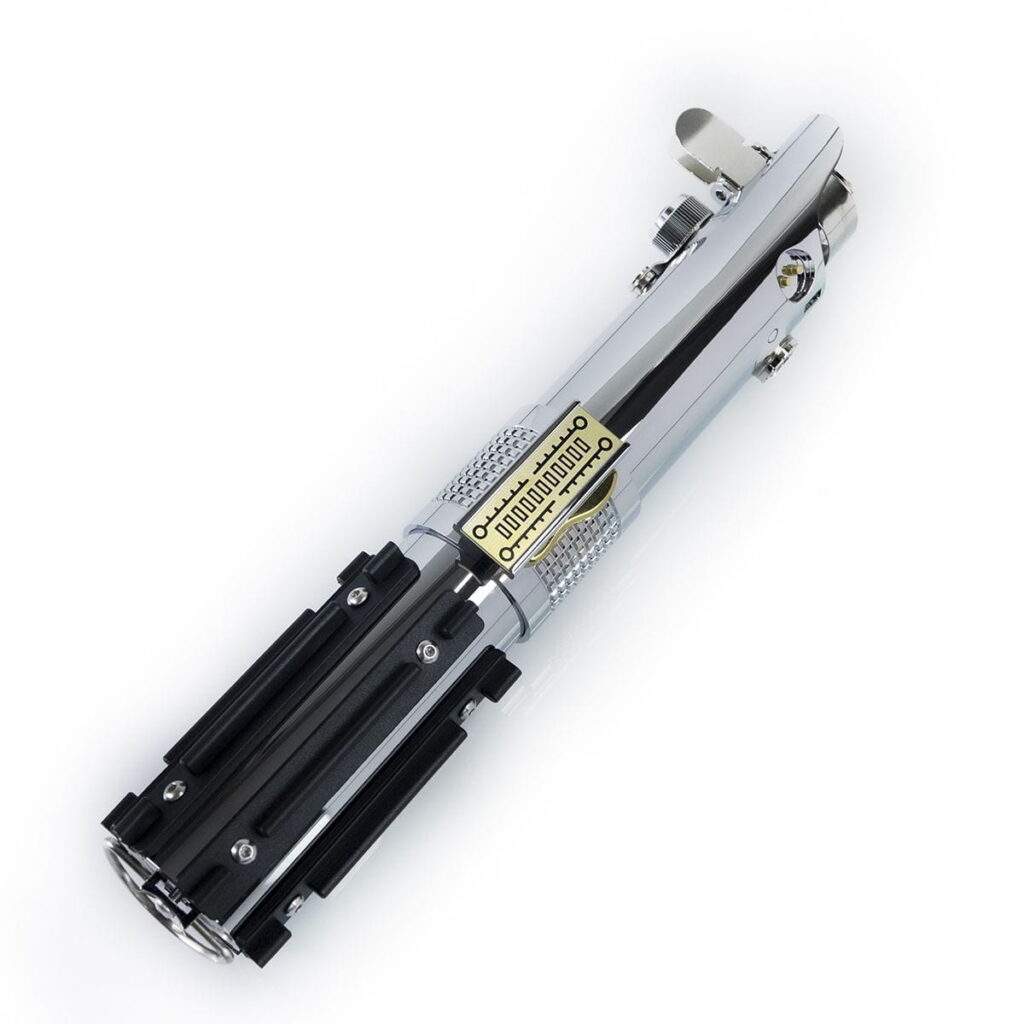
Colour is the one thing a replica hilt does not have to decide for you. Our colour-cycling hilts run the blade through the full range, so the same weapon works under a tan robe and under a black one.
The black Return of the Jedi outfit
What a trooper costume costs
Which saber for which character
What a hilt is made of
Getting a saber through a convention
FAQ
Q1: How many layers does a Jedi wear?
A: Six in the prequel builds: inner tunic, outer tunic, tabard, obi, belt, and robe. Trousers and boots sit under the tunics, so a full outfit is eight pieces in total.
Q2: What fabric are Jedi robes made of?
A: Heavy wool for the outer robe, and linen or crinkle cotton for the tunics. The inner layer in the prequels was a light hand-spun cotton, which is why it photographs softer than the layers above it.
Q3: Are Jedi robes brown or tan?
A: Both, and the character sets which. Qui-Gon is cream, Obi-Wan is tan and sandy, Anakin runs chocolate to near-black, and Luke is tan in the first film and black in the third.
Q4: What is the difference between an obi and a tabard?
A: The tabard is the two hanging panels, front and back. The obi is the wide sash wrapped around the waist, and it is what holds the tabard in place instead of shoulder stitching.
Q5: Do Jedi robes have to be wool?
A: No, but the weight matters more than the fibre. Costuming standards put the useful minimum around 280 GSM, so a heavy cotton coating can work as long as it hangs rather than flutters.
Q6: How much fabric do I need for a Jedi robe?
A: About 4 to 8 yards depending on height and sleeve fullness. A medium build using 60 inch wide fabric lands near 6 yards, and a shorter build with fewer pleats can do it in 4.
Q7: Why does my Jedi costume look cheap?
A: Usually the fabric reflects light, or the layers are missing. Shiny polyester catches convention lights as a hard highlight, and a build with one tunic instead of two loses the double collar that reads as Jedi.
Q8: What colour robes did Anakin wear?
A: Chocolate brown in the second film, darkening to near-black by the third, with black leather tabards. The darkening is deliberate and the Jedi Masters comment on it in canon.
Q9: Can I wear a Jedi costume without a lightsaber?
A: You can, and it reads as a civilian rather than a Jedi. The weapon at the belt is what completes the silhouette, which is why costume standards treat it as part of the outfit.
Q10: Does a Jedi costume need boots?
A: Yes, and they should be tall enough to disappear under the tunic hem. Brown leather matching the belt is the safe choice, and laces should be hidden or absent.
Conclusion
Six layers, three fabrics, and one colour decision per character is the whole build, and none of it requires a sewing machine you do not already own.
If you are starting from nothing, the outer tunic and the tabard do the most work for the least money, and the robe can wait a season.
We would spend the fabric budget on the tabard cloth before the robe cloth, because the tabard, the obi and the outer tunic all have to match, and three near-identical browns from three sources will not.
If you want to see the same layering logic worked through on a single screen outfit, our breakdown of Luke’s black Return of the Jedi costume counts eight pieces and five configurations.
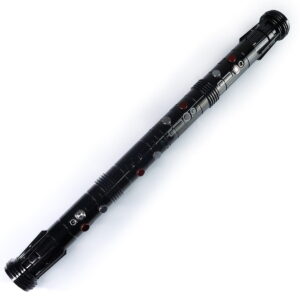
ISABER Double Bladed Lightsaber — RGB Baselit / Xenopixel Staff Saber
Accessories / RGB & Baselit Lightsabers