
A Disney lightsaber comes from one of two lines in the parks, and they are different products: the reservation-only build workshop sells a hilt you assemble yourself with a crystal, a blade and a case in one price, while the replica shelf sells pre-built character hilts with the blade extra.
Both are display pieces first, and Disney’s own park guidance describes the workshop saber as not meant to be used as a toy or a costume prop, while owners report a blade that wobbles, sleeves that loosen, and electronics that cut out during light play.
That is not a reason to skip the experience. It is a reason to know what you are buying before you stand in the queue.
This page separates the two lines, gives the numbers that decide the total cost, and then covers what changes when a saber is built around a real soundboard instead of a park core.
What’s on This Page
- The Short Answer: Two Lines, Two Different Products
- The Build Workshop: What You Actually Make
- The Replica Line: What You Actually Buy
- The Blade Is Sold Separately, and It Fits Both
- What the Park Sabers Do Well
- What They Don’t Do
- If You Want to Swing It: Board, Blade, Balance
- Where Our Hilt Fits
- FAQ
The Short Answer: Two Lines, Two Different Products
The build workshop is an experience that ends with a complete saber, and the replica shelf is a shop that sells accurate hilts whose blades you buy on top, so the two lines answer different questions rather than competing on price.
At the workshop you book a slot, sit with a small group, and assemble a hilt from themed scrap parts around a core chassis. A host talks the group through it, the room does its theatre, and you leave holding something you built.
On the replica shelf you walk in, look at a display, and pick a character’s hilt. There is no ceremony, no appointment, and in most cases no blade in the box.
The choice is really about which of those two things you want, so start there and let the numbers follow.
| Build workshop | Replica hilts | |
|---|---|---|
| What you are buying | A timed build experience | A finished replica hilt |
| Blade in the box | Yes, a 31 inch blade | No, sold separately |
| Colour choice | Set by the crystal you pick | Set by the hilt you buy |
| Hilt style | Four scrap-metal themes | Character-accurate replicas |
| Reservation | Required | Not needed |
| Typical total | One price, everything included | Hilt price plus a blade |
Read that table as a shape rather than a scorecard. One row is a product, the other is a purchase, and only one of them gives you a saber at the end of the day.
The Build Workshop: What You Actually Make
The workshop session runs about twenty minutes, you assemble a hilt from themed scrap-metal parts around a core chassis, choose a kyber crystal that sets the blade colour, and leave with the hilt, the crystal, a 31 inch blade and a padded case.
Four themes cover the parts you can choose: Peace and Justice, Power and Control, Elemental Nature, and Protection and Defense. Each theme has its own sleeve shapes and finish, and the parts are designed to swap, so a hilt is never locked to one look.
The crystal is the functional bit: the blade lights in the colour of the crystal you seat, and extra crystals are sold alongside the experience so you can change the colour later. The cracked variants are the ones people talk about, because a flick of the wrist shifts the blade between colours.
Price is the part that moves, because the rate has climbed since the workshop opened and reports from the two parks have sat in a bracket rather than a single figure, so treat the total as roughly the mid-two-hundreds and confirm it when you book.
One detail worth knowing before you go: the hilt is heavy. Owners put a workshop hilt at a little over two pounds on its own, which is more than nearly every replica hilt on the shelf, so a small builder will notice it.
The Replica Line: What You Actually Buy
A park replica is a pre-built version of a named character’s hilt, sold without a blade, and the standard hilts run well below the price of a workshop build before you add the blade you need to use it.
The range is wide because the shelf is wide. Simple single hilts sit at the low end, paired sets for characters who carry two sabers cost more, and limited releases sit above both.
Then you add a blade, and replica-line blades come in two lengths at an extra cost, which means the honest comparison is not hilt against hilt but complete saber against complete saber.
That is where the gap narrows, because a replica hilt plus a blade often lands close to what a workshop build costs all in, which is why we would frame the choice as content rather than price.
| What you get | Build workshop | Replica line |
|---|---|---|
| Hilt | Custom, four themes | Screen-accurate replica |
| Crystal colour change | Yes | No |
| Blade | Included, 31 inch | Extra, 26 or 36 inch |
| Case | Included | Extra |
| Weight of hilt | Over two pounds | Generally lighter |
Both lines share one useful property, and it is the reason people end up with more than one: the blades are interchangeable between them.
The Blade Is Sold Separately, and It Fits Both
A replica-line blade fits a workshop hilt and the other way round, so the blade is the one part you buy once and keep across both lines.
That matters more than it sounds, because if you start with a replica hilt and later build at the workshop, the blade you already own still works, and the same is true in reverse.
Length is the decision, and the shorter blade suits a smaller wielder while the longer one is closer to what the films show. The workshop ships its own 31 inch blade, which sits between the two replica options.
For a fuller breakdown of what the numbers on a blade actually mean, our page on blade length at 28, 32 and 36 inches covers the geometry rather than the marketing.
What the Park Sabers Do Well
The park sabers are the best props in this category for one specific job, which is being held, photographed, and displayed as an object that came from a place with a story attached.
The workshop is an experience you cannot buy anywhere else. You sit in a room with a group, you build in character, and the saber you walk out with has a date attached to it.
Replica hilts are accurate in a way that matters to collectors. If you want the hilt a specific character carried, and you want it to be the version the licence holder signed off, that shelf is the shortest route.
Both are also genuinely well finished on the outside. The metal sleeves look right under room light, the proportions are close to the props, and neither line looks like a toy on a shelf.
That is a real set of strengths, and we would not talk anyone out of either purchase if that is what they want from the trip.
What They Don’t Do
The park sabers are built for display, and three specific limits show up in owner reports: a blade that wobbles or cuts out during light play, sleeves that loosen at the seams, and electronics that are not built to take impact.
The blade fit is the first, because the park leaves tolerance in the socket so the blade can go in and out, and the result is movement that some owners notice while swinging. The socket also seats into the internal chassis rather than the outer sleeve, so how heavy the sleeve is does not change the fit.
The sleeves are the second, since grip sections can work loose, stop aligning, or refuse to tighten after a rebuild, and the common fixes are thin washers or tape on the threads rather than anything structural.
The electronics are the third, and this is the one that decides how you use the saber. Park cores are not built around a duelling board, so there is no clash response comparable to a proper soundboard, and impact is the fastest way to shorten their life.
Disney’s own park guidance is blunt about this. It describes the workshop saber as not meant to be used as a toy or costume prop, notes that the materials are fragile, and warns that over-tightening the hilt bolts can break the blade. That is a display instruction, not a marketing hedge.
The difference is not power, it is where the light and the sensing live: one tube diffuses a source at the base, the other lights itself along its full length.
If You Want to Swing It: Board, Blade, Balance
A saber built around a soundboard behaves differently in three ways that matter in use: the blade lights along its whole length, the board senses motion and returns sound and effects, and the hilt is designed to be taken apart for service.
Blade lighting is the most visible, because a pixel blade carries an addressable LED strip inside the tube, so each segment lights individually and effects like ignition travel up the blade instead of switching the whole thing on.
Motion sensing is the part you feel, since a board reads acceleration and rotation, so the sound follows the swing, clash registers on impact, and the blade can flash where it was struck.
Serviceability is the part you notice later, because a saber assembled around a removable core lets you replace a battery, swap a board, or change a blade without sending the whole thing back, which is the difference between an object you keep and an object you retire.
For the tiers themselves, our comparison of how blade colour is produced explains why a pixel blade and a baselit blade look different at the same brightness.
Where Our Hilt Fits
Our plainest hilt is the one we would point a park visitor at, because it is the closest thing we sell to what the workshop gives you: a saber without a character attached, sold complete, with a board already inside.
It has no screen counterpart to match, which is the point. A generic hilt works with a robe, a jacket, or nothing at all, and it does not lock the saber to one character if you later change what you carry.
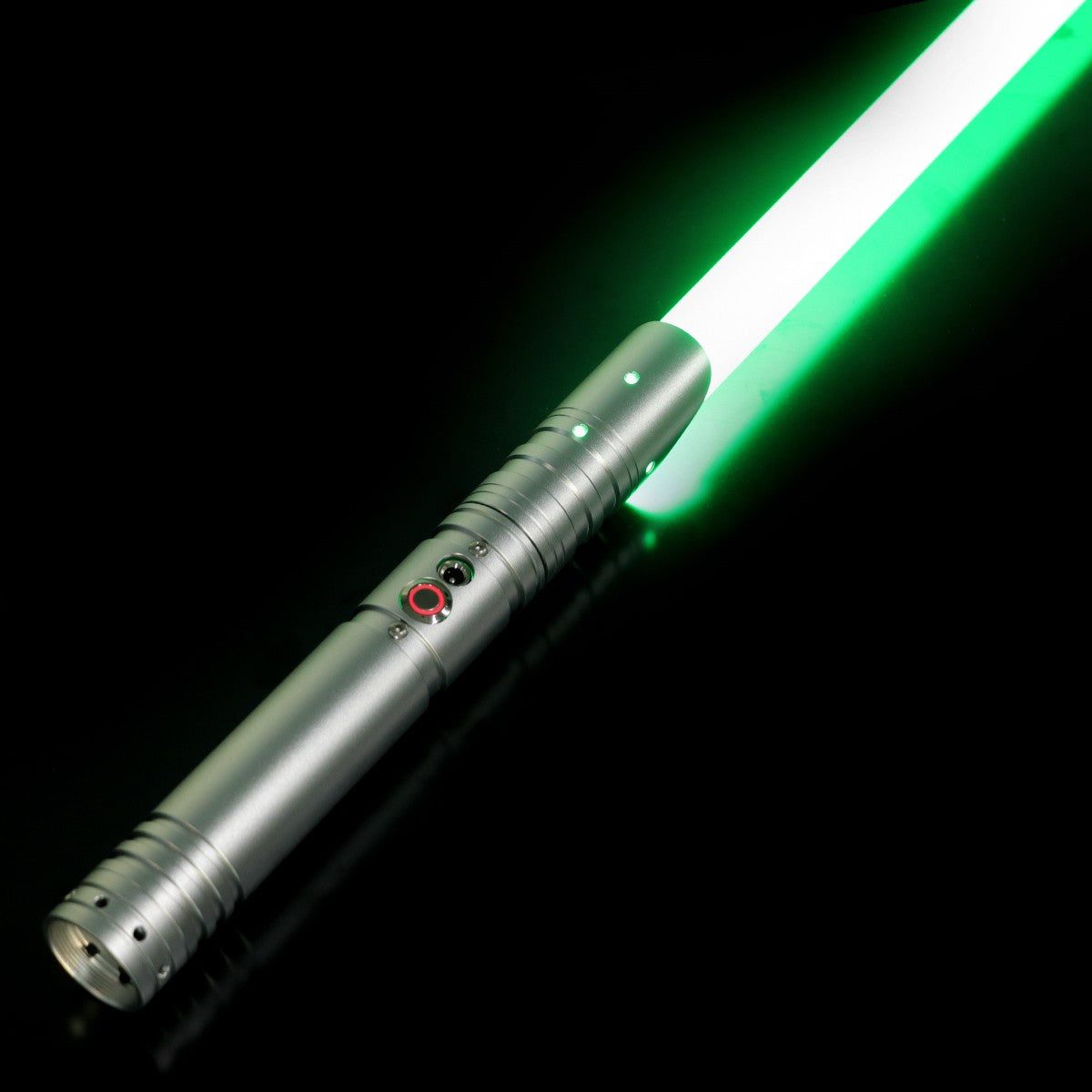
Two configuration choices separate it from a park saber. The hilt takes a colour-cycling board, so the blade is not fixed to one crystal, and the electronics tier is a choice rather than a fixed spec, so you can buy the simpler version now and keep the same hilt.
What we will not claim is the experience, because there is no room, no host, and no date to remember. That is the one thing the workshop sells that nobody else can, and it is worth being clear about.
Blade length, and what the numbers mean
How a crystal sets a blade colour
Building a saber from parts
Displaying a saber without damaging it
FAQ
Q1: What is the difference between the two kinds of Disney lightsaber?
A: One is a timed build experience that ends with a complete saber including blade and case, and the other is a pre-built character replica sold as a hilt with the blade extra.
Q2: Does a Disney lightsaber come with a blade?
A: The workshop build includes one 31 inch blade, and a replica hilt does not, so a replica saber needs a blade bought separately to work.
Q3: Are the park blades interchangeable between the two lines?
A: Yes, they fit either system, so a blade bought for one line works with the other, which makes it the one part worth buying once.
Q4: Can you change the blade colour on a Disney lightsaber?
A: Only on a workshop build, where the colour is set by the kyber crystal you seat, and extra crystals let you change it later. A replica hilt’s colour is fixed by the hilt you buy.
Q5: Is a Disney lightsaber good for duelling?
A: No. Park sabers are display pieces, Disney’s own guidance describes the workshop saber as not meant to be used as a toy or costume prop, and owners report blade wobble and cutouts during light play.
Q6: Why does the blade wobble on a workshop lightsaber?
A: Because the socket is built with tolerance so the blade can be removed, and the blade seats into the internal core rather than the outer sleeve, so a wobble is a design trade rather than a fault in one hilt.
Q7: How heavy is a workshop hilt?
A: A little over two pounds on its own, which is heavier than nearly every replica hilt on the shelf and noticeable for a younger builder.
Q8: Does a replica hilt have a crystal chamber?
A: No, replica hilts do not use kyber crystals, and their blade colour is decided at the point of purchase rather than by a removable part.
Q9: Is a Disney lightsaber worth the money?
A: It depends which part you are buying. The workshop is the only place to build one like that, while a replica hilt is the shortest route to a licence-accurate version, and neither is a good value as a saber you plan to swing.
Q10: What should I buy instead if I want to actually use a saber?
A: Look for a saber with a real soundboard, a pixel or baselit blade, and a serviceable core, because those three decide whether the blade lights properly, reacts when struck, and can be repaired later.
Conclusion
Two lines, two jobs: the workshop sells a memory you build by hand, and the replica shelf sells the hilt a character carried. Neither is a duelling saber, and Disney says so itself.
If you want the experience, book it and enjoy it. If you want a saber to use, buy one that has a board in it and keep the park build on the shelf.
Our plain hilt sits in that second category, and the link above is where we would start if you are coming home from the park with a blade and no saber that will take it seriously.
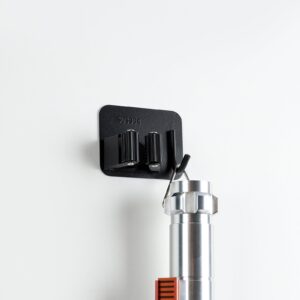
ISABER Wall Hung Saber Mount
No-drill wall mount that holds your saber hilt vertically - clamp arms with adjustment knobs, metal support hook, and 3M adhesive backing.
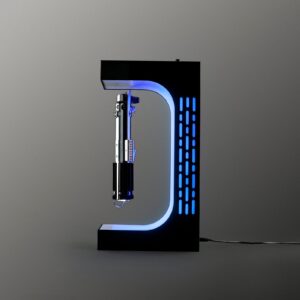
ISABER Magnetic Levitation Lightsaber Display Stand
Electromagnetic display stand that suspends your saber hilt in mid-air with a smooth 360-degree rotation - no cradle, no visible support.