
A lightsaber is a hand-held plasma weapon whose blade is contained by a magnetic field generated inside the hilt. The word itself is a coinage from 1974, chosen deliberately over “laser sword”, and that naming choice is why the films keep both terms alive.
Most pages answer this question by listing the parts. That ground is well covered elsewhere. What is less covered is what the word actually means, where it came from, and why the movies use two different names for the same object.
This page takes the definition first, then the name, then the one confusion that most definitions leave standing.
What’s on This Page
- The One-Sentence Definition
- What a Lightsaber Is, in Three Layers
- What It Is Not
- Where the Word Comes From
- Why “Laser Sword” Still Gets Said On Screen
- The Fake Version of the Name Story
- Two Words, One Object: What the Dictionary Should Say
- What the Word Means If You Are Buying One
- FAQ
The One-Sentence Definition
A lightsaber is a plasma blade projected from a hand-held hilt, contained by a magnetic field so it holds a fixed length, and powered by a crystal that focuses energy through the hilt’s internal assembly.
Every word in that sentence is doing work. Plasma is the state of matter, not light. Contained means it does not dissipate. Fixed length is what separates it from a flamethrower. Crystal is the in-universe component that makes the colour.
Strip any of those out and you get something else. A laser is light and would not stop at the tip. A torch would not clash against another torch.
What a Lightsaber Is, in Three Layers
There are three layers to the answer, and mixing them is where most definitions go wrong: the physical description, the fictional mechanism, and the real product.
The physical description is short. A cylinder roughly a foot long, held in one or both hands, emitting a blade of glowing plasma about three feet long, that hums and cuts.
The fictional mechanism adds one component: a kyber crystal that focuses energy and determines the blade’s colour. That component has no real equivalent and never will, which is worth stating because it is the line between the fiction and the object on your shelf.
The real product is the thing this site sells. It is a handle with an LED strip or a string of addressable LEDs inside a polycarbonate tube, a speaker that plays the hum, and an accelerometer that fires the impact sound when the blade stops moving abruptly.
That third layer is not a lesser version of the first two. It is a different category of object that borrowed the name, and the borrow is honest — nobody selling these claims the blade cuts.
The reason definitions get muddy is that all three share one noun. Keeping them apart is the whole of a useful answer.
What It Is Not
A lightsaber is not a laser, not a beam of light, and not a sword with a heated edge.
The laser error is the most common and the easiest to correct. A laser is coherent light, it travels until something absorbs it, and it has no length. A blade that stops three feet from the emitter is not emitting light, it is holding something in place.
The light error is subtler. The blade glows, and glow is what light does. But glow is a by-product of the plasma, not the thing itself. The films are consistent on this: blades cast light on faces, which is exactly what a hot plasma column would do.
The heated-edge error produces the wrong shape. A heated blade would need a physical blade to heat. A lightsaber has no core — the blade is the whole object.
| What people call it | What it actually is | Why the difference matters |
|---|---|---|
| Laser sword | Plasma held in a magnetic field | Light has no length; this stops at the tip |
| Beam of light | A glowing column of plasma | The glow is a by-product, not the substance |
| Heated blade | A bladeless field | There is no core to heat |
| Lightsaber | Accepted term for all of the above | The name is wrong and everyone uses it anyway |
Where the Word Comes From
The word was invented in 1974, in a draft, and it replaced an earlier term the same writer had already been using.
The early treatment used a different compound, built around the word for a laser weapon rather than the word for light. That version did not survive to production.
The person credited with the replacement is the writer hired to ghost the tie-in novelisation. He needed a word that would work in prose, and he produced the one the films have used ever since.
What makes this more than trivia is that the choice was argued for. In a 1976 conversation about the script, the filmmaker explained why the invented word beat the obvious one, and the reasoning was about sound rather than physics.
His stated objection to the plain term was that it belonged to the wrong genre vocabulary — it read as the language of a different kind of story. The coinage read as its own thing.
That transcript was not widely available until it was published decades later, which is why a lot of older writing about the name gets the sequence wrong.
| Stage | Term in use | What changed |
|---|---|---|
| Early treatment | The laser-based compound | Working vocabulary, pre-production |
| Novelisation draft | Lightsaber | The coinage enters the material |
| 1976 script discussion | Lightsaber, defended | The choice is argued for on tone |
| Release onward | Both terms, in different mouths | One is technical, one is street |
Why “Laser Sword” Still Gets Said On Screen
The rejected term was never actually removed from the films. It survived as a word, and how each character uses it tells you exactly where they stand.
The clearest case is a nine-year-old slave on Tatooine in The Phantom Menace, who tells a Jedi he saw his laser sword and adds that only Jedi carry that kind of weapon. He has the category right and the name wrong, which is precisely the point.
The Mandalorian uses the same term two decades of screen time later. He has spent his life around weapons and still reaches for the plain compound, because the Jedi vocabulary is not his.
A clone commando in The Bad Batch does the same, which makes three separate productions agreeing on the usage.
Then there is the case that breaks the pattern. In The Last Jedi, Luke refuses to leave exile and asks whether anyone expected him to walk out with a laser sword and face down an army.
He knows the proper word. He grew up on the same planet as the boy in 1999. The plain term is deliberate contempt — he is mocking his own legend, and picking the outsider’s word is how he does it.
One more thing is worth stating because a lot of writing gets it wrong. Nobody in the original trilogy says it at all. The term belongs to the films made after 1999, plus the series.
| Character | Where | Why the plain term |
|---|---|---|
| A slave boy on Tatooine | The Phantom Menace | Genuine ignorance — he is nine |
| A Mandalorian | The Mandalorian | Outsider to Jedi vocabulary |
| A clone commando | The Bad Batch | Same outsider usage |
| Luke in exile | The Last Jedi | Deliberate contempt, not ignorance |
| Nobody | Original trilogy | Never said on screen |
So the plain term is not a mistake that leaked through. It does a job the proper noun cannot: it measures distance between the speaker and the Jedi tradition, and in one case it measures how far a man has deliberately walked away from it.
The Fake Version of the Name Story
The name is often attributed to the filmmaker himself, as though he coined it on the spot. The documented record does not support that.
The shorthand version says he invented the word because the obvious one sounded wrong. The second half is right and the first half is a compression.
The coinage belongs to the ghostwriter. The argument for keeping it belongs to the filmmaker, and he made it forcefully. Two people, two contributions, usually collapsed into one sentence.
This matters less for trivia than for what it reveals. The word was not chosen because it is accurate — it is not — but because it sounded like it came from somewhere else.
Two Words, One Object: What the Dictionary Should Say
If you had to write one line for a dictionary, the honest entry would name the physics and flag the etymology as invented.
Something like: a fictional hand weapon projecting a contained plasma blade, with a name deliberately coined to avoid the term for a laser weapon.
Two things follow. First, the word is a brand rather than a description, which is why it has no competition — nobody says “plasma sword” in the films. Second, the fiction’s own characters know the name is a category term, which is exactly why outsiders get it wrong on purpose.
There is a third thing, which is that the word now covers objects that are not fictional. That expansion happened in the 2000s and it was not authorised by anyone, which is how most words spread.
What the Word Means If You Are Buying One
On a product page, “lightsaber” means four things, and only one of them is the blade.
The first is the hilt, which is the only part with real engineering in it: a machined body, a switch, and a connector for the blade.
The second is the blade, and here the choice is between a fixed strip of LEDs and an addressable string. The first is cheaper and gives you one colour per blade. The second is more expensive and lets you set colours along the blade’s length. Diameter is a separate question: 7/8 inch and 1 inch are the two standards, and the hilt you already own decides which one fits.
The third is the sound board, which decides whether the hum follows your motion or plays on a loop. The fourth is the power cell, which decides how long the bright mode lasts before it dims.
When you see a listing without a tier named, those four are what the price is actually pricing. The parts reference covers the components in detail; the point here is only that the noun is doing four jobs at once.
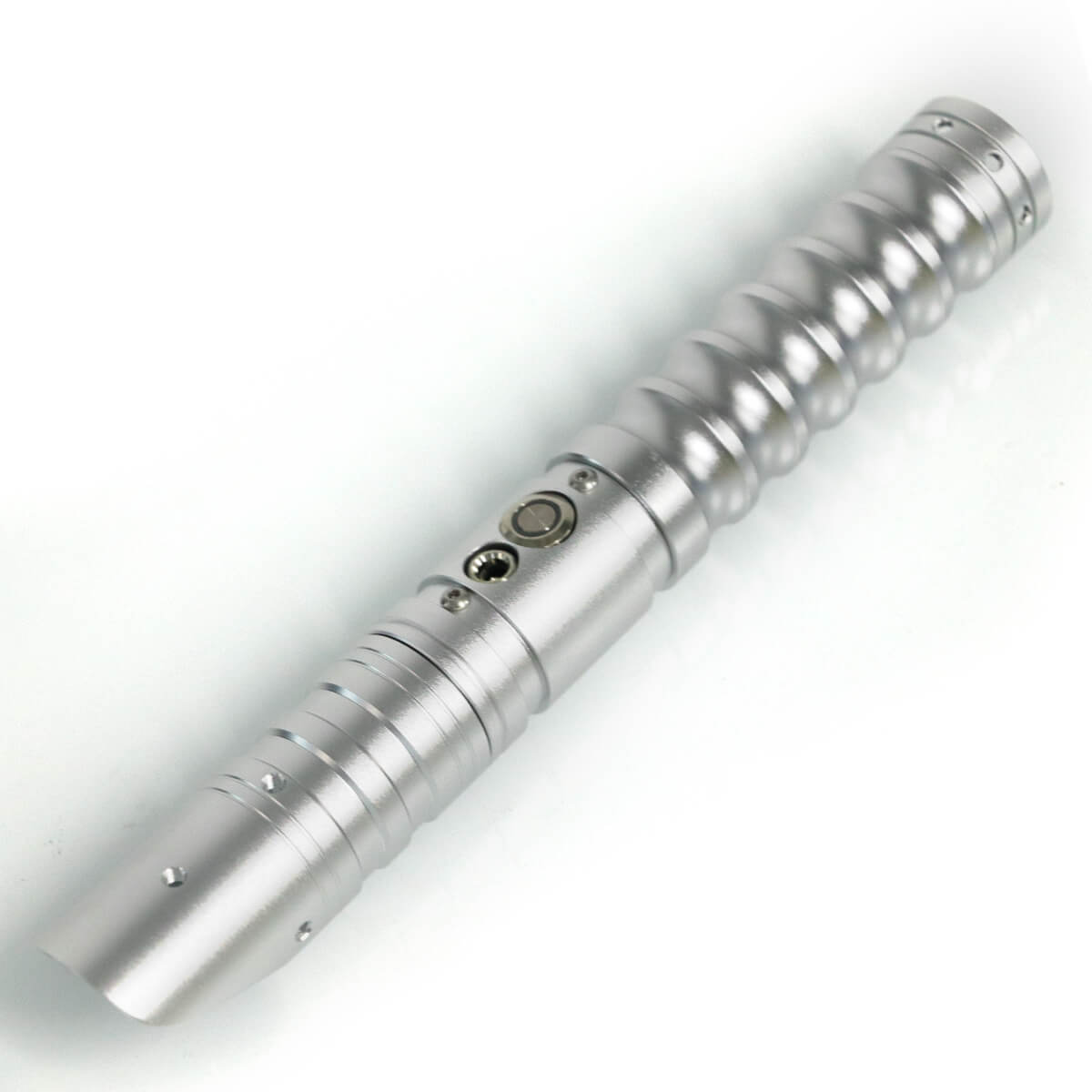
The hilt below is the plainest illustration of that split — a smooth, unengraved body where the colour of the blade has nothing to do with the metal.
FAQ
Q1: What is a lightsaber in simple terms?
A: A hand-held weapon that projects a contained blade of plasma about three feet long from a hilt roughly a foot long. In the fiction the blade is held in place by a magnetic field and coloured by a kyber crystal.
Q2: Is a lightsaber a laser?
A: No. A laser is coherent light with no fixed length, and it would keep going past the tip. A lightsaber’s blade stops at a set distance, which means it is matter being held in place, not light being emitted.
Q3: Who invented the word “lightsaber”?
A: The writer hired to ghost the tie-in novelisation coined it in 1974, replacing an earlier compound built around the term for a laser weapon. The filmmaker argued for keeping the new word in a 1976 script discussion.
Q4: Why is it not called a laser sword?
A: Because the earlier term read as the vocabulary of a different genre. The stated reason for the change was tone rather than accuracy — the invented word sounded like it belonged to this story and the plain one did not.
Q5: Why do characters in the films say “laser sword”?
A: Because it is the in-universe slang of people outside the Jedi tradition. It is used by a child who does not know the proper name, by outsiders who never learned it, and once by Luke in exile as deliberate contempt. Nobody in the original trilogy says it.
Q6: What is the blade made of?
A: In the fiction, plasma contained by a magnetic field generated in the hilt. On a real replica, a polycarbonate tube lit by LEDs or by an addressable LED string inside it.
Q7: What does the kyber crystal do?
A: It focuses the energy and sets the blade’s colour. Blue and green are the common results in canon. The crystal has no real-world equivalent, which is the cleanest line between the fiction and a replica.
Q8: Does a real lightsaber cut through things?
A: No. Replicas glow, make sound, and respond to motion. The blade is a lit tube. No consumer product in this category claims otherwise, which is why the marketing language never promises cutting.
Q9: How long is a lightsaber blade?
A: In the fiction, roughly three feet, though a shoto is shorter by design. On a real replica the common lengths are 28, 32 and 36 inches, and choosing between them is a reach question rather than a style one.
Q10: Is “lightsaber” one word or two?
A: One word. It is a closed compound, which is what the coined form was designed to be. The two-word version is the older term that the coinage replaced.
Q11: Why does the word sometimes have a hyphen?
A: Older print material sometimes set it with one, following a house style for new compounds. The films, the books published since, and the merchandise all use the closed form.
Q12: What should I check first when buying one?
A: The electronics tier, because it decides the blade, the sound and the colour range at once. Everything else about the purchase is downstream of that one choice.
The short version: a lightsaber is a contained plasma blade in fiction and a lit tube in reality, and its name is a 1974 coinage chosen for how it sounded rather than for what it describes.
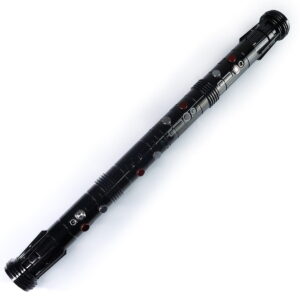
ISABER Double Bladed Lightsaber — RGB Baselit / Xenopixel Staff Saber
Accessories / RGB & Baselit Lightsabers