Ahsoka Tano Lightsaber — Xenopixel V3 / Proffie 2.2 Dual White Blade Replica Set | ISABER
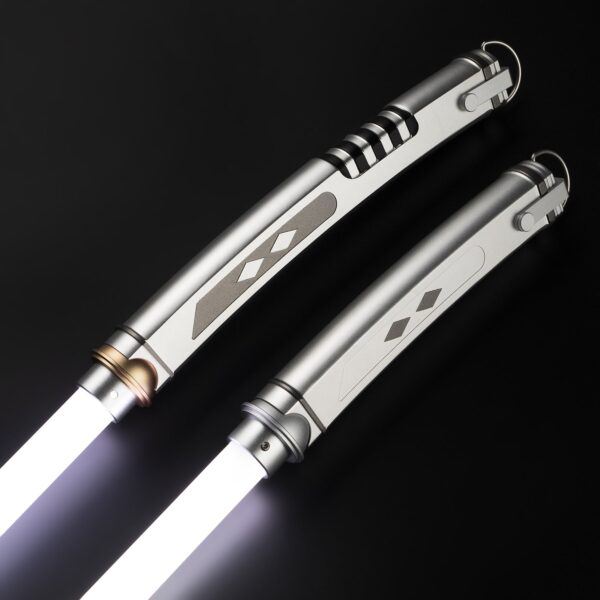
Two hilts. Two white blades. One of the most recognizable dual-wield setups in Star Wars.
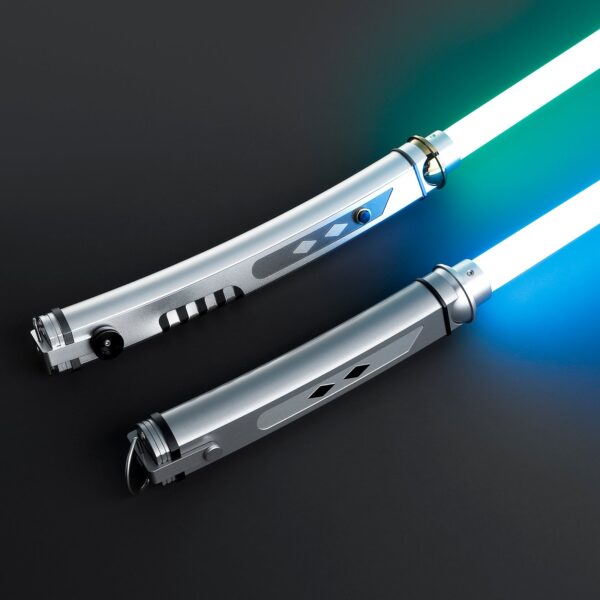
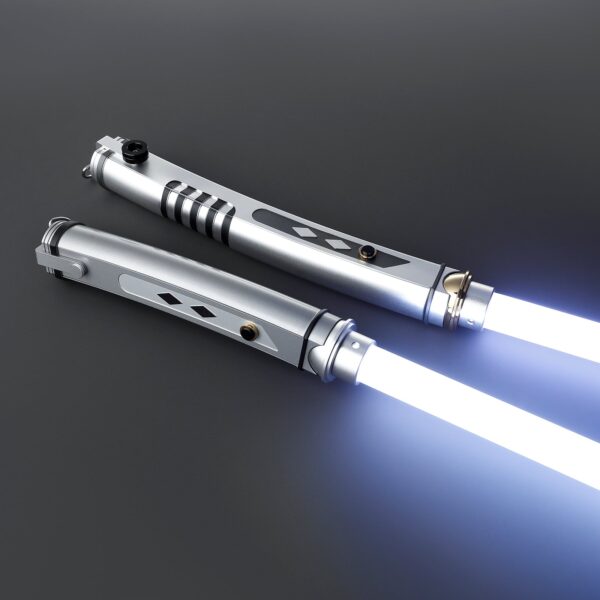
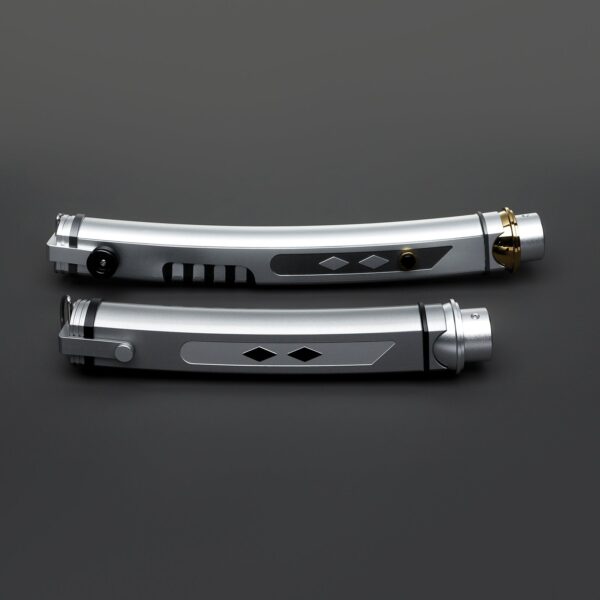
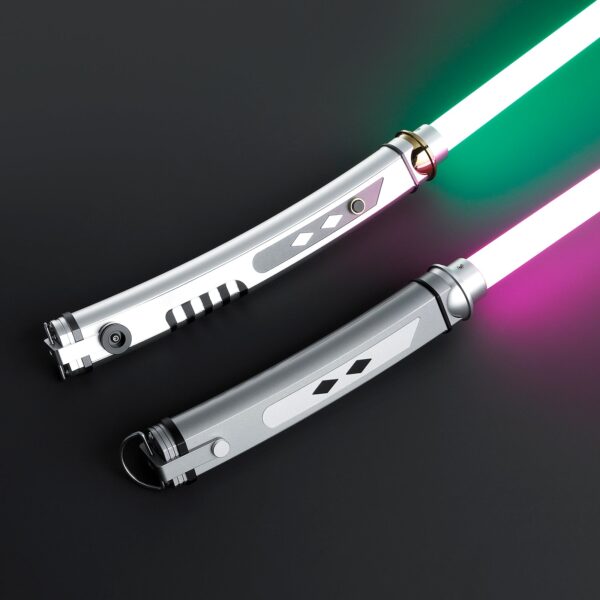
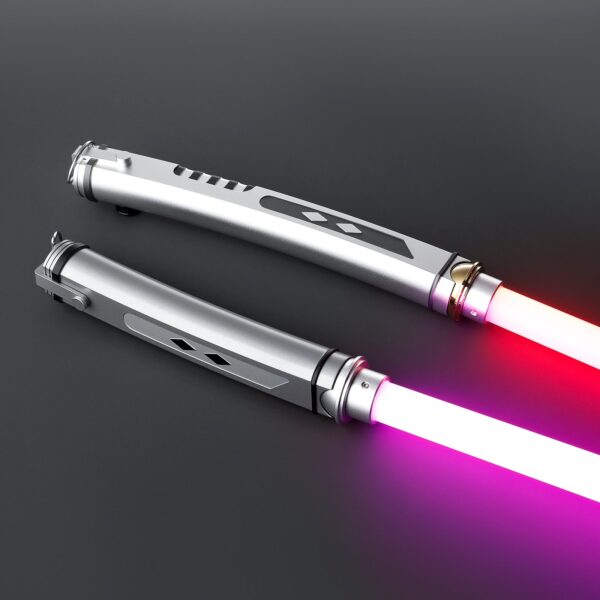
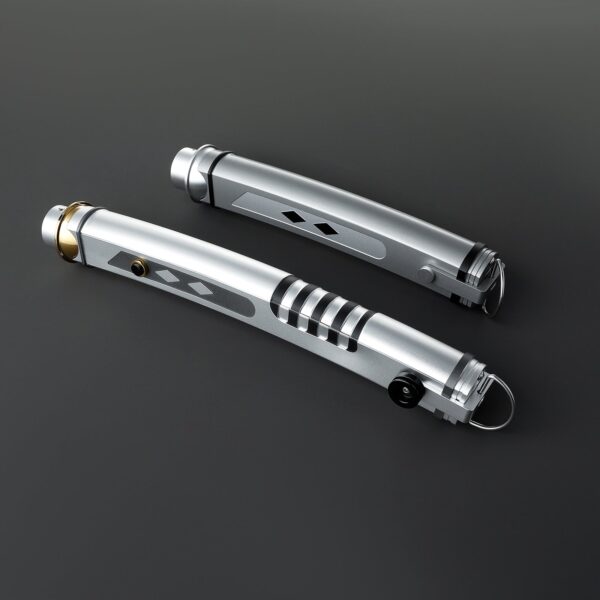
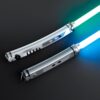
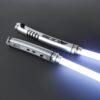
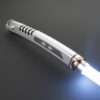
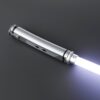
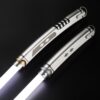
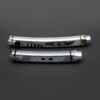
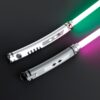
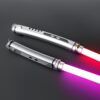
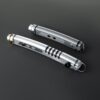
This is ISABER’s Ahsoka Tano replica set: two electroplated hilts — a full-size main hand and a shorter shoto off-hand — inspired by her Clone Wars design. Available in Xenopixel V3 and Proffie 2.2, with a pair of white Neopixel blades in 28″, 32″, or 36″. Buy a single handle or the full pair.
Why does Ahsoka’s saber matter? Because she walked away. She left the Jedi Order, surrendered her blue and green blades, and built new ones. White. The color of a Force user aligned to neither Jedi nor Sith. When you see white blades in Star Wars, you’re looking at Ahsoka Tano’s legacy. More on that below.
ISABER is not associated with Lucasfilm or Disney. This is a sabersmith-built replica set for dueling, cosplay, or display.
What Are the Specifications?
| Specification | Details |
|---|---|
| Character | Ahsoka Tano — Jedi Padawan to Anakin Skywalker, Fulcrum agent, Ronin |
| Blade Count | 2 — one main hand (full-size) + one shoto (off-hand, shorter) |
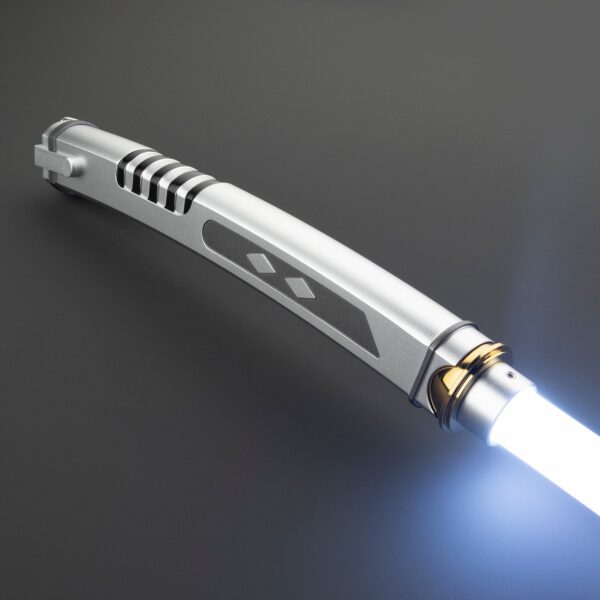
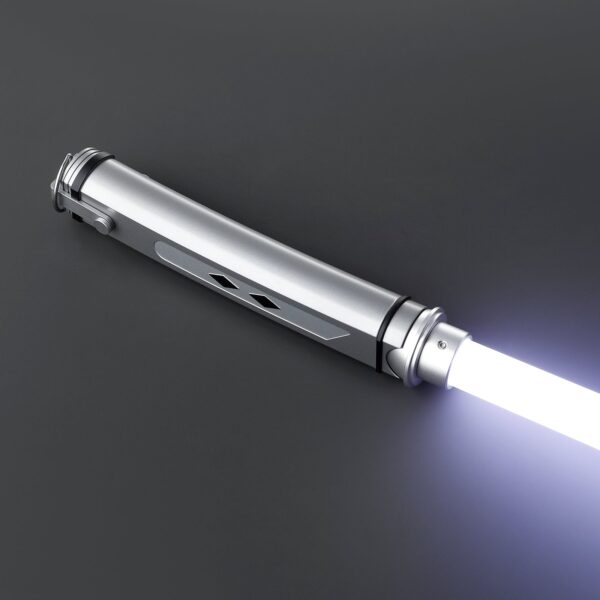
| Hilt Design | Electroplated machined aluminum, Clone Wars-inspired profile with angled emitters |
| Hilt Length | Large Handle ~28cm / Small Handle (Shoto) ~25cm |
| Hilt Material | Aluminum alloy with electroplated finish |
| Blade Type | Neopixel LED strip (50W ×2), 7/8-inch diameter, 3mm polycarbonate |
| Blade Length Options | 28″ (72cm) / 32″ (82cm) / 36″ (92cm) — per blade. Shoto traditionally paired with a shorter blade. |
| Blade Color | White (fully adjustable on Xenopixel/Proffie to any color) |
| Soundboard | Xenopixel V3 or Proffie 2.2 |
| Sound Fonts | 34 pre-installed per board (Xenopixel); 16–35, unlimited via SD card (Proffie) |
| Bluetooth | Yes (Xenopixel V3 app, controls both sabers); No (Proffie 2.2) |
| Blade Effects | 9 modes (Xenopixel): Stable, Pulse, Unstable, Ghost, Candy, Rainbow, Cracked, Fire, Flash; Fully programmable (Proffie) |
| Ignition Styles | 7 preset per blade (Xenopixel); Unlimited custom (Proffie) |
| Gesture Controls | Tip drag, stab, melt, blaster deflection, lock-up (Xenopixel); Fully configurable (Proffie) |
| Battery | 3600mAh 18650 rechargeable ×2 (built-in, one per hilt) |
| Charging | USB Type-C (~3 hours to full, each hilt) |
| Speaker | 3W bass speaker ×2 |
| SD Card | 32GB included per board (Xenopixel); 16GB included per board (Proffie) |
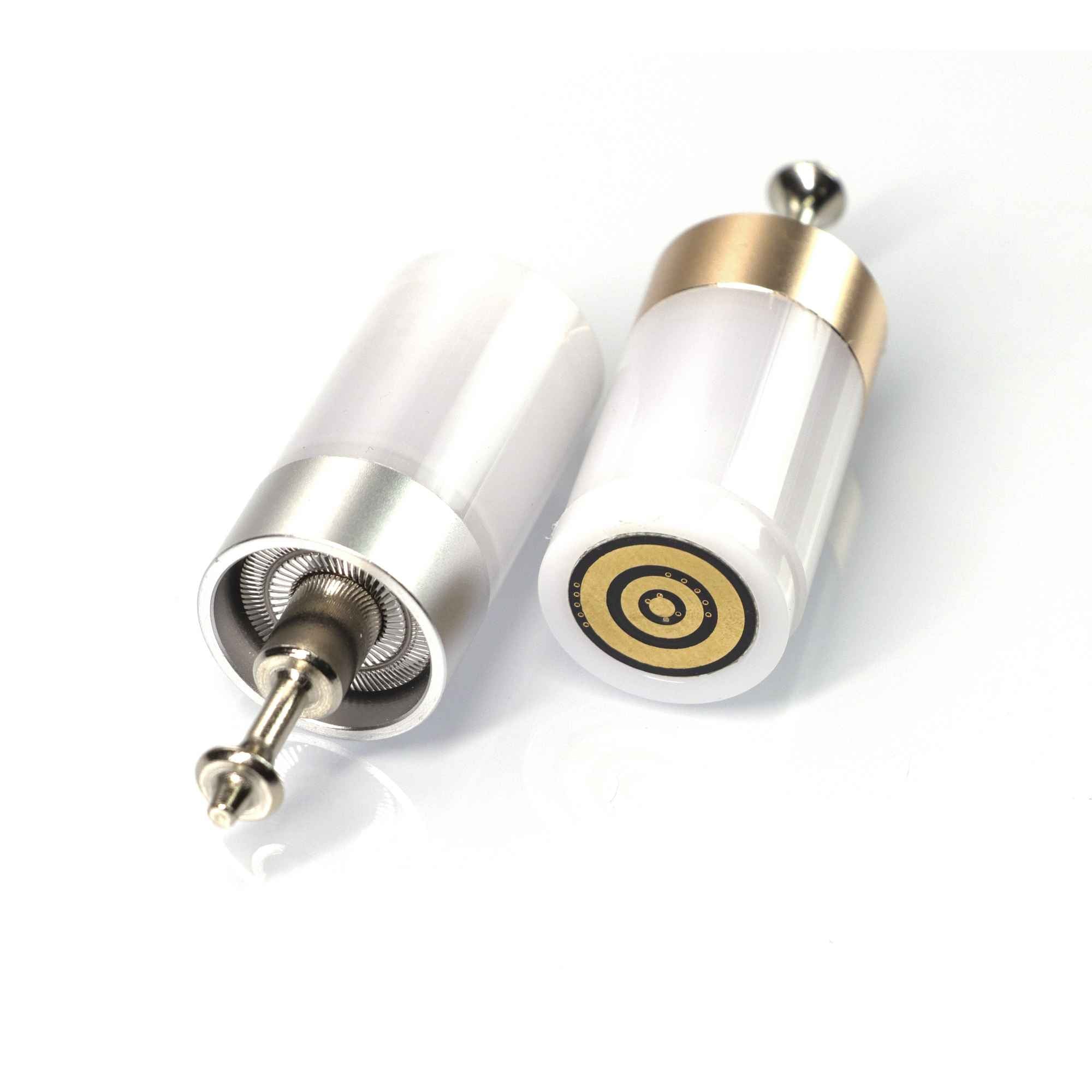
| Core System | Pogo pin removable chassis per hilt for easy battery access |
| Weight | ~2,000g (pair with blades) |
Soundboard Options
Two sabers. Two boards per saber. A dual-wield setup with independent electronics in each hand.
Xenopixel V3 — Dual Neopixel, plug and play
Each hilt runs its own Xenopixel V3 board. Both connect to the same Bluetooth app. Set them to matching white or contrasting colors. Set independent ignition styles per blade. All the standard Xenopixel features — 34 fonts, 9 blade effects, gesture controls — running independently in each hand.
- 34 pre-installed sound fonts per board on 32GB SD cards
- Bluetooth app (iOS & Android) controls both sabers
- 9 blade effects: Stable, Pulse, Unstable, Ghost, Candy, Rainbow, Cracked, Fire, Flash
- 7 ignition styles + full gesture controls per blade
- No programming. Open the box, charge both, start swinging.
Proffie 2.2 — Program the dual-wield experience
Each hilt gets its own Proffie 2.2 board. That means independent ignition sequences per hand. Want the shoto to ignite a split second before the main blade? Program it. Want different sound fonts per blade — one Ahsoka-era font in the main hand, one Clone Wars font in the shoto? You can do that.
- Open-source firmware — unlimited blade style customization per hilt
- Design dual-wield ignition sequences and independent effects per hand
- 16–35 pre-installed fonts per board, unlimited via SD card
- Arduino IDE for firmware; text files for config
Never touched Arduino? Go Xenopixel. Want to program a shoto that ignites one beat after the main blade, with Ahsoka’s Rebels-era white pulse effect? Proffie. You know which one you are.
Design Features
Electroplated Finish: A Step Above Standard Machining
The electroplated hilt finish is what separates this from a standard aluminum replica. Electroplating bonds a thin metallic layer to the aluminum surface through an electrochemical process — the result is a deeper, richer metallic sheen than anodizing alone can produce. The angled emitters, the contour lines along the grip, the transition from body to pommel — all of it catches light differently across the surface.
The Clone Wars design language is distinct from the film-era hilts. Less ornate than a Graflex. More angular than a thin-neck Obi-Wan. The Ahsoka hilt reads as purposeful and martial — a weapon designed by someone who fights with two blades and doesn’t have time for decoration.
The Shoto: Why the Off-Hand Is Shorter
The shoto (short blade) isn’t a design quirk. It’s a Jar’Kai decision. When you dual-wield, the off-hand blade passes closer to your body during spins and cross-body strikes. A full-length blade in the off hand is harder to control in tight arcs. The shorter shoto gives Ahsoka faster recovery from off-hand strikes and more clearance during spins. It’s the same principle that led her to hold the shoto in a reverse grip in early Clone Wars appearances — though she later switched to forward grip in both hands as her style matured.
One thing to know: the 7/8-inch blade diameter is narrower than the standard 1-inch. It’s more agile in the hand and closer to the on-screen proportions. The tradeoff: 7/8-inch blades are less common in the aftermarket. If you need a replacement blade, make sure it’s 7/8-inch — a standard 1-inch blade won’t fit the emitter.
White Blades: Not Neutral. Deliberate.
Ahsoka’s white blades are the visual signature of an ex-Jedi who didn’t fall. After leaving the Order, she purified a pair of red Kyber crystals taken from a fallen Inquisitor. The purification process turned them white — the only color that belongs to neither the Jedi (blue/green) nor the Sith (red). White says: I serve the Force, not an institution.
The Xenopixel and Proffie boards let you switch to any color. But the canon blades are white. Set them white. They look like nothing else in the saber rack.
Who Was Ahsoka Tano — and Why Do Her Lightsabers Matter?
Ahsoka Tano has one of the longest character arcs in Star Wars, and her lightsabers mark every chapter.
She was introduced in The Clone Wars (2008) as Anakin Skywalker’s 14-year-old Padawan — a character fans were primed to dislike. Instead, she became one of the most beloved Jedi in the franchise. Over seven seasons, she grew from impulsive apprentice to seasoned warrior. Then she walked away.
Falsely accused of treason by the Jedi Council, she was offered her place back after her innocence was proven. She refused. “I’m sorry, Master,” she told the Council, “but I’m not coming back.” The Jedi Order had failed her, and she knew it. She left her blue and green blades on the temple floor.
After Order 66, she went underground as the operative Fulcrum, coordinating Rebel cells across the galaxy. Her lightsabers from this era are the white-bladed pair on this page — built after purifying an Inquisitor’s red crystals. She carried them through Star Wars Rebels, survived a duel with Darth Vader on Malachor (she lived; the world between worlds is a separate story), and appeared in The Mandalorian and her own live-action series, Ahsoka (2023), still wielding the same white blades.
Key appearances: The Clone Wars (2008–2020, 7 seasons), Star Wars Rebels (2014–2018), The Mandalorian (S2, 2020), The Book of Boba Fett (2022), Ahsoka (2023, renewed for S2).
Ahsoka’s Fighting Style: Jar’Kai, the Dual-Wielder’s Form
Dual-wielding isn’t just “two sabers instead of one.” It’s a separate discipline. Jar’Kai — the practice of fighting with a blade in each hand — demands coordination that single-blade forms don’t. Your off hand can’t just mirror your main hand. It has to operate independently: parry while the main hand thrusts, feint while the main hand commits, cover your flank while you advance.
What Makes Jar’Kai Different
A single-blade fighter commits their body weight behind every strike. A dual-wielder can’t — both arms are extended, the stance is wider, and the center of gravity is split. Jar’Kai trades power for coverage. You control more angles, but each individual strike carries less force. Ahsoka compensates with speed and acrobatics: her Togruta agility + Ataru (Form IV) influence means she’s rarely where you expect her to be when your blade arrives.
The Reverse Grip: Early vs. Mature Ahsoka
In early Clone Wars seasons, Ahsoka held her shoto in a reverse grip (blade pointing backward along her forearm). Looked great on screen. In-universe, it’s a stylistic choice that limits thrust range and telegraphs upward strikes. As she matured, she switched both blades to forward grip — the same grip used by every other dual-wielder in canon. The reverse grip was a Padawan’s flourish. The forward grip is a veteran’s efficiency.
How Ahsoka’s Lightsabers Compare to Other Iconic Dual-Wield Sabers
| Character | Blade Count | Blade Color | Hilt Style | What’s Different |
|---|---|---|---|---|
| Ahsoka Tano | 2 (main + shoto) | White | Angled electroplated, 7/8″ blades | Shoto off-hand, white = purified crystal, neither Jedi nor Sith |
| Asajj Ventress | 2 (matched pair) | Red | Curved, connect into S-staff | Curved hilts for Makashi thrusts, connectable |
| Darth Maul | 2 (staff or split) | Red | Straight, connect into staff | Double-bladed staff primary, splits for dual-wield |
| Anakin Skywalker | 1 | Blue | Graflex-style | Single blade, classic Djem So power style |
| Obi-Wan Kenobi | 1 | Blue | Thin-neck | Single blade, Soresu defensive master |
Ahsoka’s setup is unique for two reasons. First: the asymmetrical blade lengths. Most dual-wielders use matched hilts. Ahsoka uses a main and a shoto — it’s closer to historical dual-wielding (rapier + parrying dagger) than the fantasy matched-pair approach. Second: the white blades. No other canon character carries white blades as their primary weapons. The color alone identifies her on screen before the face is visible.
Behind the Scenes: The Inquisitor’s Crystals
The white blades have a specific origin in canon. In the 2016 novel Ahsoka by E.K. Johnston, set one year after Order 66, Ahsoka defeats the Sixth Brother — an Inquisitor sent to hunt surviving Jedi. She takes the red Kyber crystals from his broken double-bladed lightsaber and purifies them through the Force. The purification process strips the “bleeding” that turns a crystal red (a dark side ritual where the user pours rage and pain into the crystal). The result is white.
Dave Filoni, who created Ahsoka and served as showrunner for The Clone Wars, Rebels, and the live-action Ahsoka series, has said the white blades represent her independence: “She is not a Jedi, but she is an agent of the light.” The purification is personal — she took something the dark side had corrupted and made it clean. That’s her arc in miniature.
When Should You Choose (and NOT Choose) the Ahsoka Tano Lightsaber?
Get this saber if:
- You dual-wield or want to learn. This is the canonical dual-wield setup. The asymmetrical hilts — main hand full-size, off-hand shoto — are the authentic Jar’Kai configuration. You can buy a single handle to start and add the second later.
- You want white blades that stand out. At a convention, in a saber rack, or in a duel, white blades are unmistakable. Everyone has blue, green, and red. White reads as Ahsoka instantly.
- You’re an Ahsoka fan. She’s arguably the most developed character in Star Wars outside the original trilogy. Seven seasons of Clone Wars. Four seasons of Rebels. Her own live-action show. The white blades are the payoff of a 15-year character arc.
Skip this saber if:
- You want a single, do-everything saber. Ahsoka’s setup shines as a pair. A single handle works fine — it’s a fully functional saber on its own — but the character identity is in the dual-wield. If you only want one saber, Anakin’s or Obi-Wan’s is a more natural single-blade choice.
- You primarily display, never duel. The Ahsoka set takes up more display space than any single hilt. Two hilts, two blades, two stands. If shelf space is tight, consider a single-hilt character replica.
- You prefer 1-inch blades. The 7/8-inch blade is closer to screen-accurate proportions, but it means your replacement blades and blade plugs are less interchangeable with the rest of your collection. If all your other sabers use 1-inch blades, this set lives in its own ecosystem.
What’s in the Box?
- 1× or 2× Hilt with Core & Rechargeable Battery (depending on selection)
- 1× or 2× 7/8-inch Neopixel Polycarbonate Blade
- 1× or 2× 7/8-inch Blade Plug
- 1× or 2× Display Stand
- USB Type-C Charging Cable
- Allen Key + Screws Pack
- User Manual
- SD Card Reader (Xenopixel version)
- Premium Carry Case
Frequently Asked Questions
Q1: Can I buy a single hilt, or do I have to buy the pair?
A: Both. Buy a single hilt (Large Handle for main hand, or Small Handle/Shoto for off-hand) to start. Add the second later. Buy the pair for the complete set with both hilts and both blades. The single handles are fully functional on their own.
Q2: Can I set the blades to colors other than white?
A: Yes. Both Xenopixel V3 and Proffie 2.2 support unlimited color selection. Set them white for canon Ahsoka. Switch to blue and green for Clone Wars-era Ahsoka (her original Padawan blades). Or set any color you want. The board doesn’t care about canon.
Q3: What’s the difference between the Large Handle and Small Handle/Shoto?
A: The Large Handle is the main-hand hilt (~28cm). The Small Handle (Shoto) is the off-hand hilt (~25cm). The shoto is shorter, lighter, and balanced for faster off-hand recovery. For a single-hilt purchase, most people start with the Large Handle. The dual-wield experience is designed around holding the Large in your dominant hand and the Shoto in your off hand.
Q4: Is the 7/8-inch blade compatible with my other 1-inch sabers?
A: No. The Ahsoka replica uses 7/8-inch blades and emitters. Standard 1-inch blades won’t fit. If your collection is all 1-inch sabers, the Ahsoka set lives in its own blade ecosystem. Replacement blades are available separately from ISABER.
Q5: Can I duel with these?
A: Light to medium contact is fine. The 3mm polycarbonate blades handle staged duels, choreography, and casual sparring. Full-contact heavy dueling risks cracking the Neopixel LED strips inside the blades — and with two blades, that’s twice the electronics to protect. Blade replacements run about $40–60 each.
Q6: What’s the difference between Clone Wars Ahsoka hilts and Rebels Ahsoka hilts?
A: Clone Wars hilts are straight, angular, with angled emitters and an electroplated finish. Rebels-era hilts are curved with more ornate detailing. This ISABER replica is based on the Clone Wars design. The curved Rebels design is a different hilt set entirely.
Q7: Why are the blades white instead of blue and green?
A: Ahsoka used blue (main) and green (shoto) as a Jedi Padawan. After leaving the Order, she purified an Inquisitor’s red Kyber crystals, which turned them white. The white blades represent her post-Jedi identity: aligned to the light side but belonging to no institution. This replica ships with white blades, but you can switch to any color via the soundboard.
Q8: Does the shoto feel noticeably different from the main hilt?
A: Yes. The shoto is ~3cm shorter and slightly lighter. In your off hand, it feels faster — less inertia to overcome during spins and parries. In your main hand, you’ll notice it’s smaller than a standard hilt. The pair is designed to be asymmetrical. That’s the point.
Q9: How does dual-wielding with this set compare to a double-bladed staff?
A: Different philosophy entirely. A staff (like Maul’s) is a single connected weapon: both hands committed to the same tool, wide sweeping arcs, limited thrust capability. Dual-wielding (Ahsoka) gives you independent control of two weapons: you can thrust with one while parrying with the other, attack from two angles simultaneously, or defend and attack at the same time. The trade: each individual strike is weaker, and the coordination requirement is higher. If you’ve never dual-wielded, expect it to feel awkward for the first few sessions.
Q10: Are the two hilts independently controlled?
A: Yes. Each hilt has its own soundboard, battery, speaker, and SD card. They operate independently. On Xenopixel V3, both connect to the same Bluetooth app for synchronized control. On Proffie 2.2, you configure each board separately via USB — which means you can program completely different behavior for each hand.
Q11: What sabers did Ahsoka use before the white blades?
A: As a Padawan, she used a standard green single-blade (standard Jedi issue). Later, Anakin gave her a second, shorter green shoto for her off hand. During the Clone Wars, she switched to a blue main blade + green shoto. When she left the Order, she left those blades behind. The white-bladed pair on this page is the set she built after Order 66 — her post-Jedi weapons.
Q12: Is this based on the live-action Ahsoka show design?
A: This replica is based on the Clone Wars animated design (angled emitters, electroplated finish). The live-action Ahsoka (2023) hilts are physically similar but with more weathered, realistic detailing. For most fans, the Clone Wars design is the iconic version — it’s the one that appeared across seven seasons, two other shows, and most of her on-screen appearances.
Reviews
There are no reviews yet.