
A lightsaber pike is a long-shafted saber with a short blade at the tip, built for reach instead of swing. Canon gives it two forms — a polearm with one short blade on a lightsaber-resistant shaft, and the Temple Guard staff with two blades on a hinged hilt — and both run into the same real-world problem: a long aluminium shaft flexes, so it needs an internal stiffener and weight at the far end.
A pike is what you get when you stop treating a lightsaber as a sword and start treating it as a polearm.
That single change moves the design problem. Length replaces blade work, the shaft stops being a grip and becomes a structural member, and balance leaves the hilt and travels down a metre of tubing.
This page covers the two canon forms, what a shaft is actually made of, how the community builds them, and where the whole idea breaks down.
What’s on This Page
- What a Lightsaber Pike Actually Is
- The Two Forms — Polearm and Staff
- The Shaft Is the Whole Weapon
- How a Pike Gets Built
- Flex, Wobble and the Insert Fix
- What the Reach Costs You
- Balance and the Far End
- Blades, Emitters and Shoto Geometry
- Building or Buying One Today
- Frequently Asked Questions
What a Lightsaber Pike Actually Is
A pike is a long shaft with a short blade at one end, and its defining number is the ratio between them — the handle is the weapon and the blade is the tip. Including the blade, a pike runs close to the wielder’s own height, which is what buys its reach.
The distinction matters because a pike is not simply a big lightsaber. Make a hilt longer and add length to the blade and you get a staff, not a pike.
The blade on a pike is deliberately short and thick rather than long and thin. Reach comes from the shaft, so the blade only has to be long enough to threaten.
That inversion is the whole idea. A standard saber’s hilt is roughly a tenth of its total length; on a pike the shaft is the majority of it.
| Property | Standard saber | Pike |
|---|---|---|
| What is long | The blade | The shaft |
| Blade length | Roughly 32–36 in | Often 16–24 in |
| Hilt / shaft | Roughly 10–12 in | Several feet |
| Number of blades | One | One or two |
| Weight sits | At the hand | Spread along the shaft |
| Built for | Cutting and deflecting | Reach and keeping distance |
Read the last row as the reason the weapon exists. Everything above it follows from keeping an opponent outside their own range.
The Two Forms — Polearm and Staff
Canon carries two versions that share a name and little else. The polearm is a one-bladed shaft of lightsaber-resistant metal, used by exotic-weapon specialists. The staff form is the Jedi Temple Guard’s hinged double-bladed pike, whose two blades are nearly identical in function to a double-bladed lightsaber.
Confusing the two is the most common mistake in writing about pikes, and it is easy to see why. Both are long. Only one is a polearm.
The polearm form puts a single short blade on the end of a long shaft, with the activation switch set well down from the tip so a hand does not rest on the emitter.
The staff form emits from both ends and folds. Its blades are the version most people picture, because the Temple Guard carried it on screen.
There is a canon wrinkle worth knowing. A staff-form pike and a double-bladed lightsaber are handled much the same way, and canon never draws a clean line between the two names. The split reads less like a difference in the weapon and more like a naming convention that stuck.
The polearm form converts a blade problem into a shaft problem: the long tube becomes the structure, so it needs an internal stiffener that a normal hilt never does. The staff form sidesteps that by keeping the shaft short and hinging it, which is why the two behave so differently in the hand despite sharing a name.
The Shaft Is the Whole Weapon
In canon the shaft is made from a lightsaber-resistant metal so an opponent’s blade cannot simply cut the weapon in half — the pike’s answer to being long is that the long part must survive a strike. That single requirement is what separates a pike’s shaft from a plain tube.
A lightsaber cuts almost anything. A weapon built around a metre of handle has to answer that problem directly, because every extra inch of reach is another inch an opponent can attack.
Canon’s answer is a rare alloy that resists a blade rather than conducting the cut, and it is treated as expensive and hard to obtain. That is not decoration. Without it, a pike is a long handle attached to the one part of itself that can destroy it.
Real builds make the same trade in ordinary materials. The shaft is aluminium, because aluminium is what sabers are machined from, and aluminium is exactly what a pike needs least.
It is light, which helps, and it is stiff, which also helps. What it does not do is bend and recover.
That is the crux. A wooden staff of the same length flexes under a hard swing and returns. An aluminium one resists right up to the point where it does not, and then it stays bent.
How a Pike Gets Built
Almost nobody machines a five-foot hilt. The standard community method is to stack threaded extension pieces onto a normal saber and fit a short blade, which is why a pike is usually a modular build rather than a single machined object.
The parts list is short, and it starts from an ordinary hilt.
Extensions come in fixed lengths, most commonly around 15 inches, and a typical pike stacks three or four of them. They thread together the same way a hilt’s own sections do, so a build grows by adding a piece rather than by machining a longer tube.
The blade is then chosen short — around 16 or 24 inches — to keep the tip light at the end of a long lever.
Four extensions puts a pike in the region of five feet of handle before a blade is fitted at all, which is where the numbers start to matter.
Height becomes a practical limit. Builders assembling four extensions indoors have found the weapon standing taller than the room, and the assembly weighs enough that a martial-arts instructor testing one worried about bending aluminium with sharp pole movements.
Coupling is the other weak point. Threading several sections together concentrates force at each joint, and a single mounting screw per joint lets the whole assembly pivot around it.
Flex, Wobble and the Insert Fix
The consistent community fix for a flexible pike shaft is a thin-walled tube running up the inside for its whole length, which stiffens the assembly and adds weight at the far end. The parts themselves rarely come apart; it is the flex that builders dislike.
Extension pieces threaded together are reported as feeling like one solid piece in the hand. The complaint is not looseness but give.
That is a material property, not a manufacturing defect.
The size of the flex depends on the tube. A thin tube a few feet long deflects noticeably under load, and one builder measured a shaft flexing slightly at around three feet. Longer and thinner means more of it.
An internal insert is the standard answer. A thin-walled tube slid up the centre of the assembled sections adds stiffness along the whole length and, incidentally, puts a little mass at the tip end.
Stunt props for the films went the other way on material. Earlier production tubes were aluminium and arrived bent and deformed; later ones used much thinner carbon-fibre and composite tubing to get stiffness at lower weight.
Joint design matters as much as material. Two sets of mounting holes per coupler, rather than one screw on each side, spreads a strike over a larger area instead of letting the section rotate about a single point.
What the Reach Costs You
A pike’s length buys reach and charges for it in defence and transition. The weapon is strong at keeping an opponent away and weak when they get inside, and it needs open space to work at all — which is the opposite of the situation where a short blade thrives.
This is the trade every polearm makes, and the pike is no exception.
Two hands spread along a long shaft cannot reposition the tip quickly. Changing where the blade points means moving the whole weapon rather than rotating a wrist, which is why a pike is described as poor at defending and at transitioning between lines.
The same length that keeps an opponent out makes closing in a losing position. Inside the pike’s effective arc, its reach turns into an obstacle.
Space is the third cost. A pike is a corridor and open-ground weapon; the places a normal saber manages fine are exactly where a long shaft runs out of room.
None of that makes it a bad design. It makes it a specific one, chosen for a job that is mostly about distance.
Balance and the Far End
On a pike the balance point matters more than the total weight, and opinions on how to tune it split. Some builders find no counterweight necessary because the hands sit far apart on the shaft; others treat hilt-end mass as essential once the technique involves sliding the shaft through a forward grip.
The disagreement is real and it tracks what the weapon is being used for.
For a held-and-swung staff, the two hands are spread widely enough that the mass between them steadies the weapon on its own. Adding weight is unnecessary.
For a thrusting technique, where the shaft slides through the front hand with the fists brought together, the mass distribution is the technique. A couple of ounces moved at the hilt end changes how the weapon travels, and builders describe swapping pommels as a normal part of tuning.
Since the far end is a metre away from the hand, small changes there swing the balance point appreciably. That is the same lever logic that governs a pommel on a normal saber, stretched over a much longer arm.
The practical approach is to build first and tune after. A pike is balanced to the person holding it, which is why the same parts list produces different-feeling weapons.
Blades, Emitters and Shoto Geometry
A pike uses a short blade on standard hilt hardware, because the emitter end is still a saber emitter. The blade is kept short for tip weight and, where the form is a polearm, is often described as thicker than a normal blade to survive contact.
Nothing about the tip changes when the handle grows. A pike’s emitter takes the same bore and the same blade as any other saber.
What changes is the choice made at that emitter.
A short blade is the point of the weapon. Reach already comes from the shaft, so a long blade would only add mass at the worst possible place, at the end of the longest lever in the build.
The canon polearm also describes its blade as shorter and thicker than standard. The reasoning is the same as the shaft’s: the weapon expects to be struck, so the parts that can be struck are over-built.
Where two blades are used, both ends need the same treatment, which is why the staff form keeps its overall length shorter than a polearm of equivalent reach.
Building or Buying One Today
Pikes are a build-it-yourself category far more than a shelf category. What is sold off the shelf is mostly the parts — extension sections, couplers and short blades — with a few complete long-hilt sabers available, so the realistic path is a modular build from a standard saber plus extensions.
The market splits cleanly along that line.
Parts are easy. Extensions, couplers and short blades are sold as separate pieces by makers who support modular systems, and they thread together with the same standard as the hilt they attach to.
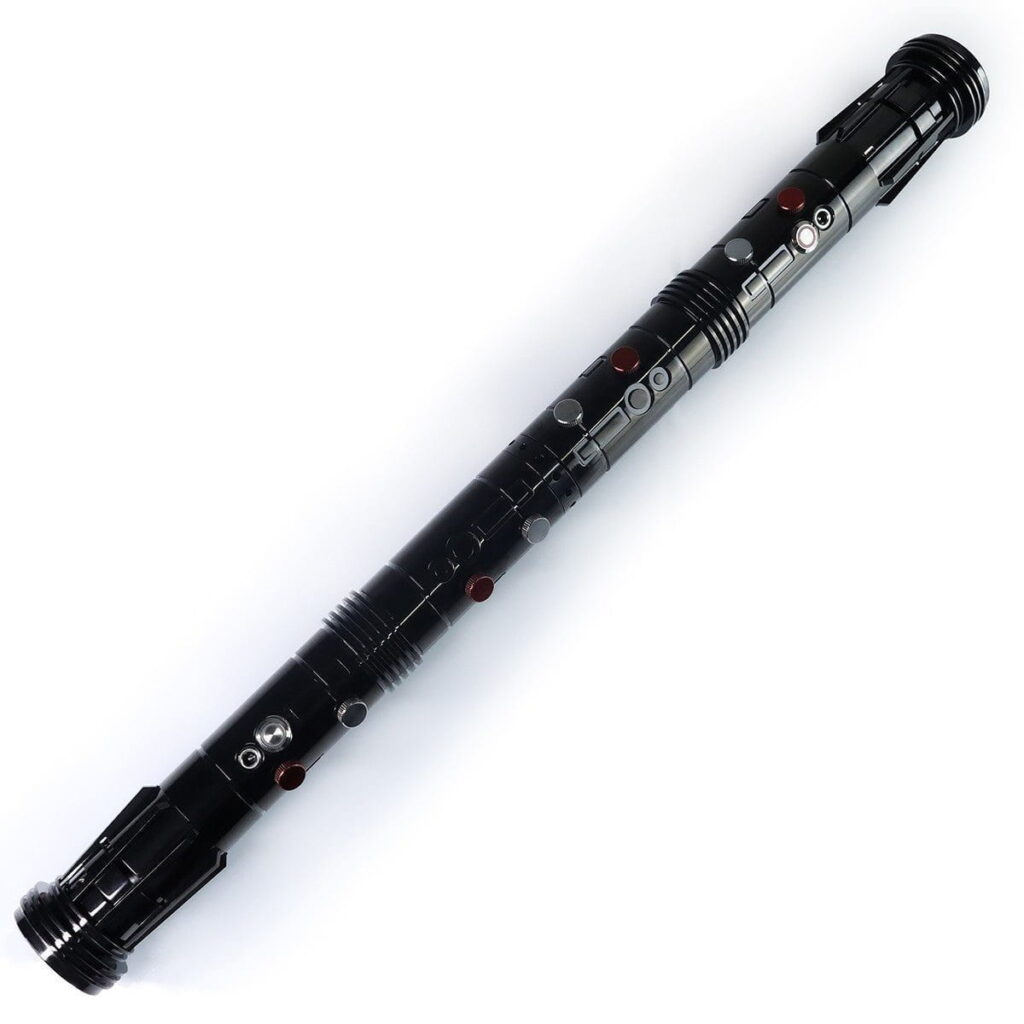
Complete pikes are rare. A few exist, some with hilts over five feet and the full electronics set — colour changing, sound, app control — but they are the exception, and they are priced as the unusual objects they are.
The most direct route for most people is to start from a dual-blade saber and add length. A double-bladed hilt already has the long central body, the emitters and the sound, and extensions are the cheapest way to turn it into something polearm-shaped.
Two things to settle before buying anything. Decide whether the weapon is a display piece or something that will be swung, because that decides the blade and the shaft insert. And measure the room, because a five-foot shaft plus a blade needs a space that most indoor areas are not.
ISABER Double Bladed Lightsaber — RGB Baselit / Xenopixel Staff Saber
Accessories / RGB & Baselit Lightsabers
Frequently Asked Questions
Q1: What is a lightsaber pike?
A: A long-shafted saber with a short blade at the tip, giving reach rather than swing. The handle is the weapon and the blade is the tip, which is the reverse of a normal saber where the hilt is short and the blade is long.
Q2: Is a lightsaber pike the same as a double-bladed lightsaber?
A: Not exactly, though the staff form is close. Both emit from two ends and both fold at the middle, which is why they get confused. A polearm-form pike is a different weapon entirely: one short blade on a long single shaft.
Q3: Who used a lightsaber pike?
A: The Jedi Temple Guard carried the double-bladed, hinged version. Yellow blades had not appeared in canon before that, and this is the design they are attached to. Exotic-weapon specialists used the polearm form, and the Grand Inquisitor was associated with a folding variant.
Q4: How long is a lightsaber pike?
A: Including the blade, close to the wielder’s own height. In canon one variant runs roughly two to three metres. Real builds usually arrive at a five-foot handle by stacking three or four extensions of around 15 inches each, before a blade is fitted.
Q5: What is a lightsaber pike shaft made of?
A: In canon, a lightsaber-resistant metal, so an opponent’s blade cannot cut the shaft in half. Real builds use aluminium, because that is what sabers are machined from, with a thin-walled tube running up the centre for stiffness.
Q6: Why do pike extensions wobble?
A: The parts rarely work loose — the issue is flex. Aluminium resists bending and then stays bent, unlike wood, which bends and returns. Threading several sections together adds joints where force concentrates, so a shaft insert and better coupler design are the usual fixes.
Q7: Can you duel with a lightsaber pike?
A: Yes, with caveats. A pike is strong at keeping distance and weak once an opponent closes inside its reach, and it needs open space to work at all. A build intended for contact should have a stated shaft insert and a short blade specified for it.
Q8: What blade length does a lightsaber pike use?
A: Short — commonly around 16 or 24 inches, against 32–36 on a standard saber. The shaft already provides the reach, so a long blade would only add weight at the far end of the longest lever in the build.
Q9: Is a lightsaber pike good for close quarters?
A: No, and this is its defining weakness. The length that keeps an opponent out becomes an obstacle once they are inside it. A pike is a corridor and open-ground weapon, not a tight-space one.
Q10: How do you counterbalance a lightsaber pike?
A: It depends on the technique. With both hands spread along the shaft, the mass between them is often enough and no counterweight is needed. For thrusting, where the shaft slides through a forward grip, a small amount of weight at the hilt end changes the motion noticeably, and builders tune it by swapping pommels.
Related reading on this site: the seven combat styles and what each one asks of a hilt, the three systems every saber is built from, and what each section of a hilt does.