
Ki-Adi-Mundi’s lightsaber is a 26.6 cm plain durlasteel hilt with a knurled grip on the upper half and no ornament anywhere on it, and it is the only blade in the films whose colour changes by accident. The colour was meant to be blue. One frame in Attack of the Clones came out green, and the way that was later explained is the most interesting thing about the weapon.
Most pages about this saber tell you the two crystals and stop. The two crystals are real canon and this page covers them, but they are one entry in a timeline that runs from a belt clip in 1999 to a museum case on Batuu more than thirty years later.
So this is written as an archive: the hilt first, then the dated entries in order, then the part that matters if you are holding a replica rather than reading a wiki.
What’s on This Page
- The Short Answer
- The Hilt: 26.6 cm and Nothing Extra
- 1999: On the Belt, Never Lit
- 2002: The First Ignition and the Green Frame
- 2002 to 2016: How One Frame Became Two Crystals
- 2008 to 2020: The Blue Years
- 19 BBY: Mygeeto, and the Blade That Outlived Him
- After Death: Anolo, Greedo, Jabba, Dok-Ondar
- What a Replica Has to Get Right
- FAQ
The Short Answer
A plain silver hilt, 26.6 cm long, holding two kyber crystals so the blade can be blue or green, with blue as the colour it shows in almost every appearance.
The hilt is the least decorated weapon carried by anyone on the Jedi Council, and that is a character decision rather than a budget one. Cerean culture favours low technology, so the Master who represents it carries a tool rather than a trophy.
The two crystals are the part that gets repeated everywhere, and the reason for them is production rather than storytelling. We will get to it in the 2002 entry.
The Hilt: 26.6 cm and Nothing Extra
Durlasteel, 26.6 cm from pommel to emitter, with ridges machined into the upper half for a two-handed grip and no shroud, no claws, no gold.
That length is short by the standards of the era. It sits inside the hand rather than extending past it, which suits a duellist who works close and keeps the blade between himself and the other person.
The ridges are the one piece of engineering on the whole object. They run around the top half so the upper hand has something to bite on when the grip changes mid-exchange, and every other surface is left smooth.
Fan builders call the family it belongs to the clan hilt, because Aayla Secura and Saesee Tiin carry near-identical bodies in the same films. All three are the same answer to the same question: what does a saber look like when nobody is trying to make it beautiful.
| Spec | Detail | Why it matters |
|---|---|---|
| Overall length | 26.6 cm | Short body, close-quarters handling, sits inside the palm |
| Material | Durlasteel, plain finish | No plating, so the metal is the whole look |
| Grip | Ridged upper half | Bite for the top hand during a two-handed grip change |
| Shroud or claws | None | The emitter is a bare cylinder end |
| Colour palette | Silver only | Nothing to read meaning into, which is the point |
| Crystals | Two, blue and green | Either colour can be produced from the same body |
1999: On the Belt, Never Lit
The saber’s first appearance is a hilt hanging on a belt in The Phantom Menace, and it never ignites in that film.
That is worth stating plainly because a lot of fan art treats the prequel-era design as though it arrived fully formed in a duel. It did not. The first job the prop had was to sit on a costume and read as a Jedi’s tool from across a wide shot.
A plain silver cylinder does that job better than an ornate one. From a distance there is nothing to resolve except a shape, and the shape says weapon without saying whose.
The belt appearance also fixes the size in the audience’s eye before the blade ever appears, which is why the saber reads as small when it finally lights up.
2002: The First Ignition and the Green Frame
Attack of the Clones gives the saber its first lit appearance, and it also contains the single frame that turned a continuity slip into canon.
Across the Battle of Geonosis the blade is blue. The intent in the art department was blue, and the vast majority of shots are blue.
One shot is green. It happens during the back-to-back fighting in the arena sequence, and it was an effects continuity error rather than a choice.
A mistake that brief is normally corrected and forgotten. This one was not, because by the time anyone could tidy it up the shot had already been seen by an audience that was about to spend fifteen years asking why.
Six entries, one weapon. The interesting two are the ones that do not fit.
| Year | Where it appears | Blade shown | Years after 1999 |
|---|---|---|---|
| 1999 | The Phantom Menace, belt only | None, never ignited | 0 |
| 2002 | Attack of the Clones, Geonosis | Blue, with one green frame | 3 |
| 2005 | Revenge of the Sith, Mygeeto | Blue | 6 |
| 2008 | The Clone Wars series begins | Blue throughout | 9 |
| 2016 | Two crystals entered into reference canon | Blue or green, by design | 17 |
| 2019 | Galaxy’s Edge comics, Dok-Ondar’s shop | Blue, and no longer his | 20 |
The bar is years elapsed since the first appearance, scaled across the whole table so the 2019 row fills it. The 2016 row is a reference book rather than a film, and that is exactly what makes it worth a row.
2002 to 2016: How One Frame Became Two Crystals
Rather than reshoot or quietly ignore the green frame, Lucasfilm’s continuity team turned it into a feature: the hilt holds two crystals, one blue and one green, and either can be produced.
The move is a retcon, and it is one of the tidier ones. It costs nothing in the films, it explains a shot that could not be withdrawn, and it gives the character something no other Jedi on the Council has.
Where it gets shaky is the popular explanation that his two brains let him resonate with two crystals. Cereans are established as having a binary brain, and the pairing is attractive, but the two-brain link is fan reasoning rather than stated canon.
What the reference material actually says is narrower. The saber contains two crystals. Whether the character has a relationship with each one is a reading, and a good one, not a fact.
This is worth separating because the two claims travel together in almost every article about the saber, and only the first one is sourced.
2008 to 2020: The Blue Years
Across the animated series the blade is blue with no exceptions, which quietly settled the question the two-crystal explanation had just reopened.
Consistency in animation is easier to hold than consistency in live action, because the colour is a property of an asset rather than the result of a composite that has to be redone every shot.
The series also gives the saber its best action beats, including the moment at the second Battle of Geonosis, where the blade is used to cut a path through a planted field rather than against another saber.
That is the sort of use the plain hilt was built for. Nothing in the design assumes a duelling audience, and the character never treats the weapon as a display object.
19 BBY: Mygeeto, and the Blade That Outlived Him
The last lit appearance is a blue blade on a frozen bridge during Order 66, and the weapon survives the man by design of the story rather than by luck.
The scene is short and the outcome is not in doubt, which makes the interesting part what happens to the object afterwards. The saber falls with him, and it does not stay there.
This is where the weapon stops being a character’s property and becomes a piece of salvage, and the rest of its history is about who can be bothered to carry it.
After Death: Anolo, Greedo, Jabba, Dok-Ondar
Four owners follow over roughly two decades of story time, and the blade passes each time because somebody valued it differently from the person holding it.
The Banking Clan’s Vice Chairman Anolo takes it as a trophy on Mygeeto, which is the standard fate of a weapon belonging to a defeated order. It sits in an office as a relic of a war that the holder won.
Greedo ends up with it on a botched job, uses it to break a window, and tries to sell it on. That is the least dignified chapter in the whole history and the most believable one.
Jabba refuses it as an obsolete Jedi trinket, which is the correct read from a crime lord’s seat. A saber with no user is a metal cylinder.
Dok-Ondar buys it for double what Greedo was asking and puts it in the Den of Antiquities on Batuu, where it is still sitting when a First Order sergeant picks it up and threatens him with it.
| Holder | How it arrived | How it left |
|---|---|---|
| Ki-Adi-Mundi | Built and carried as a Jedi Master | Lost with him on Mygeeto |
| Vice Chairman Anolo | Taken as a war trophy | Stolen during a later job |
| Greedo | Grabbed it to smash a window | Failed to sell it on |
| Jabba the Hutt | Offered it by Greedo | Refused it as obsolete |
| Dok-Ondar | Bought it for double the asking price | Still holds it on Batuu |
Five holders, and only the first one ever turned it on with intent. That is a better advertisement for a plain hilt than any amount of ornament would have been.
What a Replica Has to Get Right
The body is the hard part and the colour is the easy part, which is the opposite of how most buyers approach it.
Getting the metal right means plain, uniform, and slightly too short. A hilt that runs past the hand loses the whole character of the design, and a hilt with an anodised colour, a gold band or a clawed emitter stops being this saber.
The ridges are the second thing to check. On a faithful body they are machined rings around the upper half, deep enough to feel under a glove, and not decorative grooves cut shallow for looks.
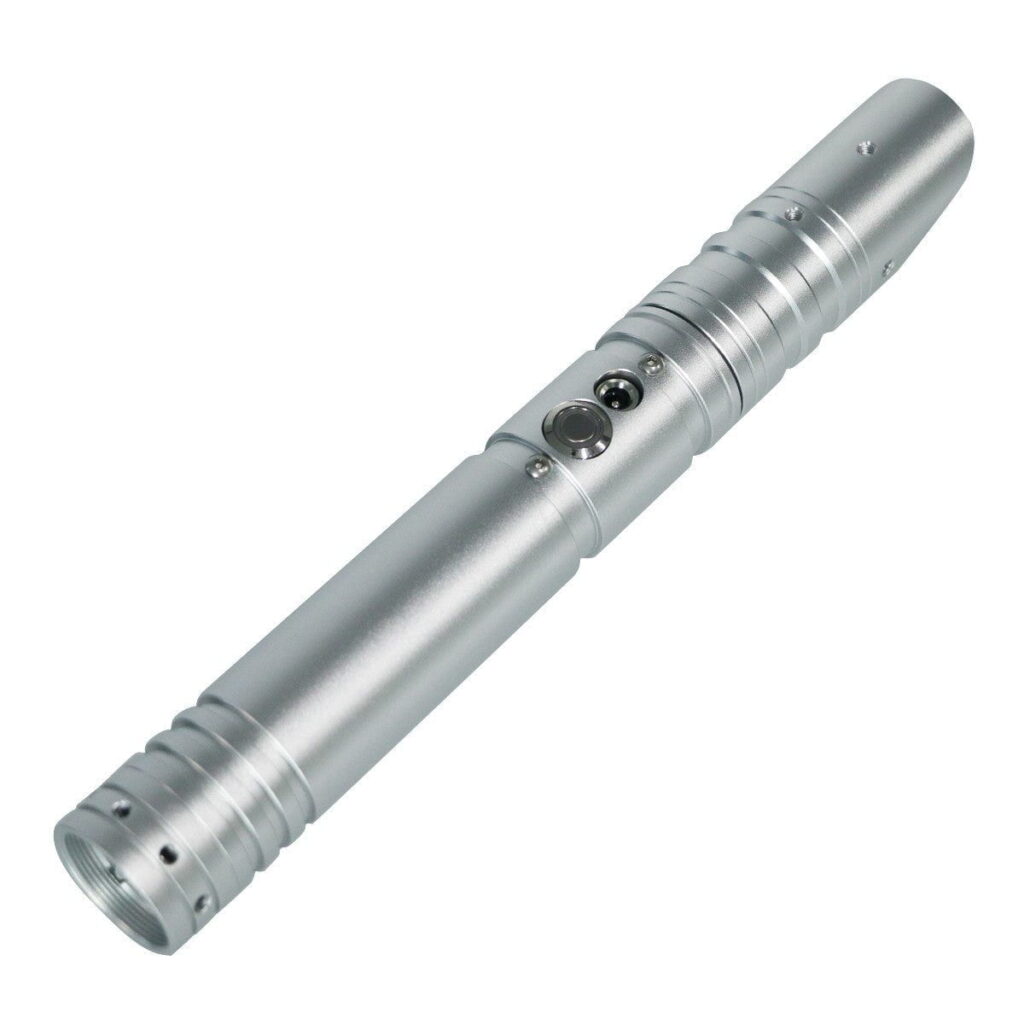
Colour is where buyers overthink it. Every lit hilt sold today runs the full range from a controller menu, so blue and green are two settings on one weapon rather than two separate purchases.
That leaves one decision that actually matters, and it is about the blade rather than the body. A baselit saber holds a single high-power emitter in the hilt and lights a hollow tube, which suits a close-quarters hilt like this because the weight stays where your hands are.
Our own plain silver body is the closest thing we stock to this design, and it ships with the full colour range rather than a fixed one.
FAQ
Q1: What colour is Ki-Adi-Mundi’s lightsaber?
A: Blue in almost every appearance, including all of The Clone Wars and the Mygeeto sequence. One shot in Attack of the Clones shows green, and that shot is the reason he is said to have two crystals.
Q2: Why does Ki-Adi-Mundi have two kyber crystals?
A: Because a green blade appears in one frame of Attack of the Clones by mistake. Lucasfilm turned the error into canon by establishing that the hilt holds a blue crystal and a green one, so either colour is a legitimate output.
Q3: Is it true his two brains let him use two crystals?
A: That part is fan reasoning, not stated canon. Cereans do have a binary brain and the two-crystal fact is sourced, but the connection between them is a reading rather than something the reference material says.
Q4: How long is the hilt?
A: About 26.6 cm, or roughly ten and a half inches, from pommel to emitter. That is short next to most Council members’ weapons and it sits inside the hand rather than extending past it.
Q5: What is the hilt made of?
A: Durlasteel, left plain. There is no plating, no gold, no leather wrap and no coloured anodising anywhere on the body, which is what makes it read as a tool rather than a trophy.
Q6: Why does it look like Aayla Secura’s saber?
A: Because the films reused a shared body design. Fans call it the clan hilt, and Aayla Secura and Saesee Tiin carry near-identical versions in the same films, all plain and all short.
Q7: Does the saber appear in The Phantom Menace?
A: Yes, but only on his belt. It never ignites in that film, and the first lit appearance is in Attack of the Clones.
Q8: What happened to the saber after Order 66?
A: It was taken as a trophy by Vice Chairman Anolo, stolen by Greedo, refused by Jabba the Hutt, and bought by the collector Dok-Ondar, who keeps it in the Den of Antiquities on Batuu.
Q9: Was the blade ever purple?
A: In earlier comics, while he was still a Jedi Knight, yes. Blue is the colour of the Master-era saber that the films establish, and purple belongs to the older print continuity.
Q10: Can I buy a saber with two crystals?
A: Not literally, because a replica runs one emitter or one strip. What you can buy is a hilt that can produce both colours from the same controller, which is the practical version of the same idea.
Q11: What should I check first on a replica?
A: The body. Look for plain silver, machined rings on the upper half, and a length that stays inside the hand. Colour is a menu setting and can be changed after the fact, so it should never be the deciding factor.
Q12: Does the plain design make it worse for duelling?
A: No, and it may be better. With nothing protruding from the emitter and nothing to catch on a glove, the hilt is easier to rotate in the hand, which is the whole reason a short plain body was chosen.
Conclusion
This is a weapon whose history outgrew its design. The object was built as twenty-six centimetres of plain metal, and the stories around it added two crystals, a continuity scandal, four owners and a museum shelf.
If you are choosing a replica, the useful conclusion runs the other way. Buy the body, because the body is the part that carries the character, and treat the colour as a setting you can change on any evening you like.
For the wider timeline of who carried what and when, our reference on judging screen accuracy sets out the checks we use on every hilt we look at.
ISABER Double Bladed Lightsaber — RGB Baselit / Xenopixel Staff Saber
Accessories / RGB & Baselit Lightsabers