
Past the entry tier, the electronics stop being what you pay for — the hilt does. Roughly 60% of a high-end saber’s cost sits in machining and hand assembly, and the markers are measurable: wall thickness at the emitter, a core that slides out, and threads cut to hold.
Above a certain price the parts list stops explaining anything. Two sabers can carry the same board, the same blade and the same cell and still differ by several hundred dollars.
The difference is labour. A hilt is not extruded and painted. It is cut, threaded, finished, anodised and assembled, and every one of those operations is a person’s time.
This page sets out where the money actually goes at the high end, gives the numbers behind each claim, and lists the markers a buyer can verify from a product page or a photograph.
What’s on This Page
- Where the Money Actually Goes
- Why the Board Stopped Being the Expensive Part
- Machining — Why the Hilt Is the Expensive Half
- The Quality Markers You Can Actually Check
- Emitter and Pommel — What Removable Buys You
- A Serviceable Core Predicts Everything Else
- Threads, Concentricity and Multi-Piece Bodies
- Wall Thickness and the Weight Question
- When a High-End Saber Is Worth It
- Frequently Asked Questions
Where the Money Actually Goes
Roughly 60% of a high-end saber’s cost is the hilt — its machining, finishing and hand assembly — and roughly 40% is the electronics and blade together. That ratio is the reverse of the entry tier, where the board dominates and the hilt is a thin shell.
Buyer’s guides that break the budget down keep arriving at the same split: about six parts hilt craftsmanship to four parts electronics once you leave the budget tier.
The reason is not that the hilt contains better metal. It is that the hilt contains more hours.
Read the two bars as a single budget. The electronics are a fixed, catalogue-priced component; everything left over is the work of making a specific metal object by hand.
Why the Board Stopped Being the Expensive Part
A soundboard is a small production circuit board, made in volume at a stable price. Enthusiast-tier boards land in a band of roughly $45–120 and stay there. What varies above that band is not the board but the hilt.
This is the part of the market that changed most in recent years. The premium boards are no longer scarce, and scarcity was what used to justify the old premiums.
The board still decides how the saber behaves. Motion sensing, swing response, blade effects and sound depth all come from it, and the difference between a good board and a basic one is obvious in the hand.
But behaviour is not cost. Two builds using the same board and the same blade can differ by hundreds, and the board’s share of that gap is roughly a hundred dollars at most.
The blade behaves the same way. A densely populated pixel blade roughly doubles the electronics budget, because it is hundreds of emitters plus the wiring to address them — but it is still a manufactured assembly with a known price.
What is left is labour. That is the half of the budget with no catalogue, and it is the half that separates the tiers.
Machining — Why the Hilt Is the Expensive Half
A machined hilt is measured in operations rather than materials. A documented ten-unit run came to about 141 hours of build labour, roughly 140 hand-cut parts, and around 620 drilled holes with 620 hand-tapped threads. Every one of those is a person’s time.
That is the mechanism behind the price curve. It is also why two hilts of the same mass and material can differ enormously in cost.
Labour replaces material as the main cost. At the high end, the aluminium in a hilt is a small fraction of what the hilt sells for; the machining, masking, buffing and finishing are the rest.
The operations that add the most time are the ones that cannot be automated away at low volume: weathering, acid etching, battle scarring and hand-buffed relief are each described by makers as heavily labour-intensive, and finish work alone can add a week or more to a build.
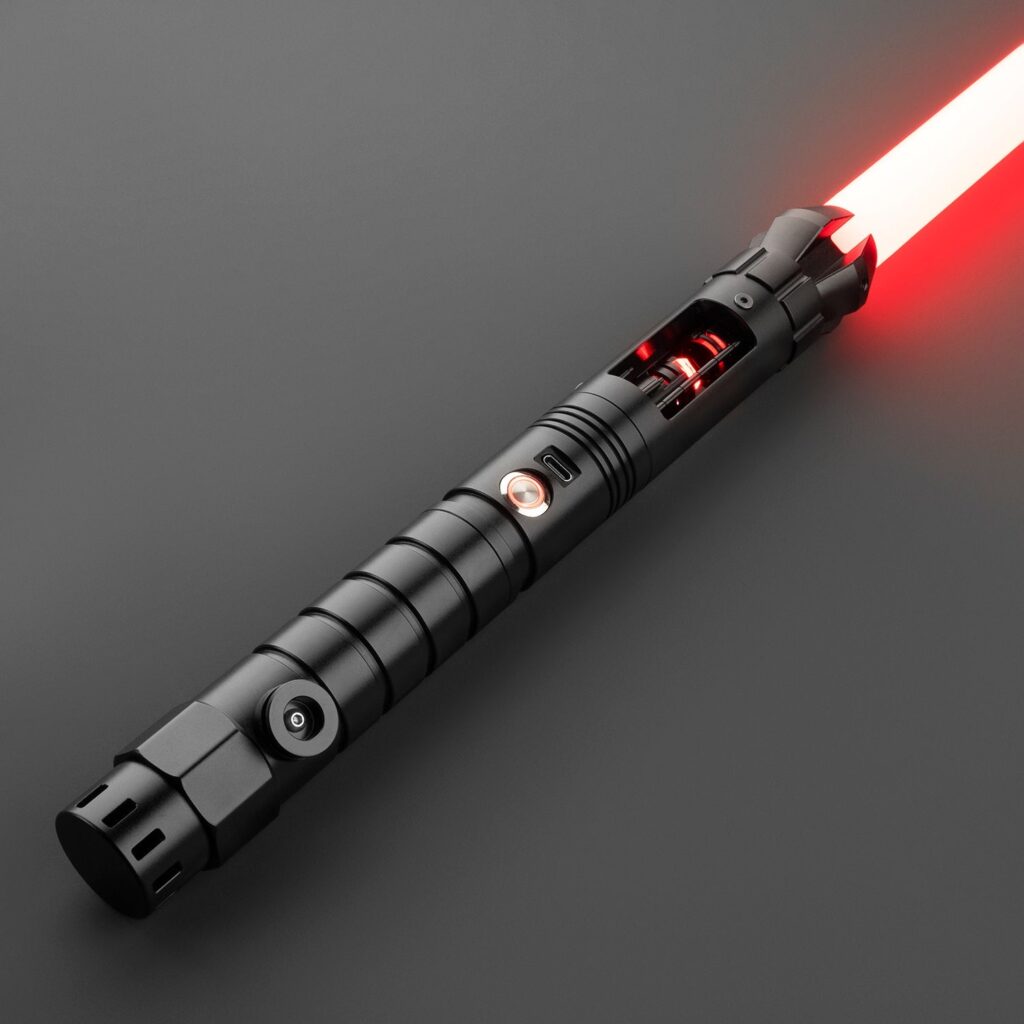
Higher-end hilts also use wax casting, brass relief engraving and multi-piece modular architecture, all of which require hand masking and hand buffing rather than a single program run.
The consequence for a buyer is that price is a labour signal, not a materials signal. A hilt can be solid aluminium and still be cheap, because aluminium is not where the cost lives.
The Quality Markers You Can Actually Check
Six markers separate a genuinely high-end hilt from a dressed-up entry saber, and all six can be checked from a specification line or a photograph: wall thickness at the emitter, a removable emitter, a removable pommel, a core that slides out, concentric threads, and an anodised rather than painted finish.
None of these require the saber to be in your hand. That is the point of the list.
| Marker | What to look for | What it predicts |
|---|---|---|
| Wall thickness | Stated, or visible in a section photo | Whether the hilt dents or survives contact |
| Removable emitter | Threaded, not pinned or glued | A hilt built as a system, not a tube |
| Removable pommel | Unscrews to open the body | Access to the core without cutting |
| Serviceable core | Electronics leave as one module | Repairability and future upgrades |
| Concentric threads | Blade sits straight in photos | Machining tolerance, not just finish |
| Anodised finish | Colour is part of the metal | Wear resistance at high points |
Read the table down the right-hand column. Every marker predicts something about the saber after you own it, not about how it looks in a listing shot.
A cutaway of a two-piece hilt. Every labelled point is one of the six markers in the table above, and every one of them is visible in a specification line or a product photograph — which is the reason the list is worth keeping.
Emitter and Pommel — What Removable Buys You
A removable emitter and pommel are the clearest signal that a hilt was engineered as a system, because both depend on a machined thread accurate enough to align when tightened. On modular hilts the standard emitter bore is 1 inch inside diameter, with a less common 7/8 inch for thin blades.
The emitter bore is the number worth knowing first, because it decides which blades will fit and which will not.
A threaded emitter is also a service point. It lets a damaged emitter be replaced on its own instead of condemning the whole hilt, and it lets a build change appearance without buying a new body.
On many designs the pommel doubles as the speaker enclosure, which is why it is threaded rather than pressed in: a resonator that cannot be opened cannot be serviced.
Tool-free modular systems take this further. Some hilt families accept interchangeable emitters, pommels and grip sections from a shared thread standard, so a buyer can change the character of a saber without touching the electronics.
Where a hilt has only a removable pommel and a pinned emitter, that is worth knowing too. It is not a defect, but it limits how much of the saber can be reworked later.
A Serviceable Core Predicts Everything Else
If the electronics slide out as a single module, the saber can be repaired, upgraded and re-bladed. If they are soldered into the tube, one dead cell can end the saber. Serviceability is the best single predictor of what a hilt is worth after the first year.
This is the marker most often missing from a specification list, and the one that matters most over the life of the saber.
A removable core usually means a chassis — a machined or printed frame that holds the board, the cell and the speaker as one rigid unit that slides into the body.
That design costs more to produce, because the chassis has to be machined to fit the inside of the hilt, and the inside of the hilt has to be machined to receive it.
It repays the cost the first time something fails. A cell is a consumable; a wire joint is a wear point; a board can be replaced with a better one years later without buying a new saber.
The practical test is a question. Can the electronics be removed without desoldering anything? If the answer is yes, the hilt was designed to be kept.
Threads, Concentricity and Multi-Piece Bodies
A hilt assembled from threaded sections needs those threads to be concentric, not merely present, because a small angular error at the joint compounds along the body. Concentricity is a machining tolerance rather than a finish, and it is where inexpensive hilts show up first.
Threads are the most quietly expensive feature of a hilt, because they are the hardest thing on it to get right at low volume.
A thread has to do two jobs at once: hold the sections together under load, and return the section to the same rotational position every time it is tightened, so a pattern that spans two pieces still lines up.
That is why the internal dimensions of a premium hilt are usually tighter than they need to be for strength alone. The tolerance is there for alignment.
Aluminium makes this harder rather than easier, because aluminium threads strip and gall sooner than steel at the same size and depth — which is why hulls that rely on a thread for a structural joint use deeper engagement or a steel insert.
O-rings are the other half of the story. Where a joint has to stay sealed against dust and moisture, a machined groove and a ring do it without a thread having to be tight enough to seal on its own.
Wall Thickness and the Weight Question
The near-universal outer dimension for a two-piece hilt is 1.5 inches. Inside that envelope wall thickness is a straight trade: a 0.25 inch wall is very strong but leaves no room for electronics, while a 0.125 inch wall opens a bore of about 1.25 inches.
The trade is not a quality ranking. A thick-walled hilt and a thin-walled hilt are built for different jobs.
Balance matters more than total mass. A saber is swung one-handed at the end of an arm, so where the weight sits changes how it handles far more than how much of it there is.
That is why a heavier hilt is not automatically a better one. A well-balanced saber in the middle of the weight range usually feels more expensive than a heavy one that is nose-heavy.
The pommel is where balance is tuned. Because it sits at the far end of the lever, small changes in pommel mass and length swing the centre of gravity appreciably, which is one reason threaded pommels come in more than one weight.
When a High-End Saber Is Worth It
A high-end saber is worth its price when the extra money buys serviceability, alignment, a replaceable blade and a core you can repair. It is the wrong purchase if your goal is to survive tournament contact on a budget, because that is a different specification and a lighter bill.
The honest version of this argument separates what you get from what you might assume you get.
What you get is longevity. Threads that stay concentric, an emitter you can replace, a core that slides out and a finish that is part of the metal — all four extend the saber’s working life rather than its specifications.
What you do not automatically get is toughness. A dense pixel blade is designed for a uniform, scrolling light rather than for impact, and a thin-walled display hilt is not a duelling hilt.
Resale is a further caution. Limited editions and official replica lines can hold a large share of their value, but a custom build generally depreciates once used. Its price is best treated as the cost of owning it, not holding it.
Time is the last factor, and the least visible. High-end custom work has been quoted at build times measured in weeks per hilt, which is a real part of the price even though it never appears on a specification sheet.
For the surrounding references, the site covers collector-grade saber construction, the parts and cost of a custom build, and what each soundboard actually does.
Starkiller Lightsaber — Xenopixel V3 / Proffie 2.2 Exposed Crystal Replica
Proffie Lightsabers / Replica Lightsabers
Frequently Asked Questions
Q1: What makes a lightsaber high end?
A: The hilt, not the electronics. Roughly 60% of a high-end saber’s cost sits in machining and hand assembly, and the markers are measurable: a stated wall thickness, a threaded emitter, a removable pommel, a core that slides out, concentric threads, and an anodised rather than painted finish.
Q2: Why are expensive lightsabers so expensive?
A: Because a machined hilt is measured in operations, and each operation is a person’s time. A documented ten-unit run came to about 141 hours of build labour, roughly 140 hand-cut parts, and about 620 drilled holes with 620 hand-tapped threads. Aluminium is cheap; the hours are not.
Q3: How much of a lightsaber’s cost is the hilt?
A: At the high end, roughly 60%, against about 40% for the electronics and blade combined. The ratio inverts at the budget tier, where the board is the largest single line item and the hilt is a thin shell.
Q4: Does a high-end lightsaber have better electronics?
A: It has electronics from the same band as any enthusiast build — boards run roughly $45–120, and a dense pixel blade roughly doubles that. Behaviour improves with the board, but the board is a catalogue part with a stable price, so it explains little of a premium saber’s cost.
Q5: Is a high-end lightsaber worth it?
A: If you want a saber you can keep, yes. The money buys a core that can be removed, an emitter and pommel that can be replaced, threads that hold alignment, and a finish that is part of the metal. If you want a saber to absorb contact, a lighter build is the better answer.
Q6: What should I check on a high-end lightsaber before buying?
A: Six things: the wall thickness, whether the emitter is threaded rather than pinned, whether the pommel unscrews, whether the electronics leave as one module, whether the blade sits straight in photos, and whether the finish is anodised rather than painted. All six show in a spec line or a product photo.
Q7: What is MHS compatibility on a lightsaber?
A: A shared thread standard that lets emitters, pommels and grip sections from the same system be swapped without machining. It marks a modular design rather than a single spec, and it is what lets a hilt’s character change without touching the electronics.
Q8: Are high-end lightsabers good for dueling?
A: Not automatically. Premium builds are often optimised for uniform, scrolling blade light rather than impact, and a thin-walled display hilt is not a duelling hilt. One meant to be used will say so, with a stated wall thickness and a blade specified for contact.
Q9: Do custom lightsabers hold their value?
A: Usually not to the same degree as limited editions and official replica lines, which can retain a large share of their price. A custom build generally depreciates once used, so its price is better treated as the cost of owning it than as an investment.
Q10: What wall thickness should a lightsaber hilt have?
A: It depends on the job. A 0.25 inch wall is very strong but leaves no room for electronics; a 0.125 inch wall opens a bore of about 1.25 inches, enough for a core. Most two-piece hilts sit at 1.5 inches outside diameter, and the wall follows from what has to fit.
Related reading on this site: the three systems every saber is built from, hilt anatomy and choke points, and what makes a saber survive contact.