
Darth Bane’s lightsaber exists in two incompatible shapes across the record. In the novels it is described as a curved duelling hilt with a ruby synthetic crystal; in the comic art and in current canon it is drawn as a straight hilt, with the blade colour also shifting between sources. The disagreement is not a memory failure, and it never resolved.
Ask two people what Bane’s saber looks like and you get two different weapons. Both of them have a document behind them.
The split follows a known fault line. The novels describe one object in prose; the comic art and the later television-era material draw a different one, and the drawings do not agree with the text or with each other.
This page sets out each source in turn, says what it actually shows, and marks the points where the record contradicts itself rather than picking a winner.
What’s on This Page
- Why the Record Is Split
- The Novels’ Hilt: Curved, and Not a Literal Hook
- Where the Curve Came From
- What the Art Actually Shows
- The Canon Design Is Straight
- The Crystal and the Colour Problem
- The Spear That Was Drawn and Never Used
- What the Hilt Was For
- What a Replica Gets Right
- Frequently Asked Questions
Why the Record Is Split
The split has two causes that are easy to confuse. One is the reset of what counted as official in 2014, which set the older stories aside. The other, and the more awkward one, is that the older stories themselves never agreed: the texts describe a curved hilt while the commissioned artwork drew a straight one.
Start with the second cause, because it predates the first and it is the one people miss.
Bane first appeared in a comic, and the covers for those comics were drawn by a series of independent artists. They drew straight hilts, and they did not agree on the blade colour either.
The novels came alongside the comics and described something else. In prose, Bane’s weapon is a curved duelling saber, which is a different object from the straight hilts on the covers of the same era.
Then the 2014 reset added a third layer by separating the prose from the current continuity entirely.
| Source | What it shows |
|---|---|
| The novels | A curved duelling hilt, described in text |
| The comic covers | Straight hilts, drawn by independent artists |
| Current canon | A straight, Chinese-inspired hilt |
So the record contains both shapes from the very beginning, and the later reset only widened a gap that was already there.
The Novels’ Hilt: Curved, and Not a Literal Hook
The novels describe a curved-hilt duelling saber fitted with a ruby synthetic crystal. The text and a companion short story call it “hook-handled”, but the author later clarified that the shape is like a curved duelling hilt rather than a literal hook.
That clarification is the single most useful thing to know about the design, because the nickname has misled a lot of people.
A literal hook would mean a handle bent back on itself like an umbrella grip. The actual description is a gentle curve, the same family of shape as other curved duelling hilts in the fiction.
“Hook-handled” is shorthand, not a blueprint. Read it as a curve that leans the blade off the arm’s line, and the rest of the design follows.
The geometry, reduced to the part that matters. A curved handle rotates the blade off the line your arm is travelling, which is the whole reason the design exists. It is a lean, not a bend.
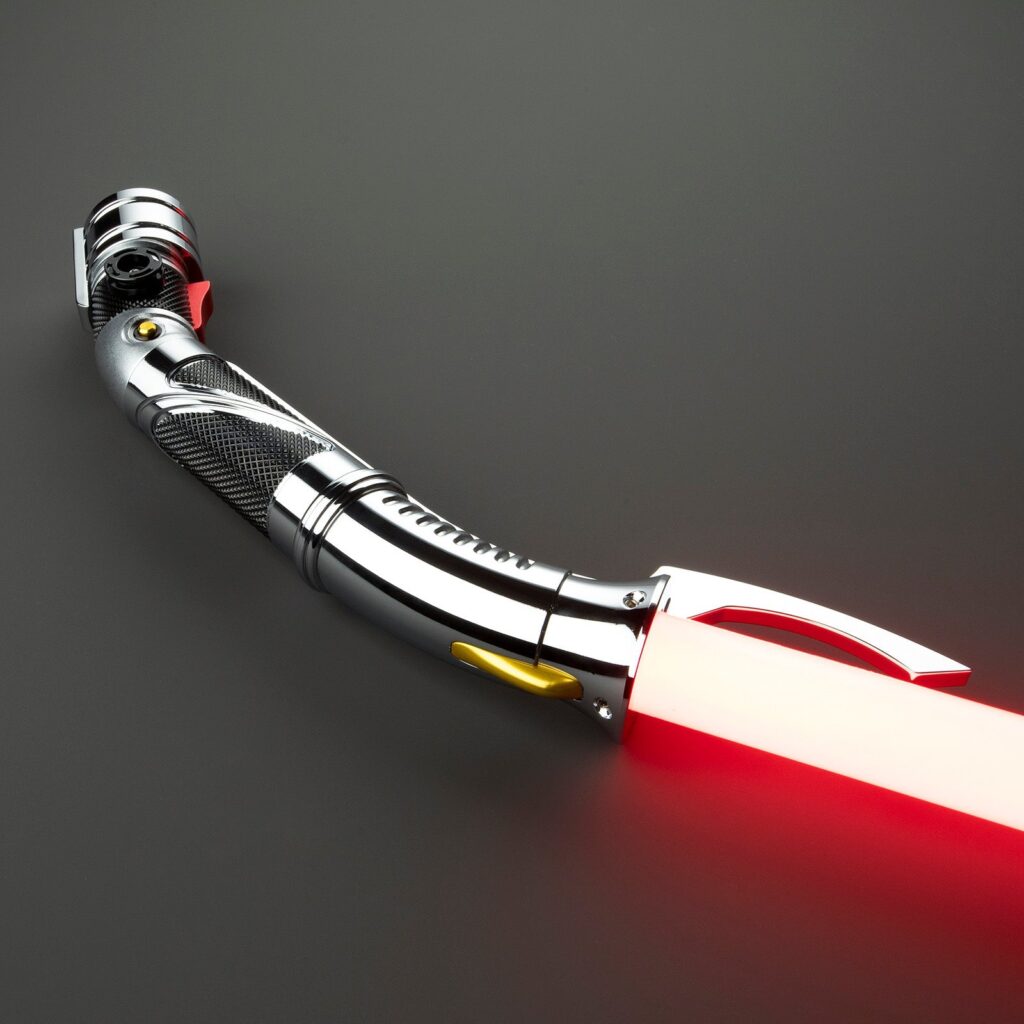
The crystal inside it is a synthetic ruby, which the text associates with a red blade, and the colour is a property of how the crystal was made rather than where it was found.
Where the Curve Came From
The curved hilt was not built for Bane in the first place. The novels give it a lineage: a weapon built by an earlier figure named Na’daz, rebuilt by his student Kas’im, and then built again by Bane himself after studying Kas’im’s version.
The novels hand the design down explicitly, which fixes the curve as a mark of a fighting school rather than a personal choice.
The earliest of the three is Na’daz’s, described as forged by him and kept until his death. It then passes to his student.
The middle hilt is Kas’im’s, and it is the direct ancestor. He reworks the curve, and this is the weapon Bane receives at the academy, after defeating a rival in a duel.
The third is Bane’s own build, following the second. So the hilt is the third in a line rather than a fresh design.
| Step | Whose hilt | What changed |
|---|---|---|
| First | Built by Na’daz | The original curved weapon, kept until his death |
| Second | Rebuilt by Kas’im | The curve reworked; the version Bane takes |
| Third | Built by Bane | His own build, following the second |
The lineage also explains why the curve matters to the character. It arrives as a blademaster’s weapon, handed over as the mark of a school, and Bane’s fighting style is shaped around it rather than the other way round.
What the Art Actually Shows
The comics in which Bane originated were covered by a series of independent artists, and those covers show straight, standard hilts rather than the curve the novels describe. The blade colour on those covers varies too, appearing in both purple and red.
This is the source of the straight-hilt version people remember, and it is a genuine depiction rather than an error.
Comic cover art in that period was frequently produced by artists working from a brief rather than from a finished design, and covers of the same character could differ noticeably between issues.
The result is that the earliest visual record of Bane’s weapon is inconsistent by construction. A reader who formed their picture from the covers would come away with a straight hilt, and a reader who formed it from the prose would come away with a curve.
The covers also disagree on colour, showing both purple and red across different issues, which is worth remembering before treating any single cover as the answer.
The Canon Design Is Straight
In the material that stands today, Bane’s hilt is drawn straight and described as Chinese-inspired. The curved version belongs to the older prose line, and the two are separate designs rather than one design drawn twice.
That is the fact most often got backwards, and it is worth stating plainly: the modern design is the straight one.
It appears in the visual material produced for the current continuity, including character-and-weapon artwork, rather than being drawn from the novels.
The curved hilt is the older line’s weapon, not the current one. Anyone treating the curve as the “real” design and the straight hilt as an early mistake has the order reversed.
| Feature | Older prose line | Current canon |
|---|---|---|
| Hilt | Curved duelling grip | Straight |
| Style note | A lean, not a hook | Chinese-inspired |
| Blade | Red, synthetic ruby | Red |
Both are official within their own material. The useful question is not which one is correct but which one a given replica is reproducing, because a maker can only build one of them.
The Crystal and the Colour Problem
The novels give the weapon a synthetic ruby crystal, which points to a red blade from the physics rather than from convention. The comic covers complicate that by showing purple as well, so the colour is a second axis on which the record disagrees with itself.
A synthetic crystal is a specific thing in the fiction, made rather than found, and its colour follows from how it was made.
Ruby means red, which is the tidy answer, and it is the colour the current material uses as well. The complication is the covers, which are not consistent with each other.
So there are two separate disagreements in the record: hilt shape, and blade colour. They do not line up neatly with each other.
| Source | Hilt | Blade |
|---|---|---|
| The novels | Curved | Red, via the ruby crystal |
| Comic covers | Straight | Purple or red, varying |
| Current canon | Straight | Red |
Red is the reading that spans the most sources, which is why a modern replica will show it, with the comic-art purple preserved rather than dropped.
The Spear That Was Drawn and Never Used
Among the designs produced for the animated material is a spear-like weapon that was drawn for Bane and then left unused. The character is not shown carrying a lightsaber on his belt in that appearance, which is why the weapon design had to be considered at all.
Designs are drawn for scenes that are later cut, and this is one of them.
It is a design document rather than a weapon he used. It records what was considered at the time, and treating it as an established version of his saber would be a category error.
| Design | Status |
|---|---|
| Novel curved hilt | Established in the older prose line |
| Comic straight hilt | Official cover art, drawn inconsistently |
| Canon straight hilt | Established in the current line |
| Spear configuration | Drawn, never used |
Keep the unused design out of any heading that claims he carried it. It belongs in the production history, not in the weapon’s specifications.
What the Hilt Was For
In the older prose line Bane fights in a form built on power and blade contact rather than speed and reach. A curved hilt suits that because it lets the wrist drive the blade through a contact rather than outrun it. The straight canon design does not carry that reading, because it was drawn for a different purpose.
This is the reason the curve persists across the old designs, and it is also why the newer straight hilt reads as a different weapon.
A heavy form needs a grip that recruits the wrist. A straight hilt hands the blade to the arm; a curved one hands part of it to the wrist, which is where the leverage in this style comes from.
The same logic shows up on real curved handles, built for control in a bind rather than for thrusting in a line.
| What a curved hilt does | Why it suits the form |
|---|---|
| Tilts the blade off the arm | Presents an edge angle without changing the stance |
| Seats into the palm | Adds the wrist to a power-driven strike |
| Shortens the effective reach | Less of a cost when the plan is to close, not to hold distance |
The cost is reach, and the design accepts it. A curve that wins in a bind gives up some of the range a straight hilt would hold, which is a fair trade only for a fighter who intends to be inside it anyway.
What a Replica Gets Right
A replica is either curved or straight, and that single choice decides which design it is copying. Curved matches the older prose line; straight matches the comic art and the current canon. There is no third option and no version that is both.
Judge a replica against the version it claims, and the disagreement above stops being a problem.
Ask the maker which version they are building. Both answers are defensible and each is wrong for the other one’s specification.
Then check the geometry that matters. A curved hilt should lean rather than bend back on itself, because the hook is a shorthand and not a blueprint. A straight hilt should be plain and slightly Chinese-inspired if it is following the canon material.
| Check | Curved build | Straight build |
|---|---|---|
| Matches | The older prose line | The comic art and current canon |
| Grip | A gentle lean, not a literal hook | Plain and uncurved |
| Blade colour | Red, and purple on some cover art | Red |
| Socket | One inch, so standard blades fit | One inch, so standard blades fit |
For a display piece, decide which silhouette you actually picture. A curved build suits someone whose image of the character came from the novels; a straight build suits someone who came to him through the comics or the current material.
Either way, treat the blade colour as a second decision rather than a fixed one, because the record does not fix it.
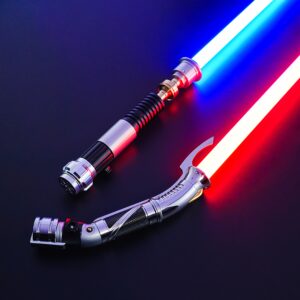
Count Dooku Lightsaber - Xenopixel V3 / Proffie 2.2 Curved Hilt Replica
Character Lightsabers / Proffie Lightsabers
Frequently Asked Questions
Q1: Is Darth Bane’s lightsaber curved or straight?
A: It depends on the source. The novels describe a curved duelling hilt, while the comic covers of the same era drew straight hilts, and the current canon design is straight and Chinese-inspired. So both shapes are official within their own material, and the curved version belongs to the older prose line.
Q2: What colour is Darth Bane’s lightsaber?
A: Red in the novels, from a synthetic ruby crystal, and red in the current material as well. The comic covers complicate this by showing purple on some issues. Red is the reading that spans the most sources, which is why a modern replica will show it.
Q3: Why do some images of his saber look completely different?
A: Because the record was never consistent. The comics were covered by a series of independent artists who drew straight hilts, the novels described a curve, and the reset of official material in 2014 separated the prose from the current continuity. Three layers, and no single design was ever settled.
Q4: What is a hook hilt?
A: A nickname from the novels and a companion short story, and a slightly misleading one. The author later clarified that the shape is a curved duelling hilt rather than a literal umbrella-style hook. Read it as a lean that tilts the blade off the arm’s line, not as a handle bent back on itself.
Q5: Did he use a lightsaber spear?
A: No. A spear-like weapon was designed for the animated material and then left unused. The character is not shown carrying a saber on his belt in that appearance, which is why the weapon had to be designed at all. The spear is a production document, not a weapon he used.
Q6: Does the curved hilt have a history before Bane?
A: Yes, and the novels give it explicitly. A curved weapon is built by a figure named Na’daz, then rebuilt by Kas’im, and Bane receives that second hilt at the academy before building his own. So his saber is the third in a line rather than a new invention.
Q7: Which version should a replica reproduce?
A: Whichever one the maker claims, and the test is the silhouette. A curved hilt matches the older prose line; a straight hilt matches the comic art and the current canon. Both are defensible for a display piece, as long as the label matches the shape. There is no version that is both.
Q8: Is the crystal natural or synthetic?
A: Synthetic, described as a ruby. A synthetic crystal is made rather than found, and in the fiction its colour follows from how it was made. That is the reason a red blade is the expected result, and it is the colour the current material uses.
Q9: Does the curved hilt make the saber better in a fight?
A: It trades reach for leverage. A curved grip recruits the wrist into a blade contact and presents an edge angle without changing the stance, which suits a form built on power. What it gives up is some of the range a straight hilt holds. That trade only pays for someone who intends to close the distance anyway.
Q10: Why does the design change between sources at all?
A: Because the material was produced at different times for different purposes, and never reconciled. Comic covers were drawn by independent artists working from briefs; the novels described a weapon in prose; the current material designed one to read at a glance. The result is a record with more than one official answer and no final one.