
Aluminum wins on strength per unit weight by roughly 3.7 to 1, and steel wins on strength per unit volume by about 2 to 1. Because a hilt is a weight-bearing object you swing one-handed, the first ratio is the one that decides the material — which is why nearly every hilt is aluminium, and the exceptions are deliberate.
The comparison usually gets settled by the wrong number. Steel is stronger, so steel must be better — except a hilt is not judged by how much load it can carry before it breaks. It is judged by how it behaves in a hand for an hour.
That reframes the question. The useful comparison is not strength against strength; it is strength against weight, thread behaviour, finish, and corrosion.
This page runs all four, gives the numbers, and then names the cases where steel is genuinely the right call.
What’s on This Page
- The Two Metals Side by Side
- Weight — Why a Steel Hilt Is Nearly Three Times Heavier
- Strength per Weight, Not Strength per Volume
- The Thread Problem — Where Aluminum Actually Loses
- Anodising and the Oversize Thread
- Corrosion and Finish
- What Steel Hilts Are Actually For
- Why Aluminum Became the Default
- Frequently Asked Questions
The Two Metals Side by Side
Aluminium runs about 2.70 g/cm³ against steel at about 7.85 g/cm³, so a hilt of identical dimensions is roughly 2.9 times heavier in steel. Aluminium machines faster, anodises into the metal, and needs no coating; steel is stronger per unit volume, takes a thread more reliably, and needs plating or paint to resist rust.
Four properties decide the choice, and they do not all point the same way.
| Property | Aluminium (6061-T6) | Steel (300-series stainless) |
|---|---|---|
| Density | ~2.70 g/cm³ | ~7.85 g/cm³ |
| Yield strength | ~276 MPa (40 ksi) | ~215 MPa (31 ksi) |
| Strength per weight | ~102 MPa·cm³/g | ~27 MPa·cm³/g |
| Machinability | Fast, low tool wear | Slow, gummy, higher tool wear |
| Finish | Anodising, part of the metal | Plating or paint over the surface |
| Corrosion | Oxide layer forms and stays | Stains unless treated |
| Thread holding | Needs depth or an insert | Reliable at shorter depth |
Read the table down, not across. Steel takes the yield-strength row and the thread row. Aluminium takes density, strength per weight, machinability, finish, and corrosion.
Weight — Why a Steel Hilt Is Nearly Three Times Heavier
Because the two metals differ in density by a factor of 2.9, a hilt of identical external dimensions and identical wall thickness swaps about 300 g of aluminium for about 870 g of steel. Nothing about the design changes; only the material does.
Stainless steel is roughly 2.9 times as dense as 6061 aluminium. That single ratio does most of the work in this comparison.
The consequence is handling, not durability. Roughly 300 g is a common weight for a machined aluminium hilt. The same hilt in steel lands near 870 g, which is a different object in the hand.
A saber is swung with one hand at the end of a lever, so every gram in the hilt is multiplied by the length of the arm. Nearly triple the mass makes a fast rotation harder to start and much harder to stop.
Balance shifts too. Because a hilt is mostly a tube, the extra steel mass distributes toward the ends, which is where a hilt is thinnest and the material volume is largest.
Strength per Weight, Not Strength per Volume
By the numbers people usually quote, steel is stronger. By the number that matters here, aluminium wins by about 3.7 to 1 — because 6061-T6 carries roughly 102 MPa per unit of density where 300-series stainless carries roughly 27.
Strength per unit volume is the figure a load-rating table wants. Strength per unit weight is the figure a hand-held object wants.
Divide yield strength by density and aluminium pulls clearly ahead. The 6061-T6 figure sits near 102 MPa·cm³/g; the stainless figure near 27. The gap is not marginal.
Higher grades widen it. A 7000-series aluminium like 7075 in the T6 temper reaches roughly 503 MPa of yield, near 179 MPa·cm³/g — more than six times stainless on the same basis.
Steel wins if you weigh the hilt on a scale and measure how much load it can take in the abstract. Aluminium wins once the load is divided by the mass the arm has to carry through every swing.
The same ratio also separates the aluminium grades from each other. A higher grade widens the gap rather than closing it.
Bar length is yield strength per unit weight on one shared axis, 0 to 180 MPa·cm³/g. Both aluminium grades sit far above stainless; the 7000-series grade sits far above the 6000-series.
The Thread Problem — Where Aluminum Actually Loses
Aluminium’s genuine weakness is not bulk strength. It is that aluminium threads strip, gall, and pull out sooner than steel threads of the same size and depth, so a hilt that relies on a thread to hold a blade or join its sections needs deeper engagement or a steel insert to match steel’s holding power.
This is the one place the strength-per-weight argument does not carry over, and it is worth being precise about why.
A thread fails by shear, not by bending. The load sits on the flanks of a few engaged turns. Those turns are shallow and soft in aluminium compared with steel, so the same thread size gives less holding per millimetre of engagement.
Aluminium also galls. Under load, aluminium-on-aluminium or aluminium-on-steel contact can cold-weld and tear at the surface, so a thread that holds fine the first time can be damaged by the second assembly.
The practical fixes are all about engagement. Cut the thread deeper, run it longer, or put a steel insert into the aluminium so the screw bears against steel rather than aluminium. Any of the three recovers most of the lost holding.
This is why the small precision parts inside a hilt — blade retention screws, section joints, the stud that anchors a belt wheel — are the parts where aluminium’s limits show up first, and where careful hilt design spends its effort.
| Load on a thread | Aluminium fix | Steel equivalent |
|---|---|---|
| Blade retention screw | Two screws, deeper thread | One screw at short depth |
| Section joint (emitter / body / pommel) | Longer thread length | Standard thread length |
| Accessory stud (belt wheel, clip) | Steel insert in the aluminium | Tapped directly |
| Repeated disassembly | Anti-seize, careful torque | Handles reassembly better |
Anti-seize is the quiet fix for galling. A thin film between dissimilar threads stops the cold-welding that tears the surface on reassembly, which is why a thread that binds on the second assembly is often a lubrication problem rather than a machining one.
Anodising and the Oversize Thread
Anodising is an oxide layer grown from the aluminium itself, not a coating on top of it. It thickens the surface by roughly 0.005 to 0.025 mm per face, which shrinks a threaded hole and grows a threaded stud — so threads that must stay accurate are machined oversize, masked, or cut after anodising.
The finish is one of aluminium’s real advantages, but it interacts with the thread problem in a way that is easy to miss.
Anodising converts the surface into aluminium oxide. That is a ceramic, harder than the metal underneath, and because it grows out of the metal it cannot flake off the way paint does.
It also grows. A layer measured in microns per face changes the dimensions of anything threaded, which on a fine thread is enough to bind.
Aluminium oxide is also brittle. On a thread crest, the anodised layer can chip and expose softer metal underneath, which is a second reason threads are often protected rather than anodised.
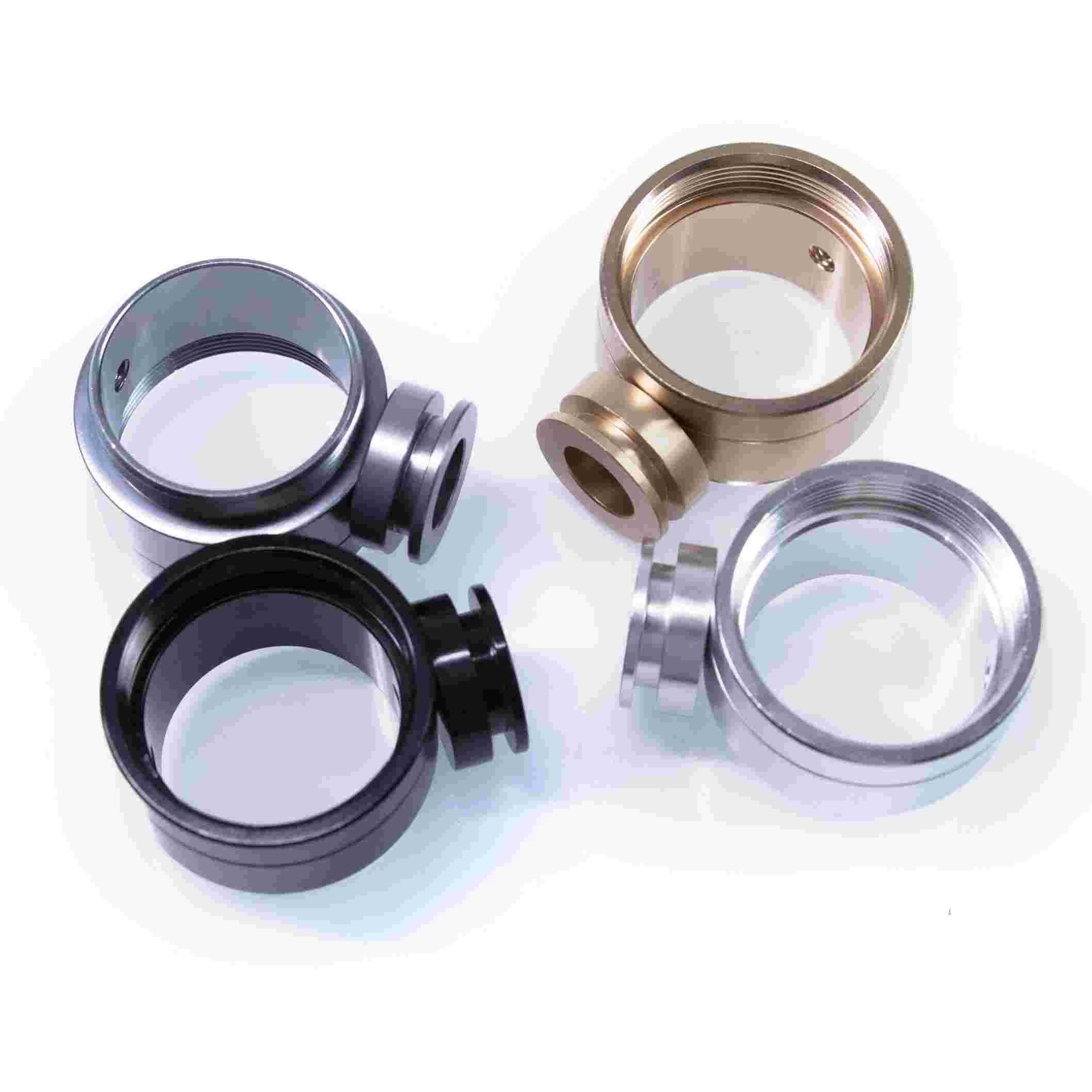
Steel’s equivalent finish behaves differently. Plating and paint sit on the surface rather than growing out of it, so they do not change thread dimensions the same way. They can also wear through and expose the metal, where anodising cannot.
Corrosion and Finish
Aluminium forms its own protective oxide within seconds of being cut, and that layer stays put, so bare aluminium needs no further protection. Steel, including most stainless grades in a humid hand, will stain or spot unless it is plated, painted, or an alloy chosen for the environment.
Corrosion is where the finish argument meets the ownership argument.
Aluminium is self-protecting. The same oxide that anodising thickens forms naturally and instantly, and if it is scratched it re-forms. That is why bare aluminium hilts exist and stay presentable.
A hilt is handled constantly, and hands are moist and slightly acidic. On steel, that is enough to leave marks over months, and the fix is a coating — which can wear through at the edges and high points.
Stainless is a spectrum, not a promise. Grades differ in how well they resist a damp palm, and the ones that machine most easily are not always the ones that resist best. The chromium content does the work.
| Situation | Aluminium | Steel |
|---|---|---|
| Damp hands, daily handling | Oxide re-forms; no action | Spots unless coated |
| Stored in a humid room | Unaffected | Higher grades preferred |
| Scratched in use | Oxide covers the mark | Coating wears through |
| Salt air or coastal use | Unaffected | Grade matters most here |
What Steel Hilts Are Actually For
Steel is the right material for three specific jobs: a hilt whose thin neck must survive hard contact, a replica that is meant to match the mass of a heavier prop, and any joint where a thread has to hold at short depth. Outside those three, the weight is a cost with no matching benefit.
Steel is not a worse material. It is a material with a different set of trade-offs, and it repays the weight in three situations.
First, thin necks. A hilt with a narrow waist concentrates stress at that waist, and a narrow aluminium neck can bend there. Steel tolerates the same profile with margin to spare.
Second, mass. Some replica designs are meant to feel heavy, and steel is the direct route to that. Trying to reach the same heft in aluminium means making the walls thicker, which changes the proportions.
Third, threads under load at short depth. Where a design cannot afford a long thread, steel holds where aluminium would need an insert.
A fourth route sits between the two metals. Some builds use a steel core with aluminium outer sections, or the reverse, so the load-bearing thread runs in steel while the visible body keeps the lighter metal and its anodised colours. It costs more to make and only pays off where one specific joint needs steel holding in a hilt that otherwise has to stay light.
Everything else is aluminium’s ground. Colours, finishes, cost, machinability and handling all favour it, and only those jobs are worth paying the density penalty for.
Why Aluminum Became the Default
Aluminium became the default hilt material because it is the only common metal that lets a maker cut a detailed, colourful, corrosion-proof hilt quickly and cheaply at a weight a person can swing. Steel’s advantage is real but narrow, and the weight penalty applies to every saber rather than a few.
The default was not an accident, and it was not a cost cut. It follows from the four properties together.
Machinability sets the shape. Aluminium cuts fast and takes fine detail with low tool wear, which is what makes ringed, grooved and windowed hilts economic to produce at all.
Anodising sets the colour. Growing the finish out of the metal gives durable colour without a coating that can chip away, and it does so in a range that steel cannot match without paint.
Density sets the feel. The same hilt that would be unwieldy in steel is comfortable in aluminium, which is the property every swing tests.
Steel remains available for the three jobs it does best. It simply is not the material a general-purpose hilt is built from.
For the surrounding references, the site covers collector-grade hilt construction, the anatomy of the three systems, and what makes a saber survive contact.
ISABER Lightsaber Covertec Wheel — CNC Aluminum Belt Clip Button
Accessories / RGB & Baselit Lightsabers
Frequently Asked Questions
Q1: Is aluminum or steel better for a lightsaber hilt?
A: Aluminum, for almost every hilt. It is about 3.7 times stronger per unit of weight and roughly 2.9 times lighter than stainless, machines faster, anodises into the metal, and resists corrosion without a coating. Steel is better only where a thin neck must survive hard contact, where a heavier replica is wanted, or where a thread must hold at short depth.
Q2: Why are lightsaber hilts made of aluminum and not steel?
A: Because a hilt is swung one-handed, and mass at the end of an arm is felt in every movement. Aluminum gives the needed stiffness at roughly a third of the weight, takes anodised colour as part of the metal, and does not need plating against rust. Those advantages apply to every saber; steel’s advantage applies to a few.
Q3: How much heavier is a steel lightsaber hilt?
A: About 2.9 times, for the same dimensions and wall thickness. A hilt that weighs roughly 300 g in aluminum lands near 870 g in steel, because the two metals differ in density by that factor.
Q4: Is steel stronger than aluminum for a hilt?
A: Per unit volume, yes. Common stainless yields around 215 MPa against about 276 MPa for 6061-T6 aluminum — but aluminum is far lighter, so per unit weight aluminum leads by about 3.7 to 1. For a held, swung object the second ratio is the one that matters.
Q5: What are the disadvantages of aluminum in a hilt?
A: Threads. Aluminum strips and galls sooner than steel at the same size and depth, so joints that rely on a thread need deeper engagement, a longer thread, or a steel insert. This shows up first in blade retention screws and section joints.
Q6: What is anodising and does it affect the threads?
A: Anodising grows an oxide layer out of the aluminum itself, adding roughly 0.005 to 0.025 mm per face. That changes threaded dimensions, so a threaded hole tightens and a threaded stud grows. Threads that must stay accurate are machined oversize, masked, or cut after anodising.
Q7: Does a steel hilt rust?
A: Stainless resists rust better than carbon steel but is not immune, especially in a damp hand or humid storage. Aluminum forms its own protective oxide within seconds and re-forms it if scratched, which is why bare aluminum hilts stay presentable without a coating.
Q8: When is a steel lightsaber hilt worth it?
A: Three cases: a thin-necked design that has to take hard contact and would bend in aluminum at that profile; a replica whose weight is part of the point; and a joint where a thread must hold at short depth that aluminum cannot provide without an insert.
Q9: What aluminum alloy are lightsaber hilts made from?
A: Most commonly a 6000-series alloy in a T6 temper, such as 6061-T6, because it machines cleanly and anodises well. Higher grades like 7075 in the same temper are stronger, reaching roughly six times stainless on strength per weight, but are harder to machine and anodise.
Q10: Can a steel hilt be anodised?
A: No. Anodising works on aluminum and a few other metals that grow a useful oxide layer. Steel is finished by plating or paint instead, which sits on the surface rather than becoming part of it, so it can wear through at edges and high points.
Related reading on this site: the full hilt anatomy reference, the two light-source architectures, and the complete blade reference.