
A Kylo Ren costume is four layers worn over a base, and the layer that decides whether the build reads is the cowl, because it is the only part of the outfit that is not black fabric like the others.
The rest is a pleated inner tunic, a mid coat with an officer collar, and a sleeveless outer robe that opens below the belt. Each one is a sewing problem rather than a sculpting one, which is why this is a fabric build wearing a hard part.
Most Kylo builds fail in one of two ways. Either the silhouette goes soft because the layers are too thin, or the cowl and cape are made from the wrong cloth and no amount of weathering rescues them.
This page takes the four layers in order, explains what the cowl fabric has to be and why, and then covers the helmet, the belt, and the saber that finishes the look.
What’s on This Page
- The Short Answer: Four Layers and One Signature Element
- The Base: What Nobody Sees
- The Inner Tunic: Where the Pleats Live
- The Mid Coat: The Collar Does the Work
- The Outer Robe: Sleeveless and Open
- The Cowl and Cape: One Fabric or Nothing
- The Belt: Where the Silhouette Starts
- The Helmet: The Hard Part
- Weathering, Heat, and What Actually Fails
- Where the Saber Fits
- FAQ
The Short Answer: Four Layers and One Signature Element
The build is a base of black shirt and trousers, a pleated inner tunic, a mid coat with a short officer-style collar, and a sleeveless floor-length outer robe, with the cowl and cape worn on top and the belt holding the whole black mass together.
That stack is what separates Kylo from a plain black robe. Take any one layer away and the silhouette collapses into a generic dark figure, because the character’s shape comes from depth rather than from detail.
The costume standards for the largest fan groups set the layer order and the proportions, and they are the most useful free reference for a build like this. We have used them for the numbers below, and our page on the five costume families explains where this one sits against robes and armour.
| Layer | What it is | What breaks it |
|---|---|---|
| Base | Black shirt and trousers | Visible gaps at the wrist or ankle |
| Inner tunic | Pleated black fabric, sleeves flaring at the cuff | Pleats that are even, or fewer than about 35 |
| Mid coat | Black wool or twill, short officer collar | A collar that is too tall and reads as a different character |
| Outer robe | Sleeveless, floor length, open below the belt | Seams that are sewn shut below the belt |
| Cowl and cape | Basketweave or monk’s cloth, one fabric for both | Any smooth fabric at all |
| Belt | Wide black belt, plain rectangular buckle | A buckle that is small, shiny, or decorated |
Read the last column as the thing to get right first. Every one of those failures is cheap to avoid and expensive to hide.
The Base: What Nobody Sees
The base is a plain black shirt and black trousers, and its job is to make sure that no skin or modern clothing shows through at the wrist, the neck, or the ankle.
This is the layer people skip, and it is the one that shows up in photographs. A sleeve that ends before the tunic cuff leaves a gap, and a gap reads as costume rather than clothing.
Builders who plan to be in the outfit for hours usually pick a breathable fabric here rather than something heavy, because this layer sits against the skin under everything else and the heat problem starts here.
For a first build we would spend the money on this layer before anything else, since a comfortable base is what lets you wear the other four.
The Inner Tunic: Where the Pleats Live
The inner tunic is matte black fabric pleated in layers, roughly 35 pleats in total across several panels, and the sleeves are fitted through the arm and then flare at the cuff until they hang past the base of the thumb.
The pleats are the tell, because detailed reference builds describe five layers of uneven pleats about half an inch to three quarters of an inch wide, which is the detail that reads as Kylo at close range and as texture at a distance.
The sleeve shape is the second thing people miss. The fabric is close to the arm through the forearm and then opens at the wrist, and the opening is wide enough to cover the back of the hand when the arm hangs, which is why the costume reads as heavy even in a still frame.
Construction is where the time goes, because detailed builds run to about eleven yards of tucks sewn top to bottom for the sleeved layer alone, and anyone planning a build should budget the fabric before they budget the trim.
The closure sits inside the sleeve seam rather than down the front, which keeps the line clean and hides the zip where the arm runs along the body.
The Mid Coat: The Collar Does the Work
The mid coat is a black wool or twill garment with a short standing collar of roughly an inch and a half to two inches, and it ends two to three inches shorter than the outer robe.
The collar height is the detail that keeps this build from drifting into another character. Take it too tall and the silhouette starts reading as a different dark side outfit, so measure it rather than guessing.
The shorter hem matters because it creates a visible step under the outer robe. When the outer layer moves, the mid coat shows at the calf, and that step is what makes the outfit look layered instead of bulky.
Fabric choice is the compromise in this layer, because wool hangs and photographs well but runs warm, and a mid-weight twill is the usual substitute for a convention build where heat is already the main risk.
The Outer Robe: Sleeveless and Open
The outer robe is sleeveless and floor length, hangs from the shoulders, and its front and side seams are deliberately left open below the belt so the layers underneath show through the gap.
The open seams are the design decision that matters most, and they are the one most often sewn shut by accident. A closed robe reads as a long coat, and the layered effect disappears into a single black surface.
Below the belt there are four panels, and the rear panels carry a vertical pleat on each side of the centre. Those pleats give the back of the robe something to catch the light, which is why a Kylo build photographed from behind looks different from a plain cape.
Sleeveless is not a shortcut, because the arms are covered by the pleated tunic, so the outer robe only has to drape, and a sleeveless panel drapes more cleanly than a sleeved one because there is no armhole pulling at it.
The Cowl and Cape: One Fabric or Nothing
The cowl, the hood and the cape are made from the same heavy textured cloth, a basketweave or monk’s cloth of roughly three to eight squares per inch, and that texture is what makes the outfit read as Kylo rather than as a plain dark robe.
The hood has to fit over the helmet, which sets its size, and it is rounded rather than pointed, double layered, with a seam along the front edge and nothing visible across the top.
The cowl gathers heavily at the neck and shoulders, so the fabric sits in folds rather than lying flat, and the cape tapers from the cowl down to a hem that falls below the belt but not below the knee, with the edge left frayed on purpose.
At the higher accuracy levels the cloth is coated or waxed so it keeps a slight sheen while still hanging, which is a detail worth knowing before you buy, since untreated monk’s cloth looks flat under convention lighting.
The order is the costume, and a build that has four of these six reads as a dark robe, because the missing two are the ones the eye was looking for.
The Belt: Where the Silhouette Starts
The belt is a wide black belt in a coated fabric or faux leather with one large plain rectangular buckle, and it is the structural midpoint of the outfit rather than an accessory.
Its job is to divide the black mass, because above it the cowl and robe create a heavy shape and below it the robe opens into panels, so the belt is the line where the costume changes from dense to loose.
The buckle is the detail people get wrong, since Kylo’s is large, flat and plain, while a smaller or shinier one pulls the eye away from the silhouette and makes the build read as costume rather than uniform.
This is also the natural place to hang a saber, and most builders add a clip here rather than carrying the hilt in a hand for a full day.
The Helmet: The Hard Part
The helmet is dark gunmetal or satin black, asymmetric, and crossed by five chrome or silver ridges that contour the eye opening and continue down into the cheek area, with the face itself blacked out behind a sheer fabric.
This is the only sculpting job in the build, and it is the part that decides whether the outfit is recognised instantly. The ridges are what the eye reads at a distance, so a helmet that gets them wrong fails in the first second.
Several routes exist, and the cheaper one is a printed helmet in multiple parts that takes a long print run plus finishing, while a sculpted or cast helmet costs more up front and saves weeks at the bench.
| Route | Up-front cost | Time at the bench | Skill that decides it | Main risk |
|---|---|---|---|---|
| Printed in parts | Lowest | Long print run, then finishing | Filling and sanding seams | Seam lines showing under paint |
| Sculpted by hand | Mid | Weeks | Sculpting and symmetry | The shape drifting away from the reference |
| Cast or bought | Highest | Days | Finishing and fitting | A shell that does not fit your head |
Finishing is where the accuracy comes from, since matte clear coat kills the plastic shine, darkening the cheek chrome and gouging the upper ridges adds the damage the character carries, and lining the cheek holes with black material stops light leaking behind the eyes.
Two practical additions make it wearable, because upholstery foam padding stops it moving on the head and an anti-fog treatment on the lens stops the visor misting once you have been in it for twenty minutes.
Weathering, Heat, and What Actually Fails
Kylo is one of the most forgiving characters to weather, because the look is deliberately unkempt, and one of the hardest to wear, because four layers of wool and heavy cloth trap heat with nowhere to go.
Weathering is where a good build separates from a great one. Thinned brown and grey acrylic on hems and boot toes, sandpaper on the belt and helmet, and a wire brush along the robe edges all read as use rather than as damage, and mistakes look authentic because the character is meant to look rough.
Heat is the honest constraint, because the layers stack up, the cowl sits over everything, and a convention hall in summer turns the outfit into an oven, so builders add hidden snaps so the cowl can come off, carry water, and plan breaks.
Drape is what the whole build hinges on, and if the fabric falls from the shoulders and catches air when you walk, the silhouette is already halfway there, while no amount of trim compensates for cloth that hangs like a curtain.
Body language finishes it, because squared shoulders and a wide stance do more for the impression than any single part of the costume, and that costs nothing.
Where the Saber Fits
Kylo’s saber is a crossguard with three blades, a main blade plus two shorter quillions venting from the sides, and it was built around a cracked crystal that makes the blade unstable rather than clean.
That design is what makes the hilt the strongest accessory for this costume. It has a silhouette of its own, so it reads in a photograph even when the rest of the outfit is in shadow, and the crossguard shape is unmistakable from a distance.
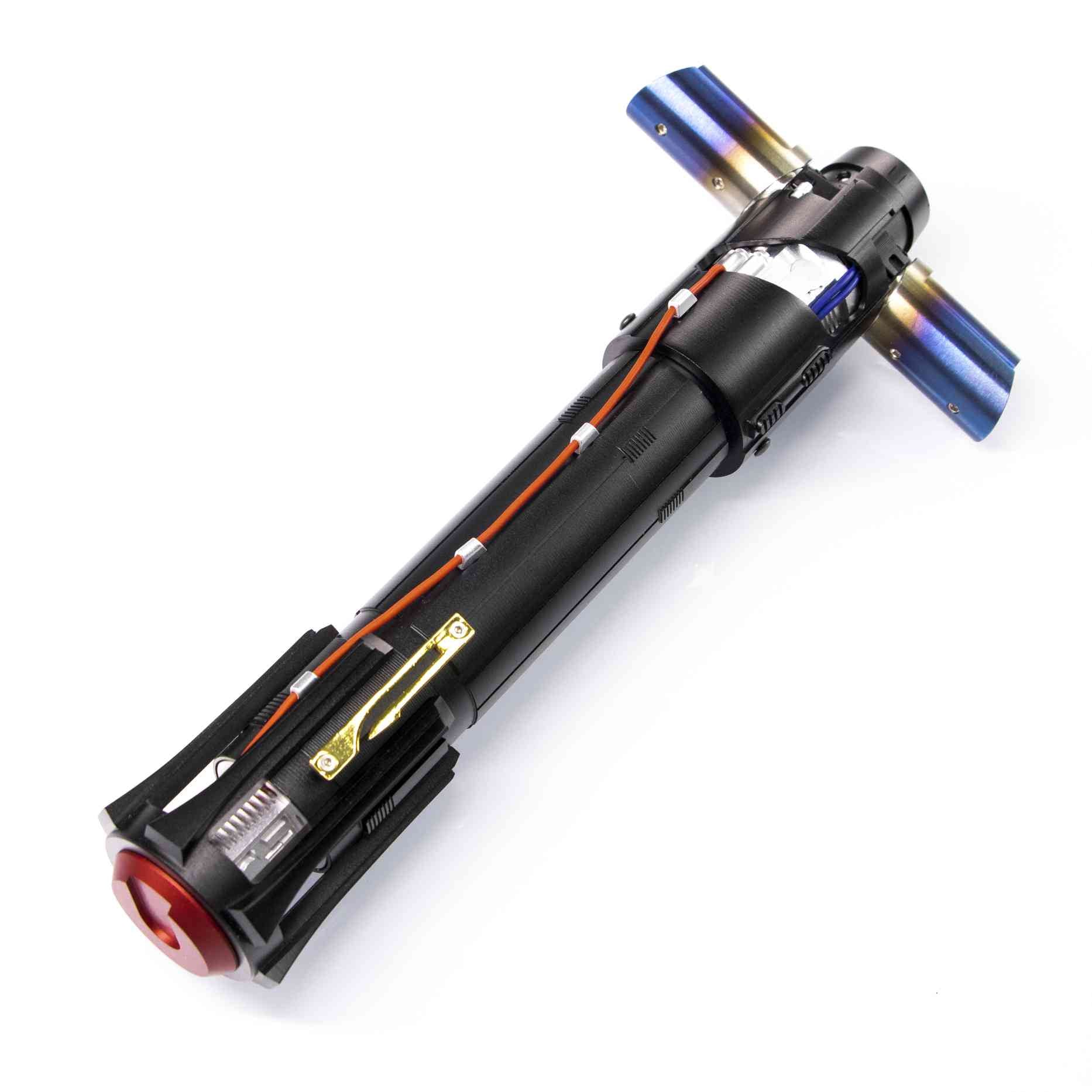
Our version matches the shape rather than the electronics myth. The hilt carries the black body, the exposed wiring detail, and the side quillions, and it ships with a 36 inch duel-grade polycarbonate blade, an 18650 cell, a charger and a hex wrench set.
The crossguard is the one part of a Kylo build you cannot sew, which is why it is worth buying rather than making. For the wider family of crossguard designs, our guide to how a crossguard saber is built covers the emitter geometry.
Kylo Ren Crossguard Lightsaber — Kylo Ren Replica from ISABER
Character Lightsabers / Replica Lightsabers
What a Jedi outfit is made of
The history of the broken blade
Pairing a hilt with a character
Getting a saber into a convention
FAQ
Q1: How many layers does a Kylo Ren costume have?
A: Four worn over a base: a pleated inner tunic, a mid coat with an officer collar, a sleeveless outer robe, and the cowl and cape on top, with a belt holding the shape.
Q2: What fabric is Kylo Ren’s cowl made of?
A: A heavy basketweave or monk’s cloth of roughly three to eight squares per inch, used for the cowl, the hood and the cape together, because the texture is what makes the outfit read correctly.
Q3: Why does the outer robe have open seams below the belt?
A: So the mid coat and tunic show through the gaps, which is what creates the layered look. Sewn-shut seams turn the robe into a long coat and the layers disappear.
Q4: How wide are the pleats on the inner tunic?
A: Reference builds use five layers of uneven pleats about half an inch to three quarters of an inch wide, around 35 pleats in total, which is why the layer takes about eleven yards of fabric.
Q5: Is the Kylo Ren costume hard to make?
A: The fabric part is a long sewing job rather than a hard one, and the helmet is the only sculpting work, so the difficulty sits in volume and in getting the cowl fabric right.
Q6: Can you wear a Kylo Ren costume all day?
A: Most people cannot wear it for a full day without breaks, because four layers plus a heavy cowl trap heat, so builders add hidden snaps to remove the cowl and carry water.
Q7: What makes a Kylo Ren costume look cheap?
A: A smooth cowl fabric, a small or shiny belt buckle, and an unweathered helmet. The first removes the texture the character is built on and the other two flatten the silhouette.
Q8: Does Kylo Ren’s helmet come off in canon?
A: Yes, he removes it more than once, so a costume with a detachable helmet is the accurate choice rather than a compromise, and it also helps with heat.
Q9: What saber does Kylo Ren carry?
A: A crossguard saber with a main blade and two short side quillions that vent from the hilt, built around a cracked crystal that leaves the blade unstable.
Q10: Do I need a saber to complete the costume?
A: No, but the crossguard hilt is the accessory that makes the outfit read as Kylo from a distance, and it is the one part of the build you cannot make from fabric.
Conclusion
Four layers, one cowl, one hard part: the sewing does the volume, the cowl fabric does the character, and the helmet decides whether anyone recognises it across a hall.
Get the drape right before you buy trim, because cloth that falls from the shoulders will carry a basic build and no amount of detailing will rescue cloth that hangs flat.
Then add the hilt, because a crossguard is the fastest way to turn four layers of black into a specific person, and the link above is where we would start.
ISABER Double Bladed Lightsaber — RGB Baselit / Xenopixel Staff Saber
Accessories / RGB & Baselit Lightsabers