
Yes, anyone can pick one up and turn it on. There is no lock that reads your blood. What the films actually gate is not activation but duelling — and the gap between those two things is where almost every answer to this question goes wrong.
The proof is a scene most people have watched a dozen times without noticing what it settles. On an ice planet, a man who has openly called the Force nonsense takes a lightsaber, switches it on, and cuts open a dead animal with it.
He is not Force-sensitive. He is not trained. He does it badly and it works. That single shot answers the question in the affirmative and then raises a harder one.
What’s on This Page
- Can Anyone Use a Lightsaber?
- Is There Anything That Stops the Wrong Person Turning It On?
- Who Used One Without the Force?
- What About Someone Who Is Not Even Organic?
- What About Someone With No Training at All?
- What About Sabine Wren?
- Who Else Has Carried the Darksaber?
- Do You Have to Be Force-Sensitive to Touch the Force?
- So Why Does It Look So Hard in the Films?
- Is the Blade Too Heavy to Swing Without the Force?
- Does the Crystal Refuse to Work for the Wrong Person?
- Is Building One Harder Than Using One?
- Does Any of This Matter If I Am Buying a Replica?
- Is a Replica Dangerous to Hand to Someone Untrained?
- More Common Questions
Can Anyone Use a Lightsaber?
Anyone can switch one on and swing it. Almost nobody can duel with one. Those are three separate questions and only the first has an unconditional yes.
Split the word “use” and the confusion dissolves. Switching on, holding and moving, and fighting another armed person are three different activities with three different barriers.
The first has no barrier at all. The second has a shallow learning curve. The third is where training actually separates people, and it separates them by years rather than by bloodline.
Canon states the limit itself. A Lucasfilm reference volume on lightsabers puts it in one line: only a Force user can use one at its full potential. That is the correct standard, and it is about a ceiling rather than a door.
| What “use” means | Barrier | How long it takes |
|---|---|---|
| Turning it on | None — it is a switch | Seconds |
| Holding and moving it safely | Care, not talent | Minutes to hours |
| Cutting something on purpose | Steady hands | A session |
| Duelling an armed opponent | Years of training | Years |
The Force is a combat advantage, not a permission slip. Nothing in the fiction checks a user’s midichlorian count before the blade ignites.
Is There Anything That Stops the Wrong Person Turning It On?
No. The activation control is a physical switch on the hilt, and it responds to a thumb.
This is the part that settles most of the argument, and it is almost too simple to state. A lightsaber is a device with an on switch. There is no biometric check, no crystal that refuses, no field that reads intent.
Every barrier people imagine turns out to be behavioural rather than mechanical. A person does not use one because they never had one, not because the weapon declined.
That distinction matters because it removes the mysticism from the object without removing it from the people. The saber is a tool that anyone may operate. The tradition around it is what was selective.
Who Used One Without the Force?
On an ice planet in 1980, a smuggler who had called the Force simple tricks and nonsense picked up a lightsaber and cut open a dead tauntaun.
The scene is easy to misremember as a bit of grim comedy. It is also the single cleanest piece of evidence in the franchise, because it was not staged as a demonstration of anything.
He ignites it with one hand, uses it as a blunt tool rather than a weapon, and does the job badly. The blade cuts the carcass open with no ceremony at all.
Then he complains about the smell. The film treats the saber exactly as a person would treat a saw.
That is the answer to the question, filmed decades before people started asking it. The one thing the scene does not show is him fighting anyone with it.
What About Someone Who Is Not Even Organic?
A Separatist general with no Force connection at all collected lightsabers and used them in combat, because he was a machine with four arms.
This is the case that breaks every version of the “only a Jedi can” argument, because he does not merely activate a blade. He duels Jedi Masters with a collection of their colleagues’ weapons and wins several exchanges.
His solution is not the Force. It is four independently controlled limbs, a body that does not tire, and reflexes that were engineered rather than grown.
That is the useful part of the example. It proves the barrier is physical capability, and physical capability can be built as well as trained. The saber itself never objected.
What About Someone With No Training at All?
A scavenger with no instruction picks one up and fights a trained dark-side user with it, and the film treats this as remarkable but not impossible.
The scene is short and it is not a victory. He is outmatched, he is nearly killed, and he is saved rather than triumphant.
But he is holding the blade correctly, swinging it with intent, and surviving long enough for help to arrive — with nothing but nerve and a few seconds of someone else shouting instructions.
That is the low end of the ladder being demonstrated on screen by a main character rather than by a side note. No training, no sensitivity established at that point, and the weapon works.
What About Sabine Wren?
She trained with one for years, never developed much Force talent, and said as much herself.
Her case is the most instructive of the lot because it sits closest to a real person’s situation. She is not a machine and not a prodigy. She is a capable fighter who was handed a legendary weapon and had to work at it.
The training of the Darksaber is treated on screen as an apprenticeship in blade work, not in mysticism. Her instructor’s frustration is about form, stance and grip — the vocabulary of swordplay.
What she does with the Force elsewhere in the story is a separate question, and it stays modest. Her lightsaber skill is not credited to it.
Who Else Has Carried the Darksaber?
A long list of people, most of them not Jedi, and several of them not even on the Jedi’s side.
The weapon passed through the hands of Mandalorian warriors, a crime lord, a Sith apprentice and a foundling raised in a cult. Ownership was settled by conquest or inheritance rather than by any test of sensitivity.
That is worth pausing on. An object treated across the culture as a symbol of leadership is not treated as an object only certain people may hold.
| Wielder | Trained in the Force? | How they got the blade |
|---|---|---|
| A Mandalorian warrior | No | Won it |
| Two Mandalorian heirs | No | Inherited or reclaimed |
| A crime lord | No | Took it |
| A Sith apprentice | Yes | Claimed it |
| A foundling | Some | Won it, then had to learn to use it |
Do You Have to Be Force-Sensitive to Touch the Force?
No, and the films state this outright. What differs is capacity, not access.
A Jedi Master puts it plainly: the Force resides in all living things. The condition he attaches is not birth, it is openness.
So the honest version of the rule is that everyone is connected and almost no one develops it. That is a statement about training and attention, not about permission.
The distinction is worth holding on to, because it explains why the order was selective without the universe being so. Institutions choose members. The underlying phenomenon does not.
So Why Does It Look So Hard in the Films?
Because being handed a blade you have never trained with is genuinely dangerous, and the films are consistent about showing that.
A lightsaber has no guard, no ricasso, and a cutting edge along its entire length. There is nowhere safe to put your second hand and no flat to rest against your forearm.
That geometry punishes any instinct borrowed from swordplay. Every real sword has a part where your hand may go. This one does not.
The films show this honestly through clumsiness rather than through lectures. The characters who use one badly are shown using it badly.
Is the Blade Too Heavy to Swing Without the Force?
The “gyroscopic effect” you have read about is an Expanded Universe explanation, not a canon one, and it is repeated far more often than it is sourced.
The claim runs that the plasma generates a strong gyroscopic resistance, so the blade fights the hand holding it. It appears in old reference entries and has been copied into countless summaries since.
What is harder to find is an on-screen basis for it. The films never describe the blade as heavy. The original film’s slower duels are choreography, not a statement about mass.
The design problems with the explanation are also worth knowing. A blade of near-massless plasma would produce negligible gyroscopic force at this scale, and the balance point anyway sits in the hilt rather than out along the blade.
That last part is the real handling issue, and it needs no mysticism. A weapon balanced behind your hand does not behave like a sword balanced in front of it. Anyone can hold it; learning to judge it takes practice.
Does the Crystal Refuse to Work for the Wrong Person?
In canon the crystal is not presented as a judge. The bond described is about attunement during construction, not about a veto at the switch.
What canon does say is that a crystal bonds with its user while the weapon is built, and that blue and green are the usual outcomes. That is a process, not a gate.
Legends went further and gave crystals something closer to a will, including stories where one resists a user. Worth knowing, and worth keeping in the Legends column — those stories are not the basis for how the films behave.
The practical upshot for this question is that no scene shows a saber declining to ignite for an unworthy hand.
Is Building One Harder Than Using One?
Yes, and this is the distinction most answers miss entirely. Using one is open to anyone. Assembling one is where the Force stops being optional.
The reason is the crystal. In canon, assembling a working weapon means getting a kyber crystal to settle and align, and that process is consistently described as requiring a bond rather than a screwdriver.
That single fact reorganises the whole question. The barrier to owning a lightsaber in the fiction was never permission to hold one — it was the ability to make one, and the Order held that.
So a non-sensitive character can pick up, carry and swing a blade. What they cannot do is replace it after losing it, which is why the smuggling and theft of lightsabers is such a recurring plot device.
| Activity | Needs the Force? | Why |
|---|---|---|
| Switching it on | No | It is a switch |
| Swinging it | No | Physical, and clumsy without training |
| Fighting well with it | Effectively yes | Reflexes and precision, not permission |
| Assembling one | Yes, in canon | The crystal has to be settled and aligned |
| Making the crystal | Not possible | Crystals are found, or taken from another blade |
Does Any of This Matter If I Am Buying a Replica?
Almost none of it. A replica is a switch, a battery and a lit tube, which puts it at the very bottom of the ladder — the level that was never gated.
There is no crystal and no plasma in a replica. The blade is polycarbonate lit from inside, and the only thing deciding whether it turns on is the power cell.
What does carry over is the handling problem. A real replica has the same absent guard, the same smooth grip and the same weight distribution, so the physics that make a lightsaber awkward are present in full.
That is why the honest safety message for this category is not about mysticism. It is about not swinging a rigid tube at head height in a room with other people in it.
Is a Replica Dangerous to Hand to Someone Untrained?
The device is close to harmless. The swinging is not, and the configuration you hand over decides how quickly that becomes obvious.
A single hilt with the blade removed is a metal tube. Even lit, a polycarbonate blade is light and will not cut anything in a room.
What it will do is travel fast in an arc you did not plan. Rigid blades do not flex, so an overshoot goes where the momentum takes it, and the tip is at eye level for anyone standing nearby.
The two failures that actually happen are a blade hitting a ceiling fixture and a blade making contact with a person or a television. Both are about where the tip ends up, not about force.
There is also a smaller hazard that gets no attention. Repeated hard contact wears the connector and the emitter, and a loosely seated blade can work its way out mid-swing.
| Configuration | Realistic risk | Sensible first move |
|---|---|---|
| Single hilt, blade removed | Almost none | Nothing special |
| Single hilt, lit | Tip hitting a fixture or a screen | Clear two arm-lengths |
| Two hilts, one in each hand | Both arcs unmanaged at once | Learn one first |
| Staff, both blades live | Long lever, both ends active | Not a beginner setup |
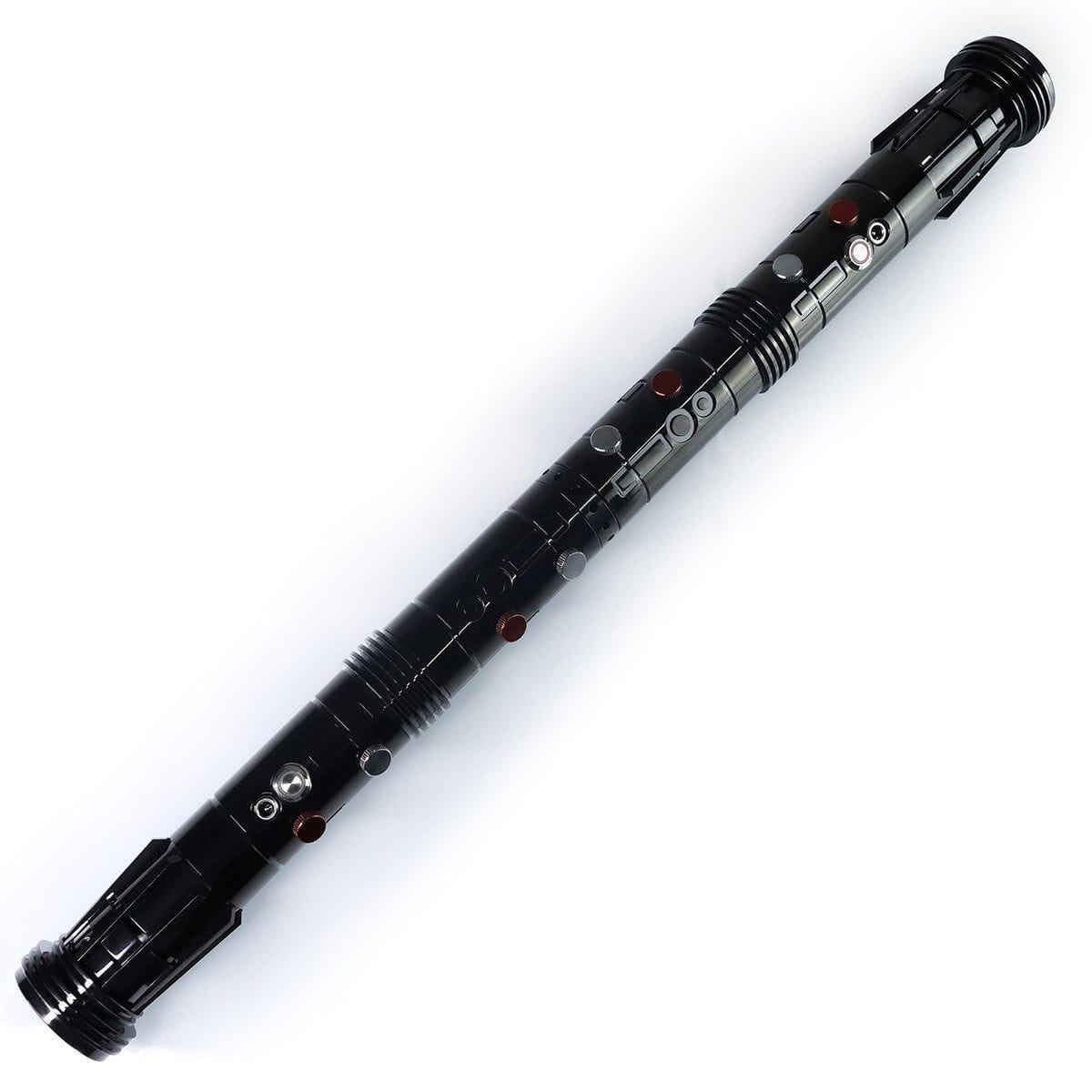
A staff is the honest stress test of the whole question. One blade is easy to hold. Two blades on a single long hilt means both ends are live and the lever is twice as long, so the untrained hand runs out of control authority almost immediately.
Which is exactly the point this page has been making. Nothing about the weapon refuses an untrained user. The user simply discovers, quickly, what training was for.
ISABER Double Bladed Lightsaber — RGB Baselit / Xenopixel Staff Saber
Accessories / RGB & Baselit Lightsabers
More Common Questions
Q1: Can a non-Jedi use a lightsaber?
A: Yes. A smuggler uses one to cut open a dead animal in the second film, and a machine with no Force connection at all duels Jedi with a collection of them. The activation control is a switch.
Q2: Do you need the Force to turn a lightsaber on?
A: No. There is no biometric check and no scene where a saber declines to ignite. Every barrier in the stories is about skill, ownership or nerve, never about the weapon refusing.
Q3: Why do people say only Jedi can use one?
A: Because only Jedi were trained to fight with one, and the films mostly show Jedi holding them. The claim describes a social pattern rather than a mechanical rule, and the exceptions are on screen.
Q4: Is the gyroscopic effect real?
A: It is an Expanded Universe explanation rather than canon, and it is repeated far more than it is sourced. The films never describe the blade as heavy, and the balance point sits in the hilt anyway.
Q5: Could I actually fight with a lightsaber if it were real?
A: Not against a trained opponent. The blade has no guard and cuts along its whole length, so there is nowhere safe to put your second hand and no borrowed instinct that transfers cleanly.
Q6: Is a replica lightsaber safe for a beginner?
A: The device is, the swinging is not. A rigid tube at head height in a shared room is the actual risk. Start with a single blade, keep clear of people, and treat it as a baton rather than a sword.
The short version: the weapon never had a lock, the tradition had a guest list, and the films show both. Anyone can switch one on. Almost nobody can duel with one, and that gap is training rather than bloodline.
RGB Lightsaber Blade (Telescopic)
Accessories / RGB & Baselit Lightsabers