
Yes — it would hurt him, and then it would stop mattering. There is no canon crossover, so no official answer exists, but canon’s rules are specific about what survives a blade, and heat tolerance is not on that list. Every material that has ever stopped a lightsaber did it by interfering with the containment field, not by being hard or heat-resistant. He is extraordinary on exactly the axis canon says does not count, and his regeneration deletes the one consequence that would.
The question gets argued on forums for years because both sides bring a stats sheet and neither sheet was written by the other publisher. A sabotage droid’s blast door and a gamma-irradiated body were never designed to be measured against each other.
But the question is answerable once you split it, because one half of it has a very firm answer inside Star Wars. That half is: what does it actually take to stop a blade? Everything else follows from it.
What’s on This Page
- Why There Is No Canon Answer
- Heat Tolerance Is the Wrong Proof
- Cauterization Cuts Both Ways
- The Hulk’s Record, Read Carefully
- The Wolverine Precedent
- The Thing the Blade Does That He Wants
- The Only Version You Can Test
- FAQ
Why There Is No Canon Answer
Neither continuity has ever staged this fight. There are no canon feats, no official numbers and no authorial ruling — only two decades of forum arithmetic.
That absence matters more than it sounds. A power-scaling argument between two unconnected fictions has no referee, so both sides quietly assume their own franchise’s rulebook governs. Star Wars fans import the blade’s on-screen behaviour; Marvel readers import the character’s durability record. The two rulebooks were never meant to sit on the same table.
Which is why most of the argument is people comparing totals. He has taken X. The blade has cut Y. X is larger, therefore.
That style of reasoning has one specific weakness, and it is exposed the moment you ask a narrower question. Not “which number is bigger,” but “what has ever actually worked?”
Heat Tolerance Is the Wrong Proof
Canon has exactly four documented ways to stop a lightsaber, and not one of them works by being heat-resistant. They all work by reaching the containment field.
This is the part of the argument that is not speculative. It is on screen, repeatedly, and the page on what a lightsaber can and cannot cut lays out all four with the mechanism for each.
| What stops the blade | Where it appears | What it does to the blade | What it does not do |
|---|---|---|---|
| Beskar | Mandalorian armour | Disperses the blade’s energy across the plate | Does not resist by being harder than the blade |
| Cortosis | Rare mineral, old stories | Short-circuits the blade, forcing it to retract | Does not absorb the heat |
| Electrostaff | Bodyguard droids and guards | Cancels the field at the contact point | Does not out-temper the plasma |
| A second lightsaber | Every duel in the series | Field meets field and the blades lock | Does not cut through the other blade |
| Bulk material | Blast doors, armour, limbs | Nothing — it just takes longer | Does not stop the blade at any thickness |
The four exceptions and the one non-exception. Thickness appears on the list only as a delay.
Canon’s four exceptions all converge on the field. The target material never gets a vote.
Which is the crack in the usual argument. “He has survived worse heat” is a true statement about the Hulk. It is also a statement about a route canon never uses for survival.
Nothing in Star Wars is ever described as too tough to cut. Blast doors are enormous and they still open. Armour still fails. Limbs come off cleanly.
Put the blade’s working band next to his, though. The minimum for cutting a solid is about 4,000 K, and a calculated plasma figure for one screen blade lands near 7,680 K. The best-known heat feat on the other side has never been given a published value at all.
So the comparison people make is not between two numbers. It is between one number and one impression.
The only thing that reliably survives is a material with a special relationship to the field — and the Hulk’s skin has no such relationship. It is simply very hard to damage. Canon’s rulebook says that is the wrong credential.
For the temperature side of the comparison, including why a blade’s working number sits where it does, the page on how hot a lightsaber actually is keeps the measured figures separate from the film claims.
Cauterization Cuts Both Ways
A lightsaber seals a wound as it opens it. Against a normal opponent that is the feature that kills them. Against something that regenerates, it is the single worst property the weapon could have.
Ask why a deep cut is lethal. Three reasons, in order: blood loss, damage to something that cannot be replaced, and infection. A saber closes two of those doors by design and narrows the third to one wound track.
Hits that miss anything vital are survivable. That is why saber duels are rarely won by glancing blows — the blade has to reach something structural.
Now reverse the target. A regenerator’s whole advantage is that structural damage is temporary. What would actually kill him is a wound that keeps getting worse: an open cut that keeps bleeding, a track that keeps introducing material into the tissue.
A lightsaber is precisely the weapon that does not produce those. It produces a sealed, localised, tidy injury that a healing factor barely has to think about.
Read the other way round, the point is sharper. A steel blade leaves an open wound and would be, on this one narrow axis, more of a problem for him than a lightsaber. The saber’s signature property is working for the Hulk, not against him.
The Hulk’s Record, Read Carefully
The documented feats are real, and they are all on the axis that canon says does not decide the outcome. They also come from decades of different writers, so they are evidence of intent rather than measurement.
The honest way to use them is to ask, for each one, what it establishes and what it leaves alone.
| What is documented | How solid it is | What it proves | What it leaves alone |
|---|---|---|---|
| Tissue and organ regrowth in minutes | Repeated across many runs and writers | Structural damage is temporary on a combat timescale | Says nothing about whether the cut happens |
| Has taken enormous heat at close range and kept fighting | Well established, but never given a value in-panel | Temperature alone has not finished him | Heat is not how canon stops a blade |
| Recovery scales with anger | Consistent framing across decades | The worse the injury, the faster the repair | Makes the injury less useful, not more |
| Pierced only by a short list of exotic metals | Repeated, and it includes failures | Penetration is a material property | A saber brings no material — only a field |
Two things are worth separating here. The first is that none of these rows is a lie. He has taken punishment that would end anything ordinary.
The second is that the pattern of the rows is the problem. Every entry is about being hard to damage. Not one of them is about resisting a containment field.
And a published figure worth refusing: the huge temperature numbers that circulate for his best-known heat feat are fan arithmetic, not panel text. They are repeated confidently in wikis. They are never stated with units in the story.
So they cannot carry an argument. The qualitative claim — he has taken far more heat than a saber delivers and stayed standing — is enough on its own, and it is enough to make the opposite case look strong. Which is why the field argument matters. It does not dispute his record. It points out the record is filed in the wrong drawer.
The Wolverine Precedent
There is exactly one weapon that has been used on the Hulk repeatedly and documented both ways — piercing him and failing to. That record answers a different question than people think.
The claws have gone through him: ribs, skull, all the way. They have also failed against him, including in his earliest encounter in 1974 and, more tellingly, in a later run where the same claws were bone rather than metal and could not get through at all.
That second failure is the useful one. Same character, same technique, same force behind the strike. The only variable that changed was the material of the blade — and the outcome flipped.
Which is the same lesson the Star Wars side already teaches. What penetrates is a property of the thing doing the penetrating, not of the strength of the swing.
Applied here, it cuts against the lightsaber rather than for it. A saber carries no material to the contact point. It carries a field and a temperature. On the one calibration test that exists across both properties, “bring better metal” is what worked, and the saber brings none.
The Thing the Blade Does That He Wants
Pain makes him stronger. So a strike that fails to end the exchange does not reset the fight — it moves it in his direction.
This is the asymmetry that makes the two questions so different. “Could a lightsaber hurt him” is easy and the answer is yes. “Would a lightsaber help you” is a much worse question, and the answer is mostly no.
Every exchange now has a cost structure that runs the wrong way. The blade’s damage is temporary by his standards, and the anger it produces is permanent for the duration of the fight.
Which is why the only version of this scenario that resembles a win involves finishing it immediately. A prolonged saber fight against a regenerator who gets stronger from damage is not a fight with a bad ending. It is a fight with a predetermined one.
The Only Version You Can Test
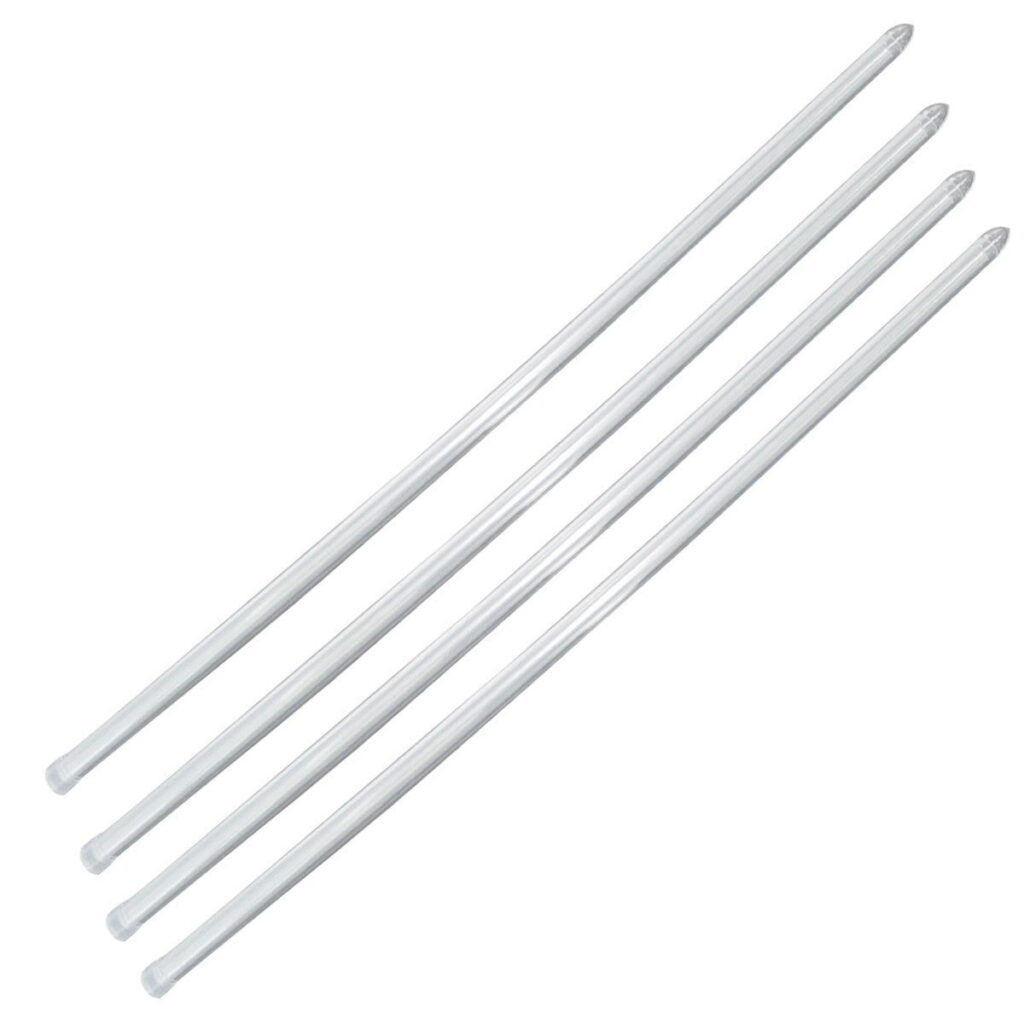
A saber you can buy does not cut anything. Its failure mode is mechanical, not thermal — and that makes wall thickness the real measure of resistance.
This matters because it is the only part of the question with a measurable answer. A real blade is a polycarbonate tube lit from inside. Hit something with it and it scuffs, flexes and eventually cracks. It does not burn through.
The temperatures make the reason obvious. A pixel blade run at full white for ten minutes measures around 100 °C at the surface. That is warm enough to notice and nowhere near cutting.
So when the question turns practical — what survives a hard strike — the answer stops being about heat and becomes about the tube.
Wall thickness is the resistance axis that actually exists. It is not a durability score, and both tubes are the same material.
Two other things matter more than people expect. Whether the blade is hollow decides whether there is anything inside to break — a baselit tube has nothing behind the impact surface, while a pixel blade carries a strip of LEDs in exactly that position.
And the tip. A glued tip is the weakest joint on the whole assembly, and it is the part that hits first.
For the full grade breakdown and what each one is rated for, the duelling spec reference covers blades, electronics and safety together. For the material side alone, the blade technical reference goes deeper on wall, diameter and diffusion.
FAQ
Q1: Would a lightsaber hurt the Hulk?
A: Yes. A contained plasma blade at cutting temperature would open his skin, and nothing in his record suggests his surface is exempt. The real question is not whether it hurts him but whether the injury lasts, and canon’s own rules say it probably would not.
Q2: Could a lightsaber cut the Hulk?
A: Probably, shallowly, by the same logic that lets an exotic metal pierce him — but a saber brings no material to the contact point, only a field and heat. Canon has never shown a blade stopped by toughness, and that is the only defense his record actually offers.
Q3: Does the Hulk’s regeneration protect him from a lightsaber?
A: Not from the cut itself, but from the consequence. A saber seals the wound as it makes it, so there is little blood loss and a single clean track for tissue to rebuild. That is the easiest possible injury for a regenerator to absorb.
Q4: Has the Hulk survived worse than a lightsaber?
A: In terms of heat, almost certainly — he has taken far greater temperatures at close range than a blade delivers and kept fighting. But heat tolerance is not the axis canon uses. Every material that has stopped a blade did it by interfering with the containment field.
Q5: Why doesn’t heat resistance stop a lightsaber?
A: Because nothing in canon survives a blade by being heat-resistant. Beskar disperses the field, cortosis shorts it out, an electrostaff cancels it, and a second blade locks against it. Threat resistance is a field property, not a temperature property.
Q6: What actually stops a lightsaber?
A: Only four things in canon: beskar, cortosis, electrostaffs and another lightsaber. All four reach the containment field. Thick material — blast doors, armour, limbs — delays a blade but never stops it.
Q7: Could a lightsaber kill the Hulk?
A: Only by hitting something regeneration cannot rebuild in time, and there is no clear candidate. Canon saber kills rely on organ damage and shock, both of which his record shows recovering within a fight. Prolonged exchange makes the outcome worse, not better.
Q8: Would a lightsaber make the Hulk angrier?
A: Yes, and that is the part usually left out. Pain and injury raise his output, so a strike that does not finish the fight strengthens the other side. The weapon’s damage is temporary while the anger it causes is not.
Q9: Can Wolverine’s claws cut the Hulk?
A: Sometimes. The metal claws have pierced him repeatedly, while the bone version in a later run could not get through at all. Same character, same technique — only the material changed, and the result reversed.
Q10: Would a lightsaber cut through vibranium or adamantium?
A: Canon has no answer, because neither metal exists there. The transferable lesson is that penetration depends on the material’s relationship to the blade, not on the force behind it — which is exactly why a saber’s lack of material matters here.
Q11: Who would win, a Jedi or the Hulk?
A: There is no canon answer, and the question is mis-framed anyway. Canon is explicit that duels are decided by the wielder — form, reach, timing — not by the blade. So it is a question about a person, not about a weapon.
Q12: Does a real lightsaber cut anything?
A: No. A saber you can buy is a polycarbonate tube lit from inside. It scuffs, flexes and eventually cracks, and the failure is mechanical. Nothing about it is hot enough to cut, which is why safety on a duelling blade is about the tube.
Q13: What should I look for in a blade that takes impacts?
A: Three things. A 3 mm wall rather than 2 mm, a hollow tube if you want maximum durability, and a tip that is not simply glued on. Everything else is brightness and effects.
The short version: the saber would land. It just would not be the deciding factor, because canon’s rulebook says the deciding factor is something the Hulk’s record does not have — and his regeneration removes the one consequence that might otherwise have mattered.