
A complete lightsaber typically weighs 540 grams to about 1 kilogram. A light thin-wall aluminium build can come in near 420 grams, a bare 6061 hilt tube is about 220 grams with another 90 of electronics, and full-metal replicas run 1.5 to 2 kilograms.
Weight is the least documented spec in the hobby, and the most felt.
Most listings never publish it. The numbers below come from component makers and from the electronics community, and they explain why two sabers that look identical can feel like different objects.
What’s on This Page
- What Canon Says About Weight
- The Numbers: 420 Grams to 2 Kilograms
- Where the Mass Actually Sits
- Blade Weight: Wall Thickness Changes Everything
- Hilt Weight: Material and Length
- Why Full-Metal Replicas Weigh 1.5 to 2 kg
- Why It Feels Heavier Than It Weighs
- How to Get a Lighter Saber
- Weight for Children
- Frequently Asked Questions
What Canon Says About Weight
Canon never states a lightsaber’s weight, and the physics makes the question stranger than it looks: the blade is energy, so in canon the saber weighs only what the hilt weighs.
Films show characters spinning a saber one-handed with no visible effort. The original trilogy’s fights were staged slower and more deliberately than the prequels, which reads as weight even though nothing was measured.
Staging is a directorial choice, not a spec. Nothing in canon gives grams or pounds.
It matters because a real LED saber behaves differently from a canon one. It has a physical blade with mass at the far end, and that mass is what your wrist argues with.
The Numbers: 420 Grams to 2 Kilograms
Most complete sabers land between 540 grams and one kilogram, with light thin-wall builds coming in near 420 grams.
That spread is wide because the hilt, not the blade, is the variable. Production hilts with thicker bodies and more hardware commonly weigh 400 to 680 grams before a blade goes on.
Step up to a full-metal replica with a machined body, a crystal chamber, or a two-battery setup and the number doubles or triples.
| Build | Typical total | What drives it |
|---|---|---|
| Thin-wall aluminium, 32″ light blade | 420–500 g | Light tube, single cell, in-hilt LED |
| Production hilt, 32″ heavy blade | 660–940 g | Hilt alone runs 400–680 g; blade adds about 260 |
| Production hilt, 36″ heavy blade | 700–1,000 g | Longer blade plus more pixels to drive |
| Full-metal replica, 36″ | 1.5–2 kg | Machined steel or thick aluminium body, crystal chamber, dual cells |
| Saberstaff, two full hilts | 1.3–1.9 kg | Two of everything |
The row that surprises people is the second one. The jump from a light build to a production hilt is the single biggest step in the whole table, and it happens before a blade is even fitted.
How to get a real number before buying
Weight is rarely published, so ask for the two inputs that determine it: blade wall thickness and hilt material.
Those two answers narrow the total to within about 50 grams. Ask whether the body is thin-wall tube or machined billet and you have the rest.
Where the Mass Actually Sits
In a light thin-wall build, the hilt tube is the single heaviest part at about 220 grams, followed by the blade at 160, with roughly 90 grams of electronics and battery inside the hilt.
The blade and the installed hilt together explain almost the whole 470-gram total. There is very little else.
A light thin-wall build, not an average saber. The electronics segment is the residual after subtracting the blade and bare tube, since builders rarely publish board and cell mass separately.
Note the shape of the two bars. The hilt and electronics blocks stay the same width. Everything that grows when you upgrade the blade grows on the right.
Blade Weight: Wall Thickness Changes Everything
A 32-inch blade weighs about 160 grams in a light build and about 260 in a heavy one, a gap that tracks wall thickness and whether an LED strip runs inside the tube.
That is a 60 percent increase, and it sits entirely at the far end of the lever.
Thicker walls resist dents better and diffuse light more evenly, which is why duelling blades are the heavy ones. The trade is mass you feel on every rotation.
Length compounds it more gently. Blade mass scales with length, so a 36-inch blade is about 12 percent heavier than the 32-inch version of the same type.
Hilt Weight: Material and Length
A bare 6061 aluminium hilt tube of about 265 millimetres weighs roughly 220 grams, and installed it reaches about 310; a production hilt with a thicker body commonly runs 400 to 680 grams.
Hilts in this class run 27 to 32 centimetres. Most of the mass is the tube wall and the pommel, not the internals.
Wall thickness matters more than length. Two hilts of the same length can differ by several hundred grams if one is thin-wall tubing and the other is a machined billet body.
That is why the lightest complete sabers land near 420 grams: thin-wall aluminium plus a light blade leaves very little left over.
Why Full-Metal Replicas Weigh 1.5 to 2 kg
Full-metal replicas reach 1.5 to 2 kilograms because the body is machined solid, not tube, and every detail is a separate metal part.
Grip rings, activation boxes, shrouds and pommels are individual pieces. A crystal chamber adds a second tube inside the first.
Two cells instead of one adds more, and heavy-grade blades add more again on top.
These are display and cosplay objects first. They feel substantial in the hand, and that heft is the point.
Why It Feels Heavier Than It Weighs
A saber with the mass concentrated at the blade end feels heavier than its number, because the wrist fights the distance, not the grams.
Moving mass away from the pivot multiplies the effort needed to turn it. Shifting the balance point forward does more to the effort than adding 100 grams at the pommel would.
This is why two sabers with similar published weights can feel completely different, and why the balance point matters as much as the total.
Blade length shifts that balance forward. A 36-inch blade moves the centre of mass further from the grip than a 32, without changing the hilt at all.
How to Get a Lighter Saber
The reliable levers are wall thickness, blade length, hilt material, and cell count, in that order.
| Change | Measured effect | What you give up |
|---|---|---|
| Heavy blade → light blade, 32″ | −100 g | Less dent resistance in hard contact |
| 36″ → 32″ blade | −20 g light, −30 g heavy | Reach, and screen-accurate proportions |
| Steel body → thin-wall aluminium | Largest single saving of any change | The machined heft some buyers specifically want |
| Dual cell → single cell | Saves mass at the pommel end | Shorter runtime between charges |
| Skip the crystal chamber | Biggest saving among optional features | The display feature itself |
Be realistic about the floor. Below roughly 400 grams you are into small hilts and short blades, and the saber stops feeling like a saber.
Weight for Children
Under 500 grams holds up for most children; a 24 to 28-inch blade on a light hilt lands well under that.
The blade is where the leverage is, so shortening it helps a child more than anything else you can do.
Two-millimetre walls are also the right call here. A child is not going to dent a blade through hard contact the way an adult duellist will.
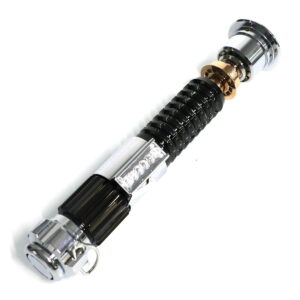
Kenobi Lightsaber v2.0 — Obi-Wan Kenobi Neopixel Replica | ISABERS
Character Lightsabers / Neopixel Lightsabers
Frequently Asked Questions
Q1: How much does a lightsaber weigh?
A: Most complete sabers land between 540 grams and one kilogram. A light thin-wall aluminium build with a 32-inch blade can come in near 420 grams; a production hilt with a heavy blade usually runs 660 to 940 grams; full-metal replicas run 1.5 to 2 kilograms.
Q2: How heavy is a lightsaber hilt on its own?
A: A bare 6061 aluminium tube of about 265 millimetres is roughly 220 grams. Installed with electronics and a cell it reaches about 310 grams.
Q3: How much does a lightsaber blade weigh?
A: A 32-inch blade is about 160 grams in a light build and about 260 in a heavy one. A 36-inch blade of the same type is about 12 percent heavier.
Q4: Why are some lightsabers so heavy?
A: Machined solid bodies, separate metal detail parts, crystal chambers, dual battery cells and heavy-grade blades all add up. A full-metal replica can reach 1.5 to 2 kilograms.
Q5: Does blade length affect weight?
A: Yes, and it matters more than the number suggests because the added mass sits at the far end. Going from 32 to 36 inches adds roughly 20 grams on a light blade and 30 on a heavy one, and moves the balance point forward.
Q6: What is the lightest lightsaber build?
A: Thin-wall aluminium hilt, a single battery cell, no crystal chamber, and a short two-millimetre blade. That combination lands around 400 grams.
Q7: How heavy is a lightsaber in canon?
A: Canon gives no figure. Because the blade is energy and has no mass, a canon saber would weigh only what its hilt weighs, though the films’ choreography was deliberately slowed to suggest heaviness.
Q8: What weight is right for a child?
A: Under 500 grams with a 24 to 28-inch blade and a two-millimetre wall. Shortening the blade helps a child more than any other single change.