
A lightsaber blade is usually sold as 36 inches, but only about 33 to 34 inches is exposed once it seats in the emitter. 32 inches is the balanced default, 28 inches suits shorter users and kids, and 24 to 28 inches is the shoto and saberstaff range.
Two numbers get confused constantly: the length printed on the blade, and the length you actually swing.
Once you separate them, choosing a blade stops being a matter of taste and becomes a measurement.
What’s on This Page
- What Canon Says: About One Metre
- Nominal Length vs Exposed Length
- The Four Sizes That Matter
- Matching Blade to Height
- Matching Blade to Use
- What You Give Up at Each End
- Saberstaff and Dual-Wield Lengths
- Cutting, Swapping, and What Can’t Be Resized
- How to Measure Before You Buy
- Frequently Asked Questions
What Canon Says: About One Metre
Canon puts the blade at roughly one metre, with a hilt of 20 to 35 cm, for a total saber a little over a metre long.
No film stops to measure a blade. The number comes from reference material and from the props themselves, which used 36-inch blades through the prequel era.
That is where the hobby’s default comes from. A 36-inch blade is not an engineering choice; it is a copy of what the films used.
Hilts run shorter than people expect. Most sit between 20 and 35 cm, with roughly 28 cm the common middle. The blade does most of the length.
Nominal Length vs Exposed Length
Part of every blade sits inside the hilt. A nominal 36-inch blade exposes about 33 to 34 inches, and a deep emitter can take more.
Blades seat into the emitter far enough to be gripped by the retention screw. Depending on the hilt, that is 1 to 3 inches, and some deep-seated designs take 4 to 5.
Which means two 36-inch blades on two different hilts can expose noticeably different lengths, even though the packaging says the same thing.
The relationship is simple arithmetic: total length = hilt length + nominal blade length − socket depth.
Why sellers quote the nominal number
Because the blade is the part being sold. Socket depth belongs to the hilt, and the blade maker has no idea which hilt you own.
The exception is a hilt-and-blade bundle, where the exposed length is fixed by the design. That is the one case where the number on the page is the number you get.
The Four Sizes That Matter
Almost every purchase resolves to 28, 32, 36, or a custom 34 inches.
Twenty-four inches and below exists for shoto blades, off-hand weapons, and very small children, but it is a specialist length rather than a default.
Thirty-four is the compromise a lot of experienced users land on. It costs the reach of a 36 and keeps most of the control of a 32, and some makers charge extra to cut it.
The gap between 32 and 36 is four inches, which sounds small until you are spinning indoors.
Matching Blade to Height
Height gives you a starting point, not a rule: under 5 foot 6 leans to 28 to 32 inches, 5 foot 8 to 5 foot 10 is genuinely split, and taller users usually prefer 36.
| Height | Common choice | Why |
|---|---|---|
| Under 5′0″ | 24″–28″ | Full-length blades drag the floor on spins |
| 5′0″–5′6″ | 28″–32″ | Proportion, and enough clearance indoors |
| 5′6″–5′10″ | 32″, sometimes 36″ | The split zone; users at the same height disagree |
| 5′10″ and up | 36″ | The 36-inch blade finally looks and feels proportionate |
| Children | 24″–28″ | Weight, reach, and control |
The middle row is honest about the disagreement. Several users at 5′8″ to 5′10″ insist on 32, and others at the same height happily use 36.
That is not confusion. It reflects the fact that fighting style and arm length matter as much as total height.
Matching Blade to Use
Dueling and cosplay pull toward 36; spinning, indoor practice and dual-wielding pull toward 32 or shorter.
| Use | Length | Reason |
|---|---|---|
| Full-contact dueling | 36″ for average or taller | Reach decides exchanges; a few inches can be the difference in a point |
| Light sparring | 32″ | Enough reach, much easier to control |
| Spinning and flow | 28″–32″ | Tip stays off the floor; the balance sits closer to the hand |
| Indoor practice | 32″ or shorter | Ceilings and furniture are the real opponent |
| Cosplay and display | 36″ | Screen-accurate proportions |
| Dual wield | 36″ main, 24″ off-hand | Long primary, short shoto |
| Saberstaff | 24″–28″ per side | Two long blades become unusable |
| Children | 24″–28″ | Weight and control |
Worth noting: some sport and federation rules describe a total saber length of roughly 100 to 110 cm, which lands near a 32-inch blade on a standard hilt.
What You Give Up at Each End
A longer blade buys reach and costs control, brightness and balance.
Reach is the obvious gain, and in dueling it is real. The costs are less obvious until you have swung both.
Brightness
Light has to travel further through diffusion material to reach the tip. A shorter blade is measurably brighter along its length, and the difference shows most on dense Neopixel strips.
A longer blade also means more pixels to drive, which is more current draw from the same battery.
Balance
Mass at the far end of a lever costs more effort per rotation than the same mass near your hand, which is why total weight and balance point are two different questions. A 36-inch heavy-grade blade moves the balance point forward, and the wrist feels it.
This is why spinners tend to run shorter blades. It is not about the look; it is about where the weight sits.
Clearance
Indoors, four extra inches is the difference between a clean behind-the-back spin and a blade tip hitting the floor.
Users around 5′8″ report that a 36-inch tip comes within a couple of inches of the ground on a normal spin. On carpet, that is contact.
Saberstaff and Dual-Wield Lengths
A saberstaff takes 24 to 28 inches per side; a 36-inch blade on each end is effectively unusable for anyone who is not extremely tall.
Two 36-inch blades on a coupler produce a weapon over two metres long, and the leverage at the ends is punishing.
The same logic applies to dual-wielding. The common pairing is a full-length main blade and a short shoto in the off hand, not two matched long blades.
For a staff, measure the whole assembly against the room before you commit. The ceiling is part of the specification.
Cutting, Swapping, and What Can’t Be Resized
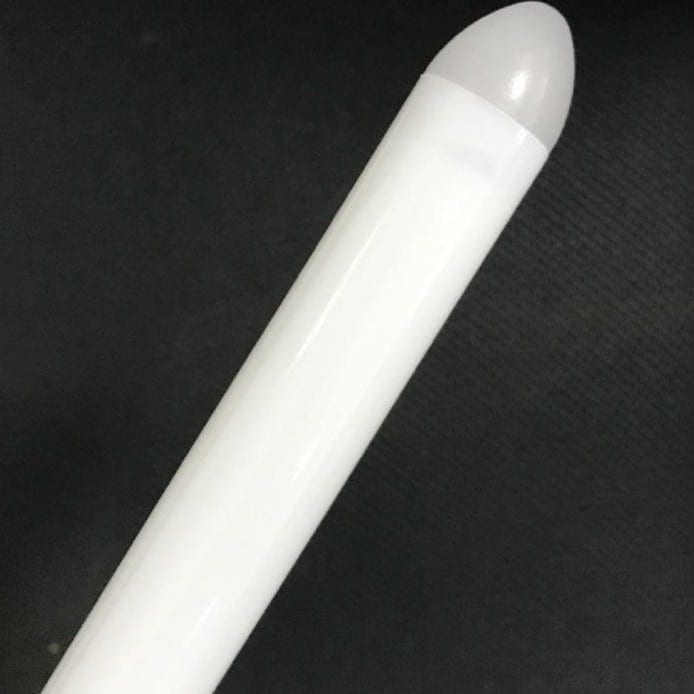
A baselit blade can be cut to length with hand tools. A Neopixel blade cannot, because the strip and connector are part of its structure.
Polycarbonate cuts cleanly with a fine-tooth hacksaw or a pipe cutter. After cutting, deburr the edge and refit the diffusion film and tip.
On a Neopixel blade, cutting means cutting the LED strip and re-soldering the connector PCB. That is a rebuild, not a trim, and it usually voids any warranty.
If you want a length between the standard sizes, buy it cut to order. Paying for a 34-inch blade is almost always cheaper than rebuilding a 36.
How to Measure Before You Buy
Measure the blade against your arm, then add your hilt’s socket depth to get the nominal length you should order.
The blade starts inside the hilt, not at the emitter mouth. Socket depth is set by the hilt, so two identical blades can expose different lengths on different sabers. The drawing is schematic, not to scale.
- Arm test. Hold the hilt at your natural grip and lay the blade along your arm. The tip should land just past your shoulder. Short of that feels stubby; well past it feels unwieldy.
- Room test. Stand where you normally practice and spin the hilt with the blade on. If the tip reaches the floor or ceiling at any point, the blade is too long for that space.
- Socket check. Measure how far the blade seats into your emitter, or take it from the hilt’s documentation. This is the number that gets subtracted.
- Order nominal. Take the exposed length you want and add the socket depth. That total is what you order.
The arm test is borrowed from sword fitting, and the older guidance for a 5′10″ practitioner lands near a 30-inch blade, which sits between the 28 and 32 options.
Treat it as a starting point. The blade you keep using is the one that clears your ceiling and comes back to your hand without thinking about it.
Frequently Asked Questions
Q1: What is the standard lightsaber blade length?
A: 36 inches is the nominal standard and 32 inches is the practical default. Most people swinging in a normal room end up on 32, because a 36-inch blade only exposes 33 to 34 inches and needs more clearance.
Q2: How long is a lightsaber in canon?
A: About one metre of blade, on a hilt of 20 to 35 cm, for a total a little over a metre. The prequel props used 36-inch blades, which is where the hobby default comes from.
Q3: What blade length should I get at 5′10″?
A: Either 32 or 36 works. 32 is easier indoors and faster to spin; 36 gives reach and screen-accurate proportions. A custom 34 is the usual compromise for people who cannot decide.
Q4: Is 32 or 36 better for dueling?
A: If you are average height or taller and have room, 36 gives reach, and reach wins exchanges. If you train indoors or in tight spaces, 32 keeps the tip under control.
Q5: Can I cut a Neopixel blade to length?
A: Not practically. A Neopixel blade carries an LED strip and a connector PCB, so cutting it means cutting the strip and re-soldering the connector. Baselit blades are hollow tubes and can be trimmed with hand tools.
Q6: What length for a double-bladed saber?
A: 24 to 28 inches per side. Two 36-inch blades on a coupler produce a weapon over two metres long and are hard to control for anyone of normal height.
Q7: How much of the blade goes into the hilt?
A: Usually 1 to 3 inches, depending on the emitter. Deep-seated designs can take 4 to 5, which is why the same blade can feel shorter on one hilt than another.
Q8: Does blade length affect brightness?
A: Yes. Light travels further through diffusion material to reach the tip, so a shorter blade is brighter along its length, and a longer blade draws more current for the same density of pixels.