
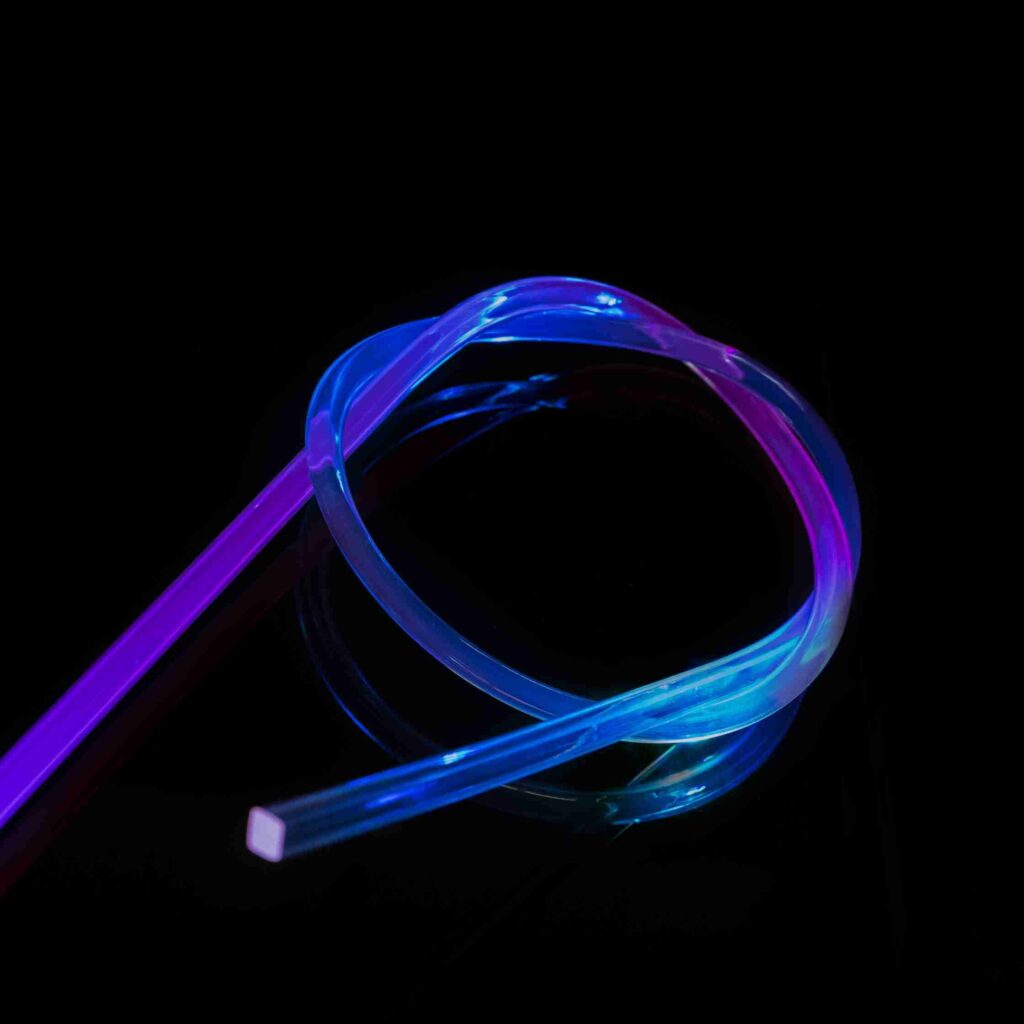
A lightsaber light whip is a flexible, metre-plus emissive strand that runs from a standard hilt instead of a rigid tube blade. The hilt and electronics are ordinary; what changes is everything above the emitter, because a light whip has to bend without breaking and carry light along its whole length.
It is one of the few saber variants where the hard part is not the electronics but the light path. A rigid blade holds its own geometry. A whip is asked to hold none, and still glow evenly from the plug to the tip.
That single difference is why a light whip costs more than a blade of the same length, why it wears out in a different place, and why it will not work on every saber you already own.
This page covers how a light whip is built, the two ways light is carried along it, why compatibility is narrower than for a blade, the failure points that are unique to a flexible strand, and how real light whips differ from the flexible blades in Star Wars lore.
What’s on This Page
- What a Light Whip Actually Is
- Two Ways to Carry the Light
- Why Compatibility Is Narrower Than a Blade
- The Plug and the Stress Point
- Flexibility, Taper, and Momentum
- Lore Light Whip vs a Real One
- Care and Common Failures
- Frequently Asked Questions
What a Light Whip Actually Is
A light whip replaces the rigid blade with a flexible emissive strand that attaches to the same hilt. The emitter, the soundboard, the battery and the switch are unchanged; only the part above the emitter is different.
Light whips are approachable because of that one fact. You are not buying a different class of saber. You are buying a different blade, in the way you would buy a heavier or longer tube.
What you lose is the blade’s self-supporting shape. A polycarbonate tube holds a straight line under its own stiffness, which is why a saber points where the emitter points.
A whip has no stiffness to hold it in line. Its direction is set entirely by how it is moving, so the same hilt that points a blade can send a whip anywhere within its reach.
| Part | Rigid blade | Light whip |
|---|---|---|
| What sits above the emitter | Polycarbonate tube, fixed length | Flexible strand, folds or coils when slack |
| How direction is set | By the hilt and the emitter axis | By the motion of the strand |
| How light travels | Reflected down the tube from a single source | Emitted along the strand, or carried through a fibre |
| Reach | Fixed at 28–40 in | Variable, up to the strand’s length |
| Where it wears | Impact bands near the tip | The junction at the plug |
| Blade swap | Round 1 in tubes interchange freely | Requires a whip-compatible hilt |
The part above the emitter is the entire product. So a light whip is sold as an accessory, and the question before buying is not which whip to get but whether the saber on your shelf can drive one.
Two Ways to Carry the Light
There are two practical ways to light a whip: a fibre that carries light from the emitter and glows along its length, and a strand with small LED beads spaced inside it. The first is simpler and dimmer; the second is brighter but far harder to build for a strand that actually moves.
A fibre lights the whole strand from one source, so the far end is always working with what is left over. Beads put the source along the strand instead, which is how the second approach holds its brightness — and why its wiring has to survive constant twisting.
A side-glow fibre is the older approach. Light enters at the plug, travels along the fibre core, and leaks out through the cladding along the whole length.
Its weakness is distance. Light leaving the core as it travels means less of it arrives further along, so a fibre strand gets noticeably dimmer toward the tip unless the strand is kept short.
Staggering the second row so its beads land where the first row has gaps is what turns a dotted strand into a continuous glow. It also doubles the wiring inside the sleeve, which is part of why the build costs what it does.
The second approach puts the light source inside the strand. Small addressable LED beads are spaced along flexible wiring, and a translucent silicone or fibre sleeve diffuses each bead into a soft, even glow.
The engineering problem is mechanical rather than electrical. A standard flexible LED strip is built on a flat circuit that tolerates bending but not repeated twisting, and a whip is twisted constantly as it coils and uncoils.
| Side-glow fibre | Segmented LED beads | |
|---|---|---|
| How it lights | One source at the hilt, light leaks out along the strand | Many small sources spaced along the strand |
| Evenness | Falls off toward the tip | Even, if the beads are spaced and staggered correctly |
| Colour | Whatever the source runs, fading along the length | Per-bead, so effects and colour change along the strand |
| Fails by | The strand cracking or the fibre hazing with use | A bead connection breaking where the strand twists |
| Hardest part | Getting enough light to the far end | Stopping the strand from twisting the wiring apart |
A woven sleeve is what holds the beads in place. Because the beads sit at intervals, a single strand reads as a dotted line of bright spots instead of a continuous glow.
The usual fix is two strands, staggered so one fills the gaps the other leaves. Which is why the good ones are not simply LEDs pushed into a tube.
A note on terms: the word “bead” here means an encapsulated LED chip on flexible wiring, not the decorative bead you would thread on a cord.
Why Compatibility Is Narrower Than a Blade
A light whip is not a universal fit. The version sold for analogue LED sabers runs on the blade’s own light and needs a hilt that drives a hollow blade, which means it will not work on a strip-blade hilt.
The most common mistake, and an easy one to make, because it contradicts a rule most buyers already know.
With ordinary blades, a strip blade is the more capable option and most buyers work up to it. With whips, the relationship inverts for the simpler build.
An in-hilt LED sabre lights the strand from a single source at the emitter. A strip-blade hilt instead sends data and power down the blade connector to LEDs mounted inside the blade, and a passive fibre strand has nothing to receive that signal.
So the whip designed around an in-hilt LED saber suits a hilt that drives a plain hollow blade, and the brighter a saber’s blade electronics are, the less likely it is that a simple whip will work on it.
| Your hilt drives | Will a light whip fit? | Why |
|---|---|---|
| In-hilt LED, hollow 1 in blade | Yes, with the matching whip | The whip takes light from the emitter the same way a hollow blade does |
| Strip blade, LEDs inside the blade | No, for the fibre type | The hilt sends data down the blade, and a passive fibre cannot use it |
| Convertible hilt | Sometimes | Depends on whether the whip’s fitting matches the socket and the drive |
| Blade with its own electronics in the strand | Its own product | A lit strand is a powered accessory, not a passive one |
Check the socket as well as the electronics. The standard blade socket is one inch, and a whip plugs into the same opening a blade would.
Confirm both at once: that the hilt drives a hollow blade rather than a lit one, and that the plug is sized for the socket it is going into.
The Plug and the Stress Point
The plug is the one rigid part of a light whip’s strand, and the joint where the flexible strand meets the plug is where whips wear out. The strand above it flexes; the plug below it does not, so the transition carries every cycle of bending.
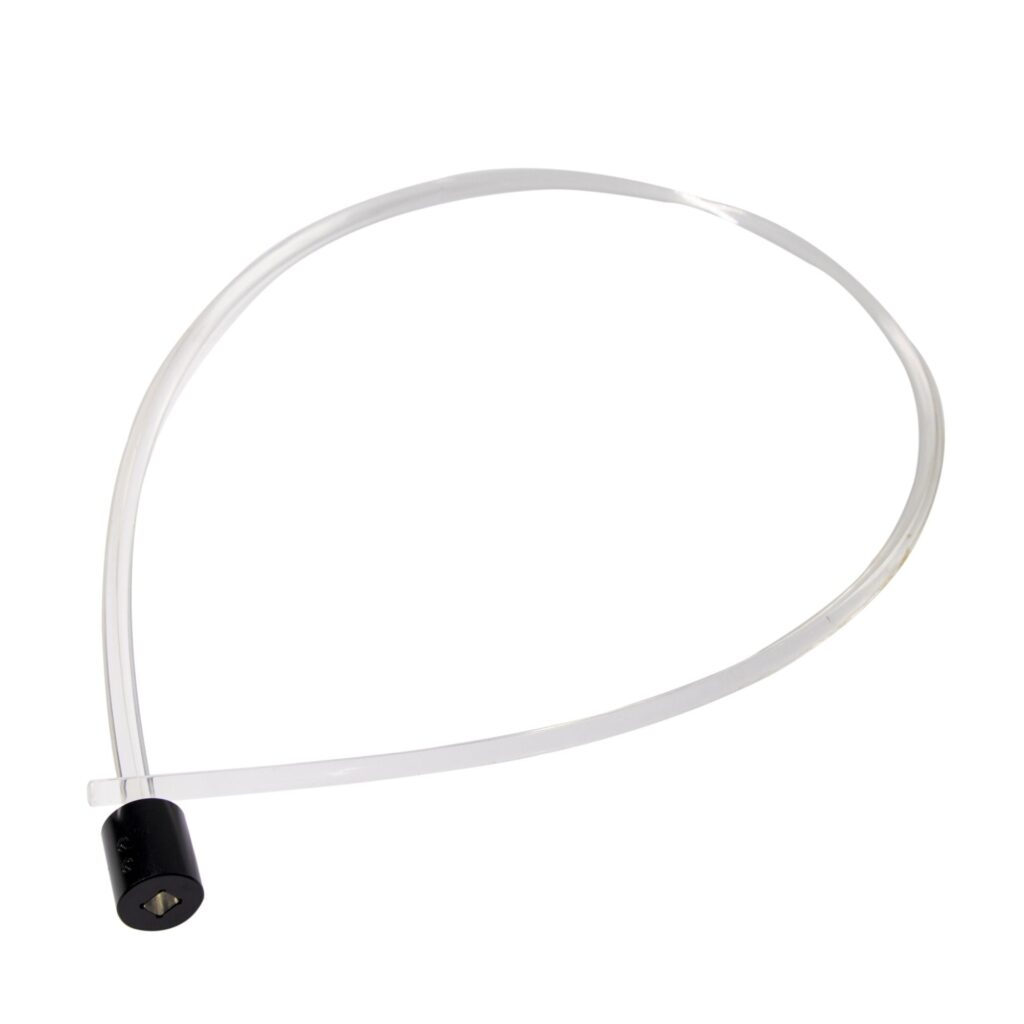
The plug does two jobs. It locates the whip in the emitter socket and it holds the base of the strand perfectly still relative to the hilt.
A metal plug matters for the second job. The strand enters the plug and is anchored there, and everything the strand does above that anchor is transformed into force at the anchor.
This is the opposite of where a rigid blade wears. A hollow blade takes its damage at the tip and along the impact band, where it is struck.
A whip takes it at the base, where it is held. Striking a target hard puts a sharp bend at the plug, and repeated hard strikes work the strand exactly where it has the least room to give.
Two consequences follow from that. The plug is worth buying in metal, because a plug that deforms loosens the strand at the point that already sees the most load.
And the strand is worth storing slack. A whip left coiled tight or hung by its tip puts a permanent set into the fibre, and a fibre that has been trained into a curve struggles to run straight when it is struck.
Flexibility, Taper, and Momentum
A light whip is not a blade that flops. Every bend in it costs reach and speed, so the strain the strand can take, not its colour or its length, is the number that decides how it behaves in use.
The reason is that a whip delivers energy along its length rather than along its axis. A blade transfers force when it is driven forward; a whip transfers force as a wave that travels down the strand and releases at the tip.
That wave is lost at every point where the strand bends instead of passing the energy on.
The stiffer the strand, the more of the wave reaches the tip. A strand that bends too freely looks dramatic and hits softly, which is why a light whip with no stiffness at all is a light-saber-shaped ribbon rather than a weapon.
Taper is the second lever, and the easiest to get wrong.
A whip with too much taper concentrates stress at the thin end, where there is least material to take it. A whip with almost no taper has a heavier tip and a slower, more deliberate motion.
A short light whip and a long one barely belong to the same category. Short strands swing fast and are easy to control. Length adds reach and drama, and it also adds mass at the far end, which is the mass you have to stop.
Lore Light Whip vs a Real One
The light whips in Star Wars are described as pure contained plasma with no cell walls to keep them straight. A real light whip is the opposite: a physical strand carrying light, because the containment problem the fiction skips is exactly what makes the real object hard.
In the fiction, the whip is a lightsaber blade freed from the geometry that keeps it rigid. A single crystal or a set of them emits the energy, and because the field has no cell structure, the blade has no reason to stay in a line.
The real problem the fiction removes is that a plasma blade holds its shape because containing walls keep it in a line, and those walls are also what makes it a line in the first place, not a whip.
Remove the walls and you no longer have a contained blade; you have an uncontained emission. Which is why no real light whip is plasma, and every one you can buy is a physical strand with light in it instead.
| In Star Wars | Real light whip | |
|---|---|---|
| What the strand is | Contained energy with no cell walls | A physical fibre or sleeved strand |
| Why it bends | The blade field has no rigid containment | The strand is flexible material |
| How it lights | The whole length emits | Light is carried or emitted along a material core |
| Cutting | Cuts, but less than a blade, and can short out | No cutting; it is light in a strand |
| Why it can short | A flexible field is described as volatile under impact | No field to short; the failure is mechanical |
Most modern canon appearances treat the whip as a flexible blade setting rather than a separate weapon. The hilt is a recognisable saber and the strand is what changes, which lines up with how the real accessory works.
Canon depictions also tend to show the strand as thin, less powerful than a full blade, and better at tangling a guard than at cutting through one.
Care and Common Failures
Light whips fail in four places: the plug joint from bending, the strand from a permanent set after storage, the fibre or sleeve from hazing, and a lit strand from a broken bead connection. Three of the four are storage faults rather than use faults.
Worth knowing, because the fix is mostly how you put it away rather than how you swing it.
Store it slack and straight, or loosely coiled at a wide radius. A whip kept in a tight coil takes a set, and a strand that has learned a curve cannot deliver a straight strike.
Keep it out of sunlight when it is not in use. The silicone sleeve and the fibre both age under ultraviolet light, and a hazey sleeve scatters light it should be shaping.
Clean the strand with a damp cloth rather than a solvent. The sleeve is there to diffuse, and a solvent that clouds it removes the diffusion the strand depends on.
Do not swing a light whip at hard targets. The strand has no blade to absorb the hit, so the energy goes into the bend at the plug, and that is the joint most likely to fail.
Frequently Asked Questions
Q1: What is a lightsaber light whip?
A: It is a flexible emissive strand that attaches to a lightsaber hilt where a blade would go. The hilt, soundboard and battery are ordinary; the strand replaces the rigid tube blade. It bends freely, so its direction is set by how it is moving rather than by the emitter axis.
Q2: Will a light whip work on my lightsaber?
A: Only if your hilt drives a hollow blade with an in-hilt LED. A whip of the passive kind takes light from the emitter the way a hollow blade does. A hilt that sends power and data down the blade to LEDs inside it has nothing a passive whip can use. Check what your hilt drives before you buy, not just the socket size.
Q3: Is a light whip brighter or dimmer than a blade?
A: Dimmer per unit length, and the gap widens toward the tip. A fibre strand loses light as it travels, while a blade is lit along its whole length. A lit strand with beads inside it is brighter than a fibre one, but a lit strand is a powered accessory rather than a passive blade replacement.
Q4: Can you duel with a light whip?
A: You can swing one, but it is not a duelling weapon, and the reason is control before it is force. A whip delivers energy as a wave and loses it at every bend, so contact is soft compared with a blade. The last stretch of a flexible strand is also hard to predict, and it can carry back toward the person swinging it rather than the target. Hitting hard drives the load into the plug joint as well, which is the part most likely to fail. Choreography with planned timing is what a whip is actually good at.
Q5: Why does my light whip keep breaking near the hilt?
A: That point is the plug joint, where a flexible strand meets a rigid part. Every bend in the strand is transformed into force at the anchor, so it is the highest-stress point on the whole accessory. A metal plug helps, but the real fix is not striking hard targets with it.
Q6: How should I store a light whip?
A: Slack and straight, or loosely coiled at a wide radius. A whip stored in a tight coil takes a permanent curve, and a strand that has taken a set does not run straight when it is swung. Keep it out of direct sunlight as well; ultraviolet light hazes the sleeve the strand needs to diffuse light.
Q7: Do light whips have colours?
A: A whip lit by the hilt takes whatever colour the hilt produces, so the colour range is the hilt’s range. A strand with its own beads can change colour along its length and run effects a single-source blade cannot. The first type is limited by the emitter; the second is not.
Q8: Is a real light whip like the ones in Star Wars?
A: No. The fictional whip is contained energy with no cell walls to keep it straight, so it can bend while still being plasma. A real one is a physical strand with light carried or emitted along it. The containment that keeps a real plasma blade rigid is the same thing that prevents it being a whip.