The problem a lightsaber display solves is damage, not decor — most saber wear happens not in a duel but while the hilt is sitting down, and the four kinds of display (cradle stands, floating displays, wall mounts, and illuminated lamp displays) each trade a different protection profile against a different damage source.
A machined hilt is anodized aluminum, a pixel blade is a strip of LEDs inside a diffusion tube, and both are more fragile than they look. Resting a hilt on a bare shelf scratches the anodizing. Sunlight through a window fades it over time. A blade left lit for months wears its electronics. The display you choose is really a statement about which of those risks you are managing — and this page lays out the trade-offs as clearly as a spec sheet would.
It is a category guide rather than a single product page: it maps the four display families, explains the protection science behind each, and cross-references the specific ISABER display pieces that belong to each family. If you already own a saber and are deciding how to show it off, this is the whole decision in one place.
What’s on This Page
- Where Saber Damage Actually Comes From
- The Four Display Families — a Side-by-Side
- Cradle Stands — the everyday workhorse
- Floating Displays — the showpiece
- Wall Mounts — blades up, off the surface
- Illuminated Lamp Displays — the room piece
- The UV and Sunlight Question
- Does Leaving a Blade Lit Wear It Out?
- Keeping the Display (and the Saber) Clean
- Arranging a Multi-Saber Collection
- Frequently Asked Questions
Where Saber Damage Actually Comes From
If you protect a saber from four everyday sources — surface scratches, roll-off impacts, dust and debris, and ultraviolet light — you have solved the vast majority of the damage it will ever take outside a duel.
The four threats in order of how often they actually strike:
- Surface scratches. Anodized aluminum is hard but not scratch-proof. Setting a hilt directly on wood, glass, or a tabletop — or letting it rest against metal objects — is how the first visible marks appear.
- Roll-off impacts. A round hilt on a flat surface wants to roll. The classic accident is a bump that sends a saber off the table onto a hard floor, and the impact site is usually the emitter or the pommel.
- Dust and debris. An upright hilt collects dust in the emitter, the switch housing, and the seam lines. Over months that settles into crevices that are fiddly to clean.
- Ultraviolet light. The slowest threat and the least reversible. Prolonged direct sunlight fades anodized finishes and is harsh on the plastic of blade tubes. It is the one damage source that acts even on a perfectly untouched saber.
The unifying idea: a display is not a pedestal for a pristine object — it is a controlled resting position that removes all four threats at once. The differences between display types come down to which threats each one is best at removing.
The Four Threats, Drawn on the Saber
Where each damage source attacks a displayed saber.
The Four Display Families — a Side-by-Side
The hobby’s display options fall into four families — cradle stands, floating displays, wall mounts, and illuminated lamp displays — and the honest way to choose is not by looks but by what each one does to the saber sitting in it.
The Four Families at a Glance
| Family | How it holds the saber | Strongest protection | Watch-out |
|---|---|---|---|
| Cradle stand | Hilt rests in a shaped cradle, base grips the shelf | Scratches + roll-off + dust | Curved hilts sit at a slight angle |
| Floating display | Magnetic suspension holds the hilt above a base | Full-surface contact eliminated | Hilt must take a suspension insert; needs power |
| Wall mount | Hilt clipped or held off a wall surface | Roll-off + shelf clutter; full silhouette visible | Requires wall space and a stable mount |
| Illuminated lamp | Full saber (blade on) standing as a light piece | Scratches + roll-off; the saber becomes the lamp | Blade stays lit — power draw and LED lifespan to manage |
The Four Families, Drawn Side by Side
Same saber, four ways the hardware holds it — which one matches how you use yours?
The cradle cups the hilt and keeps it at hand, the float keeps it airborne with zero contact, the wall mount lifts it off every surface, and the lamp keeps it lit as a fixture. None is “best” — each trades one protection profile for another, so match the family to how the saber actually gets used.
Cradle Stands
Cradle stands are the everyday workhorse of saber display — a shaped rest that holds the hilt off the surface so it cannot roll and cannot touch the shelf — and they earn their place by being the lowest-friction way to protect a saber you actually handle.
The classic cradle is clear acrylic with a shaped groove for a standard 1-inch hilt, a flat base with rubber feet, and often a small logo etch. The acrylic disappears visually, which is the point: the eye lands on the saber, not the furniture. Because the base grips the shelf, a casual bump tips the stand without sending the saber to the floor.
Cradle stands hold a hilt with or without its blade installed — with the blade up for the full look, or hilt-only when space is tight. They are the display you buy when the saber still comes down regularly for a swing, because the hilt lifts straight out of the cradle with no mount to undo.
One honest limit: curved hilts, such as the Count Dooku design, rest at a slight angle in a cradle because their center of mass is offset. The grip holds; the saber just does not sit perfectly level, which is a property of the curve rather than a fault of the stand.
Floating Displays
Floating displays use an electromagnetic field to suspend the hilt above a base with no visible cradle, eliminating every point of physical contact with the hilt’s finish — the most complete answer to surface-scratch risk, bought with the need for power and a compatible hilt.
A small magnetic insert — shaped like a blade plug — sits in the emitter end of the hilt, and the base locks onto it from below. The field adjusts in real time to hold the hilt at its balance point, and many units rotate the hilt slowly so every angle of the machining passes through the light.
The protection logic is total contact avoidance: nothing touches the anodizing, so nothing can scratch it. The trade-offs are practical rather than protective — the hilt must be able to take the suspension insert, the stand needs a power adapter, and balancing a heavier hilt takes a careful setup with the included adjustment.
Floating displays read as showpieces, and that is their honest role: the saber is the centerpiece of a room, displayed for visitors rather than stored for quick access.
Wall Mounts
Wall mounts take the saber off horizontal surfaces entirely — the strongest answer to both roll-off accidents and shelf crowding — and they suit the collector who wants the full blade silhouette on display without a base occupying shelf space.
A wall mount holds the hilt against a vertical surface, typically with a clip or bracket that cradles the hilt or grips it at the emitter. Blades run upward or along the wall, and a row of mounts turns a collection into a gallery line.
The protection case is straightforward: a hilt on the wall cannot roll off a table, cannot be knocked by someone reaching across a desk, and stays clear of the dust-and-scratch environment of a surface. The costs are the need for wall space, a mount you trust not to release, and a saber that is no longer instantly grab-able mid-spin.
Wall mounts are also the practical answer to double-bladed staff sabers displayed in their joined staff configuration, where a horizontal surface cradle would need to be two stands holding two halves.
Illuminated Lamp Displays
An illuminated lamp display turns the saber into the light source of a room — a full blade kept lit as a lamp rather than stored — and it changes the display question from “how do I store this safely” to “how long can this stay lit.”
The tripod-lamp style is a floor-standing or shelf-standing piece: a hilt mounted on a base, topped with a dedicated pixel blade that stays illuminated. Many are sound-reactive — the blade’s light effects shift with music or room noise — which makes them ambient lighting with a saber’s silhouette rather than a prop at rest.
Because a lamp display is meant to stay on, its design assumes continuous power through an adapter rather than a dueling battery, and the blade is often a dedicated display blade. The protection question changes accordingly: the risks are no longer scratches and roll-off, which the mount solves, but LED lifespan and power draw, which are a function of how long and how often the piece runs.
The honest framing matters: an illuminated display is a lamp first and a saber second. It is not built to be pulled off its base and swung, and treating it as a dueling saber is the one mistake that genuinely damages it.
The UV and Sunlight Question
The two materials on a saber respond differently to sunlight — anodized aluminum finishes can fade under prolonged direct UV, and polycarbonate blade tubes can yellow — so the display rule is simple: keep any displayed saber out of direct, sustained window light.
UV damage is slow, which is why it is easy to ignore. An anodized hilt that faces a bright west window for months can show a faded, washed patch on the side the light hits. A blade tube left in direct sun can develop a yellow cast over a long period, the same way clear acrylic and polycarbonate age.
None of this happens from ordinary indoor room light — the agent is direct sun through glass, hour after hour. A shelf across from a window but out of the beam, or under a UV-filtering window film, is a different world from a hilt sitting in the direct sunbeam itself.
This is also the argument for cases: a closed display case with UV-rated acrylic or glass removes the UV threat almost entirely while still showing the saber. It is the display equivalent of the museum case, and it is the only display type that actively filters light rather than merely avoiding the worst of it.
Does Leaving a Blade Lit Wear It Out?
Leaving a blade lit does wear the electronics, but on very different timescales — a modern LED blade can run for thousands of hours before its brightness meaningfully drops, while battery chemistry degrades fastest when a cell is repeatedly drained to empty and recharged.
The two components age differently, and it is worth keeping them separate:
- LED emitters and pixel strips are rated in tens of thousands of hours of operation. A blade left on as a lamp for a few hours an evening is not meaningfully aging its LEDs. This is precisely why illuminated lamp displays exist — the LED is the last thing to wear out.
- Batteries are the component that actually degrades. Repeated full drain-and-recharge cycles, heat, and age reduce capacity. A display piece that runs on its internal cell and is cycled daily will age that cell far faster than one that runs on an adapter or is charged properly.
The practical conclusion: an illuminated display that runs on continuous power and a dedicated display blade is designed for this use and is not a battery concern. A dueling saber left with its blade on, draining and recharging its internal cell every day, is the scenario that actually ages the battery — which is why dedicated lamp displays separate the two jobs.
Keeping the Display (and the Saber) Clean
Cleaning a displayed saber comes down to three habits — dust the display regularly with a soft cloth, never use chemicals on acrylic or anodized surfaces, and keep cleaning friction gentle so the finish and the display both stay clear.
A soft, dry microfiber cloth is the only tool most saber displays need. Acrylic shows dust quickly, so a light wipe every couple of weeks keeps a cradle or case looking new — and the same cloth handles the hilt’s anodizing. Damp is fine; chemicals are not. Glass cleaners and abrasive wipes are the classic way to haze an acrylic display or dull a finish.
For a hilt, the emitter and switch housing are where dust settles, and a dry cloth or a soft brush reaches the crevices without scratching. The blade tube wipes clean the same way. The rule that covers all of it: gentle, dry, and chemical-free.
Arranging a Multi-Saber Collection
Once a collection passes a few hilts, arrangement becomes the real display decision — and the two honest structures are the gallery line of matching mounts and the tiered shelf of mixed stands, each of which shows different hilts to their best advantage.
A row of wall mounts at matching height reads as a deliberate gallery and keeps every blade silhouette fully visible. A shelf of cradle stands stacked into tiers shows hilts up close for handling. Mixed collections often do both — the daily spinners in cradles at hand height, the showpieces floating or mounted above.
Two practical notes for the arranging phase. Curved and unusual hilts deserve to be the sight line — their silhouette is the reason to own them. And symmetrical hilts (paired, twin, staff halves) display strongest in mirrored or paired positions, where the eye reads the pattern before the individual pieces.
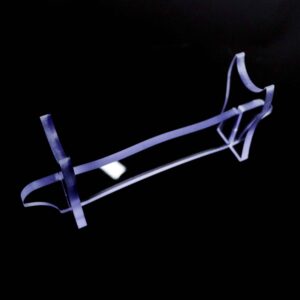
ISABER Lightsaber Display Stand — Acrylic Hilt Stand with Laser-Etched Logo
Accessories / RGB & Baselit Lightsabers
Frequently Asked Questions
Q1: How do you display your lightsabers?
A: The hobby settles on a few proven setups — vertical cradle stands for individual hilts, horizontal stands to show machining detail, glass-door display cabinets to keep a collection dust-free and pet-proof, and repurposed wine racks or shelves for large counts. Match the approach to how many sabers you own and whether you want them at hand or sealed away.
Q2: Wall mount or stand — which is better?
A: A wall mount wins when the blade stays on and you want the full silhouette vertical without a base taking shelf space; a stand wins when you rent (no drilling), rearrange often, or own an unusually shaped hilt. Horizontal displays show hilt detail; vertical displays emphasize the blade’s length.
Q3: What is the best way to mount a saber on the wall?
A: Anchor the mount to a stud or a proper wall anchor so the saber’s full weight is held at the end of the mount arm, and make sure every contact point with the hilt or blade is padded so nothing marks the finish. A wall-mounted saber hangs by its blade and pommel, so both contact points matter.
Q4: Should I display the saber with the blade on or off?
A: Both are legitimate and most stands handle either — blade on shows the full lit silhouette, blade off shows the hilt’s machining and eases long-term stress on the blade connection. Many collectors keep the hilt on display daily and insert the blade for guests or photos. Store any blade you remove upright.
Q5: Will a curved, crossguard, or double-bladed saber fit a normal stand?
A: Usually not without help. A standard straight cradle can’t hold a curved hilt like Count Dooku’s, which sits at an angle — you want a vertical stand or one made for the curve. Crossguards need extra horizontal clearance for the side blades. A double-bladed staff needs two stands or blade supports, because a single center point can let the long ends sag over time.
Q6: Will sunlight fade or damage a displayed lightsaber?
A: Yes, over time — prolonged direct sun fades anodized finishes (the dye in the oxide layer breaks down under UV) and can yellow polycarbonate blade tubes. Display cases can yellow too. Keep sabers out of direct, sustained window light, or use a case with UV-rated glass or verified UV-stable cast acrylic.
Q7: Can I leave a saber on its stand long-term without it warping or drooping?
A: Yes, with the right setup. Keep it out of sun and heat, position the hilt so it carries most of the weight rather than hanging from the blade, and rotate it every few weeks. For zero worry, display vertical or use a stand that supports the blade along its length.
Q8: Is it bad to leave the blade lit while on display?
A: It doesn’t meaningfully damage the LEDs — but it drains the battery fast. A Neopixel strip draws current even showing a dark blade, so a blade left powered on a stand dies within about a day or two instead of lasting months. Display unlit, and use the saber’s kill switch so nothing draws current while it sits.
Q9: How do I get dust off a displayed hilt without scratching it?
A: A soft, dry microfiber cloth is all you need for display dust — the same cloth works on the hilt and the acrylic stand. For fingerprints, dampen the cloth with a mild cleaner and buff dry; never spray liquid onto the saber (it can reach the electronics), and never use abrasives or acetone on anodized or painted finishes.
Q10: Should I take the batteries out of a saber that is just sitting on display?
A: Yes, if it will sit for a week or more — cells left installed can corrode and leak, and one leaking cell can damage the saber’s internals. A commonly cited collector rule is to change or remove batteries about every 90 days on displayed sabers, or use a kill switch that cuts the circuit entirely.
Q11: Acrylic or glass case — what actually stops UV and yellowing?
A: Museum-grade glass blocks nearly all UV and never yellows, which makes it the archival choice — but ordinary glass on its own does not block UV. Verified UV-stable cast acrylic blocks most UV and stays clear for years; generic clear acrylic can yellow within a few years. For a sunlit case, choose rated glass or spec’d UV-stable acrylic — never generic clear acrylic.
Q12: How do people display big collections without the sabers taking over a room?
A: Glass-door cabinets hold a collection dust-free and out of sight behind glass, with shelf weight limits worth checking. Dense racking — like repurposed wine racks — stores large counts in a small footprint and keeps every saber accessible. Either beats spreading individual hilts across open shelves.