Darth Nihilus wielded a single-bladed red lightsaber — the only weapon the Lord of Hunger ever carried, held by a Sith who had already torn his own spirit out of his body and bound it into a mask and a set of robes.
He was a Jedi who survived the Mass Shadow Generator at Malachor V and came out of it hollowed into a wound in the Force. Everything about his saber follows from that.
A man who was no longer fully alive did not need a weapon built for a duel. He needed something to hold while the hunger did the work.
This page follows the blade through the whole of his story — what he carried, what the hilt looks like, why the design is unlike any other Sith weapon, and why red is the only color it could have been.
What’s on This Page
- What the Blade Actually Is — the short answer
- Before Malachor V: A Jedi With a Name
- The Mass Shadow Generator and the Wound
- The Trayus Academy and the Sith Triumvirate
- The Hilt: A Weapon for Something No Longer Human
- Why the Blade Is Red
- Katarr, Visas Marr, and the Death at Telos
- What Survived Him
- Frequently Asked Questions
What the Blade Actually Is
Darth Nihilus carried a single-bladed red lightsaber, and it is the only lightsaber he is ever shown using — no second blade, no staff configuration, no backup weapon.
He appears in one story: Knights of the Old Republic II — The Sith Lords, released in 2004, which places him in the Legends continuity roughly four thousand years before the films.
Custom saber makers have built replicas of the hilt for years, but no officially licensed Nihilus saber, replica prop, or toy has ever been produced.
A single crimson blade, held one-handed, swung by a body that was being held together by will rather than by flesh.
His fighting style is described as aggressive and one-handed, in a form close to Makashi — the classic dueling style built around precision and economy rather than power. It fits a man who had very little body left to spend.
| Attribute | Darth Nihilus | How it differs from a typical Sith saber |
|---|---|---|
| Blade count | Single | Era contemporaries like Darth Sion carry one blade too, but Nihilus is never shown with a staff despite the double-blade being common in the Old Republic period |
| Blade color | Red / crimson | Standard for the era; produced by synthetic crystals rather than bled kyber |
| Hilt finish | Dark metallic, subtle curved contours, ancient Sith detailing | Described as sleek and minimalist rather than aggressive — closer to ceremonial than combat-grade |
| Combat role | Secondary | The saber supports the drain rather than the other way around; planets were destroyed without a duel |
| Wielder’s state | Spirit bound into armor and mask | No other Sith of the era fought while no longer inhabiting his own body |
| Licensed replica | None | Only custom makers produce it; no official saber, prop, or toy was ever licensed |
Before Malachor V: A Jedi With a Name
Before he was Darth Nihilus, he was a Human male — almost certainly a Jedi — who fought in the Republic’s war against the Mandalorian Neo-Crusaders and lost everything he had to it.
The Mandalorian Wars were the Republic’s worst conflict in a thousand years, and the Jedi who chose to fight in it did so against the explicit instruction of the Jedi Council.
Those Jedi followed two leaders: Revan and Malak, who took the fight to the Mandalorians after the Council refused.
Nihilus was among them. What he was called before — if anything survives — is never stated. The game gives him no past, only the shape of one.
What the war cost him is left deliberately blank. His name itself is the only hint: nihilus, from nihil, nothing.
The Mass Shadow Generator and the Wound
Nihilus became the Lord of Hunger because he was standing on Malachor V when the Mass Shadow Generator fired — a superweapon that killed almost every living thing on the planet and left him with a wound in the Force he could never close.
The Mass Shadow Generator was a Republic weapon deployed at the final battle of the Mandalorian Wars, and it worked by dragging the planet into a gravity collapse.
It killed the Mandalorian fleet, the Republic forces that had been sent to fight them, and the surface of Malachor V itself. The planet became a graveyard of ships and a permanent tear in the Force.
Everyone else who was there died. Nihilus did not — not exactly. He survived the shadow, and the shadow stayed in him.
What he came away with was an endless hunger for Force energy. He could not stop consuming it any more than a person can stop being hungry, and the appetite began to eat his own body instead.
This is the single fact that makes every other part of his story make sense. He was not a Sith who fell to the dark side and grew cruel. He was a man with a hole in him that no amount of power could fill.
The Trayus Academy and the Sith Triumvirate
Darth Traya — the Sith Lord better known as Kreia — found Nihilus in the wreckage of Malachor V and trained him at the Trayus Academy, where he and Darth Sion together formed the Sith Triumvirate that hunted the Jedi to the edge of extinction.
Traya understood what he was immediately. She recognized him as a wound in the Force and taught him to feed it deliberately, to devour whole worlds instead of merely surviving.
Under her instruction he learned to drain the life and Force energy out of an entire planet at once — a technique that made him a strategic weapon rather than a duelist.
The Triumvirate divided itself by what each member was: Traya took the title Lord of Betrayal, Sion became the Lord of Pain, and Nihilus became the Lord of Hunger.
The arrangement did not hold. Nihilus and Sion turned on Traya, sapping her connection to the Force and casting her out — the same betrayal that gives her the name she carries for the rest of the game.
By the time of Knights of the Old Republic II, the three of them had reduced the Jedi Order to a handful of survivors in hiding.
The Hilt: A Weapon for Something No Longer Human
Nihilus’s hilt is described in replica work as dark metallic with subtle curved contours and ancient Sith detailing — sleek and minimalist rather than aggressive, closer to a ceremonial object than a combat weapon.
By the time he carried it, his body had eroded so completely that he had torn his spirit free of it and bound it into his armor, robes, and mask instead.
He held those pieces together with the Force. The mask is what most people recognize — a bone-white, skull-like shell covering the upper face, worn with black robes and a tattered cape.
The mask was designed at the studio that developed the game, and it was not the artist’s own concept. The brief was to build a Sith Lord on No-Face from the film Spirited Away, and the result was one of the most distinctive villain designs in the saga.
A saber held by a being in that condition is not built for a contest of skill. It is what remains of a weapon when the thing holding it is no longer a man — simple, primitive intent given a hilt.
This is also why the hilt design matters to collectors more than the specs do. Custom makers offer it in weathered and clean finishes for cosplay, display, and light dueling rather than serious sparring, because the character it belongs to never fought that way.
Why the Blade Is Red
Nihilus’s blade is red because he is a Sith Lord of the Old Republic era, when red blades came from synthetic crystals grown by Sith themselves rather than from natural ones.
In the Legends continuity — the continuity Nihilus belongs to — the Sith did not bleed kyber crystals the way the later films describe. They manufactured their own.
Synthetic crystals were grown in laboratories to produce a blade that natural crystals could not, and the process almost always yielded red. The nickname that stuck was bloodshine blade.
The distinction matters because the rule is different in the canon films, where a red blade comes from dominating a kyber crystal with the dark side until it bleeds.
Both traditions agree on the outcome — a red blade is not a color a Jedi chooses. They explain the cause differently, and Nihilus sits on the older side of that line.
For Nihilus specifically, red carries an extra reading. The blade is the color of consumption, of power expressed as famine rather than as force, and the man who held it was defined entirely by what he took from others.
A crimson blade does not by itself prove someone is a Sith, and fans have argued that point for years. In Nihilus’s case there is no ambiguity to argue about.
Katarr, Visas Marr, and the Death at Telos
Nihilus wiped out the entire Miraluka colony world of Katarr in 3952 BBY in a single act of feeding, sparing only one survivor — Visas Marr, whom he took as his servant — and he was finally killed a year later at Telos IV.
Jedi Master Atris had gathered a large body of Jedi on Katarr, hoping to draw the Sith out into the open. Nihilus felt the concentration of Force energy and consumed the planet: every Jedi, every Miraluka, every living thing on the surface.
Visas Marr, a blind Miraluka woman, was the only person left alive. He spared her for reasons the game never explains, and bound her to him through the Force.
A year later he sensed the Jedi Exile — Meetra Surik — and sent Marr to find and destroy her. Surik defeated Marr and turned her to the light side, and Marr abandoned Nihilus to join the Exile.
Kreia then used that defection. She fed false information through Colonel Tobin that led Nihilus to believe a Jedi academy full of Force-sensitives existed on Telos IV.
He came. A Republic and Mandalorian fleet drew his attention while Surik, Visas Marr, and Mandalore the Preserver boarded his flagship, the Ravager.
Surik was herself a wound in the Force, and that was what made the difference. She resisted his Force drain rather than being consumed by it, and the resistance weakened him enough for the boarding party to finish it.
He died aboard the Ravager, his form erupting with dark side energy. The ship was destroyed, Telos was saved, and the mask was left behind as the last surviving piece of him.
Five Stages of the Lord of Hunger
Nihilus carried a saber before he became the Lord of Hunger, and carried one after his body was gone. The weapon never changes — only the thing holding it does.
What Survived Him
The mask of Darth Nihilus outlived him — recovered after his death, still carrying enough dark side energy to let a non-Force-sensitive wearer use the Force like a Sith apprentice, at the cost of slowly destroying whoever wore it.
Meetra Surik had Visas Marr retrieve it from the wreckage, and it later surfaced again on the planet Volik, recovered from a crashed smuggling ship.
That the mask retains his power is consistent with everything else about him. He bound his spirit into objects rather than flesh, and objects do not die on schedule.
His hilt survives the same way, though not in-universe. No licensed replica was ever produced, which left the design to custom saber makers, and it is through their work that the weapon stayed available to anyone who wanted to hold it.
Behind the scenes, there is one more thread worth knowing. A passage drafted for the Knights of the Old Republic Campaign Guide proposed that the mask was a Hendanyn death mask.
That artifact first appeared in the 1996 novel The New Rebellion. The passage was cut before publication.
The passage was cut before publication.
And the claim that the mask was made from Revan’s skull, which circulates widely online, comes from fan sources rather than from the games or any published material.
The official explanation is simpler. He bound the mask to himself with the Force, and it was part of his armor all along.
His saber did not survive him. It was destroyed aboard the Ravager during his final battle with Meetra Surik. That leaves the mask as the only piece of him that outlasted the ship.
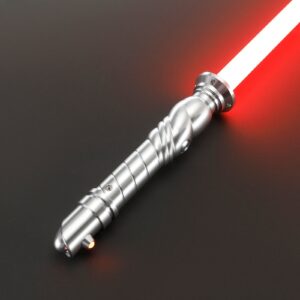
Darth Nihilus Lightsaber — The Lord of Hunger Replica
Character Lightsabers / Replica Lightsabers
Frequently Asked Questions
Q1: What color is Darth Nihilus’s lightsaber?
A: Red. Nihilus carries a single-bladed red lightsaber, described in replica work as crimson. In the Legends era he belongs to, red blades came from synthetic crystals the Sith grew themselves rather than from natural ones.
Q2: Does Darth Nihilus have a red lightsaber with one blade or two?
A: One blade. He is consistently shown with a single-bladed saber and never with a double-bladed staff, despite the staff being common among other Sith of the same era. Replica listings describe a single crimson blade, not a staff configuration.
Q3: What does Darth Nihilus’s lightsaber hilt look like?
A: It has a dark metallic finish with subtle curved contours and ancient Sith detailing — sleek and minimalist rather than aggressive. Replica makers offer it in both clean and weathered versions, usually pitched for cosplay, display, and light dueling.
Q4: Is there an official Darth Nihilus lightsaber replica?
A: No. No officially licensed Nihilus saber, replica prop, or toy has ever been produced. Only two licensed Nihilus collectibles exist — a minibust released in 2011 and a 3.75-inch action figure from 2008 — and neither is a lightsaber.
Q5: Why did Darth Nihilus become the Lord of Hunger?
A: He survived the Mass Shadow Generator at the Battle of Malachor V, which killed nearly everything on the planet. The experience left him a wound in the Force with an endless hunger for Force energy — an appetite that consumed his own body because it could never be satisfied.
Q6: Who trained Darth Nihilus?
A: Darth Traya, better known as Kreia. She found him after Malachor V, recognized him as a wound in the Force, and trained him at the Trayus Academy to devour entire worlds to feed his hunger. He later turned on her along with Darth Sion and cast her out.
Q7: Was Darth Nihilus’s mask made from Revan’s skull?
A: No. That claim circulates online but comes from fan sources rather than the games or any published material. The official explanation is that the mask was part of the armor he bound to himself with the Force after his body eroded, and it contained part of his spirit.
Q8: How did Darth Nihilus die?
A: He was killed in 3951 BBY at the Battle of Telos IV. Kreia tricked him into attacking the planet, and the Jedi Exile Meetra Surik boarded his flagship, the Ravager. Because Surik was also a wound in the Force, she resisted his drain — and weakened, he was destroyed along with the ship.
Q9: Is Darth Nihilus canon or Legends?
A: Legends. Nihilus appears in Knights of the Old Republic II — The Sith Lords, released in 2004, and belongs to the Expanded Universe era. When the continuity was reset in 2014, his story became part of the Legends label.