
Darth Malgus’s lightsaber is defined by one piece of geometry: an emitter that splits into two outward-curving shrouds, so the tip reads like an axe head rather than a cylinder. Everything else about the weapon follows from that, including why replicas of it are longer and heavier than a standard hilt.
It is one of the few sabers whose identity lives entirely in the front end. Cover the emitter and it looks like a plain long hilt.
The design came out of a specific period of the fiction, and the details around it are unusually well documented for a character who appears mostly in a video game.
This page covers the geometry, the two finished states the weapon is shown in, the hilt’s proportions, and the parts of the legend that are documented rather than assumed.
What’s on This Page
- The Shape: An Axe-Head Emitter
- Why the Emitter Splits
- Pristine and Battle-Damaged
- The Hilt: Length, Weight, and Materials
- From Veradun to Darth Malgus
- The Crystal and the Blade
- The Sacking of Coruscant
- The Mask and the Armour Body
- What a Replica Has to Nail
- Frequently Asked Questions
The Shape: An Axe-Head Emitter
The emitter is built from two straight blade shrouds that curve outward from the hilt’s axis and then run parallel to it. Set against the round body, the pair reads as an axe head: two flat cheeks flanking a narrow gap where the blade emerges.
That silhouette is the entire design. Nothing else on the hilt is distinctive enough to identify it from across a room.
The shrouds are what people mean when they call it an axe-head emitter, and the name is accurate rather than poetic.
The blade leaves through the gap between the two cheeks, so the shrouds are not decoration hung beside the emitter. They frame the point of exit.
The distinction, reduced to outlines. The shrouds do not grip the blade; they stand off it, curving out from the body and then running alongside, which is what produces the axe-head read and keeps the emitter from looking like the end of a tube.
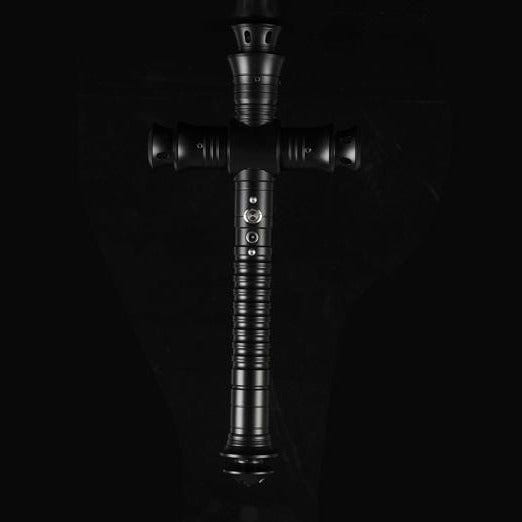
The gap between the shrouds is part of the design, not a defect to be closed. A replica that joins them into a solid ring has misunderstood the shape, even if the profile looks heavier and more impressive.
Why the Emitter Splits
The split emitter changes how the hilt’s end reads in silhouette. A plain cylinder ends in a flat face; the divided head ends in a shape that is wider across the shrouds than the body is round, which makes the weapon look larger than its dimensions actually are.
That is a visual effect, and for a design created for a screen it is the whole point.
The shrouds also serve a practical fiction. They suggest a guard around the point where the blade exits, which fits a weapon described as used with force rather than finesse.
The cost is length and mass, and both are real. Adding structure in front of the emitter lengthens the weapon, which a fighter handling it has to carry.
| Design choice | What it buys | What it costs |
|---|---|---|
| Split emitter | A wider, heavier read in silhouette | Added length ahead of the hand |
| Parallel shrouds | A guard-like frame around the blade’s exit | More mass at the far end |
| Long body | Room for a two-handed grip | An unwieldy weapon at close range |
The design accepts an awkward weapon in exchange for a distinctive one. That is a reasonable trade for a character built to look monumental, and a poor one for a fighter optimised for speed.
Pristine and Battle-Damaged
The weapon is documented in two finished states. One is clean, with the shrouds sharp and the surface unmarked; the other is worn, with the plating scarred and the body visibly used. The two are the same design at different points in its history, not two different sabers.
This distinction trips people up when they compare images, because the two states can look like separate weapons if the wear is heavy enough.
The pristine state shows the geometry clearly. The shrouds are crisp and the contrast between the dark body and the bright metal fittings is obvious.
The damaged state obscures exactly those things. Wear blurs the edges of the shrouds and dulls the finish, which is why it is a poor reference for anyone trying to copy the shape.
| State | How the shrouds read | Best used for |
|---|---|---|
| Pristine | Sharp and clean | Studying the geometry |
| Battle-damaged | Worn and slightly rounded | Characterising the age of the weapon |
A replica has to choose, and the choice is visible. A clean build and a weathered one are both correct for one of the two states, and only one of them matches whatever reference the buyer has in mind.
The Hilt: Length, Weight, and Materials
Documented replicas of this design come in at roughly sixteen and a quarter inches overall, in the region of seven hundred and thirty grams, with a one-inch blade socket and a body machined from aluminium. It is a long hilt, and the length is deliberate.
Those numbers describe replica builds rather than a canonical object, so treat them as what a physical version of the design measures, not as a fact about the fiction.
The length is what makes the two-handed grip possible, which the character’s size and fighting style both call for.
The mass sits forward, which changes how the weapon balances. A long hilt with shrouds at the front puts more weight ahead of the hands than a standard saber, and that is felt the moment you hold one.
| Specification | Typical figure |
|---|---|
| Overall length | About 16.25 inches |
| Weight | Around 730 grams |
| Blade socket | 1 inch |
| Body material | Aluminium, typically 6061 |
A one-inch socket is the common standard, which means blades and blade plugs are readily interchangeable with most other sabers.
Aluminium is the usual body material because it machines cleanly and keeps the weight down. A steel body of the same dimensions would be considerably heavier and far harder to handle.
| Property | Aluminium body | If it were steel |
|---|---|---|
| Weight | Practical for handling | Substantially heavier |
| Machining | Clean edges on the shrouds | Harder to finish precisely |
| Finish | Anodised or plated | Plated to resist corrosion |
The shrouds are the part that punishes a careless build. They are thin, they curve in two directions, and any roughness in the machining shows immediately when the blade lights them from inside.
From Veradun to Darth Malgus
The character was born under a name recorded as Veradun and took the name Darth Malgus later, after training at the Sith academy on Dromund Kaas under an instructor named Vindican. The hilt belongs to that later identity, not the one he started with.
The progression matters for sourcing, because material about the earlier period describes a person who did not yet carry this weapon.
The academy on Dromund Kaas is where the training happens, and it is where much of the character’s early development is set.
The instructor is part of the story rather than a footnote. Vindican is the master the apprentice eventually surpasses, which is a familiar shape in this fiction and one the weapon design quietly supports.
| Stage | Name | Where |
|---|---|---|
| Birth name | Veradun | — |
| Training | As an apprentice | The academy on Dromund Kaas |
| Instructor | Vindican | The same academy |
| Later identity | Darth Malgus | — |
The hilt is a marker of the later identity. Searching for images from the earlier period and expecting this emitter will only produce confusion.
The Crystal and the Blade
The blade is red, and the crystal behind it is described as synthetic. That pairing is the convention rather than a coincidence: a synthetic crystal is engineered rather than found, and its colour follows from how it was made.
Red is the colour of the character’s blade throughout, and it is not one of the disputed cases.
A synthetic crystal is a deliberate object. The distinction from a natural one is a matter of origin, and the fiction attaches consequences to it that go beyond colour.
The blade itself behaves as any other lightsaber blade does in the fiction. Nothing about the axe-head emitter changes how the blade works; it changes only how the weapon is shaped around it.
| Element | Description |
|---|---|
| Crystal | Synthetic |
| Blade colour | Red |
| Effect of the emitter on the blade | None; the geometry shapes the hilt, not the blade |
Do not expect the shrouds to produce a wider or different blade. They frame the emitter; they do not alter what comes out of it.
The Sacking of Coruscant
The event most associated with the character is the attack on Coruscant, during which he kills a Jedi identified as Ven Zallow and enters the Jedi Temple. The date often given is 3653 years before the Battle of Yavin.
That event is the reason the character is remembered at all, and it is the scene most replicas are built to evoke.
The fighting in that sequence is where the hilt’s proportions make sense. A long hilt for a two-handed grip suits a saber used with power, which is what the scene is built around.
A companion named Eleena Daru is recorded in the same events, and the pairing is part of the story rather than an aside.
| Detail | Recorded value |
|---|---|
| Event | The attack on Coruscant |
| Jedi opposed | Ven Zallow |
| Location reached | The Jedi Temple |
| Date given | 3653 years before the Battle of Yavin |
The date is stated relative to another event rather than as a calendar year, which is how this fiction usually measures time, and it should be read that way.
The Mask and the Armour Body
The character is visually defined as much by the mask and the armoured body as by the weapon, and the two are usually depicted together. The mask is a mask; the armoured frame is a separate physical characteristic.
For anyone assembling a display or a costume, that separation matters, because the mask is a prop and the body is not.
The weapon is the part a replica can reproduce directly. A mask and an armoured build are costume work, governed by their own constraints and their own sources.
The combination is what produces the silhouette people recognise, which is why a hilt photographed alone can look like a generic long saber to someone who does not know the design.
| Element | Nature | Replicable as a prop |
|---|---|---|
| The hilt | A weapon design | Yes, directly |
| The mask | A worn prop | Yes, as costume work |
| The armoured build | A physical characteristic | Not as a prop |
Keep the three separate when you are evaluating a replica. A good hilt does not imply a good mask, and neither implies anything about the body, because they are three different problems.
What a Replica Has to Nail
A faithful replica gets the emitter right before anything else. The shrouds have to curve outward from the body and then run parallel, with a real gap between them, and the body has to be long enough that the proportions read correctly.
Get the shrouds wrong and no amount of finish will rescue the silhouette.
The second test is the length. A hilt cut down to a standard size loses the two-handed proportions that make the design look monumental, and the result reads as a small saber with a strange nose.
Then check the balance. A replica that is correctly shaped but light at the front will not handle like the weapon it is copying, which is noticeable the moment it is held.
| Check | What correct looks like |
|---|---|
| Emitter | Two shrouds curving out and running parallel, with a gap |
| Body length | Long enough for a two-handed grip |
| Socket | One inch, so standard blades fit |
| Balance | Mass carried forward, not concentrated at the grip |
Decide which state you want before you buy. A clean build and a weathered one are both correct, and buying the wrong one is the most common avoidable disappointment with this design.
For a display piece, the pristine state shows the geometry to best effect. For something that plays to the character’s history, the worn finish is the one that matches.
Frequently Asked Questions
Q1: What is Darth Malgus’s lightsaber called?
A: It has no separate nickname in common use. It is usually described by its defining feature, an axe-head or split emitter, because the two shrouds flanking the blade are what make it recognisable. That description is the standard way to refer to it.
Q2: Why does the emitter look like an axe head?
A: Because it is built from two flat shrouds that curve outward from the body and then run parallel to the blade, with a gap between them. Set against the round hilt, that pair reads as an axe head with the blade emerging from the gap. It is a deliberate shape rather than an artefact.
Q3: Is the blade red or some other colour?
A: Red, consistently, from a synthetic crystal. This is not one of the disputed cases in the fiction, unlike some other characters whose blade colour changes between sources. The shrouds shape the hilt around the blade; they do not change what the blade looks like.
Q4: How long is a Darth Malgus lightsaber?
A: A documented replica comes in at roughly sixteen and a quarter inches overall. That is longer than a standard hilt, and the extra length is there to allow a two-handed grip, which is how the weapon is depicted in use.
Q5: Why is it so heavy?
A: Documented replicas weigh in the region of seven hundred and thirty grams, which is heavier than a short hilt. Part of that is the length, and part is the emitter structure sitting ahead of the hands. The mass is carried forward, which is something you feel immediately when holding one.
Q6: What is the difference between the pristine and battle-damaged versions?
A: They are the same design in two states, not two different weapons. The pristine version has sharp shrouds and an unmarked finish; the battle-damaged version is worn, with scarred plating and softened edges. The clean one is the better reference for the geometry.
Q7: Who was Ven Zallow?
A: A Jedi recorded as killed by the character during the attack on Coruscant, the event most associated with him. The fighting in that sequence is where the weapon’s proportions make sense, because it is built around a two-handed grip and heavy strikes.
Q8: Does the mask come with the saber?
A: No. They are separate objects. The hilt is a weapon design; the mask is a worn prop; the armoured build is a physical characteristic rather than a piece of equipment. A faithful hilt and a faithful mask are two separate projects with two separate sets of constraints.
Q9: Can I change the blade on a replica?
A: Usually yes, because documented replicas use a one-inch socket, which is the common standard. That means blades and blade plugs are generally interchangeable with most other sabers built to the same standard. Check the socket size before assuming it, though, because the design is long enough that a maker might have chosen differently.
Q10: Why does the hilt look plain without the emitter?
A: Because the identity of the design lives almost entirely in the front end. The body is a long, relatively straight hilt, and the shrouds are what turn it into a recognisable weapon. Covered up, it reads as a generic long saber, which is exactly why the emitter is the part worth checking most carefully.